[ Persian Pantheon ] [ Baxt | Daevas | Yazad ]
The Yazad — the Persian Pantheon of Asha
The Thirty Three Deities; the Guardians of the Days
The Yazad, Ahura Mazda’s pantheon of asha, consists of thirty three yazatas. What is a Yazata? Well, unless you ask an Athar, the word means ‘divinity worthy of worship’. For all intents and purposes a Yazata is a power, but one who was emanated from their parent god. This means all yazatas are simultaneously a part of Ahura Mazda yet also separate powers with independent thoughts, aims and personality. Technically, they are gods without being gods and creatures without being creatures—something different to powers, yet also familiar. Most scholars stroke their gray beards at this sagely, and then proceed to categorise them in the same way as powers anyway. As the saying goes, if it quacks like a duck… no wait. That’s a different saying. Anyway. Being two contradictory things at once is all in a day’s work for a power, so it’s best not to worry about it too much.
The Amesha Spentas
Seven of the yazatas make up the close retinue of Ahura Mazda. These so-called amesha spentas (‘beneficent immortals’), sit directly below him in the hierarchy of the Yazad. Their names are: Ameretat the Undying, Armaiti the Bountiful, Asha Vahishta the Excellent, Haurvatat the Perfect, Kshatra Vairya the Desirable Dominion, Spenta Mainyu the Holy, and Vohu Mana the Thoughtful. Together, they fight for truth and justice—asha. They serve as the guardians of the celestial bodies, and messengers of Ahura Mazda in his continued absence, assisting in the maintenance of asha and in combating druj. Whether they actually commune with Ahura Mazda or somehow know his will, that’s dark.
| AMESHA SPENTA | PORTFOLIO | ALIGNMENT, POWER LEVEL, PRONOUNS |
| Ahura Mazda ‡ | Wisdom, truth, benevolence, fertility, the sky, kingship | LG, Greater; Pantheon leader (He/Him) |
| Ameretat ‡ | Immortality, plant growth, spiritual reward | NG(L), Intermediate (She/Her) |
| Armaiti ‡ | Holy devotion, righteous obedience, fertility, the dead, earth, fertility, farming, nature | NG, Intermediate (She/Her) |
| Asha Vahishta ‡ | Truth, sacred fire, asha itself | LG, Intermediate (He/Him) |
| Haurvatat ‡ | Perfection, purifying water, life after death | LG, Intermediate (She/Her) |
| Kshatra Vairya ‡ | Metal, civilisation, weapons, victory, kingdoms, myrioi | LG, Intermediate (He/Him) |
| Spenta Mainyu ‡ | Goodness, light | LG, Intermediate (He/Him) |
| Vohu Mana ‡ | Purity, wisdom, knowledge | LG, Intermediate (He/Him) |
The Yazatas
The Yazad are an unusual group amongst the pantheons of the planes. Most pantheons are a loose group of powers who’re bound together by the beliefs of their worshippers. Powers both good and ill are collected together under a broad roof, and the bickering and rivalry between them generates the myths of an entire culture. The Yazad are different. They exist in opposition to the Daevas, as two divided groups within the Persian pantheon, balanced by a third smaller group called the Baxt. Whether you count these powers are forming three discrete pantheons or one large one fractured into three, well that’s your call. But the upshot is the Yazad are a group of powers with a much tighter and more coherent philosophy than most pantheons—while their individual approaches to law and chaos might differ, a defining feature of the Yazad is that all its members are benevolent. They also have portfolios that overlap more than most pantheons, and some of their areas of interest are fairly obscure. Sages reckon this is a side-effect of them all being aspects of Ahura Mazda himself. It also probably helps the Yazad has not just a common enemy in the Daevas but also a moderative force in the Baxt. If you counted all three groups as a single pantheon, the result is a lot less cosy.
When Frashokereti finally comes to pass, prophecy reckons Ahura Mazda will return to depose Angra Mainyu, and take his rightful place as the ruler of the multiverse. Most graybeards assume the Yazad will rejoin with him to form a single overpower. But the end of time is a long way away, cutter—hopefully.
| YAZATA | PORTFOLIO | ALIGNMENT, POWER LEVEL, PRONOUNS |
| Airyaman ‡ | Friendship, marriage, healing | NG, Lesser (He/Him) |
| Anahita ‡ | Prosperity, justice, liquid, rivers, streams, sacred cleanliness, life-giving water | LG, Lesser (She/Her) |
| Apam-Natat ‡ | Hidden fire, life-giving waters and royal glory | LG, Demipower (He/Him) |
| Ard ‡ | Just rewards, karmic justice, truthful oaths | LG, Lesser (She/Her) |
| Ashman ‡ | The sky, the firmament, the highest heaven | LG, Lesser (He/Him) |
| Atar ‡ | Light, heat, truth, health, sacred fire | LG, Lesser (He/Him) |
| Baga ‡ | Prosperity, wealth, the fair share | LN(G), Demipower (They/THem) |
| Drvaspa & Geush Urvan ‡ | Horses, cattle, protectors of grazing animals | NG, Demipowers (She/They) |
| Hom ‡ | Harvest, health, strength, vitality, the divine haoma plant | CG, Lesser (He/Him) |
| Hvar Ksata ‡ | Radiant sun, motion, anti-undead crusades | LG, Lesser (He/Him) |
| Mah ‡ | Moon, tides, cattle, mental harmony | CG/CN (He/She) |
| Ormahzd | Creation, community, peace, learning, parenthood | LG, Greater (He/Him) |
| Rapithwin ‡ | Midday, summer | NG, Demipower (He/Him) |
| Tishtrya ‡ | Rain | LG, Lesser (He/Him) |
| Vanant ‡ | Vanquishing evil | CG, Demipower (He/Him) |
| Verethragna ‡ | Victory, triumph | CN(G), Lesser (He/Him) |
Ahura Mazda
The Lord of Wisdom. LG Greater power of wisdom, truth, benevolence, fertility, the sky, kingship [He/Him]; Pantheon leader
Realm: Mount Celestia / Chronias / Garōdmān, the House of Song ‡
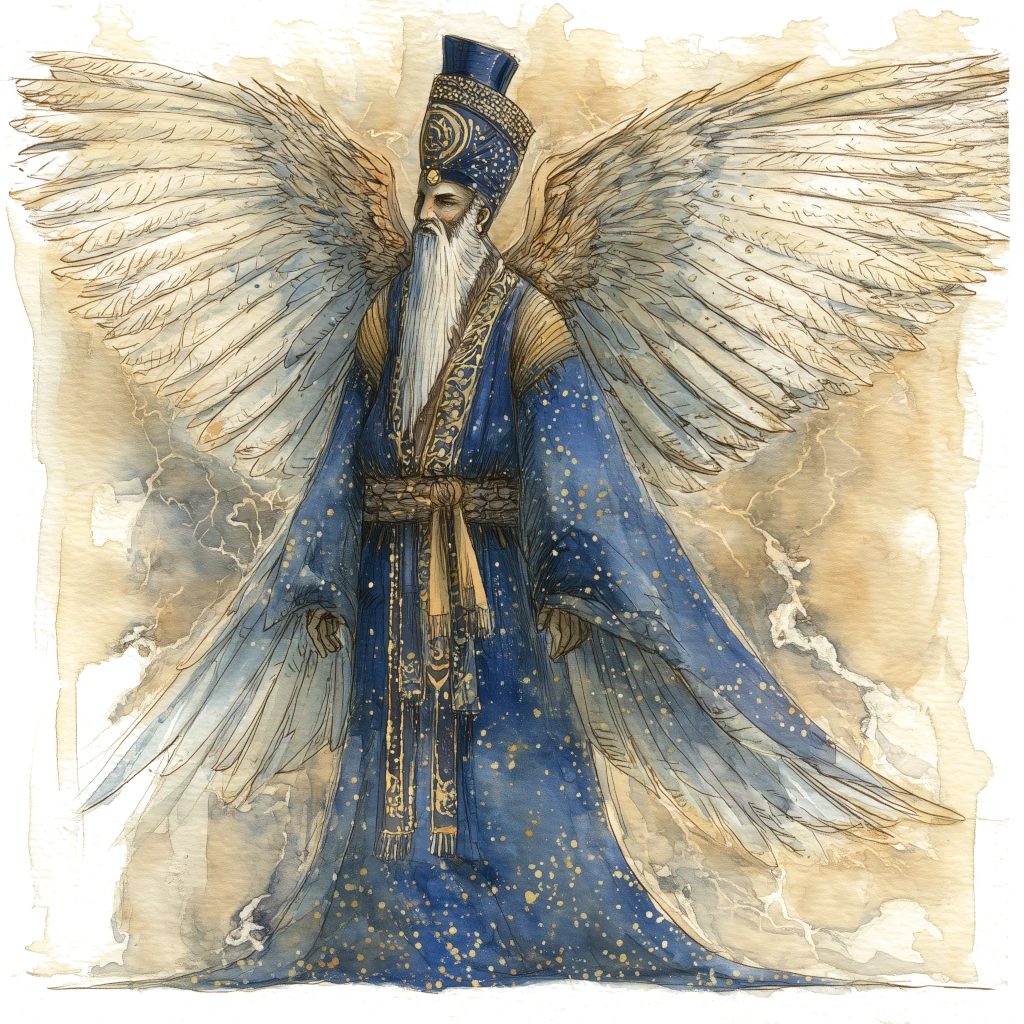
Ahura Mazda (ah-HOO-rah MAZ-dah) is the supreme wise creator, a being of transcendent intellect, light, and beneficence rather than a god limited by something so mundane as a body. He’s often symbolised as a winged disc with a majestic male figure emerging from it. The few times he has manifested directly to mortals, he appeared as a towering king of white-gold radiance whose face was calm, ageless, and impossible to behold for long. His beard was immaculate, the colour of starlight, and his four wings flexed constantly behind him. Constellations drifted within his robes like fireflies trapped in silk, and his voice sounded like a memory resurfacing in your mind rather words than being spoken. Ahura Mazda is locked in a cosmic struggle against Angra Mainyu, the destructive spirit of druj.
More chant on Ahura Mazda here…
Airyaman
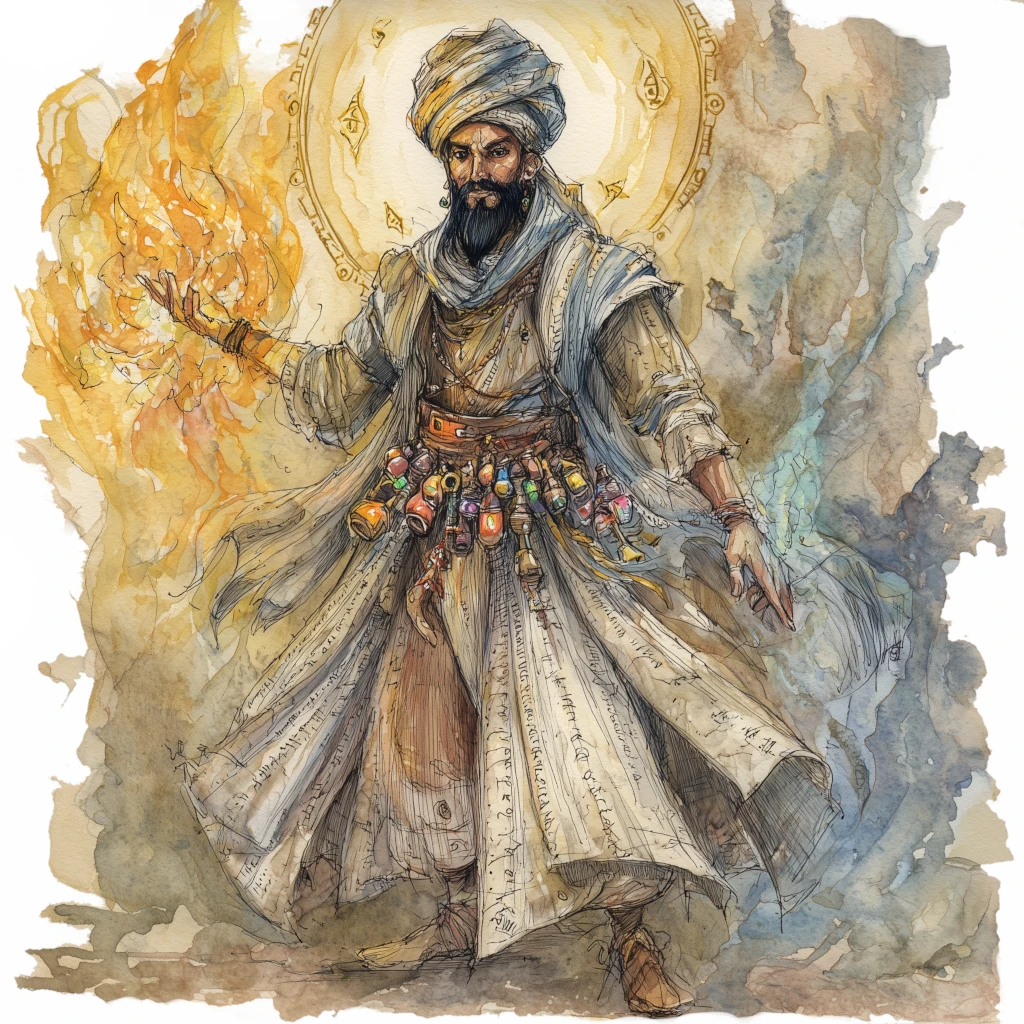
The Lord of the Noble Bond; NG Intermediate power of friendship, marriage, and healing [He/Him]
Realm: Elysium / Amoria / the Oath of Kinship ‡
The steady hand on the fevered brow, Airyaman [arry-AMMAN] is a power of friendship, marriage, and healing. Chant goes he knows the cures for all 99,999 diseases that exist. He appears as a beneficent noble who looks like he’d be more at home as a courtly companion than in a hospital. He’s a calm, friendly cutter who is far more approachable than most of his fellow powers.
More chant on Airyaman here…
Ameretat
The Undying; NG(L) Intermediate power and amesha spenta of immortality, plant growth, and spiritual reward; [She/Her]
Realm: Bytopia / Dothion / the Ever-Green Garden ‡
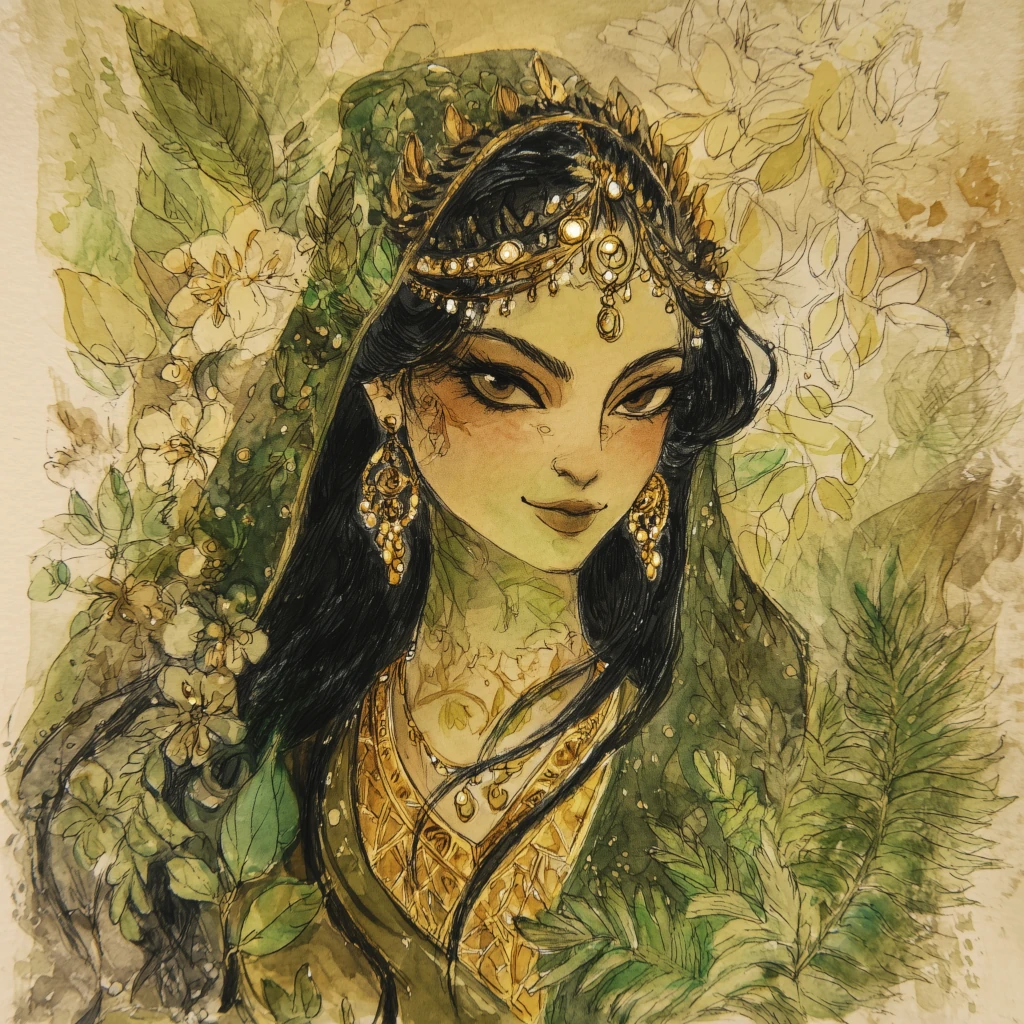
Ameretat [ah-meh-reh-TAHT] is the power of the green-fingered, the holy and the long-lived. She appears as a tall, slender woman crowned in living green. Her robes are woven from leaves that never wither, and her jewellery are white blossoms that never fall. Her skin has the gold-green glow of sunlight filtering through orchard leaves. In her presence, cut branches root, dry seeds swell, and the petrichor scent of rain on soil rises from nowhere. She’s not just the goddess of long life on the Prime, but also perpetual life in the hereafter.
More chant on Ameretat here…
Anahita
The Immaculate One; LG Lesser power and amesha spenta of prosperity, justice, liquid, rivers, streams, sacred cleanliness, life-giving water; [She/Her]
Realm: Mount Celestia / Lunia / Purifying Water ‡
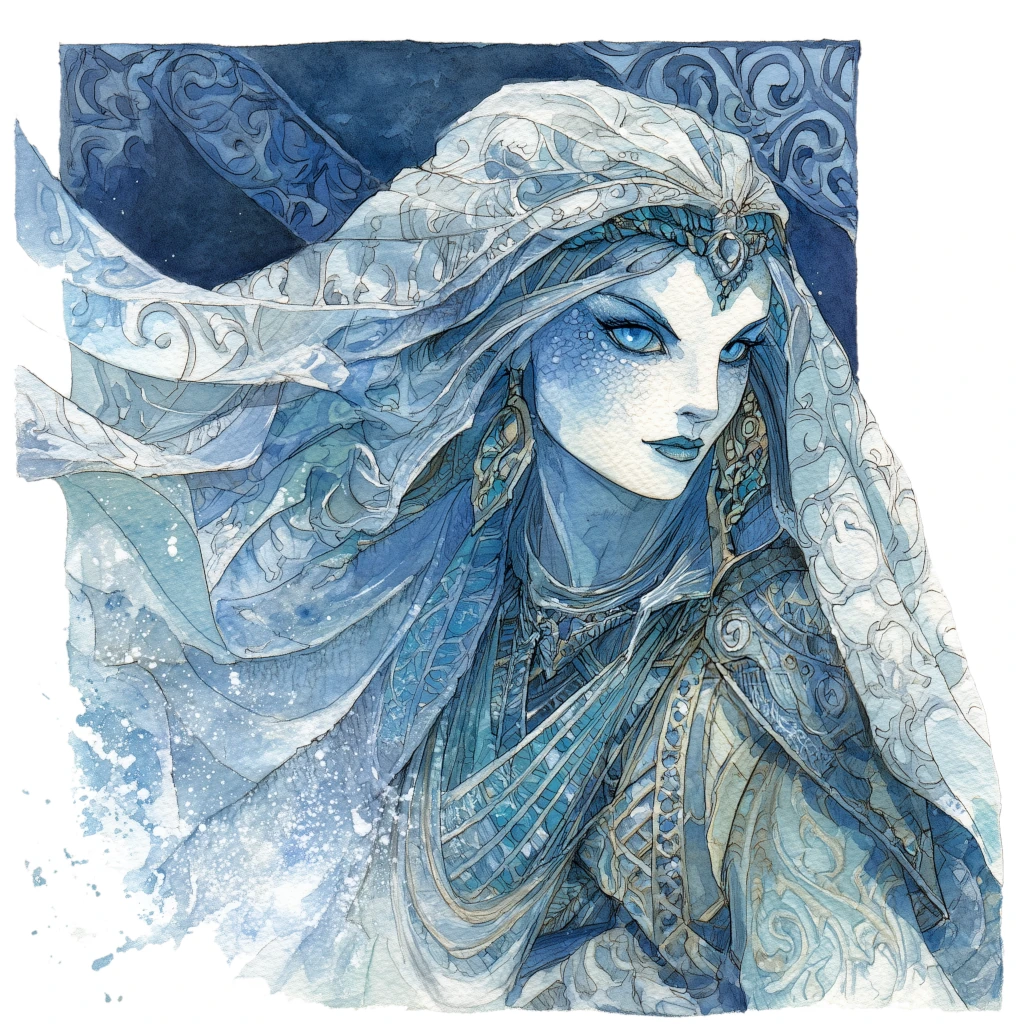
Anahita [anna-HEATER] is an ancient water goddess who’s also associated with fertility, prosperity, justice and healing. She manifests as a young woman with flawless alabaster white skin, with subtle blue scales. She’s always surrounded by a gentle swirling mist of soothing coolness, no matter the weather. She has cascading blue hair woven with water lilies, flowing blue-and-white silk robes that look like rushing water, and she move with the grace of a river. Anahita wields power over rivers and water sources, especially welcome desert oases. Through her grace and mercy flows the vitality and abundance that water brings to the land, its plants, animals and mortal inhabitants.
More chant on Anahita here…
Apam Napat
Apąm Napāt, the Fire Within the Waters, the Lofty Ahura, Burz; LN Demipower (yazata) of hidden fire, life-giving waters and royal glory
Realm: Mount Celestia / Lunia / the Glorious Deep ‡
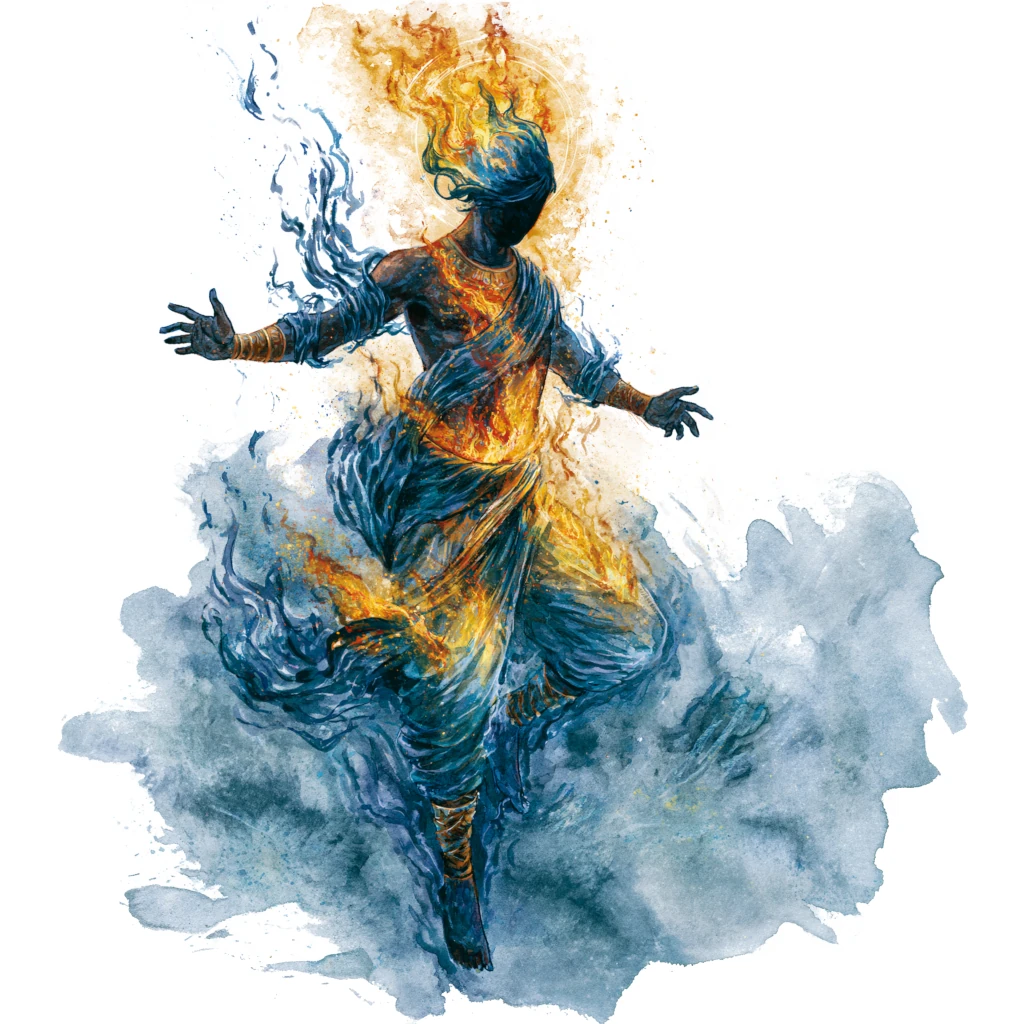
Apąm Napāt (AH-pam nah-PAHT), the God Found in the Water, is a splendid glowing power who dwells beneath the waters of the Silver Sea off the coast of Anahita’s realm of Purifying Water. He appears as a bronze-skinned youth wreathed in fire and water, flames moving continuously beneath his skin like water gushing beneath ice. He is associated with brightness, glory, and the fire-within-the-water, a mysterious quality of water understood by the Persians. When the sun sets over the ocean, the fire goes into the water, see? It’s the same when you quench a campfire with a bucket of water, or thrust a red-hot piece of metal into water. The fire disappears, and goes inside the liquid. Apam Napat is the fure that does not hiss when plunged in water, because he was always there to begin with. His role in the pantheon is to distribute water to the seas, safeguard the depths, and ensure that water retains its life-giving powers. He is also responsible for khvarenah, a mystical force that gives kings the right to rule. If the king rules with asha, they possess khvarenah, but as soon as druj enters their minds, they lose it.
Ard
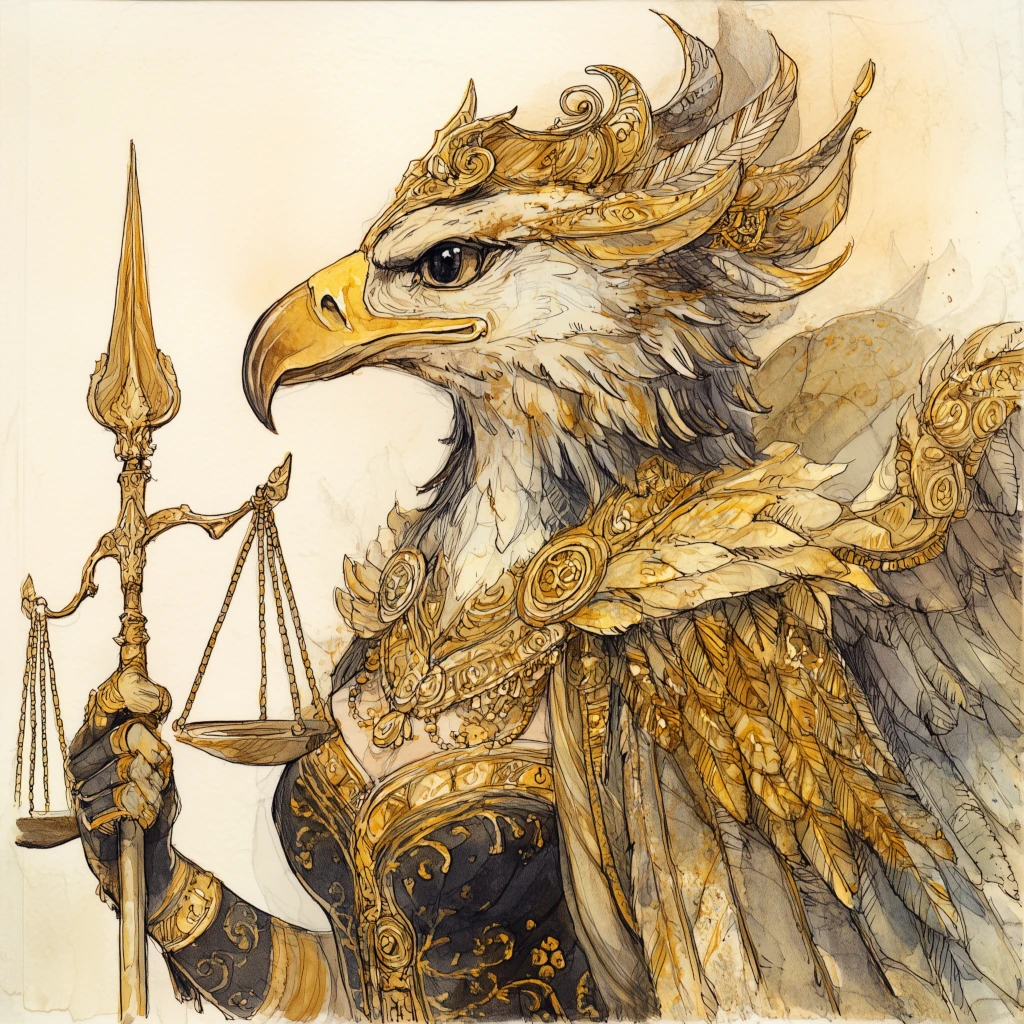
Lady of Just Measures; LG Lesser power (yazata) of just rewards, karmic justice, rectitude, truthful oaths; [She/Her]
Realm: Arcadia / Buxenus / the Scales of Victory ‡
Appearing as a golden-white humanoid eagle with a golden feathered cloak, Ard [AHRD] is the goddess of deserved rewards, rectitude and karmic justice. She holds a set of golden scales which she uses to weight up the rightness of decisions and ensure fate is fairly dealt out over the life of a mortal. Her eagle eyes have vision so sharp she is able to see into the future or the past. Ard governs the keeping of oaths a cutter has sworn, that rewards are distributed to those who deserve them, and it is she ensures that falsehoods eventually tips the scale against itself. She is not a wrathful avenger, so much as an exacting benefactor. She wants cutters to receive what they have truly earned, no more and no less, and she has little patience for self-pity, excuse-making, or clever lies dressed up in weasel words. Ard circles above courts, unseen by mortal eyes. The chant goes that every oath spoken under open sky flashes for an instant across one pan of her scales. When a vow is kept at great cost, a feather of gold falls from her wing onto the soul of the speaker; when a vow is broken for gain, the same soul grows heavy and hard to lift in the afterlife.
Armaiti
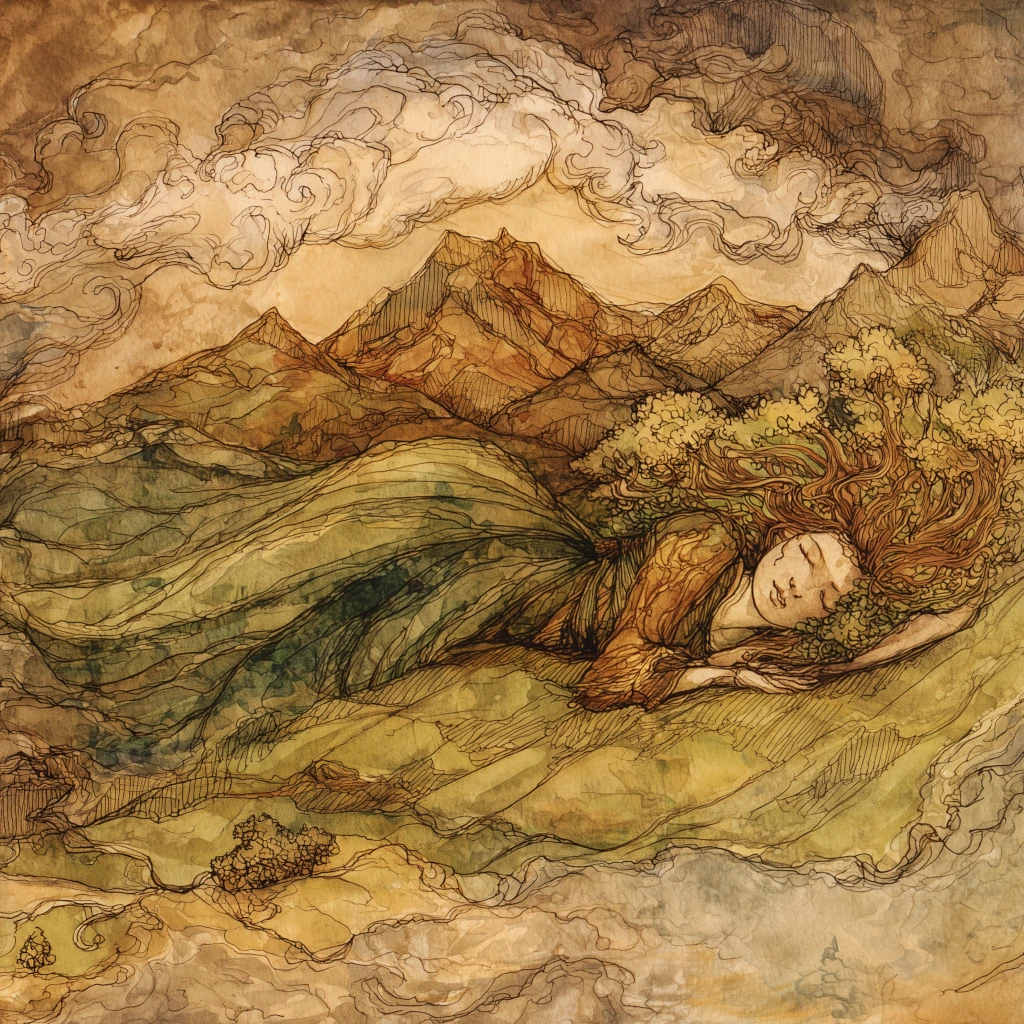
𐬯𐬞𐬆𐬧𐬙𐬀 𐬁𐬭𐬨𐬀𐬌𐬙𐬌, Spenta Armaiti, Sandaramet; NG Intermediate power and amesha spenta of the earth, devotion, the buried dead, and fertility; [She/Her]
Realm: Bytopia / Dothion / the Bountiful Expanse ‡
Armaiti [ar-MY-tee] is the gentle but immovable amesha spenta of Holy Devotion, the wife of Ahura Mazda and divine mother associated with righteous obedience, faith, serenity, the earth, farming, fertility, and the dead who rest within the ground she governs. As a power who literally embodies the ground upon which the faithful of the Persian pantheon dwell, she doesn’t manifest as n individual, but she’s depicted as an enormous sleeping mother figure, robed in the calm colours of soil and leaves, who blends into the land. Her feet are bare, her eyes are quiet pools of water. Armaiti’s portfolio is unusual because it unites things that simultaneously seem opposite but are deeply connected: she rules both the fertile earth and the dead, since the same sacred ground that nourishes crops also receives the departed. While she is venerated all year round by followers of the Yazad, she is especially celebrated in the festival of Sepandārmazgān, a day associated in love of mortals and the land alike, especially in her realm, the Bountiful Expanse, the most lush and verdant rolling farmlands of Dothion. Her eternal opponent is the daeva of discontent, Nanghaithya.
Asha Vahishta
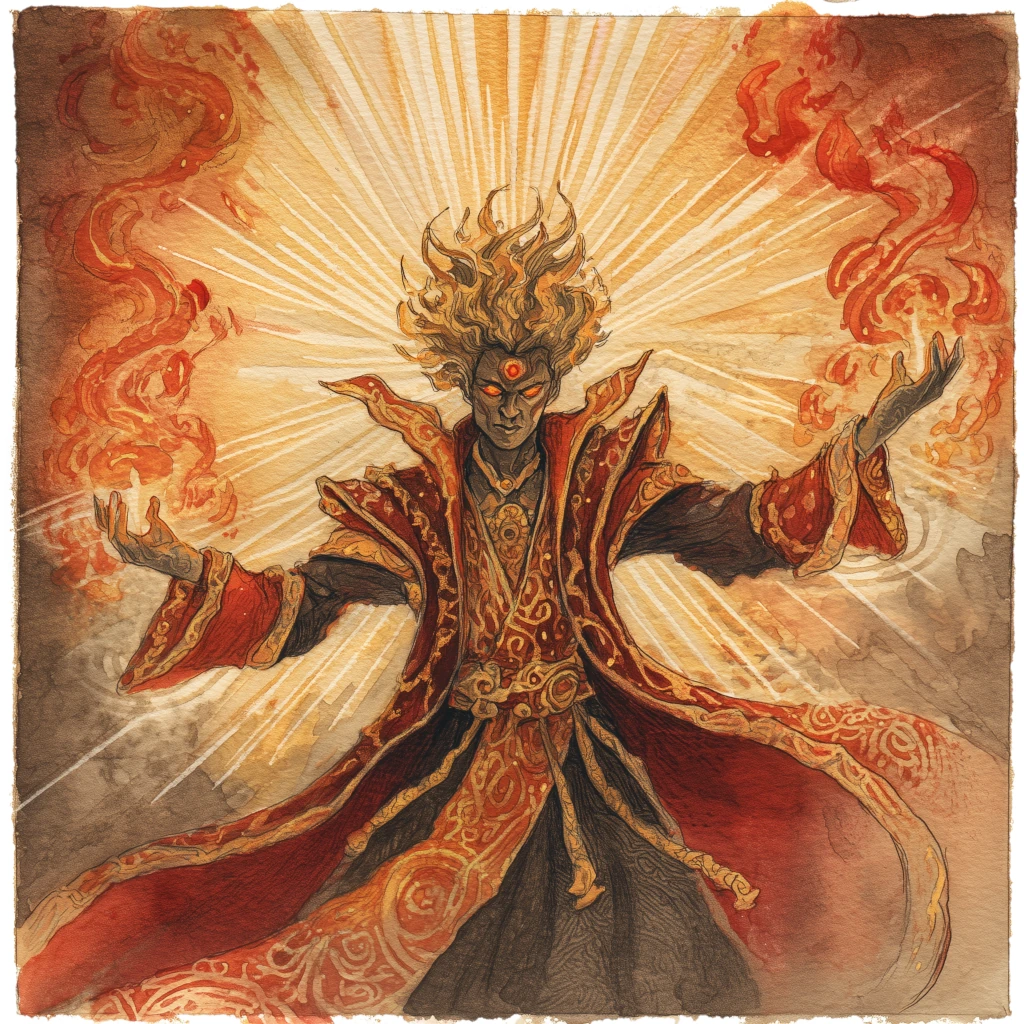
𐬀𐬴𐬀 𐬬𐬀𐬵𐬌𐬱𐬙𐬀. LG Intermediate power and amesha spenta of truth and asha; [He/Him]
Realm: Mount Celestia / Mercuria / Ayokhshust ‡
Asha Vahishta [AH-sha vah-HISH-tah], the Best Truth, is one of the greatest of the amesha spentas, and the divine embodiment of asha itself: truth, righteousness, justice, sacred fire, and the perfect moral and physical order that keeps creation from collapsing into chaos. He is said to be the living law made luminous: an embodiment of the principle that reality has a right shape, that truth is stronger than falsehood, and that purity is more than just cleanliness but also alignment with the divine pattern established by Ahura Mazda himself. He manifests as a tall, regal male figure with dark skin, wreathed by pale gold flames, with white-fire hair, red eyes that flicker like candle flames, and robes which glow like heated metal. He’s said to be the most beautiful of all the yazata. Of all the amesha spentas, Asha Vahishta is the principal enemy of the daevas, especially the vile Ahriman, the daeva of lies Druug and the archdemon of apostasy Indar. While Asha Vahishta battles against the fickle plots of the div, prophecy promises an even greater role in the future for this cutter. In the final renovation of the cosmos: at the Frashokereti, when the multiverse is purified withriver of molten metal, it is Asha Vahishta who will be leading this last cleansing of creation. Prophecies reckon that his realm Ayokhshust, which is a bottomless lake of bubbling liquid metal in Mercuria, will overflow and form the River of the End of Days. All souls will have to pass through this river—to the pure of spirit this will feel like warm milk, but to the wicked, there will be unspeakable agony as their sins are burned away. The river will then flow down to the bottom of Baator and destroy Angra Mainyu once and for all. Well, so go the prophecies anyway.
Ashman
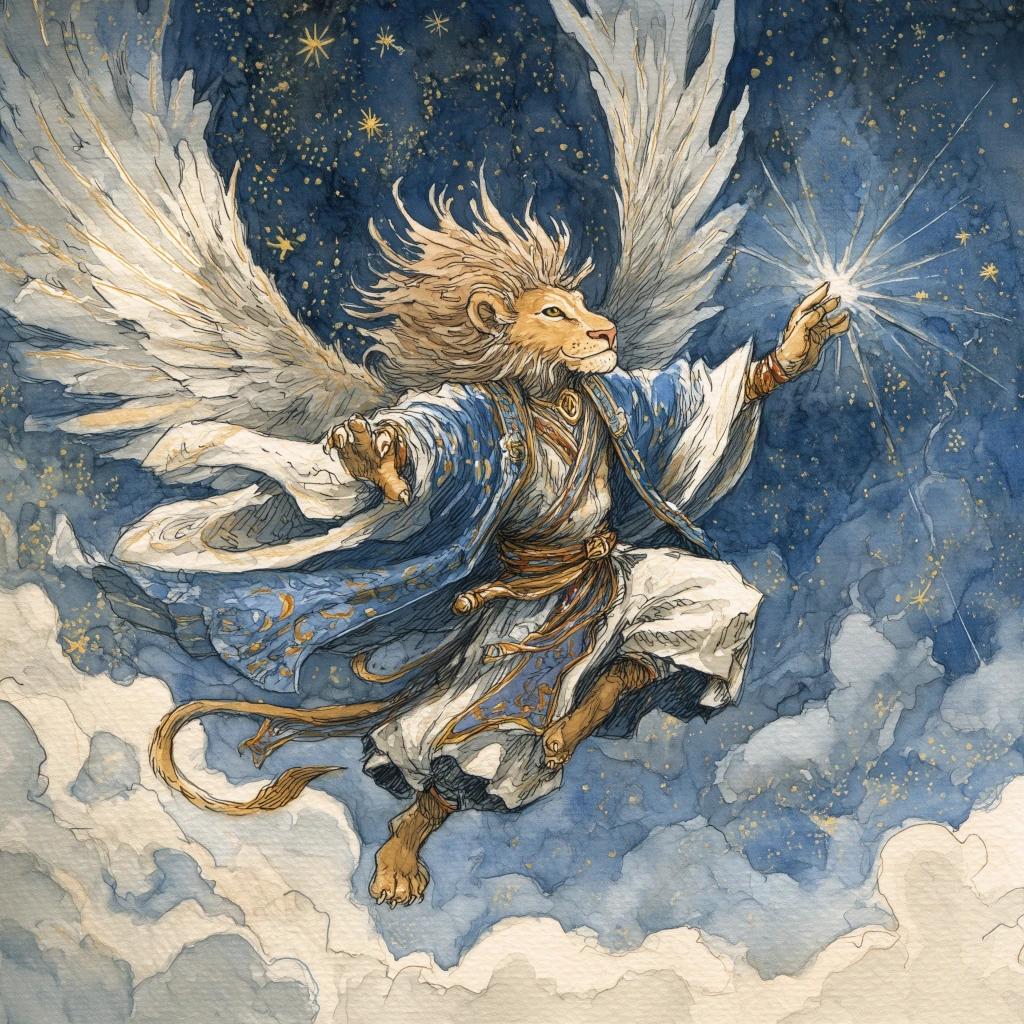
LG Lesser power (yazata) of the sky, the firmament, the Crystal Spheres of Wildspace; [He/Him]
Realm: Mount Celestia / Solania / The Diamond Vault ‡
Ashman [ASH-man] personifies the sky itself, specifically the highest heaven set above the lower firmament. This makes him less a weather-god than a power of than the sacred vault of ordered creation that was first raised over the world by Ahura Mazda. Higher up than any cloud, storm, or gust of wind, he’s the god of the hard, shining structure of heaven itself. Planewalkers who’ve travelled Wildspace on the Prime will no doubt imagine this refers to those Crystal Spheres that protect each of the solar systems—the stony, jewel-like, brilliant dome painted with stars—but Ashman is also responsible for the intangible division between the Prime and the Outer Planes themselves. Ashman takes many forms but a favourite is an angelic winged lion who can create a new star simply by pointing where he wants it to appear. His divine portfolio includes the sky, the highest heaven, the celestial spheres, and the order that separates the Upper Planes from the Prime. Some myths claim that Ashman was the very first yazad to emerge from the Cosmic Egg, and this explains his priority for all things cosmological. He’s a patron of sailors, astronomers, Spelljamming navigators, planewalkers seeking to find new portals to the Upper Planes, and he’s thanked by any cutter who’s grateful the sky doesn’t come crashing down on the world.
Atar
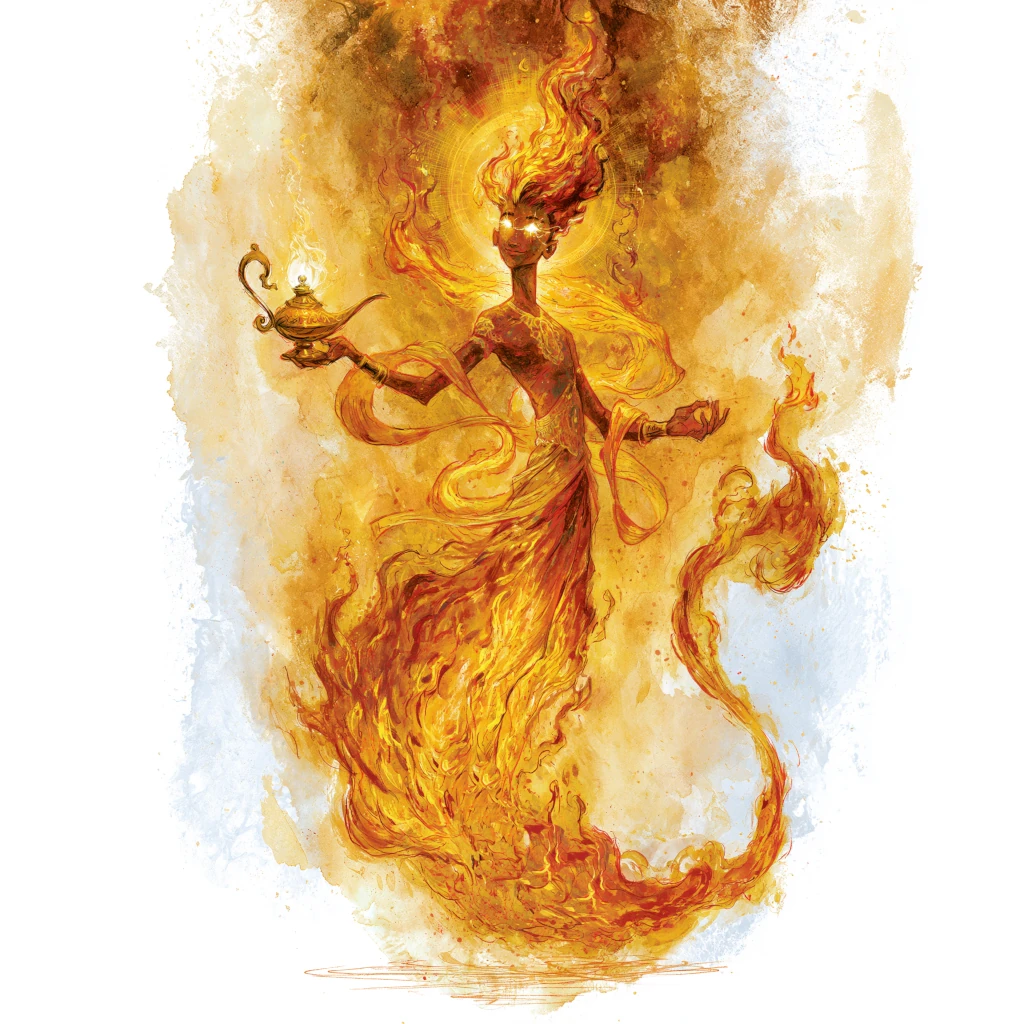
Atash, Adar, the Holy Fire; LG Lesser power (yazata) of light, heat, truth, health, sacred fire [He/Him]
Realm: Fire / Hearth Eternal ‡
Atar [AH-tar] is the holy fire of Ahura Mazda made divine. He’s not a power who commands flames so much as the very personification of sacred fire itself. This is the visible and invisible sign of Ahura Mazda’s presence in the multiverse. Whenever there is a consecrated fire on an altar or burning incense in a brazier, that is a manifestation of Atar. the pure flame through which truth, reverence, and divine energy become manifest to mortal senses. If given a mythic body for fantasy presentation, he can be imagined as a regal male figure formed from white, gold, and crimson flame, with a face that appears only for moments in the heart of the fire and robes woven from sparks; this anthropomorphic image is invented, while his identity as sacred flame is fully traditional. His divine portfolio includes light, heat, truth, purity, and health, because for the Yazad, fire is not just for cooking and heating but is morally revelatory. Divine fire purifies, exposes falsehood, sanctifies rituals, and stands in as a material sign of asha.
Some graybeards point to the similarity between Atar and Atreia, the Lambent King and one of the archomentals of fire. If these two cutters aren’t aspects of one another in some form, I’ll eat this mimir. My suspicion is that Atar is somehow linked to the recent freeing of the archomental, but why he would need to do this secretly, that’s anyone’s guess. In any case, the two seem natural allies, so if they do team up then you heard it here first. Other than the old three-headed archomental phoenix, Atar also works closely with the yazata Airyaman, especially when particularly virulent plagues sweep the land. While Airyman cures, Atar purifies. Is it effective? Well it certainly seems to annoy old Stribog and his likhoradkas.
Baga
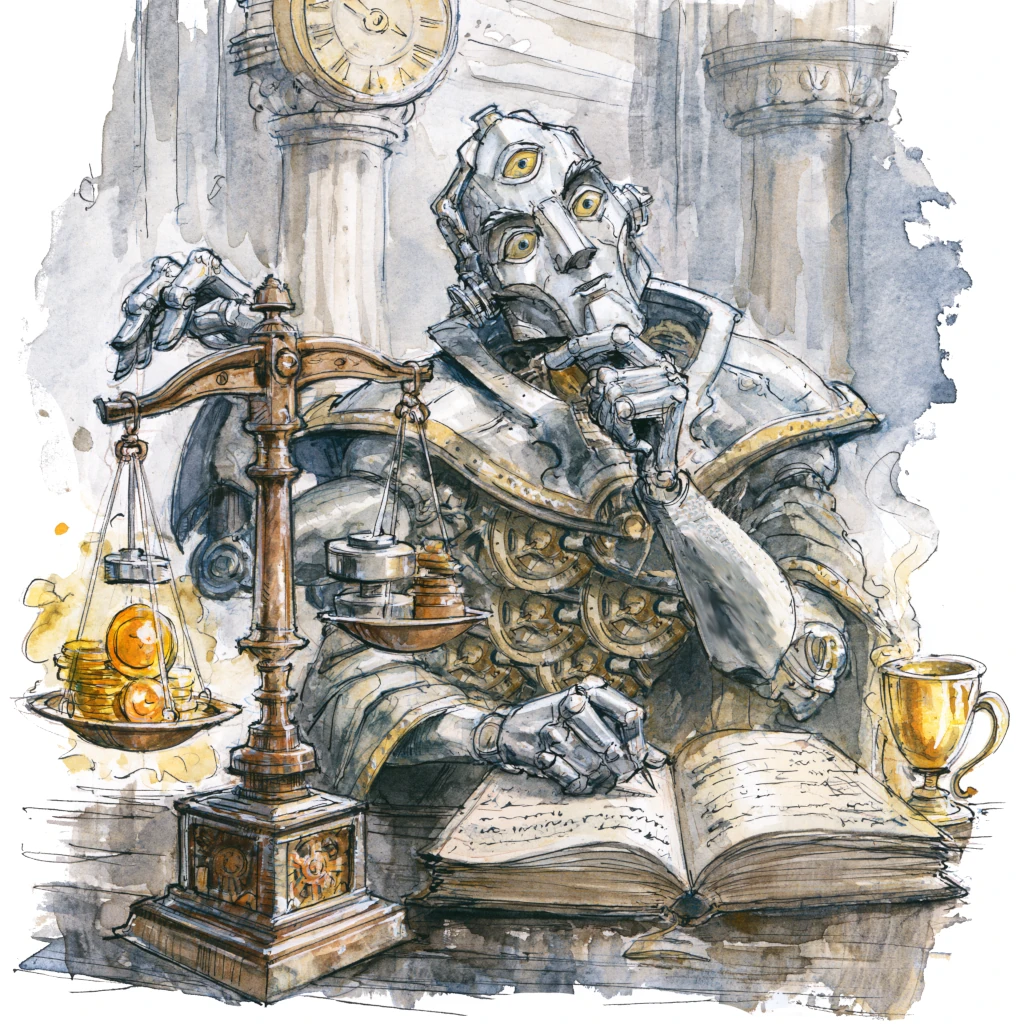
The Dispenser, the Lord of the Fair Share; LG(N) Demipower of prosperity, welath and sharing [They/Them]
Realm: Arcadia / Buxenus / the Counting House ‡
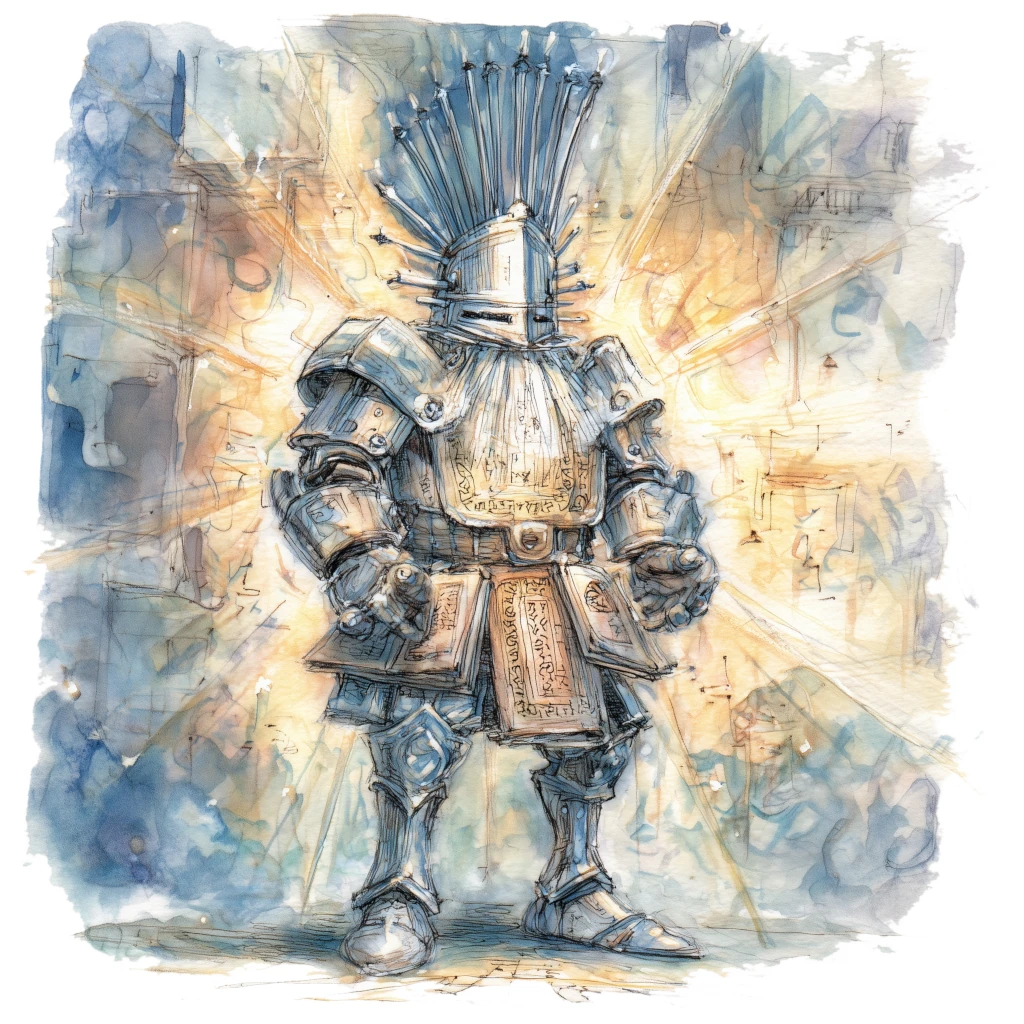
Baga [BAH-gah] is one of the more elusive powers of Buxenus. They are the demipower of prosperity and wealth, sure, but as is typical for yazata of Ahura Mazda, there’s a moral component too. Baga is also the power tasked with ensuring cutters get their fair share of prosperity, averaged over their lives. Now just because there’s inequality in the multiverse, doesn’t mean Baga is slacking at their job—see, they have to take into account the entire existence of a mortal. If someone is having a bad time of things now, you can be sure that’ll show up in old Baga’s ledger and at some point in the future, the debt of prosperity will be balanced out with some excellent luck, a windfall, or opportunity. It’s up to them to take it though. Baga appears as a scholarly accountant made from silver metal, an automaton construct incapable of bias or deceit. They have three eyes and three hands, one to watch the scales to make sure they balance, one to take care of the ledger to make sure it balances, and a third to watch over the other two and make sure they act together. As well as being a power venerated by moneylenders, jink-counters, and Numismatists, Baga also has a number of sapient automatons and even a few rogue modrons as followers.
Drvaspa & Geush Urvan
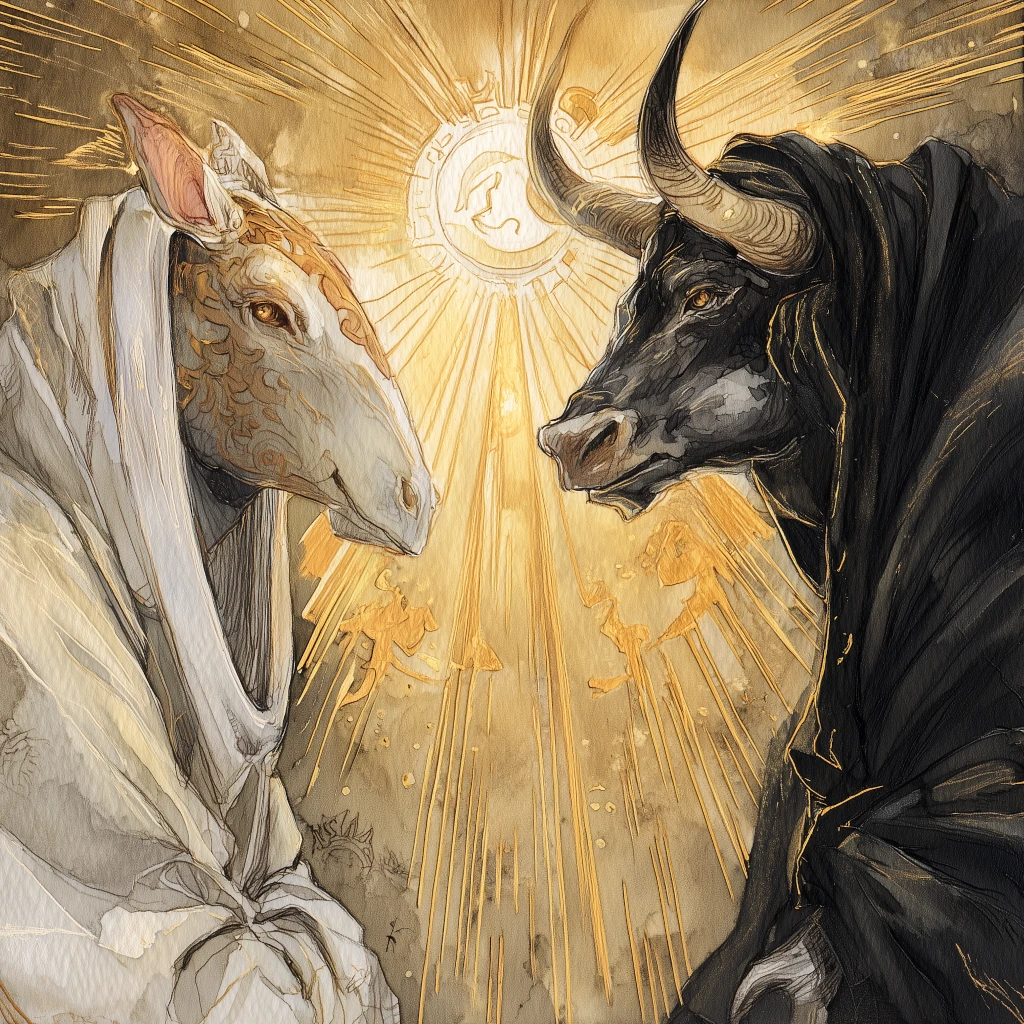
The Lady of Strong Horses, the Soul of the Ox; NG Demipowers (yazata) of horses, cattle, protectors of grazing animals; [She/They]
Realm: Beastlands / Krigala / the Lamenting Meadow ‡
Drvaspa [drvahs-PAH] and Geush Urvan [gay-oosh OOR-vahn] are a pair of yazata who oversee grazing animals, and share a realm, as well as spending all their time together. Some have wondered whether they’re an item, although that’s just speculation. The Lamenting Meadow is their shared realm in Krigala, a sorrow-sweet pasture where every lost or slaughtered beast is remembered and every gentle bovine can finds rest. No animal soul here can ever become sick or injured through natural means—although that doesn’t mean they can’t be hunted by planewalkers. And cutter, you’d better believe that one way to really rile up these demipowers.
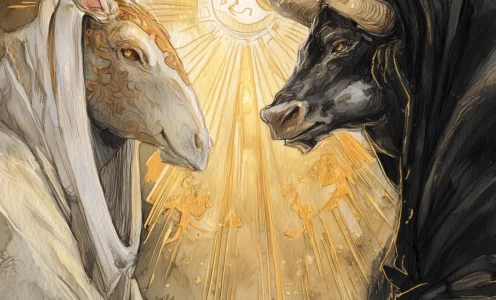
Drvaspa is a protector of horses and cattle herds. She appears as a radiant humanoid mare with white and gold fur, wearing a pure white robe, although her gender seems to be fluid as sometimes she appears as a stallion instead. She embodies the desire for the herd to return each night at dusk, alive, fed and unafraid. Geush Urvan is a yazata born from tragedy. She embodies the soul of the archetypal bovine and the spiritual essence of livestock and suffering animal life, the cry for justice that turns the mistreatment of animals into a moral issue. She is responsible for receiving the spirits of livestock after they are slaughtered in her realm the Lamenting Meadow, where they are treated with dignity and respect and allowed to rest until the end of times. In one myth, Geush Urvan was a simple cow who cried out to the gods because she has been abandoned to violence, oppression, and the ravages of the druj. Her voice was of such absolute innocence and helplessness that Ahura Mazda could not help but be moved by it, and lifted her up and made her a yazata tasked with protecting her fellow cattle too. Her portfolio includes cattle and grazing beasts, as well as children and friendship. She is venerated by farmers, druids and all kinds of awakened animals, and like Drvaspa, has a fluid gender where when it suits, means while Geush Urvan is usually a black cow, sometimes they appear as a horned steer.
Haurvatat
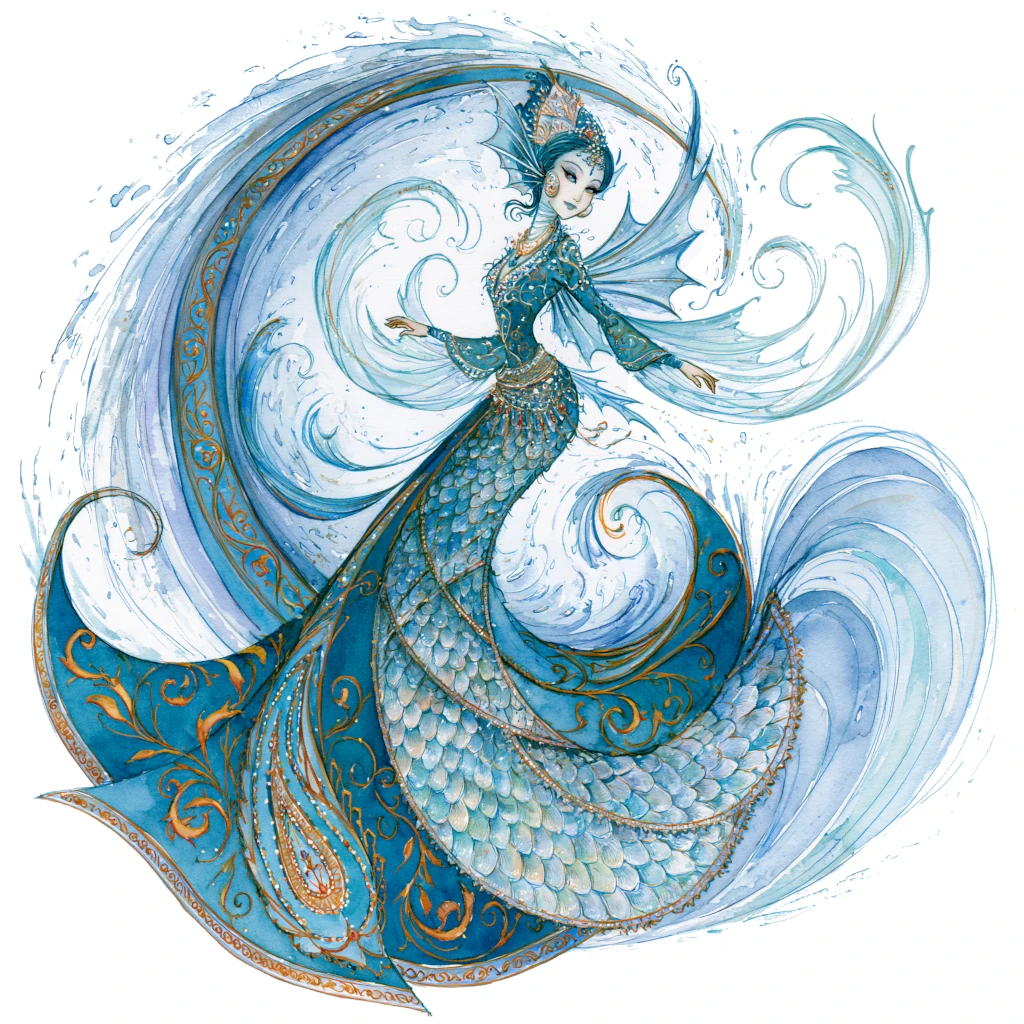
Keeper of the Waters of Completion; LG Intermediate power and amesha spenta of perfection and life after death; [She/Her]
Realm: Mount Celestia / Venya / the Wells of Completion ‡
Haurvatat [howr-vah-TAHT], whose name means Wholeness or Perfection, is the embodiment of wellbeing, completeness, health, prosperity, and the fulfilled state of a truly righteous soul. She’s associated with pure water, just as her amesha spenta counterpart Ameretat is linked to plants. Together the two govern the paired necessities of life: drink and food, health and endurance, wholeness and immortality. She appears as radiant woman in robes of silver-blue, gold and white, with skin bright as clear water under moonlight, surrounded by converging streams.
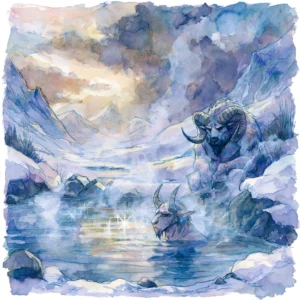
Her realm in Venya, the Wells of Completion, seems to be a strange mirror of the Abyssal Wells of Darkness. Rather than being prisons for demons too awful to be allowed to rampage free, however, the Wells of Completion are hot springs of holy water which bubble up from the mountains of Venya. The restorative waters here can heal all kinds of moral and philosophical issues.
Hom
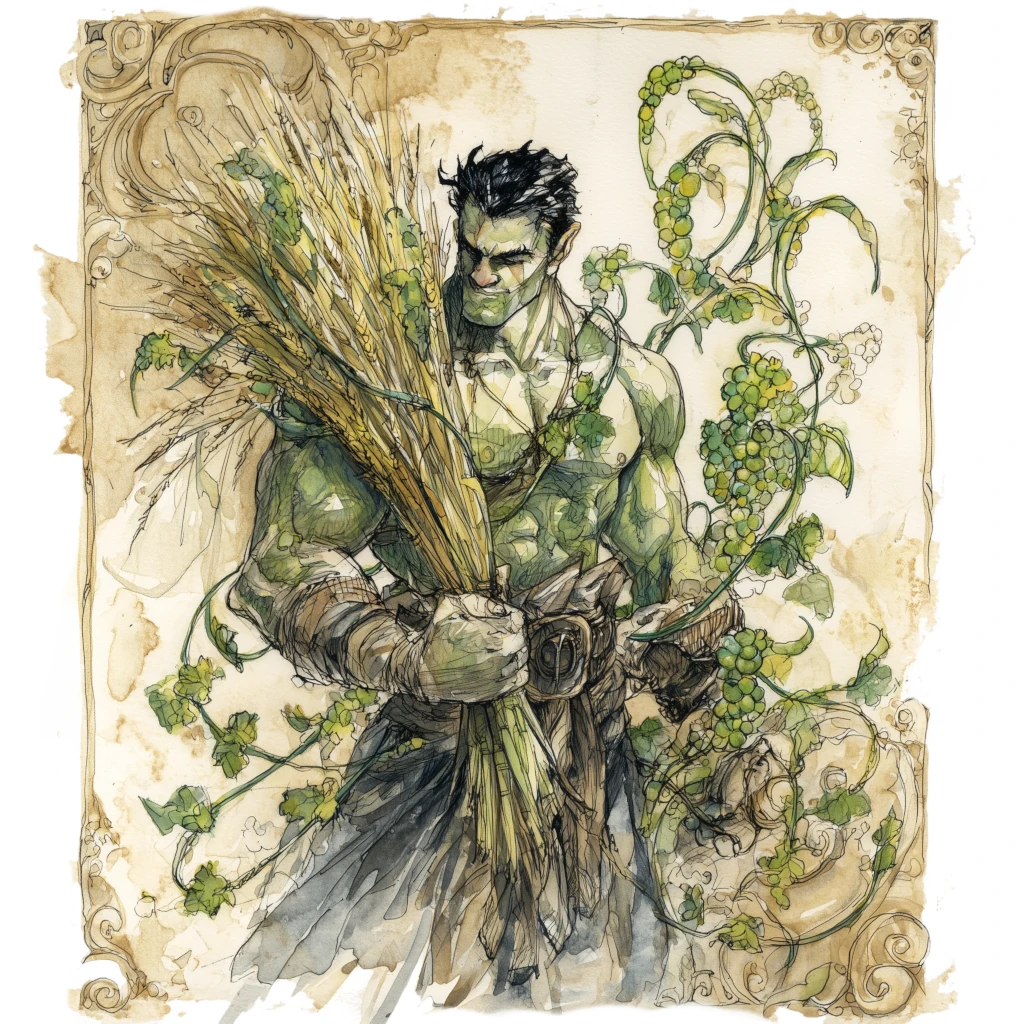
Haoma, Lord of the Sacred Plant, the Pressed Elixir; CG Lesser power of the haoma plant, harvest, health, strength and vitality; [He/Him]
Realm: Arborea / Arvandor / the Grove Eternal ‡
Hōm is another one of the peculiar several-things-at-once yazata. He is simultaneously a plant, a ritual drink, and the god embodied within both. In Persian rituals, the haoma plant is pounded and prepared as a sacred offering and libation. The drink is praised for conferring strength, vitality, health, fertility, and even a spark of immortality. Unlike many powers, Hom is inherently vegetal: he’s is not merely a god of a plant, but he is the deified life-force of the haoma plant itself—the medicinal and ecstatic essence hidden in its stalk and its sap.
When Hom manifests, he appears as a lean, wild-haired healthy green-skinned young man, with pale sap shining like silver on his skin and mountain herbs woven through his belt. He carries bundles of haoma, both fresh leaves and dried twigs. His portfolio includes harvest, health, medicinal herbs, vigour, fertility, and immortality. He is linked to fire-purification through a sacrificial rite in which haoma twigs are burned with the sacred flame of Atar. Hom is said to grants husbands to maidens, righteous offspring to pregnant women, and strength to warriors and priests.
His realm in Arvandor is called the Grove Eternal, and he shares it with the eladrin twins Ibeji. Not far from the Unity Tree stands the White Haoma, a juvenile World Tree growing on the lower slopes of a mountain. Chant goes that when the multiverse is renewed, the juice from this tree will help to confer immortality for those worthy. Right now the tree is small and needs protecting, and that’s the task of Hom and Ibeji, at least until Ahura Mazda returns.
Hvar Ksata
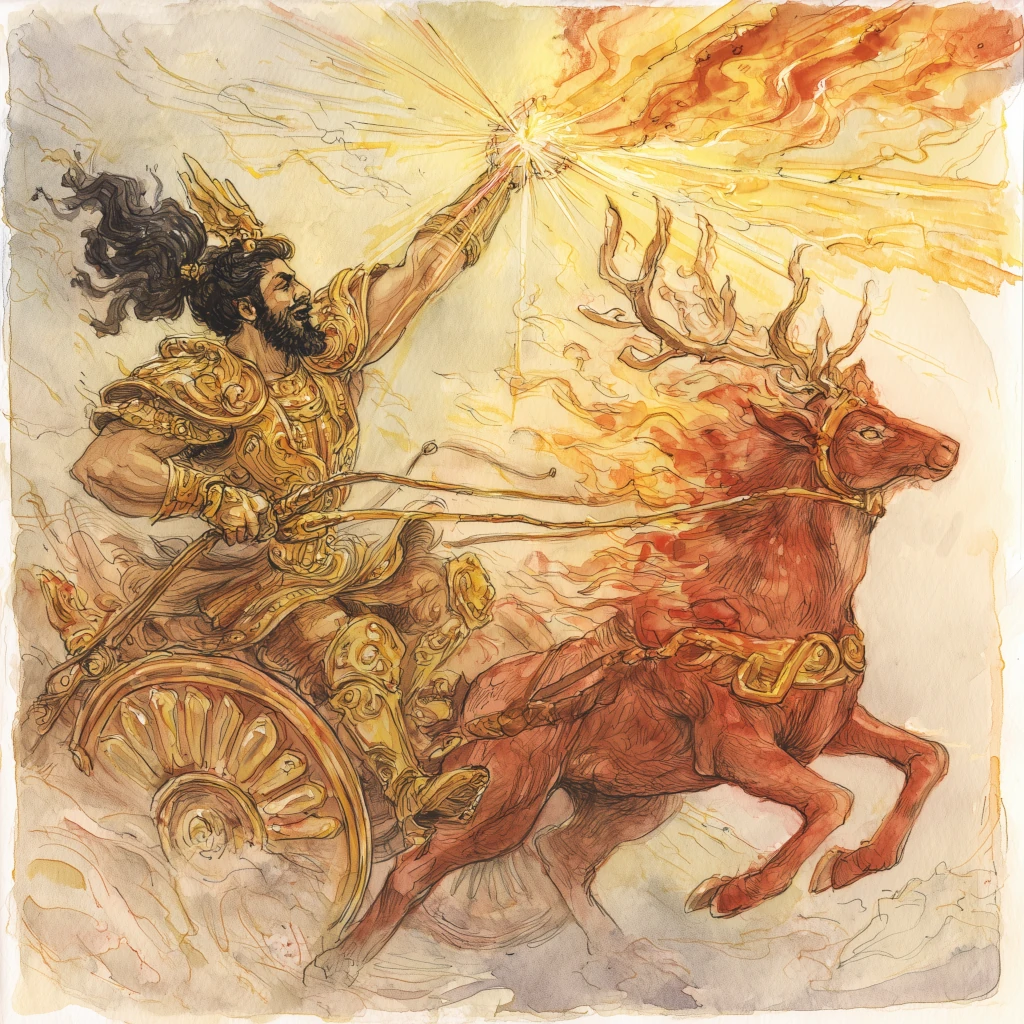
The Radiant, the Swift Horse-Lord of Day; LG Lesser power (yazata) of the sun; [He/Him]
Realm: Upper Planes / Wandering / the Chariot of One Thousand Rays ‡
Hvar Ksata [huh-VAR kuh-SATHA] is the radiant yazata of the sun, and his daily course across the sky is a deliberate manifestation of the divine power of the Yazad and the daily triumph of light over darkness. Hvar Ksata is said to be undying, ever-shining, and swift-horsed. He appears as a golden warrior-king riding a blazing chariot drawn by flaming red horses. From his hand brilliant beams of light emanate, and he can point these rays in any direction to uncover falsehoods and secrets. His divine portfolio includes the sun, daily celestial motion, light, and purity. He’s a militant enemy of darkness and its spawn. He has launched countless crusades against the undead, demons, and creeping blight. Chant goes that sacrifices to Hvar Ksata are especially likely to draw his attention and favour—the yazata is only too happy to help his favourites protect themselves against robbery and sorcery. His realm is the his chariot itself, and it passes through the skies of the Outlands, many of the Upper Planes, and the Prime each day.
Kshatra Vairya
𐬑𐬱𐬀𐬚𐬭𐬀 𐬬𐬀𐬌𐬭𐬌𐬌𐬀; the Desirable Dominion, Chosen Sovereign; LG Intermediate power and amesha spenta of metal, civilisation, weapons, victory, kingdoms, myrioi [He/Him]
Realm: Arcadia / Buxenus / the Adamant Throne ‡
Khshatra Vairya [kshahth-rah VYE-ree-yah] whose name means “Desirable Dominion” or “Chosen Sovereign,” is one of the amesha spentas and the divine embodiment of rightful rule, idealised authority, and the strength required to protect an ordered world so it can flourish. More than a simple war-god or king-god, Khshatra Vairya upholds the spiritual principle that power should be worth choosing: authority governed by justice and restraint, rather than tyranny or appetite. He is also a power of metal, and the guardian of metal ore seams, armour, tools, and by extension the civilisational power that metal makes possible, from weapons to crowns to ploughshares. He appears as a warrior-king in polished steel armour that completely covers his body. bearing a helmet with a crown built in. In combat, he carries a shield, and wields a spear.
His divine portfolio includes civilisation, kingdoms, victory in combat, armaments, achieving peace through showing strength. He is a staunch defender of both the ruling classes and the poor—and the divided loyalties this can create in his priesthood can cause all sorts of political tensions. Sometimes he roots for the disenfranchised, but other times he has been as a defender of royalty. At the Frashokereti—the great renovation and purification of all existence—Kshatra Vairya will stand alongside Asha Vahishta as the yazata together melt the metals from the mountains of Mount Celestia, sending a great river of molten ore flowing from across the planes. This river will burn away all remaining wickedness and sin, purifying every soul that passes through it.
Mah
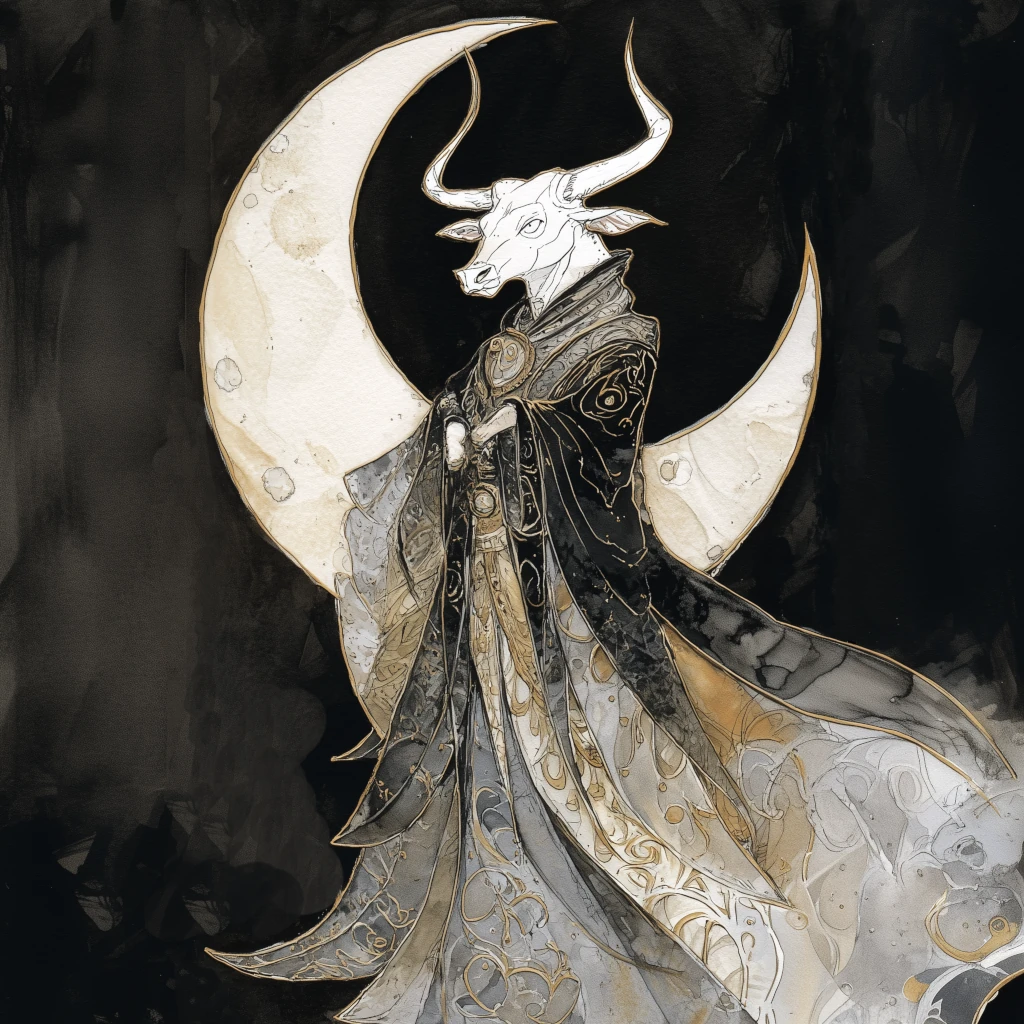
Keeper of Waxing Horns; CG/CN Lesser power (yazata) of the moon, cattle, tides, mental harmony; [He/She]
Realm: Beastlands / Brux & Karasuthra / the Waxing Crescent ‡
The Persian divinity of the moon is Mah [MAR], a yazata whose name means both moon and month. You’ll no doubt guess from this that their portfolio revolves around cyclical time and the measurement of the recurring rhythms of the heavens. Mah is a close ally of Vohu Manah, especially in relation to cattle, and the influence of the moon on the minds of mortals. This makes Mah rather more than a simple nightlight in the sky—the moon of Mah is a focus of reflection, emotional regulation, and predictable, ordered change. Mah manifests as a bovine humanoid, their fur glowing with a reflected white radiance during the full moon, or a deep silver-black when the moon is new. The gender of Mah is fluid—some myths describe him as masculine, and others as feminine—and it seems their gender at any one time is also linked to the phase of the moon. When the moon is a crescent, looking like a pair of horns, he also sprouts horns. At other times, Mah’s image softens and she becomes a power of fertility. At any time of the month, Mah presides over the ebb and flow of the tides, the quieting of restless thoughts, and the health and wellbeing of cattle. Their realm, the Waxing Crescent, can be found on Noctos, the moon that floats over the eternal twilight of Brux and the darkened land of Karasuthra. A perfect and endless pasture of glowing white grass, clover, and flowers, here their petitioners roam in the form of intelligent cattle, carefree and fulfilled. On Brux, where Noctos is always a crescent moon, Mah is male. On Karasuthra, where Noctos is always full, she is female.
Ormahzd
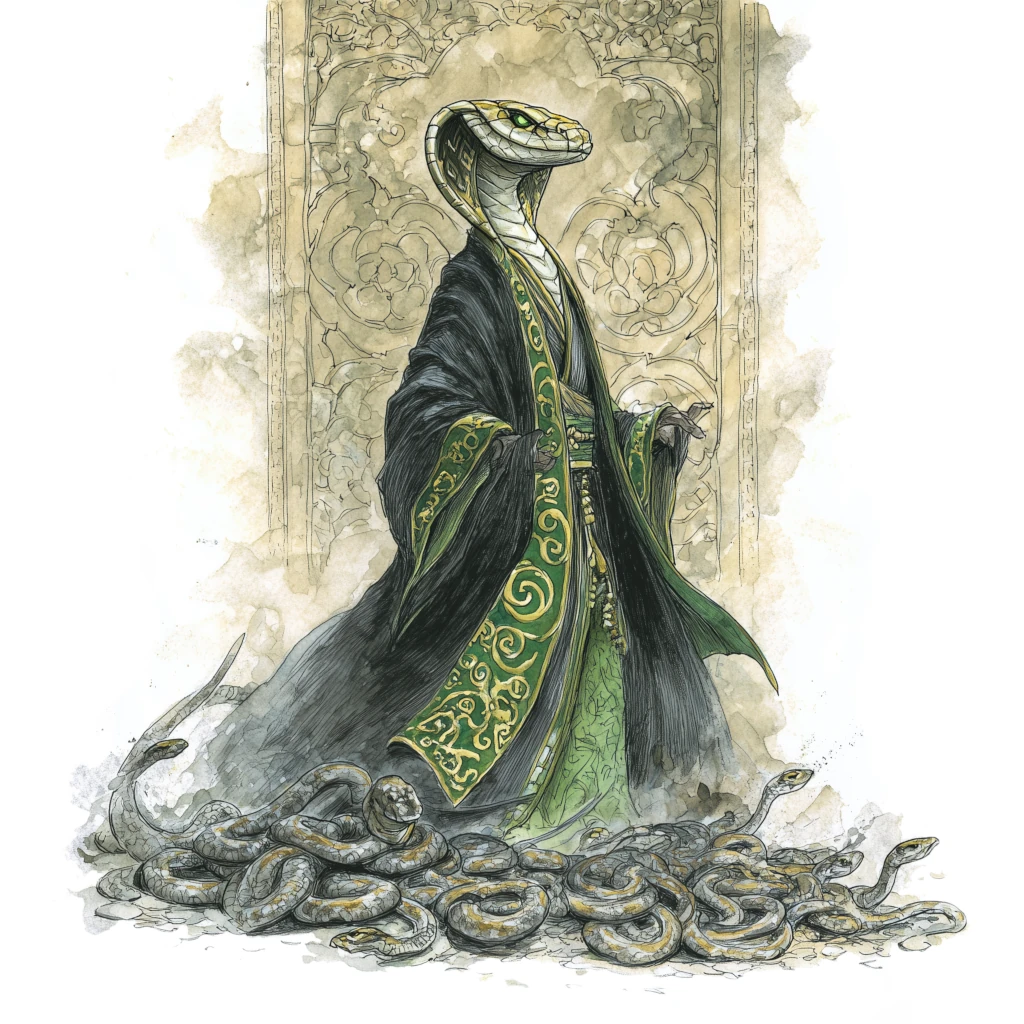
Jazirian, the Wise Lord Under an Old Name; LG Greater power of creation, community, peace, learning and parenthood; [Genderfluid]
Realm: Mount Celestia / Solania / Uroboros, the Gates of Wisdom
Of all of the yazata, Ormahzd [or-MAHZD] is the most Ahura Mazda, if that means anything to you. Before Ahura Mazda retreated from the planes, he emanated Ormahzd, to represent some essential aspects which needed to be embodies in a divinity. Ormahzd the Wise is a representation of the moral and social order which cutters need to live by if civilisations are to thrive. They’re the yazata of creation, community, peace, and learning. Ormahzd appears as a regal humanoid serpent, a hooded cobra who appears dangerous, but is infinitely restrained and wise rather than venomous. They are surrounded by dozens of baby snakes, which represent their embodiment of parenthood. As well as being a member of the Yazad, Ormahzd is also worshipped by the sarrukh, that ancient serpentine progenitor race, and the couatls, as the power Jazirian. Their realm, called Uroboros by the couatls and the Gates of Wisdom by the Yazad, is an invisible and intangible city made from words, that floats in the skies above Solania.
Rapithwin
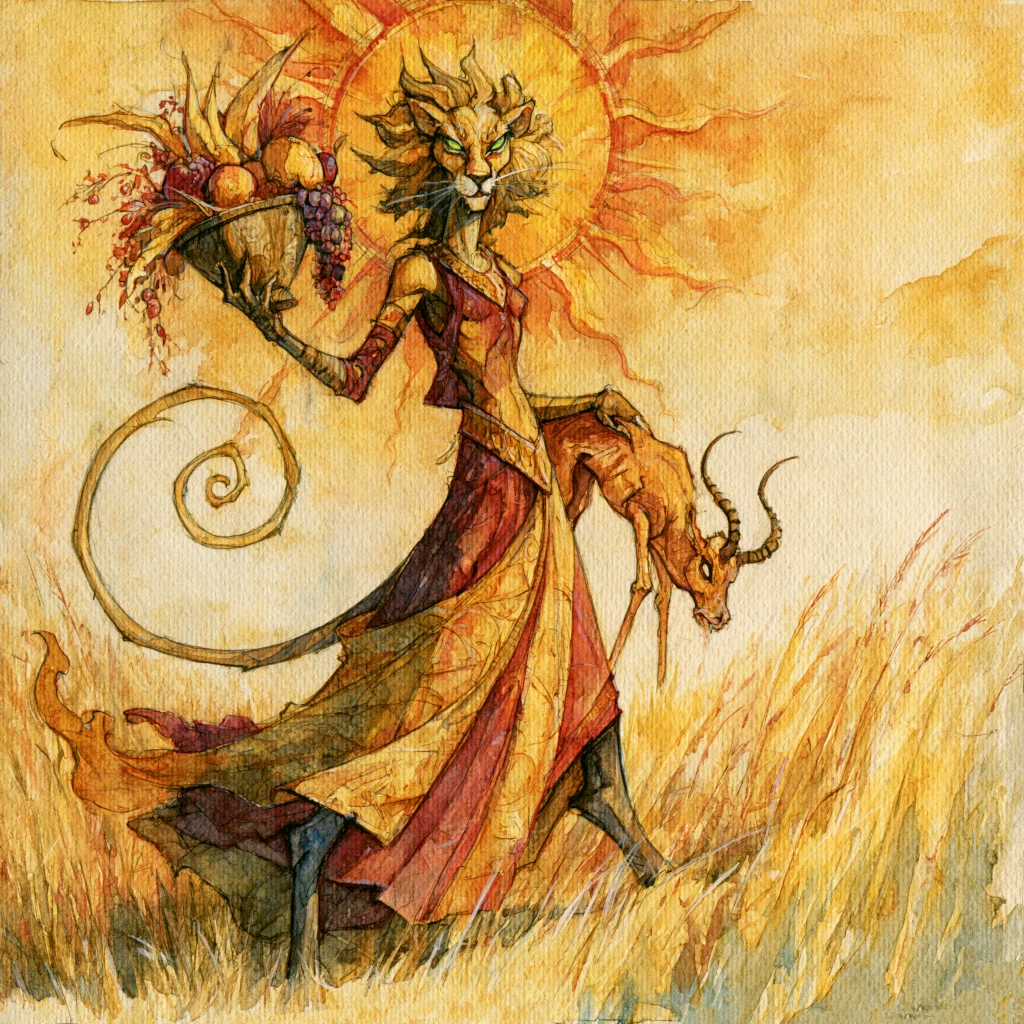
The Lord of Midday; NG Demipower (yazata) of warmth, brightness, summer, radiant abundance, midday [She/Her]
Realm: Beastlands / Krigala / the Meridian ‡
Rapithwin [rah-pith-WIN] is the yazata who personifies midday, summer. She’s a luminous power of noontide warmth and life-sustaining radiance. To the Persians, the word rapithwin refers to the idyllic three hour period (or gah) from noon to mid-afternoon, as well as the yazata himself—which gives Rapithwin a strange identity as both deity and moment. Her portfolio of control is abundant food, in particular the midday meal. She manifests as a humanoid lioness wearing red and saffron-coloured robes, holding a freshly slain antelope she’s hunted in one hand, and a cornucopia of fruit and grain in the other hand. A gloriole of sunlight shines around her head, and the heat of midday shimmers around her like a cloak. During the winter on the Prime, she retreats beneath the ground to warm the roots of plants and underground waters, only to return at the end of the spring to warm up the land. All year round, however, her endless savannah realm the Meridian in Krigala bakes under the hottest noonday sun. Here the game is abundant and the shade spots are few and far between.
Spenta Mainyu
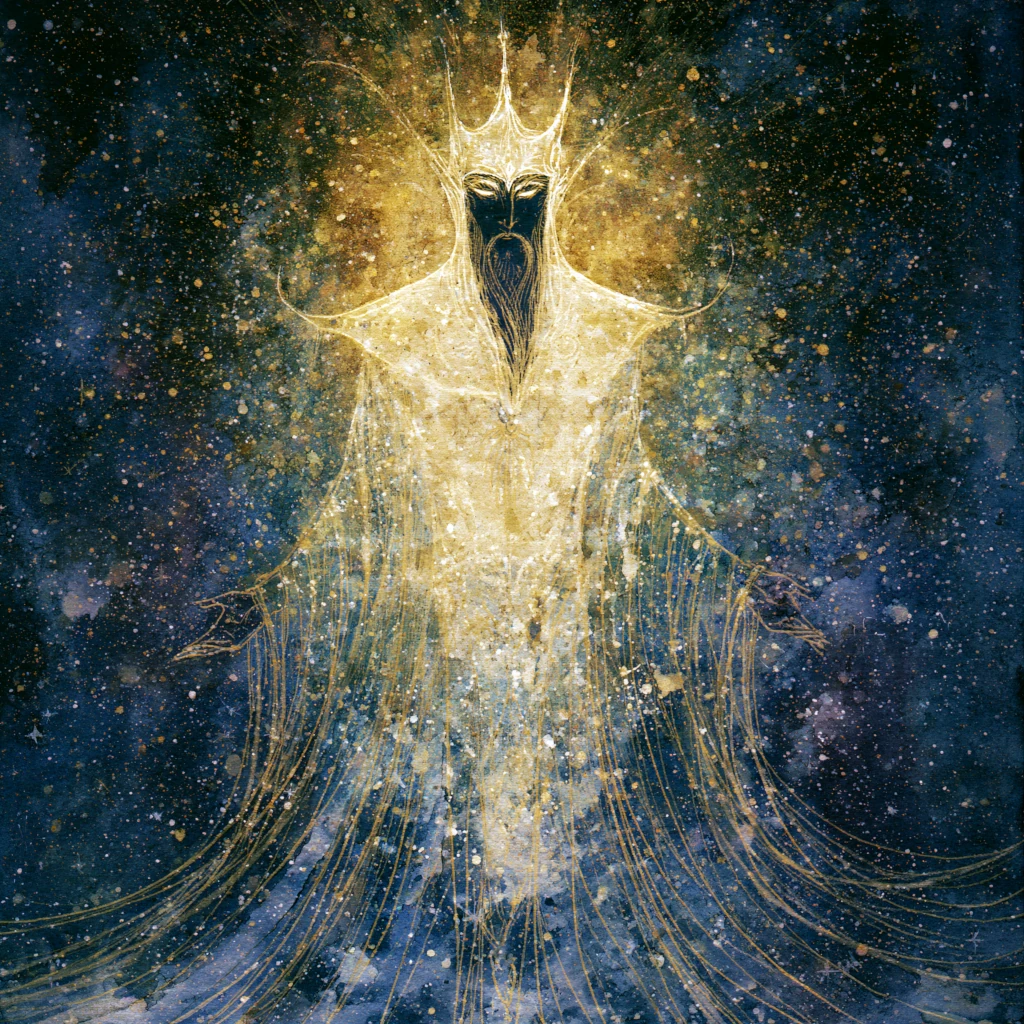
The Holy Spirit, the Bounteous Spirit, Light That Creates; LG Intermediate power (amesha spenta) of light and goodness [He/Him]
Realm: Unknown, possibly Mount Celestia / Chronias / Garōdmān ‡
The Bounteous Spirit Spenta Mainyu [SPEN-ta MAIN-yoo], like Ormahzd, is an amesha spenta who is highly attuned to being an aspect of Ahura Mazda himself. Spenta Mainyu is the emanation of the part of Ahura Mazda that directly opposes Angra Mainya, his wicked twin, and his active, creative, beneficent aspect that chooses life, truth and light when Angra Mainyu chooses death, deceit and darkness. If Ahura Mazda desires to act in the multiverse, it is usually through Spenta Mainyu that his will is carried out. Spenta Mainyu is rarely seen, but cutters who have been blessed with a vision describe him as a radiant king of white-gold fire, whose form is half light and half breath, with stars kindling wherever his feet touch the world. If you can imagine a silhouette or shadow, and then think of the opposite of that, that’s Spenta Mainyu. If this blood has a realm, its location is unknown. It’s possible it’s somewhere in unreachable Chronias, which would explain why he’s so rarely seen by cutters. If one of the most wicked creatures in all the planes was your dirrect opposite, you’d probably do just the same, I’d wager…
Tishtrya
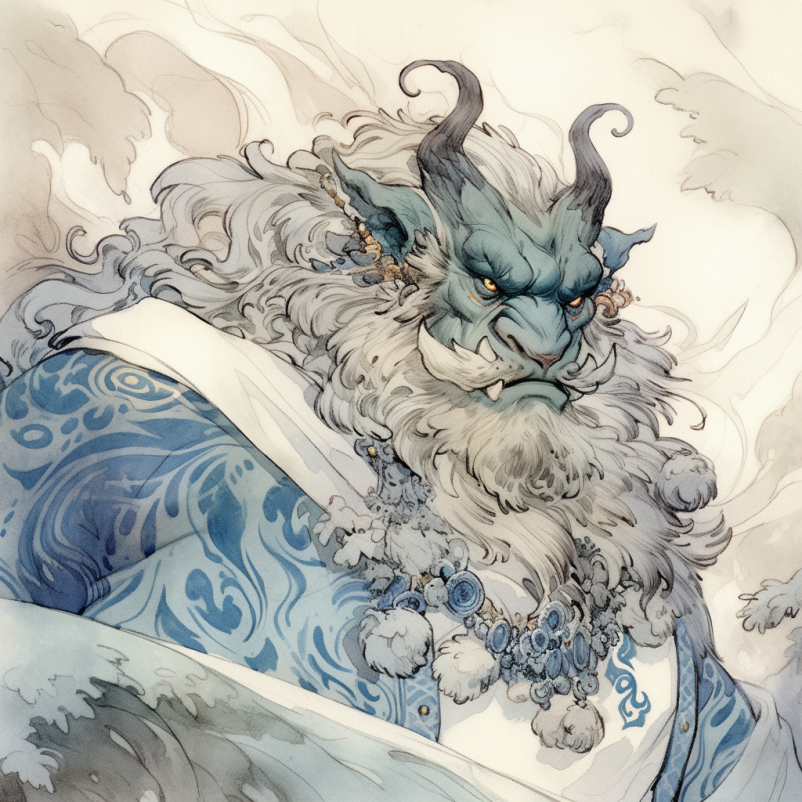
The Rainbringer, Star of Heaven’s Waters; LG Lesser power (yazata) of rain, fertility; [He/Him]
Realm: Mount Celestia / Lunia / Water from Heaven ‡
The yazata of rain and fertility is Tishtrya [tish-TRY-ah] luminous divinity identified with the brightest star in the sky, and praised as the bringer of the rains that keep pastures, and indeed all mortal life from falling into drought and ruin. Legends have it that the only reason it rains at all is because of Tishrya’s mythic victory over Apaosha, the demon of drought, although it was a close-run thing. The chant goes that mortals has become lazy and neglected to pray to Tishtrya, so when the power was challenged by Apaosha, he was initially driven back. Tishtrya appealed directly to Ahura Mazda, who sacrificed some of his own power to bolster Tishtrya enough so that he can return, defeat the demon, and release his long-withheld rains onto the parched world. Tishtrya manifests as a shining youth when the rains are gentle, a wild beast when the rains are heavy, and as pure white horse when he fought Apaosha.
More chant on Tishtrya here…
Vanant
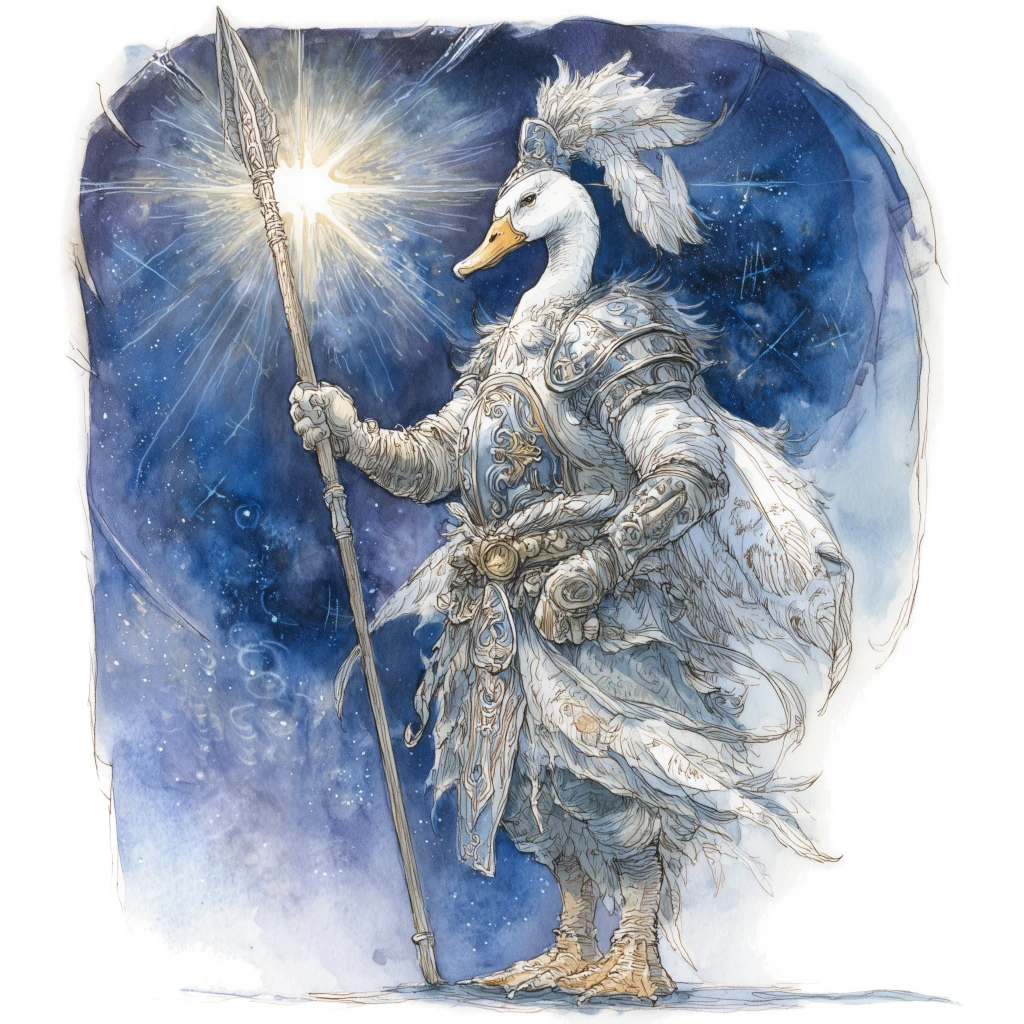
The Conqueror; the Guardian Star; CG Demipower (yazata) of the conquest of evil; [He/Him]
Realm: Arborea / Arvandor / the Star of Binding ‡
Vanant [VAH-nahnt] is a relatively minor but striking yazata whose role in the Yazad is to defeat evil, wherever he may find it. That usually takes the form of swooping down and attacking fiendish forces who are menacing Persian petitioners on the Upper Planes, but he also tries to keep an eye on worshippers on the Prime too. Like Tishtrya, Vanant is represented by one of the stars in the sky, although graybeards can’t agree which one. That’s because Vanant actually manifests as different stars over different planes, and it’s this way that he keeps watch of what the wicked are plotting. He typically manifests as a pure white humanoid-goose hybrid, decked in mithril armour and wielding an adamantine spear. His realm in Arvandor, the Star of Binding, is known as the Wandering Star as it never remains in the same place from one night to the next, and its movement is completely unpredictable. Cutters assume that’s either his realm, or Vanant himself, flying high in the skies watching out for trouble to get himself involved in.
Verethragna
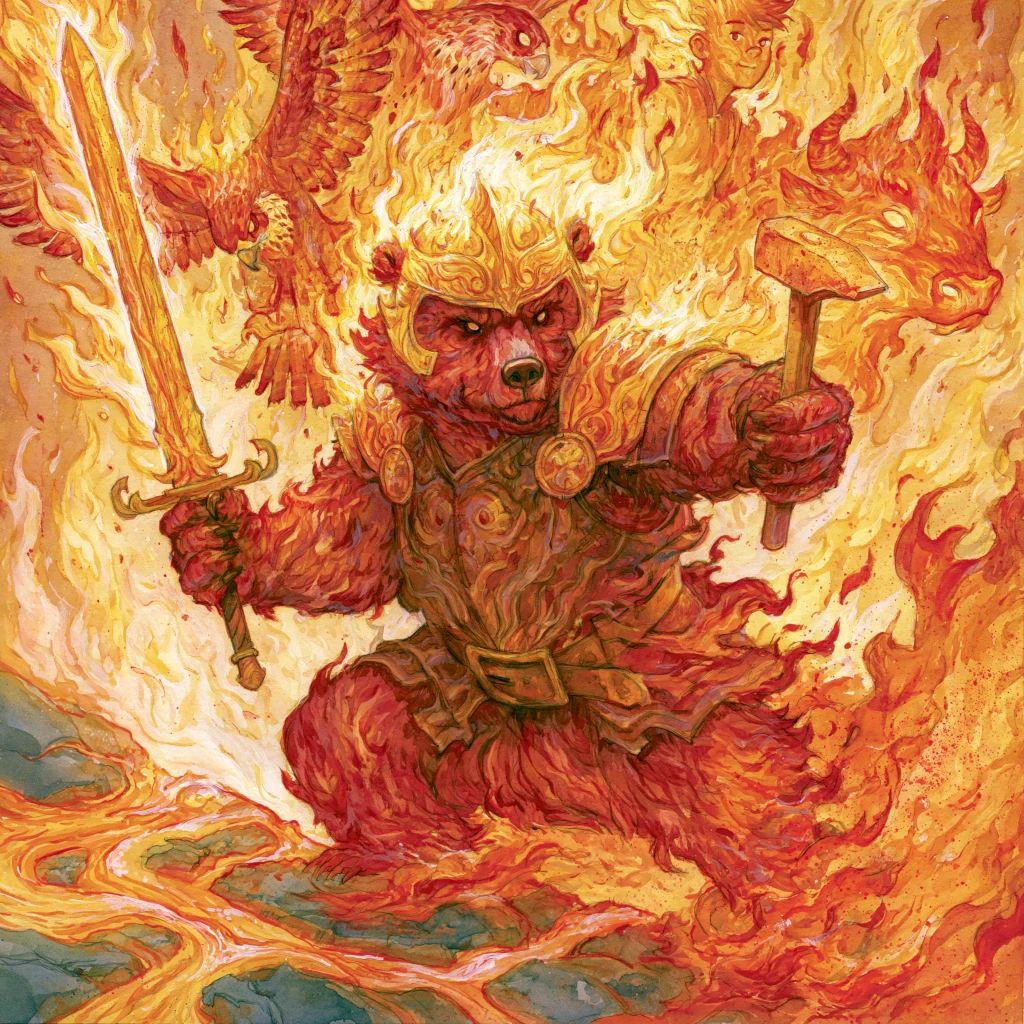
Bahram, the Smiter of Resistance; CG Lesser power (yazata) of victory, righteous aggression, and triumph
Realm: Ysgard / Muspelheim / Atash Behram ‡
The personification of the triumph a cutter feels when they are victorious in battle, Verethragna [veh-reth-RAG-nah] is a smasher of obstacles and enemies who stand against the Yazad. He adopts many different forms—a bull, a raven, a youth, a bird of prey—but his favourite form is a flaming bear with a golden sword. While his combat style is more aggressive and wild than Vanant, when a threat is great enough, the two of them will team up.
Verethragna’s realm in Muspelheim is called Atash Behram. It is a colossal forge-temple where three lava rivers converge. The central forge contains Vahrām fire, the holiest grade of fire, which must be established from fires collected from sixteen different holy fires from across the planes, and transported here without being extinguished. If you think that sounds like a task for an adventuring party, you’d be right. Guarding religious caravans transporting holy flames can pay well and take a berk to all sorts of interesting places. Holy volcanoes, the Deep Fire, metal working forges of fellow powers—you name it.
Vohu Manah
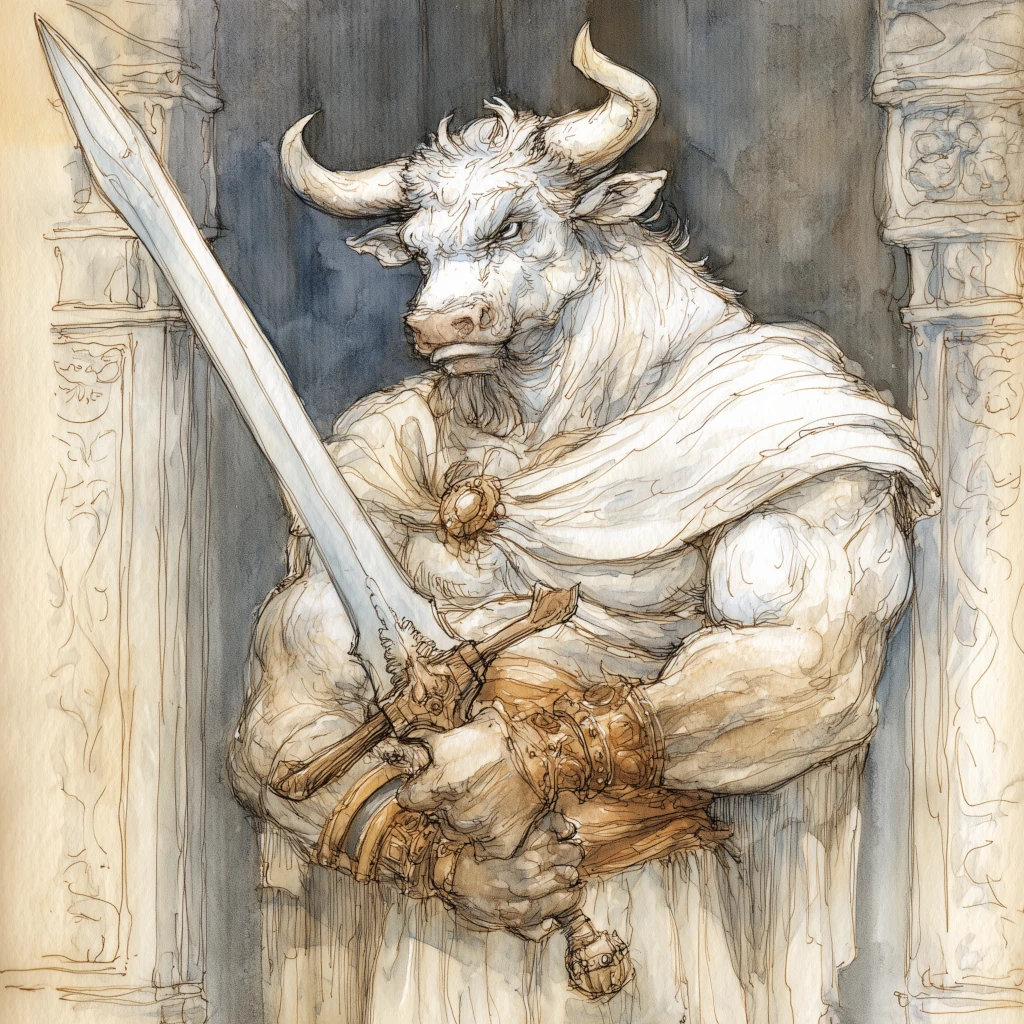
𐬬𐬊𐬵𐬎 ⸱𐬨𐬀𐬥𐬀𐬵; the Thoughtful; LG Intermediate power and amesha spenta of purity, wisdom and knowledge; [He/Him]
Realm: Mount Celestia / Mercuria / the Pasture Prudential ‡
The amesha spenta Vohu Manah [VOH-hoo MAH-nah], whose name means good thought or good purpose, is the embodiment of the benevolent intelligence by which mortals recognise truth from falsehood. He’s a god of abstract wisdom sure, but also the principle of right-mindedness itself. It’s the purity of thought that turns knowledge into moral action. His makes him one of the most influental bloods in the Yazad’s eternal struggle against chaos, deception, and the warped intentions embodied by Vohu Manah’s personal antithesis, Aka Manah, the Evil Mind.
Vohu Manah manifests as a pure white minotaur, both thoughtful and ready for battle against wickedness. While he’s not technically a psychopomp, Vohu Manah sometimes he escorts the souls of the truly just toward paradise—perhaps to ensure these cutters actually make it across the Chinvat Bridge safely, for the enemies of the Yazad are cunning and persistent.
When he isn’t battling evil or guarding the righteous, Vohu Manah can be found in his Mercurian realm, the Pasture Prudential. It’s a peaceful place of gently rolling hills covered in verdant golden grass, apple and pear orchards, and babbling streams—and highly conducive to meditative thought.
| POWER | PORTFOLIO | REALM |
| Ahura Mazda ‡ | Wisdom, truth, benevolence, fertility, the sky, kingship | Mount Celestia / Chronias / Garōdmān |
| Airyaman ‡ | Friendship, marriage, healing | Elysium / Amoria / the Oath of Kinship |
| Ameretat ‡ | Immortality, plant growth, spiritual reward | Bytopia / Dothion / the Ever-Green Garden |
| Anahita ‡ | Prosperity, justice, liquid, rivers, streams, sacred cleanliness, life-giving water | Mount Celestia / Lunia / Purifying Water |
| Apam-Natat ‡ | Hidden fire, life-giving waters and royal glory | Mount Celestia / Lunia / the Glorious Deep |
| Ard ‡ | Just rewards, karmic justice, truthful oaths | Arcadia / Buxenus / the Scales of Victory |
| Armaiti ‡ | Holy devotion, righteous obedience, fertility, the dead, earth, fertility, farming, nature | Bytopia / Dothion / the Bountiful Expanse |
| Asha Vahishta ‡ | Truth, sacred fire, asha itself | Mount Celestia / Mercuria / the Flame of Best Order |
| Ashman ‡ | The sky, the firmament, the highest heaven | Mount Celestia / Solania / The Diamond Vault |
| Atar ‡ | Light, heat, truth, health, sacred fire | Fire / Hearth Eternal |
| Baga ‡ | Prosperity, wealth, the fair share | Arcadia / Buxenus / the Counting House |
| Drvaspa & Geush Urvan ‡ | Horses, cattle, protectors of grazing animals | Beastlands / Krigala / the Unfailing Pasture |
| Haurvatat ‡ | Perfection, purifying water, life after death | Mount Celestia / Venya / the Wells of Completion |
| Hom ‡ | Harvest, health, strength, vitality, the divine haoma plant | Arborea / Arvandor / the Grove Eternal |
| Hvar Ksata ‡ | Radiant sun, motion, anti-undead crusades | Upper Planes / Wandering / the Chariot of One Thousand Rays |
| Kshatra Vairya ‡ | Metal, civilisation, weapons, victory, kingdoms, myrioi | Arcadia / Buxenus / the Adamant Throne |
| Mah ‡ | Moon, tides, cattle, mental harmony | Arborea / Arvandor / the Waxing Crescent |
| Ormahzd | Creation, community, peace, learning, parenthood | Mount Celestia / Solania / Uroboros, the Gates of Wisdom |
| Rapithwin ‡ | Midday, summer | Beastlands / Krigala / the Meridian |
| Spenta Mainyu ‡ | Goodness, light | Unknown |
| Tishtrya ‡ | Rain | Mount Celestia / Lunia / Water from Heaven |
| Vanant ‡ | Vanquishing evil | Arborea / Arvandor / the Star of Binding |
| Verethragna ‡ | Victory, triumph | Ysgard / Muspelheim / Atash Behram |
| Vohu Mana ‡ | Purity, wisdom, knowledge | Mount Celestia / Mercuria / the Pasture Prudential |
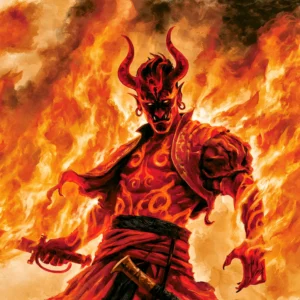
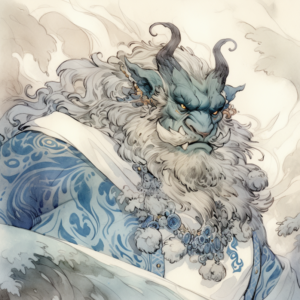
A Who’s Who of the Pantheon
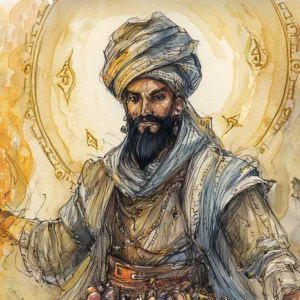
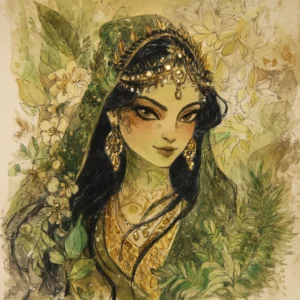
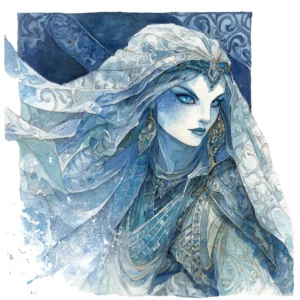
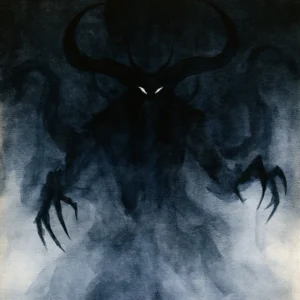
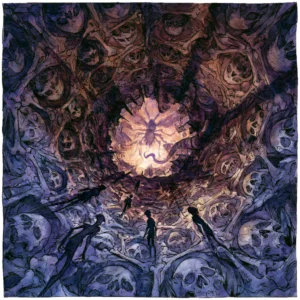
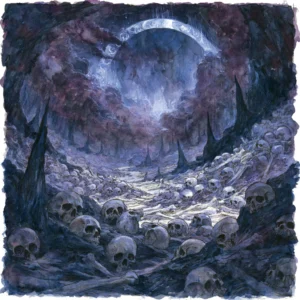
Realms of the Persian Powers

Source: Jon Winter-Holt. Dragon Magazine #12 (there’s a blast from the past!). The sourcebook Scion 1e: Yazata was also helpful in getting my head around the Persian powers. ‘Yazata’ is I suspect also where the Pathfinder term for eladrin-like creatures, ‘azata’ comes from. The pantheon and philosophy described here are based on Zoroastrianism, at 3500 years old or more, it is one of the most ancient religions, and even more impressively, it’s still around to this day. While the religion originated in what is now called Iran, most of the 100,000+ faithful are Parsis who live in India and Iran. I hope I’ve done these powers justice, and the liberties I’ve taken when details were sparse are in-keeping with the historical details—as always, if you know more about Zoroastrianism or ancient Persian or Iranian mythology please do get in touch! And yes, I know there aren’t 33 yazatas described here. Gotta leave some room for later expansion / homebrewing eh? Also — this one was a LOT of work already! 😛