The Pit of Bones
Planar pathway
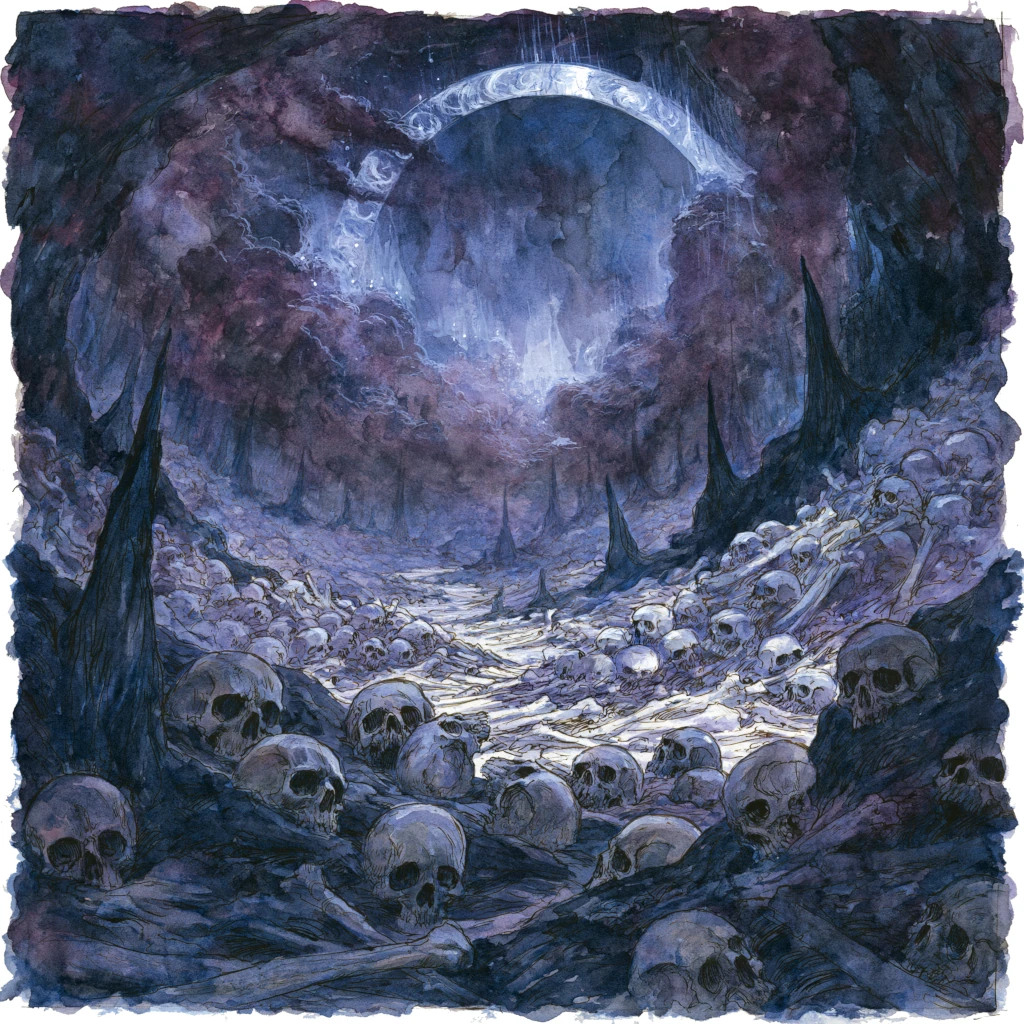
If a berk falls from the Chinvat Bridge, and isn’t immediately grabbed by a demon or a xrafstar, things get rapidly worse for them. If they are lucky, they won’t survive the fall. If they are not so lucky, well… below the bridge is the Pit of Bones, and yes cutter, it’s exactly as bad as it sounds. An endless valley of bleached humanoid remains, picked over by ghouls—and worse. This is the realm of Asto Vidatu, the Bone-Dissolver. At the lowest points of the pit are enormous gaping holes; the only way out of the Pit. These belong to Druj-Demāna, the House of Lies. Whatever you do, don’t go there…
The dead man never did learn the name of the berk that killed him. He’d anticipated there would be darkness, or fire, or at least the dignity of silence, but instead there was a chain noose pulled tight around his neck—well, his spirit-neck anyway—and a voice like dry bones being banged together: Asto Vidatu had snared him at the exact moment his final breath left his body, and then yanked his spirit from the mortal world with all the tenderness of a butcher lifting a carcass. Around the dead man the Astral seethed with silver chords and the traffic of souls, all bright threads and pale embers moving ever-closer toward judgment. And then suddenly ahead of him stretched the Chinvat Bridge, a beam of light spanning the infinite gulf between the land of the living and the provinces of death.
At the bridge’s approach he was met by its guardians. Sraosha stood there first, grave expression and body poised like a cockerel waiting for dawn. Beside him hovered Daena, in the shape of his own conscience rendered visible. When the dead man looked at her, she was not the beautiful maiden the righteous were said to see, but neither was she the withered hag the wicked deserved. She was instead severe, and somehow that was worse. “You believed your sins were small,” she said, “but they only felt small because they were too familiar.” The dead man had no answer. No, he had not been a villain in the great, operatic sense. No cities burned because of him; no people died screaming his name. But he had lied, he had withheld taxes, had taken more than his share, and dressed up his whims as necessity. Already the bridge under his feet was narrowing, now a path, now a shelf, now a mere stick’s width. He finally understood that souls were not just judged by the single worst thing a cutter ever does, but also by the weight of many small sins.
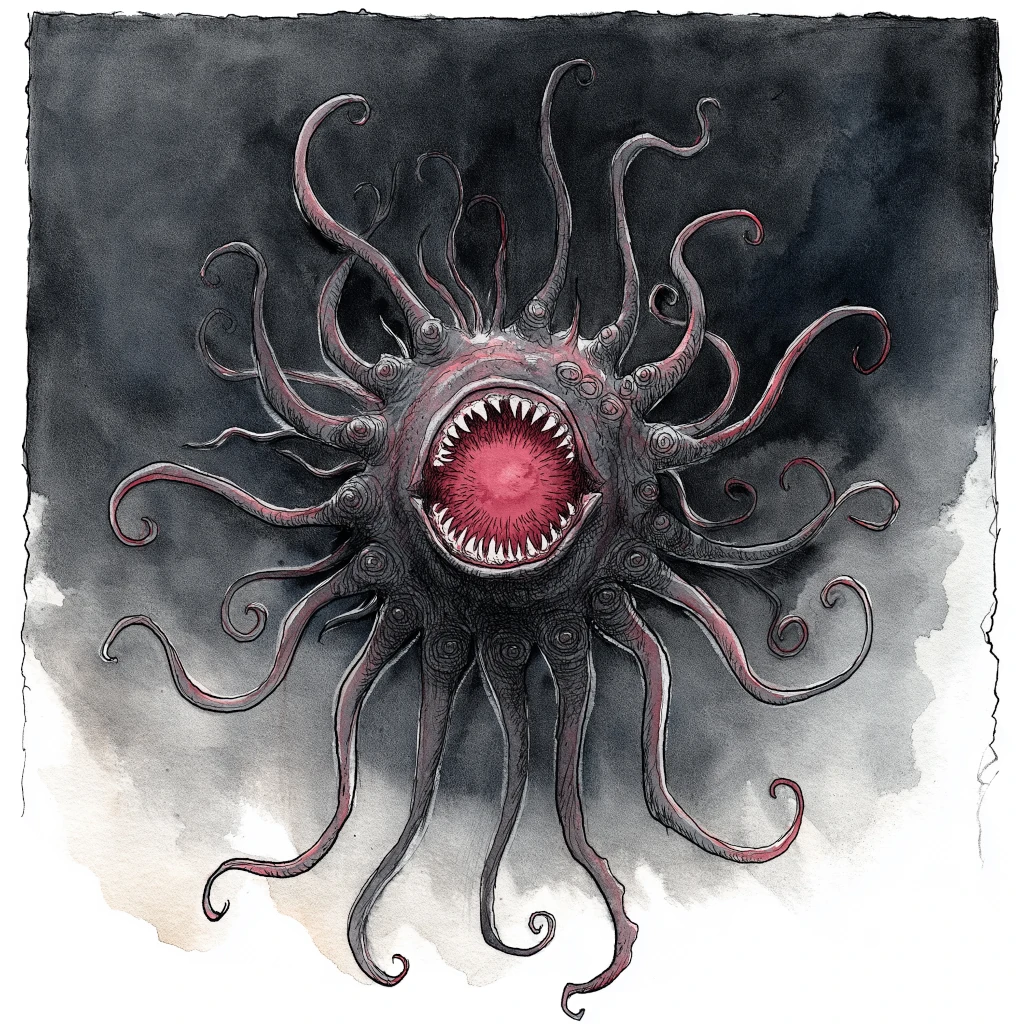
Then came the sound of furious wings and the stink of blood. Aeshma rose from below like a storm, his bloody mace glinting as it reflected the light from what was left of the bridge. His grin gave away his appetite. The dead man felt terror try to climb inside him, but he clenched whatever part of himself could still clench and refused it. “No,” he said, though he did not know to whom. “You won’t be getting that from me.” Aeshma’s laughter shook the bridge, but somehow the dead man balanced, even as the span thinned until it was almost nothing. He made it three steps further before something wet coiled around his ankle. A black tentacle, cold as a grave, rose from below. Chinnaphapast had been waiting in the pit beneath the crossing, and now he hauled the soul sideways with a brutal tug. The dead man struck the bridge’s edge, lost his footing, and fell.
He landed hard, in a clatter of skulls and femurs. The Pit of Bones was a wound in the Underworld: a wide valley of bleached-white remains, cracked skulls, thigh bones, shattered ribs, and knuckles. Far above, impossible and distant, the bridge that had rejected him burned an arc across the dark sky like a fault line of light. The dead man rose to his knees in the ashes between the bones and realised to his horror that he was not alone. He could hear something enormous slither out there in the darkness. Holes opened everywhere in the ground, narrow tunnels going down and down, each one exhaling a different smell—rot, rust, wet stone, old incense, and something sweetly poisonous. The nearest tunnel looked recently cut, as if some buried thing had been clawing its way upward. The dead man approached it because there was nowhere else to go. The opening was deep, black, and round as a screaming mouth. The dead man bent close, heard movement below, and saw that the tunnel did not sink into darkness but was lit with a faint, patient glimmer, as though something deep in the earth had begun to wake and was waiting for him to come nearer.
He climbed in…
Story continues with Druj-Demāna
Source: Jon Winter-Holt, idea based on real world mythology