
Outsiders > Elementals > Genies
Genies
Even the most clueless of primes know one truth about the Multiverse: There’s meek, commonplace mortals and then there’s Rare and Mighty Immortal Beings. The Outer Planes have their fiends, celestials and monitors. The Prime has dragons and giants (and archfey, if the Feywild is to be considered the reflection of Prime). And the Inner Planes—well, they have a bunch of powerful cutters, but the most famous and powerful of them are genies.
The origin of genies themselves is dark, and this seems to be an intentional act of the genies themselves. No one, for example, has ever seen a baby genie—new genies seem to spring up fully formed as young adults. Some graybeards reckon that genies originate from pneuma—the petitioners of the Inner Planes. Other cutters argue that genies are descendants of spirits of land of the Prime Material that were originally worshipped by mortals, and over time slowly began to manifest humanoid ways themselves. Other sages think that genies represent the embodiment of elemental magic. However, none of this hypotheses truly answers all of the outstanding questions, and all three theories are contradictory—to each other, and to reality. You could almost believe that even genies themselves don’t have a clear grasp on this conundrum—or at least they do a good job of pretending not to.
While all genies are of course different, on an individual as well as an elemental level, their cultures do share much in common. Genies place significant importance on etiquette and courtly graces. Only those who can learn the ins and outs of the social rules of the genie courts can hope to earn any respect in such a society. All genies are more or less hierarchical in nature. They believe themselves to be a step above any mortal race, of naturally, but they also treat their noble classes and especially their rulers with humility and awe. In other ways the genie cultures differ, though. For example, while dao treat any non-dao as potential slaves, djinn more commonly believe in treating every cutter with respect. Despite their supremacist views, genie culture is highly concerned with honour. Genies will typically try to fulfil deals they make, uphold promises and contracts, and return favour they owe—if only to not be shamed if found out by their peers. Whether a genie fills a deal to its spirit, or just to the letter though—that’s a matter for that genie’s sense of morals.
Dao

The dao (DOW) are the dominant force of the Plane of Earth, exceeding even the archomentals in both power and malevolence. Their Khanate is built on the backs of slaves, and dao society is driven primarily by their obsession with accumulation and consumption of wealth. Few cutters like the dao—even other dao themselves. A splinter faction of earth genies have called themselves jabali, while referring to the Khan-abiding dao cousins by the derogatory term “shaitan” (shy-TAWN). No matter their clan though, dao seem to be obsessively drawn to wealth and adore the beauty of gemstones.
More chant on the dao coming soon…
Source: [ AD&D 2e | 3e | 5e | PF1e | PF2e ] Monstrous Manual [2e]; Monstrous Compendium Vol. 2 [2e]; Manual of the Planes [3e] p172-173; Manual of the Planes [5e] p372; Bestiary [PF1e] p143 (as shaitan); Monster Core [PF2e] p158 (as jabali); I can’t find D&D 5e stats that aren’t behind a paywall [shrugs]
Djinn
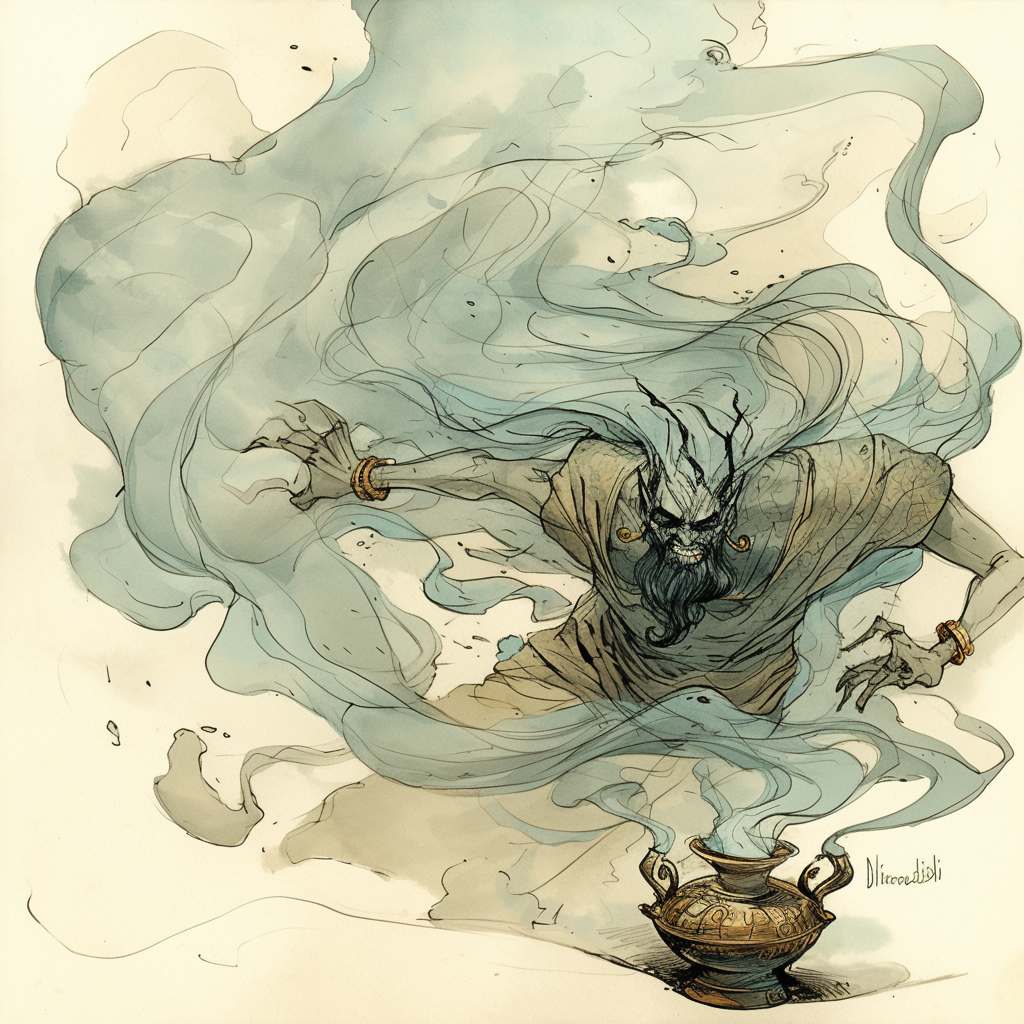
While djinn (JIN) may appear mercurial and aloof, they are just as—if not more—powerful and intelligent than their kin. Djinn typically detest slavery, and make sure to employ their servants on favourable terms, while ruthlessly fighting against both efreet and dao. The Plane of Air nurtures their souls with its endless freedom and beauty. Some djinn, known as jaathoom, take this fascination so far that they forsake even words to instead speak with images and illusions. Overall, djinn are usually the friendliest of the genie-kind towards planewalkers, although anyone walking amongst them must still pay close attention to their traditions—and of course present appropriate gifts.
More chant on the djinn here…
Source: [ AD&D 2e | 3e | 5e | PF1e | PF2e ] Monstrous Manual [2e]; Monstrous Compendium Vol. 2 [2e]; Monster Manual [3e]; Bestiary [PF1e] p139; Monster Core [PF2e] p157 (as jaathoom)
Efreet

The Plane of Fire is an endless battlefield, and efreet (eh-FREET) are the greatest warmongers of the Crematorium. From his throne the Sultan sends his armies of servants and slaves to control the endless expanse of flames. Efreet are almost as hated as dao—and perhaps even more so by natives of Air and Water. However, don’t let them catch you saying that, because they control the City of Brass—the fabulous Inner Planar metropolis that is rivalled by few others.
More chant on the efreet coming soon…
Source: [ AD&D 2e | 3e | 5e | PF1e | PF2e ] Monstrous Manual [2e]; Monstrous Compendium Vol. 2 [2e]; Monster Manual [3e] p115; [5e] p109; Bestiary [PF1e] p140; Monster Core [PF2e] p159 (as ifrit)
Hinn

Djinn weren’t the first race of geniekind to be targeted by the efreet empire. Several races of para-elemental genies were destroyed by the efreet long ago, in a genocidal war that spanned centuries. One who managed to survive are the Hinn, the genies of Smoke, who rather than fighting, wisely retreated deep into their obscuring realms and hid. They swore to abandon their system of nobility and monarchy, and instead formed a ruthlessly lawful egalitarian society. Unlike other genies, hinn cannot grant wishes, but instead they have mastered the ability to possess other beings. With their nebulous forms, they have perfected other arcane arts of shape-shifting too.
More chant on the hinn coming soon…
Source: Homebrew, based on Arabian myth ‡
Jann

These genies of all elements are bound to the Prime Material Plane, where they often live as nomads and explorers, and are able to pass for humans or genasi, or take the form of animals. Jann are comfortable in and can freely travel between all of the elemental planes, but they have to return to their home plane every few days. While outmatching most mortal cutters, jann are less powerful than other genies and can often be found in their service. The recent re-emergence of the Elemental Chaos has revealed one other truth about jann—they are actually native to that Plane, and a small number of them had remained amidst the Chaos for many millennia. These jann are much more terrifying than their Prime-bound cousins, and seem to be at least touched by the Primordial powers of the elements.
More chant on the jann coming soon…
Source: [ AD&D 2e | 3e | 5e | PF1e | PF2e ] Monstrous Manual [2e]; Monstrous Compendium Vol. 2 [2e]; City of Brass [5e]; Monster Manual [3e] p116; Bestiary [PF1e] p141; Monster Core [PF2e] p156
Khayal

It’s dark (pun intended), whether or not khayal used to be elementals, but today they are certainly creatures of the Shadowfell. While not as hostile as dao or efreeti, their culture is unusually deceptive, to the point where khayal have turned lying to outsiders into something of an art form. Unlike other genies, deals of any kind with khayal are impossible, for they are almost certain to never honour them. However, if a cutter can catch a khayal in a lie, their twisted sense of honour means they can be forced to perform a service as a penance. Fortunately, khayal rarely take slaves and could be considered inoffensive—if not for their eternal rivalry with jann. While khayal are masters of shadow magic, they are also unable to survive for more than a day away from their home plane, lest they begin to sicken and diminish.
More chant on the khayal coming soon…
Source: [ 3e ] Tome of Magic [3e] p162-163
Kizidhar

Strange and distant, kizidhar genies have shunned the company of other genies for millennia, and even tend to avoid their own kind. They prefer to spend their days in perfecting their mastery of reshaping wood into different forms—often into their own likeness. They can merge with plants and especially love to inhabit trees to watch mortals undetected. Kizidhars love flattery even more than other genies—which says a lot—and surround themselves with sycophants and admirers. It’s enough to make a berk wonder whether re-discovering the Plane of Wood was even worth it.
More chant on the kizidhar coming soon…
Source: [ PF2e ] Rage of Elements [PF2e] p212 †
Marid

The largest and arguably the strongest of all genies, marids are also the most aloof and sure of themselves. Their alternative name is faydhaan—citizens of the Faydhaan Empire, which used to be the greatest nation of the Inner Planes (though not all marid are faydhaan—there are also so-called savage marid too). Because of the incursion of Elemental Evil the marid nation fell in disarray however, and now the Padishahate is small and the remaining marid nations are fragmented and scattered. Most marids don’t seem to be too upset about this state of affairs, though. These genies prefer lounging around to fighting and dominating lesser races, and treasure songs, greetings, and tales far more than material riches (although that’s not to say they aren’t fond of wealth either).
More chant on the marid coming soon…
Source: [ AD&D 2e | 3e | 5e | PF1e | PF2e ] Monstrous Manual [2e]; Monstrous Compendium Vol. 2 [2e]; Monster Manual [5e]; Bestiary [PF1e] p142; Monster Core [PF2e] p158 (as faydhaan)
Qorrash

The genies of the Para-Plane of Ice are rare, and not very sociable. Currently locked in a bitter fight against the elemental forces of Cryonax, the qorrashi live in tight-knit groups in their citadels on the endless plains of the Precipice. Qorrash are honourable warriors, and are both similar to and the complete opposites of efreet. One must hope their plans for the Plane of Ice are gentler than those of brutal Cryonax, should they prevail in their war.
More chant on the qorrashi coming soon…
Source: [ 3e ] Frostburn [3e] p131
Zuhra

Zuhras are beautiful beings of liquid metal with appropriately mercurial personalities. They treat life as art, and love being the center of attention. However, at the same time, zuhras rarely, if ever, form deeper bonds. As the Plane of Metal returns to its rightful place, zuhras seem eager to explore the Multiverse around them—although they have the tendency to quickly bore their audience. Just, you know, don’t tell them that.
More chant on the zuhra coming soon… †
Source: [ PF2e ] Rage of Elements [PF2e] p160

Geniekin
There are many creatures that are related to genies in some way, some by blood, some linked by curse. Some are less mighty, some more. All of them seem fascinated by mortals.
Blightburn Genie

Genies corrupted by the certain kinds of dark magic, such as blightburn radiation, can become twisted animalistic beings of destruction. The muurfeli are rare owl-like genies—corrupted djinn now formed from poisoned winds and flammable gas— who dwell in tainted lands deep underground or in cursed parts of the Inner Planes. Ararda are scorpion-like corrupted dao whose forms are embedded with glowing minerals that radiate deadly blightburn. There are dog-like suayiks, born of corrupted efreet, and horrifying serpent-like laanum, former marid. Some graybeards hypothesise that the first divs may have been born from those genies too. †
Source: [ PF2e ] Pathfinder Extinction Curse #155: Lord of the Black Sands p78
Genasi

Genasi (jen-AH-zee) aren’t necessarily related to genies, but most of them seem to come from the union between a genie and a mortal, or to have a genie in their ancestry at some point. These are mortal beings whose blood runs hot—or cold—with an echo of raw elemental power.
Genie Conglomerate

When a genie dies, its form dissipates into elemental matter, and is reabsorbed by the plane. But if this residue collects together and builds up, it can start to degrade and become infused with magical corruption, necromantic energies, or planar entropy. If enough genie detritus gathers in one place, it can fuse into a genie conglomerate, a twisted and broken amalgamation of dozens of tortured genie souls. It remembers fragments of its past lives, and all the wishes it has twisted in the past. A creature of great chaos and malice, these tormented beings hate everything and everyone. They’re most often encountered near the battlefields of historical genie conflicts—many of them that there have been—and lost in the Elemental Churn.
Source: [ D&D 5e ] Manual of the Planes [5e] p374-375
Gennayn

Gennayn (jen-AY-in), sometimes simply called ‘gen’ are minor spirits shaped like tiny humanoids. They serve genies and sha’irs—mortal spellcasters who receive their spells straight from the Elemental Planes. Each kind of genie, except for the jann and the khayal, has spawned its own type of gen, though there’s also one apparently without a progenitor species—the lightning gen.
Source: [ AD&D 2e | 3e | PF2e ] Monstrous Compendium [2e] Al Qadim Appendix; Rage of Elements [PF2e] p226; Dragon Magazine #315 [3e] p82-83
Ghul

While genies can’t become undead by conventional means, special and powerful magic can warp them into ghul (GOOL)—monstrous undead that feast on flesh. Many bloods even assume that ghuls and ghouls are somehow connected—perhaps one curse is derived from another. Ghuls are typically separated into great ghuls that come from elemental genies and ghul-kin that come from jann, although in practice the difference between them is minimal.
Source: [ AD&D 2e | PF2e ] Monstrous Compendium [2e] Al Qadim Appendix; Monstrous Compendium [2e] Annual Vol. 2; Book of the Dead [PF2e] p106
Markeen

Also known as genie doubles, markeen are barely spoken of among geniekind at all. They are apparently descendants of jann, cursed long ago. Every markeen is identical to some human, born on the same day. It’s usually only famous, or infamous, cutters who have a markeen double, although of course how the multiverse knows the newborn will one day become famous, that’s dark. They have some inherent magical powers, and the ability fly. While ignored, even scorned, by genies, markeen form secret societies and have their own culture which laments the curse of being cast out of genie society. Once markeen realise what they are, they usually try to discover who their mortal double might be. What they do with that knowledge, well, that’s up to them.
Source: [ AD&D 2e ] Monstrous Compendium [2e] Al Qadim Appendix
Tasked Genie

Nobody’s quite sure where tasked genies came from. Some say they were cursed and enslaved by powerful mortals, while others believe that they once were simply genies entirely consumed by a single task. Whatever the truth, tasked genies are workaholics, obsessed with a single profession, like herding or winemaking. Tasked genies constantly search for new work and help mortals for little pay. And mortals should oblige—for a tasked genie who is denied their work may slowly become corrupted, and turn their hand to more sinister occupations, becoming a slayer or a warmonger genie. True genies are frankly unnerved by their tasked peers and have been known to try to revert them back with a difficult ritual.
Source: [ AD&D 2e ] Monstrous Compendium Annual [2e] Vol. 1
Canonwatch: † from the Pathfinder setting; ‡ Homebrew. I have resolved contradictions in D&D and Pathfinder lore by suggesting the Pathfinder names are individual sub-cultures within the greater genie races. Hinn, savage marids and chaos jann are homebrew.
I have a few head-canons with genies:
Janni are the guides from mortal realms to the great cities of the Genies. The intermediary realm is Al-Ajaniya (don’t parse the language: it’s totally made up).
Tasked genie should be a template that can be applied to any base genie, rather than being derived from a specific genie.
Genies are a counterpart to faeries, but tied to the elemental planes rather than the Astral or Outer planes. They are just as bound by rules and commitments, hence the limitations on their wishes in the Prime.
Last, and this speaks more to the elemental planes, but genies should be the prime inhabitants of the elemental planes. Greater free floating elementals should be rare and mostly ineffectual on a plane where everyone is immune to their power. The elementals encountered on the Prime are small bits of the plane itself, dragged to the prime and rejecting the shackles of creation – hence their anger of an inbound elemental.
Hi, is there any further information on the Hinn?
Not yet, they are my homebrew and I haven’t gotten to fleshing them out yet, but in their current form they are secretive and very opposed to monarchies, while also having a strict chain of command that can be described as totalitarian. Hinn were nearly wiped out by the efreeti, who wage a propaganda war against them to this day. Oh, and they can also possess people