
[ Powers of the Underworld ] [ Movers & Shakers | Minor ]
The Anunnaki

The Former Gods; the Pantheon of the Mesopotamian Underworld
Alright cutter, clear out your earlugs for the dark on the Anunnaki, the ruling powers of the Mesopotamian Underworld. You’d better believe, down there, things get grim. If you’re a follower of one of the Ancient Pantheons and you’re careless enough to get yourself dead-booked, there’s a good chance it’s these powers who’ll be marking your ledger. At the high table sit Queen Ereshkigal and King Nergal, the shadow and the tempest. Together, they run the cold, unforgiving realm of Kur hand-in-hand as equal partners, but also as wary rivals.
Kur itself is a three-tier stacked nightmare realm with iron-black corridors and ash-thick air. It’s split into three major burgs and deeper levels into which every shade gets sorted. The first level is on the surface—Kutha, where Mammitum sits on her frigid throne. The rivers here run slow, choked with restless spirits of the newly-croaked. Drop deeper and you find Irkalla, the heart of Ereshkigal’s domain and grand palace Ganzir. The lowest level is Arali, the shadowy city of the dead—Nergal’s domain of blood and pestilence and Nungal’s iron gaol Kur-Banûtu, which is chock-full of chains, curses, and the shrieking of insurrectionist shades.
Petitioner spirits turn up here as hollow shadows, stripped of their names and memories. There’s nothing to eat here, and they arrive hungry, so they end up eating sand and dust and sipping what passes for water. If Ningikuga takes pity on ’em she might give them some clean water. The afterlife isn’t torture like you’d get in Baator perhaps, but it’s nonetheless bleak and monotonous—unless a wily petitioner tries a stunt, then it’s the gaol for them or a brutal dressing down from the steely guardian twins Lugal-irra and Meslamta-ea.
The Anunnaki aren’t just heavyweights in Nether though—these bloods demand respect from all the powers in three different pantheons. They’ve got history with the Sumerian, Babylonian, and Anatolian pantheons, and some of the Anunnaki used to be members of those panthons themselves. There are plenty of old treaties from Hittite and Hurrian powers who’ve sworn oaths by the Anunnaki’s icy judgment, invoking ’em as the former generation of gods who were exiled to the Underworld for being too powerful. If you’re a planewalker caught in flagrante in Kur though, beware—the Anunnaki don’t care who your patron power is (or was): once you’re in their patch of ground, you belong to them…
Movers and Shakers of the Anunnaki
| NAME | PORTFOLIO | REALM | PRONOUNS | ALIGNMENT | POWER LEVEL |
|---|---|---|---|---|---|
| Ereshkigal | Queen of the Netherworld | Nether / Kur / Irkalla / Ganzir | She/Her | LE | Intermediate |
| Lamashtu | Mother of Monsters; aberrance, nightmares; madness | Abyss / Layer 243 / Kurnugia or Layer 503 / Torremor | She/Her | CE | Greater |
| Namtar | Doom; disease; sukkal of Ereshkigal | Nether / Kur / Irkalla / Ganzir | He/Him | LE | Demipower |
| Nergal | War, death, disease, inflicted death, Underworld, unnatural death, plagues | Gray Waste / Oinos / Nergaltos and Nether / Kur / Arali | He/Him | NE / CE | Lesser |
| Nungal ‡ | Prisons, underworld | Nether / Kur / Arali / Kur-Banûtu | She/Her | LE | Lesser |
| Pazuzu | Temptation; pestilence; harpies; the Abyssal skies | Abyss / Layer 1 — Pazunia (contested); Layer 503 — Torremor; the skies of all Abyssal layers and Nether | He/Him | CE | Obyrith Lord |

Ereshkigal

Queen of the Netherworld. LE intermediate power of the dead, justice, the afterlife, eternity [She/Her]
Ereshkigal [ur-resh-kee-GAHL] is the formidable Queen of the Dead, and ruler of the Underworld and the Mesopotamian Anunnaki. She presides over Kur with steely authority, strictly enforcing the laws of life, death, and afterlife. Stern, feared, and unwavering, she judges the souls of the dead, hearing (but usually dismissing) appeals, no matter the importance of the supplicant. Even the gods must bend to her decrees. Her domain is one of darkness, inevitability, and fair—if merciless—justice. Bound to the Underworld, she’s unable to leave Kur, and spends most of her time in her palace Ganzir, which is situated at the dark heart of Irkalla. She’s something of a black widow—chant goes she’s now on her third husband. Her current consort is Nergal, a power of plague and war in his own right. Since they became an item they’ve rule the Underworld jointly together.
Cutters often confuse her with Areshkagal the Abyssal Lord of greed, and they’d be right to, because their tales are dark and twisted together. Despite the similar names, they’re not a scribe’s spelling error, but two distinct entities. In fact, both are the spawn of Lamashtu, but whether they are twin sisters, or two aspects of the same being, is unclear. Some graybeards reckon that Areshkagal emerged when Ereshkigal dallied too long with an Outer God, and was corrupted even further. To protect her own divinity and sanity, she sloughed off her form and discarded it, assuming it would wither and die. In fact, it crawled away to the Blood Clefts in the Abyss and established herself as a demon lord. Others point out how Mesopotamian divine siblings usually have similar names; take Enki and Ninki, or Anshar and Kishar—so the jury is still out on that question. What the two beings think of one another is also not known.
More chant on Ereshkigal here…
- Dragon Magazine #016 p4; #329 p36,40; Planes of Conflict [2e] Liber Benevolentiae p54 (mentioned as the sister of Ishtar)
Lamashtu

She Who Erases; The Mother of Monsters. CE greater power of aberrance, nightmares and madness [She/Her]
Legends say that Lamashtu, the hideous, child-devouring Mother of Monsters, was once a driving force in the Anunnaki, perhaps even its leader. She was certainly responsible for spawning many of the fiends that currently plague the Underworld. Nobody knows why, but she’s no longer on speaking terms with the rest of the pantheon. She’s abandoned the Mesopotamian Underworld in favour of the Abyss, but the chant is unclear about what happened next. Some graybeards reckon she now rules a realm called Kurnugia. Other chant claims she was imprisoned by Pazuzu in Torremor, and impaled on a mountain. Yet more whispers reckon she’s somehow wrested control of that layer, even though she is still imprisoned there, since Pazuzu’s attention has been distracted by his ludicrous claim to all of the Abyssal skies, and the Plain of Infinite Portals.
- Dragon Magazine #329 p60,67; Fiendish Codex Volume I [3e] p77,155
Namtar

The Vizier; the Sukkal of Ereshkigal. LE demipower of doom, disease [He/Him]
Namtar, the dread Vizier of Ereshkigal, is both herald and harbinger of death, and his word seals the fate of every soul in the underworld. As the divine sukkal, he stands ever at the Queen of the Dead’s side in Irkalla, acting as her mouthpiece. Clad in shadowy-black robes embroidered with ghostly cuneiform signs, his gaunt form is crowned by twisted horns, his hands have broken claw-like fingers, and his wings hang like tattered night. In one hand he carries the Tablet of Destinies, on which he inscribes each spirit’s final allotment, and in the other a bronze staff topped with a scorpion’s tail—symbols of his power over pestilence and the sudden sting of death. Coldly impartial and unflinching, Namtar greets new arrivals with a curt nod, checks their names against the Tablet, and dispatches them to their appointed realm. Feared as the god of fate’s final pronouncement he ensures that no soul escapes judgment and that the laws of the Underworld remain absolute. Chant goes he is a son of the Queen of Death and was once an archfiend or a mighty power. However, those tales barely matter anymore, for if they’re true then he’s been reduced to a mere proxy. Reminding him of his old powers might get a body in the dead-book. What cannot be underestimated though is his relationship with Ereshkigal. He’s her favourite, she trusts him the most of all her servants.
- Dragon Magazine #016 p4
Nergal

The Destroyer; Ninazu; Erra; Reshep; Simut; Nirig; Mekal. NE lesser power of the dead and the Underworld [He/Him]
Nergal the Destroyer [NAIR-gahl] is the brutal power of inflicted death, plague, and the underworld. His terrible temper drives him to spread destruction not for cosmic justice, but simply because it’s in his nature to tear things down. This fierce warrior deity, depicted with a lion’s head, skeletal humanoid form commands legions of fiends including the dreaded Sebitti—seven minor war gods who serve as his agents of devastation across the planes. His marriage to Ereshkigal began with violence when he refused to show respect to her vizier Namtar at a divine banquet, leading to a confrontation in the underworld where he seized the Queen of the Dead by the hair before accepting her offer of marriage and shared dominion. Now he splits his time between his primary stronghold Nergaltos in the Gray Waste and his deeper realm Arali beneath Nether, which he shares with Ereshkigal for six months each year while spending the other half roaming the planes spreading war, pestilence, and famine. His daughter-proxy Tadmustum rules Arali in his absence.
- Dragon Magazine #016 p4; #329 p36,42,44; #358 p72
- On Hallowed Ground [2e] p47,62,65,172,182
Nungal

The Grim Lady of Prisons. LE lesser power of prisons and the Underworld [She/Her]
The Grim Lady of Prisons, Nungal [NUN-gahl] is one of the most feared powers in Kur. She rules Kur-Banûtu, the deep gaol of Arali, with a severe gaze that causes even the darkest of souls to tremble beneath it. The daughter of Ereshkigal, her domain is the unquiet spirits of Kur. Petitioners who cause trouble, cutters who foment unrest or insurrection, or sods who steal food or water are rounded up by the gallu and dragged down below. Nungal and her husband Birtum, the Sovereign of Shackles, are only too happy to receive them. Cutter, if you thought the conditions in Kur were grim for petitioners, you really don’t want to hear about what happens in Kur-Banûtu. It’s a ruinous labyrinth down there where the prisoners wander about in chains, being stung by scorpions, bitten by snakes and gnawed on by giant cockroaches. Their afterlife is harsh, but let it not be said that Nungal is unfair. She abhors injustice, and she is not beyond forgiveness when a soul proves their innocence, or can show they have truly repented.
Pazuzu
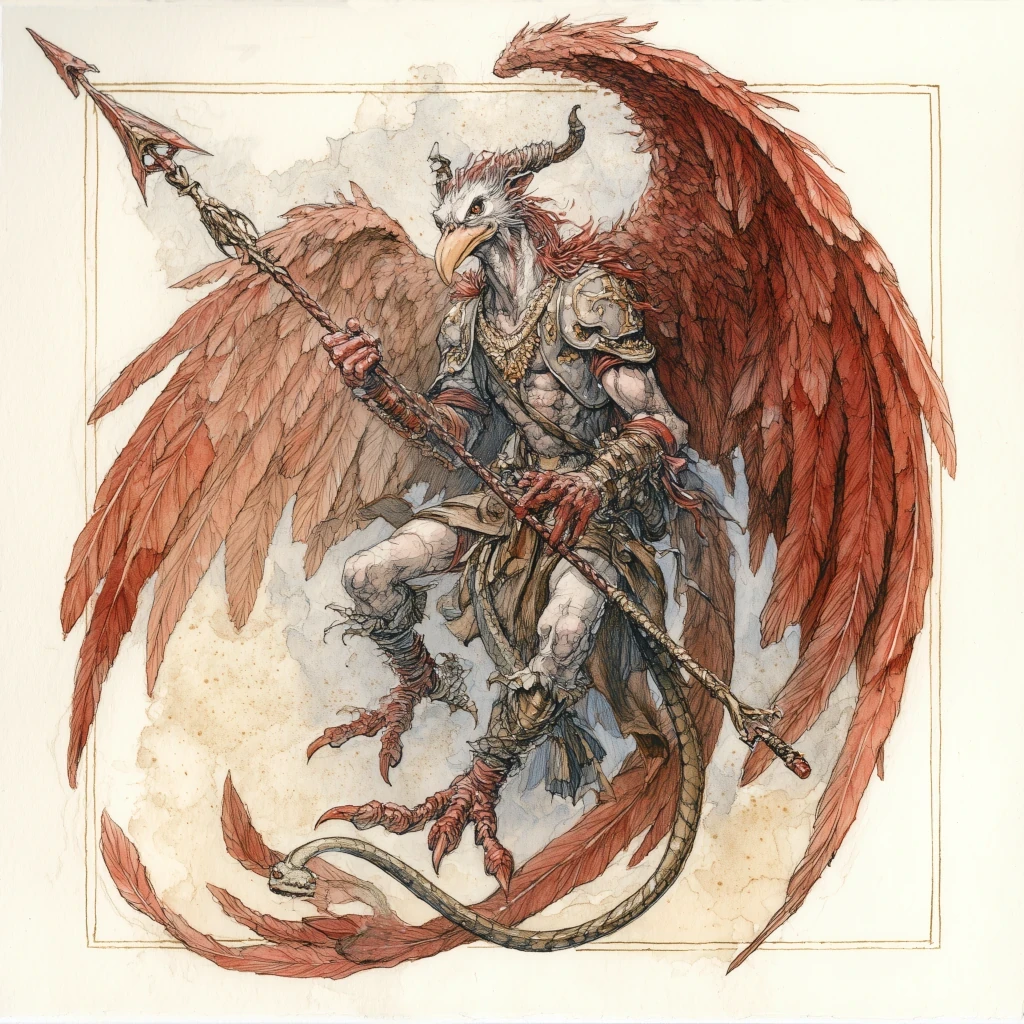
Pazrael; Ghlaunder; Prince of the Lower Aerial Kingdoms. CE planar obyrith lord of temptation, pestilence, harpies, the Abyssal skies [he/him]
Pazuzu, once counted among the Anunnaki of the Mesopotamians, reinvented himself as the Demon Prince of Corruption and now claims undisputed lordship over the Abyssal heavens. He’s staked his name on the Plane of Infinite Portals, Pazunia, and the perilous 503rd layer, Torremor—but also claims ownership of the steel-gray skies of Nether. This four-winged obyrith-turned-demon lord abstained from the primordial War of Law and Chaos, forging uneasy alliances with yugoloths and even archdevils like Zariel to manipulate infernal politics. His insidious creed, the Temptation of the Lesser Evil, preys on the virtuous by granting miraculous “gifts” that foster dependency and slowly erode moral fiber until his victims betray their own souls. Pazuzu delights most in leading heroes into acts of cruelty, for the souls of corrupted cutters apparently taste so much sweeter.

The Anunnaki in Brief
| NAME | PORTFOLIO | REALM | PRONOUNS | ALIGNMENT | POWER LEVEL |
|---|---|---|---|---|---|
| Allatu ‡ | Determination of fate | Nether / Kur / Timri Eže | She/Her | LN | Demipower |
| Asag ‡ | Cold; sickness | Abyss / Unknown (dead / reforming?) | He/Him | CE | Abyssal lord |
| Belet-seri ‡ | Judge of the Netherworld | Nether / Kur / Irkalla / Ganzir | She/Her | N | Psychopomp |
| Birtum ‡ | Shackles | Nether / Kur / Arali / Kur-Banûtu | He/Him | LE | Velstrac |
| Dumuzid | Shepherds; agriculture | Nether / Kur / Arali / Kur-Banûtu (half of the year) | He/Him | N | Demipower |
| Erra ‡ | Drought; mayhem; pestilence; political confusion | Nether / Kur / Arali | He/Him | LE | Demipower |
| Geštinanna ‡ | Prophetic dreams; Recording the names of the deceased | Nether / Kur / Irkalla / Ganzir | She/Her | LG | Demipower |
| Humuṭ-tabal ‡ | The ferryman of the Mesopotamian Underworld | River Styx | He/Him | NE | Marraenoloth |
| Išḫara ‡ | Oaths; underworld; love and passion; marriage; divination; plague; springs; wells; water; scorpions; hydra | Nether / Kur and Elemental Water | She/Her | CN | Lesser |
| Laṣ ‡ | Medicine; war | Gray Waste / Oinos / Nergaltos | She/Her | N | Demipower |
| Lugalirra & Meslamtea ‡ | Divine twins who guard the gates of the underworld | Nether / Kur / the Gates of the Dead | He/Him | NE | Demipowers |
| Mamitum ‡ | Frost; ice; judging of the dead | Nether / Kur / Kutha / Crystalline Palace | She/Her | LN | Demipower |
| Naram-Sin ‡ | Fallen god-king | Nether / Kur / Arali | He/Him | NE | Petitioner |
| Neti | The gatekeeper in charge of the seven gates to Ganzir | Nether / Kur / Gates of the Dead | He/Him | LN | Demipower |
| Ninazu ‡ | Underworld; snakes; snake bites | Nether / Kur | He/Him | NE | Lesser |
| Ningikuga ‡ | Reeds; medicine; care for petitioners | Nether / Kur / Kutha / Palace of Reeds | She/Her | LG | Demipower |
| Tadmuštum ‡ | Proxy of Nergal | Nether / Kur / Arali | She/Her | N | Demipower |
Allatu

Allatum, Allani, The Weaver of Fate. LN demipower of destiny [She/Her]
The fate goddess of the Mesopotamian Underworld and also the Persian Pantheon, Allatu is something of a thorn in the side of the Anunnaki—although they don’t realise this yet. She’s the power who determines the fate of mortals, but she’s particularly interested in those who she thinks don’t deserve to spend all of eternity in the miserable Underworld. From Timri Eže, the Palace of the Gate of the Dark Earth, she secretly spirits away cutters she thinks merit better, sending them to more pleasant afterlives, right under the noses of the Anunnaki. To do this, she works with the psychopomp judge Belet-Seri, and the underground rilmani railroad network Sanctuary of Spire. Chant goes she likes to manifest as a tout named Allani, to offer cutters she likes—or pities—subtle help to survive the many dangers of the realm.
Asag

CE Abyssal lord of cold and sickness [he/him], dead/vestige
The fiend Asag was said to be so hideous that his presence would boil fish alive in rivers. He was defeated by the power Ninurta with Sharur, a magical talking mace. However this merely banished the spirit of the vile creature to the Abyss for 1001 years. Shattered fragments of the fiend’s body broke off and found their way the Plane of Earth, where they possessed dozens of earth elementals. These creatures, who all call themselves Asag, caused enough trouble that most of them were also banished by elemental sorcerors and genies. Chant goes they are starting to gather, drawn inexorable towards the deep Abyss and their originator. The vestige of Asag is reforming slowly but surely, and he’s close to being strong enough to menace the planes and seek his revenge again.
- Dragon Magazine #334 p37-38 (stats for the asag earth elemental fiend)
Belet-Seri

N Yamaraj psychopomp [she/her]
Belet-Seri is a yamaraj psychopomp who usually manifests in a humanoid form. She serves the court of Ereshkigal as a judge of the Netherworld, recording laws, decrees and the machinations of the Anunnaki. For half of the year, Belet-Seri is joined by her consort Geštinanna when she replaces her brother Dumuzid—although with the huge backlog of petitioners that builds up after Geštinanna’s absence, the couple get to spend less time together than they’d like.
Birtum

Sovereign of Shackles. LE vincuvicar velstrac [he/him]
Husband of Nungal the Goddess of Imprisonment, Birtum is an exiled vincuvicar velstrac who calls himself the Sovereign of Shackles. Less forgiving than his wife, she’s put Birtum in charge of punishing petitioners who try to escape Kur. It’s a job he is fanatically fond of, especially when his favourite prisoner Dumuzid comes to pay his regular yearly visit. He is the cutter responsible for the ‘innovation’ of the Sixty Miseries, which are a plague of many diseases which are simultaneously visited upon the unluckiest petitioners. Another nasty trick of Birtum’s is to let shades loose from the Underworld to visit and terrorize the living back on the Prime. He’s only permitted to do this if the relatives of the deceased fail to observe the mandated funerary rights—but the rules are complex and easy to mistake, so Birtum is kept pretty busy with this too.
Dumuzid

Dumuzi; Tammuz. N demipower of shepherds and agriculture [He/Him]
Sumerian power of light, shepherds and agriculture, and the Gatekeeper of Heaven, Dumuzid [dum-OOZ-id] was the first consort of Inanna. However, following her death, descent to the Underworld, and subsequent return she judged that he’d not mourned her sufficiently, and sent gallu demons to drag him to Kur as her replacement. She regretted the decision later of course, and decreed that instead he must spend half of each year in the Underworld, and the other half of the year with her in Baator. This is the reason for seasons on the Prime—when Dumuzid ‘dies’, this is when the hot summers bake the land. He’s a handsome cutter, but resigned to his eternal fate. Chant goes he’s not well treated at all when he’s imprisoned in Kur-Banûtu. The jealous Ereshkigal, still angry at Inanna getting the better of her, takes it out on the poor sod.
- Dragon Magazine #016 p4
Erra

The Plague-Bringer. LE demipower of drought, mayhem, pestilence, political confusion [He/Him]
One of the minor powers in the court of Nergal, the deeply unpleasant Erra the Plague-Bringer [EH-ruh] is in charge of destroying humanity by any means possible. Unfortunately (for him, not humanity) he was bound by strict rules by the powers of the Dingir that prevent him from entering the Prime and wreaking havoc—so long as the correct prayers are spoken. The few times the mortals forgot to do this have been costly for them; Erra kills indiscriminately, striking berks down by plague or blade. Each time he’s been repelled by the correct prayers eventually, but he’s getting more efficient in his strikes and perhaps the next time he’ll be even more successful. He spends his time stalking the streets of Kurnugi, dispensing dark wisdom about war, pestilence, and the gentle art of civilisational collapse, while champing at the bit to be let back into the Prime to practise what he preaches. Some say that Erra is really Nergal in disguise, although recent sightings of both simultaneously in different parts of Kurnugi have scholars and fiends alike questioning the nature of their Lord’s identify more openly than ever.
Geštinanna

The Scribe of the Dead. LG demipower of prophetic dreams, language and duty [She/Her]
Geštinanna [gesh-tin-ANNA] is the Sumerian power of prophetic dreams, language and duty, and during the long hot summer she perform those duties for the Dingir. However, like her brother Dumuzid, she too is bound to the Underworld. When Inanna send Dumuzid down to replace her, without the god of agriculture, the world quickly became barren and infertile, the crops failed and mortals began to starve. Dutiful Geštinanna quickly realised that if her brother was imprisoned much longer, all of humanity would die. So she did the noblest thing, and offered herself in his place for six months of the year. It was a hard sell at first, for Ereshkigal enjoyed the company of Dumuzid, and since he’d been there record numbers of new petitioners were arriving. However, Geštinanna made her realise that without proper records of the names of the souls, it was getting harder for the bureaucracy of death to keep track. Geštinanna was the power of language too, see, so she offered to teach the judges of the Underworld how to use cuneiform to record the names of the dead. Ereshkigal agreed, and so for half of the year since then Geštinanna replaces Dumuzid, her brother gets to return to the Heavens, and the crops can grow again. It might seem like a raw deal for Geštinanna, but it’s not all bad. In the Underworld she met the psychopomp Belet-Seri, and the two became a couple—although with the huge backlog of petitioners that builds up after six months of absence, the pair get to spend less time together than they’d like.
Humut-tabal

NE marraenoloth (he/him)
The marraenoloth responsible for ferrying all Mesopotamian petitioners who need to use the River Hubur to reach Nether, Humuṭ-tabal [hum-MUT-TAH-bahl] is a busy cutter. Unusually for merraenoloth, his skiff is crewed by a pair of stone golems which, while badly weathered with age and damaged from scuffles with unwilling passengers, are nonetheless efficient oarsmen. While he is not permitted to talk to petitioners, with the pilots doing all the work Humuṭ-tabal has plenty of time to regale any mortals he encounters with tales of adventure. At great length, the marraenoloth will tell listeners about how he and Gilgamesh completed all sorts of heroic tasks back in the day. The chant goes he is the power of the rivers and canals of the Lower Planes, and technically a power of the marraenoloths themselves. Graybeards point out though that a true yugoloth would never debase itself by worshipping a deity, and therefore Humuṭ-tabal is effectively no more than a particularly overworked marraenoloth with a very large chip on his shoulder about it.
Išhara

CN lesser power of oaths, the Underworld, love and passion, marriage, divination, plague, springs, wells, water, scorpions and hydra [She/Her]
Beautiful but mysterious, Išḫara [EE-shah-rah] is a complex and chaotic goddess of almost a dozen disconnected areas of interest. So far, she’s a power of oaths, curses, love, passion, marriage, divination, plagues, springs, wells, water, scorpions, and hydra. Something of a jack of all trades, she seems unable to focus on one divine duty at a time, instead throwing herself into whatever takes her fancy at that moment. Fortunately for her, she’s able to master new skills quickly, and her bizarre portfolio has expanded to encompass many disparate topics. The other powers of the Anunnaki regard her fondly, seeing her as too chaotic to be a threat to them—but the fact is she’s picking up worshippers faster than any of them and growing in power accordingly. She’s also one of the few powers of the Anunnaki who’s also part of another pantheon, as Išḫara is also a member of the One Thousand Gods pantheon of the Inner Planes. Oh, and chant goes she’s married to the Abyssal Lord Dagon as well, just in case all that wasn’t enough for you. She’s a darling of the Believers of the Source, at least what remains of them, who see her impressive portfolio as evidence of divinity being shaped by intent, if a blood has the right kind of attitude.
Las

N demipower of medicine and war [She/Her]
Laṣ [la-SS] is a wise power of healing, especially in times of war, and the second of the primary wives of Nergal. Until his marriage to Ereshkigal, Laṣ was his favourite wife—but following a series of unfortunate incidents between the two of them, Laṣ now resides primarily in Nergaltos on the Gray Waste. The chant goes that Laṣ has the unique ability to persuade fierce Nergal to show mercy to mortal supplicants. It’s this rare mediating function that’s made her beloved of worshippers who need someone to soften the mythic wrath of the Lord of Death. It was apparently Laṣ who convinced Nergal to spare the life of Naram-Sin, and make use of him as a cautionary tale instead.
Lugal-irra & Meslamt-ea

NE demipower twins who guard the gates of the underworld [He/Him]
Lugal-irra [loogle-EAR-uh] and Meslamta-ea [mez-LAM-ta-AY-uh] are the twin wardens of the Gates of the Dead, born of Nergal’s blood and tasked with standing perpetual watch over the thresholds of the underworld. Always ready, clad in iron-studded leather and horned bronze helmets, each carries a wicked studded mace in one hand and a sacrificial dagger in the other—Lugal-irra strikes fear into any shade that dares stray, while Meslamta-ea drags stubborn spirits back to their fate. Though twins in visage—broad-shouldered, grim-faced, with eyes like smoldering embers—they differ in temperament: Lugal-irra broods in silent menace, relying on dread as his weapon, whereas Meslamta-ea moves with lightning speed and agility. Together they ensure that no soul slips past the dark gates of Kur once they have been committed.
Mammitum

LN demipower of ice, judging of the dead [She/Her]
Mammitum [mam-EE-tum], the ancient Ice Queen of Kutha, is the most emotionally distant of Nergal’s three wives. She rules with frosty detachment from her stronghold in the burg above the deeper realms of Kur. While Ereshkigal commands the shadowy depths of the Underworld and Laṣ offers mercy and intercession, Mammitum governs the frozen bureaucracy of death itself. She oversees the processing of doomed souls with emotionless precision, never allowing sentiment to cloud her judgment or warmth to crack her icy demeanour. Her Crystalline Palace in Kutha serves as the administrative hub where the newly arrived petitioners are catalogued, sorted, and dispatched to their final destinations down below in Kur. It’s a task she performs with the same emotionless efficiency whether handling a former beggar or an ex-king. The Ice Queen seemingly shows no rivalry with Ereshkigal, and no jealousy toward Laṣ—such feelings would require the capacity for emotion, which she abandoned eons ago in favor of perfect, glacial order.
Naram-Sin

Fallen god-king. NE human petitioner / Believers of the Source [he/him]
This blood’s story is long indeed—as a great conqueror of his prime world, he became a god-king, and declared himself King of the Multiverse and God of his home city. This was, of course, not to last. Naram-Sin wanted to continue his glorious campaign of conquest, but there was nothing left to conquer, other than Heaven itself. So the hubristic Naram-Sin declared war on Heaven for the sake of his own pride, greed and vanity, swearing he could take on the pantheon’s leader, Enlil. There was of course no fair fight, no real battle—only slaughter. Enlil sent his mightiest, most loyal servants to remind the mortal of where he stood. But the mere death of their god-king wasn’t enough for Enlil, so he ordered his servants to not only put Naram-Sin’s city to ruin but to erase it from History itself. Now Naram-Sin spends his time in Arali, where he warns outsiders of the dangers of angering the gods. He is unable to remove his tarnished crown or his regal clothes, which have become torn and dirty over many years, making him look bedraggled and pitiful.
Neti

Nedu; The Gatekeeper. LN demipower [He/Him]
Neti [netty] is the final sentinel at the threshold of Kur, at the Underworld’s greatest Gate of the Dead, whose very name means “Open!” Ever-watchful in the flickering glow of the gate’s flaming hinges, Neti is a towering beast with the head of a lion, the taloned feet of a giant bird, and human hands that clutch an iron staff. Cloaked in shadow and silence, Neti never speaks except to intone a single command of admission or denial. His glowing amber-eyes miss nothing that approaches the gates. As the Great Gatekeeper he is tasked to ensure that no shade may escape and no living soul may enter the Underworld unbidden. In incantations meant to bind restless spirits, his name alone carries the power to wrench them back through the gates. The chant goes he’s eternally impartial, and unmoved by pleas or bribes, which means challenging him in combat is possibly the only way to get past him. But they also say every cutter has their price. Perhaps nobody’s offered the right garnish yet.
- Dragon Magazine #016 p6
Ninazu

King of Snakes. NE lesser power of the Underworld, snakes and snake bites [He/Him]
Ninazu [nin-AH-zoo], the King of Snakes, once reigned over the Underworld, perhaps even as it’s original ruler. Now, it’s unclear whether he’s the son or the consort of Ereshkigal (although knowing the powers it could well be both). Ninazu appears as man with the head of a black dog—an ancient omen of death—flanked by a couple of snake-dragons known as mushussu. These days he’s rarely seen, and thought to lurk in the deepest parts of Kur, brooding and plotting.
Ningikuga

The Lady of Life and Death. LG demipower of reeds; medicine; care for petitioners [She/Her]
The Lady of Life and Death Ningikuga [NING-ee-koo-gah], dwells in the Palace of Reeds, woven from dried pampas grass. It floats on the River Huber, and is the first thing petitioners see when they arrive in Kur to start their afterlives. An accomplished physician and medic, Ningikuga heals any ailments that petitioners might have died from and her convent of catrina psychopomps soothe the newly dead, providing them with fresh clothing and clean water. She ensures that the souls have the best possible start in their afterlives, perhaps through a sense of guilt, for it is all downhill from here. The petitioners then file into the burg of Kutha where they are catalogued and processed by the bureaucracy of death.
Tadmuštum

The Mournful; Proxy of Nergal. N demipower of melancholy [She/Her]
Tadmuštum [tad-MUSH-tum] is a shadowy princess of the Underworld, and the daughter and divine proxy of Nergal, and she serves as overseer and reluctant caretaker within the House of Dust. She manifests as a pale, regal figure shrouded in mourning veils, crowned with black poppies and carrying a staff of night-blooming reeds. Her eyes are solemn, reflecting endless sorrow, but never despair. Tadmuštum’s role in Arali is to maintain order among and provide solace to the dead while her father is away. She rules over the mournful caverns of Arali with a firmness she’s clearly inherited from Nergal, but it’s tempered by her own melancholic acceptance of fate. Unlike the more savage powers in the Anannake who revel in torment, Tadmuštum’s definitely one of the more empathic. Her philosophy holds that every soul, no matter how ruined, deserves to face oblivion with dignity. Whether she really wants to be a proxy of Nergal or not, she bears the burden of her lineage with grace. Only rarely does she unleash the destructive rage inherited from her father—but when roused, her anger is quick and devastating.
A Who’s Who of the Underworld Anunnaki


Realms of the Anunnaki




Source: Jon Winter-Holt. Mythwatch: The Underworld powers of the Anatolian, Sumerian and Babylonian pantheons have an extremely high degree of overlap, so I thought it made sense to combine all of the powers of the dead and turn the Anunnaki (literally the ‘former gods’) into a shared pantheon of the Underworld. The word ‘Anunnaki’ has meant different things at different times over the millennia—it originally referred to all the children of An and Ki, but later came to refer to the Underworld gods specifically, and that’s the meaning I’ve chosen to use.
I’m not sure if it was intentional or not, but shouldn’t this be part of the Power list on the top?
Fixed! Thanks for catching 🙂
Allani’s entry is missing – also not sure she should really be a separate entity from Ereshkigal. Might fire you an email 🙂
Well spotted – Allani is the Hurrian another name for the Akkadian goddess Allatu (aka Allatum) — I’ve added the alias now. I understand the earlier mythology had Allani and Ereshkagal as separate beings, becoming linked later. More powers is more interesting than fewer, so I went with that, especially as you get some interesting tension and plot opportunities if Allani is a non-evil power in a Lower Planar Underworld.