[ Smoke > Burgs > Slaan ]
[ Ancestries | High-Ups | History | Locations | Religions | Services ]
Slaan
Location: Para-Elemental Smoke / Core Smoke / Slaan
CHARACTER: There are many ways to describe a city—glowing poetry, epic histories, great paintings perhaps—but to describe the lizardfolk burg in the Para-Elemental Plane of Smoke a single word suffices: Slaan. The locals seldom get more descriptive than that, and it turns out “slaan” doesn’t even mean anything, either in Planespeak or Draconic, the prevailing languages in the city.
Slaan is a teeming place, possibly the busiest place in all of the Inner Planes short of the Cities of Glass or Brass—and that’s saying a lot. It’s certainly the busiest place on the para- or quasi-elemental planes, and only the city of Hoard on Mineral even comes close to matching its mortal population and trade output. The place is busy—all day, every day, kind of busy. There are things traded here that don’t pass through any other market in the multiverse.
All planewalkers pass through Slaan—eventually.
—Planewalker saying
INTRODUCTION: So why should a city filled with bitter lizardfolk be one of the largest hubs of trade in a whole elemental cosmos? Well, there are a bunch of reasons.
First, Slaan’s habitable. That’s kind of a rarity on the Inner Planes. Sure, on most Outer Planes you can put a city just about anywhere and the populace should still be able to breathe. But things just don’t work that way in this part of the multiverse. Slaan takes care of that. The city is stable in one location (if that means anything in a giant cloud of smoke), and even better, it provides clean air and a stable food and water supply. If you can get yourself to Slaan, you probably won’t die there, at least not from the environment. The city is rather hot, and parts of it burn like a desert or are fetid as the worst swamp you’ve ever visited—but a body can deal with those problems. A body can’t always deal with the scorching heat of the City of Brass.
That leads nicely into the second point about Slaan: The Genieban. Genies, whether they are djinn or efreet, dao or marid, kizidhar or zuhra—or even jann—aren’t allowed into the city’s confines, on pain of immediate expulsion and possible death. Chant goes the ban was originally enforced to assert the city’s independence over battling armies of efreet and djinn, and only got extended to the other genie races later. Kiidhar and zuhra were only added to the list recently when the planes of Wood and Metal re-emerged. No one knows quite how the residents manage to keep the ban enforced, since the genies have got numbers, strength, and wishes on their side. Slaan doesn’t have a patron like the Lady of Pain either, but the city must have some protector, or the city would have been conquered long ago. Anyway, the genieban makes it possible for cutters to visit a Inner Planar burg that’s not dominated by the genies, who are limited to sending proxies and stooges (and boy do they ever). Couple this with the ambivalence of the Smoke para-elementals to mortal goings-on, and you actually get a city in the Inner Planes that’s not run by any of the elemental types. It makes a big difference, believe me. If you don’t, try just you try visiting the Citadel of Ice and Steel one day and see how that goes for you.
Third: Location and portals. Okay, so perhaps the Plane of Smoke ain’t on everyone’s top ten list of “places I need to visit”, but it turns out that it actually is a pretty good location to have a city. Smoke’s not all that hard to move around in, and with protection from toxic vapours, it’s quite survivable as Inner Planes go. The constant war between djinn and efreet brings in business too, even if the genies can’t enter the burg themselves. Furthermore, Smoke is relatively distant from Earth and those sodding dao slavers. And finally, within the Smoke, Slaan is one of the few pieces of solid ground. Turns out Smoke has a serious shortage of solid pockets, so there’s little to build upon. So if a berk wants to stop falling forever here, Slaan is a good place to land. The portals help too. There’s not that many of them, but Slaan has stable connections to some important destinations: the City of Glass, Hoard, the illithid burg Yuhnmoag in Ooze, the Adrift City of Steam, and even the Great Dismal Delve. There are some newer portals as well—recently, some top shelf bloods have established a portal to Farer’s Freehold, and Taifun among others places. So from Slaan, you can easily get to just about anywhere, even the Prime.
Finally, there are the primary inhabitants. Sure, not everybody likes lizardfolk, and most cutter like khaasta, troglodytes, and kobolds even less—to say nothing of the other strange races that reside here. For their part, the lizardfolk are far more tolerant, and don’t seem to have a problem with all the visitors that come through. They’ve even taken steps to enforce a set of laws and to keep commerce in some semblance of order. Sure, locals keep some of the levels of the burg to themselves, but they also provide employment for outsiders doing things like patrolling the water supply, or investigating the runes on the outer walls. They also run basic crafts and are willing to export food they grow, something almost nobody else does in Smoke. All in all, the lizardfolk population, relatively uninterested in outsiders as it is, exerts a stabilising influence in Slaan that keeps the burg from falling apart.
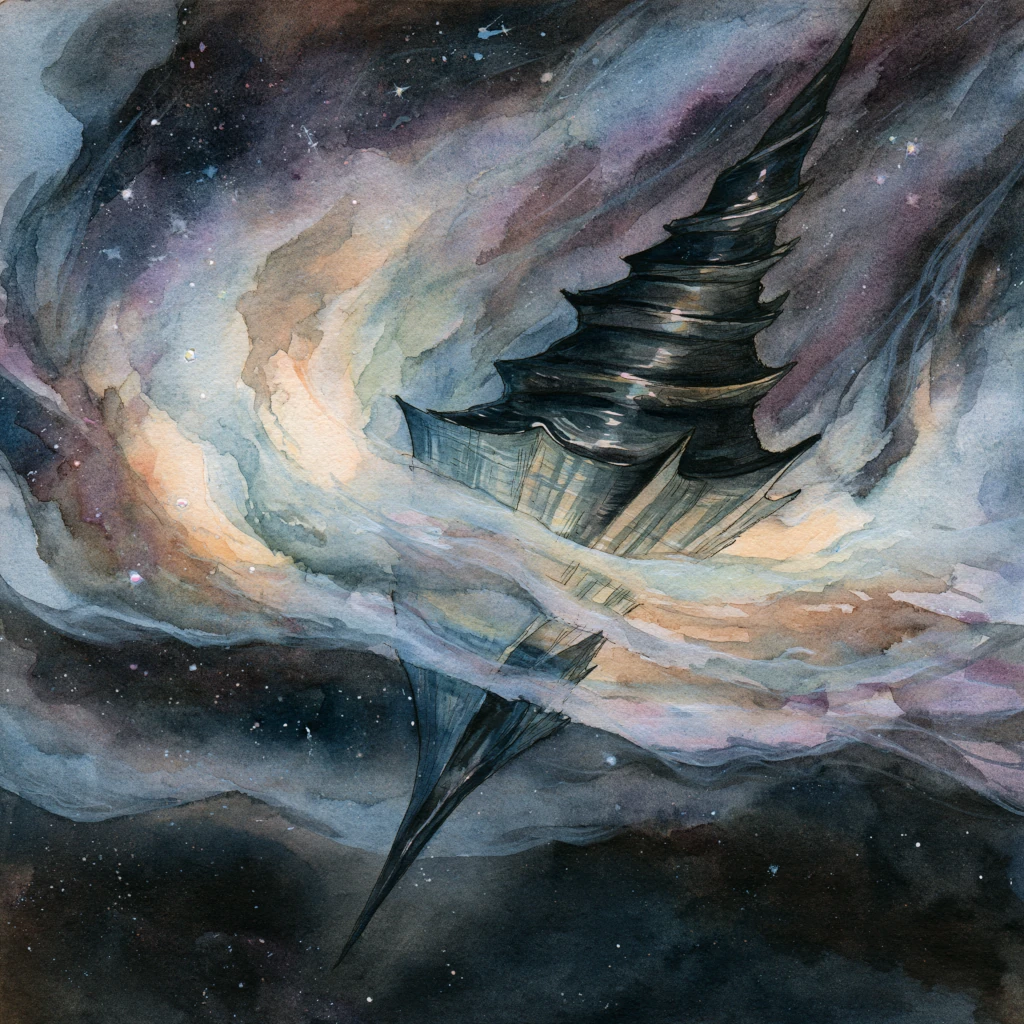
DESCRIPTION: This is where things get tricky. See, Slaan might not be as impossible as some burgs out there in the multiverse, like Sigil, Malsheem, or Regulus—but it might just be more complicated in structure than just about anywhere else. The chant goes something like this: Slaan is a shell made of Elemental Mineral, with most of its outer walls sliced off and replaced with glass. Sound complicated? It is. Most people looking at the city for the first time can’t quite figure it out. Slaan is shaped precisely like a spiral shell, specifically a cerith shell, except the mineral part of the shell is only on the inside. On the outside surface everything’s been replaced by glass. Sure, it has been stained black by all the soot and smoke, but it’s still glass—extremely thick, hard glass that is virtually impossible to break. The burg is organized into six levels which do not necessarily correspond with the swirls of the spiral, for each level is defined by the inhabitants and the prevailing microclimate. Generally the climate becomes more temperate as you move upwards from the portal to the Plane of Water at the bottom of the structure, though there are exceptions.
Within each level Slaan is organised in a helter-skelter fashion, with buildings arranged every which way. There is some system to it all, at least in the lower levels, but it’s mostly a chaotic jumble that makes little sense even to permanent residents. The city’s vertical nature has resulted in buildings piled up on top of each other in multiple levels and catwalks everywhere. Several levels have a high water content, and combined with the soil packed onto the mineral base this results in literal bogs, especially as no water can drain downward—indeed it is channelled upward through capillary pipes in the spiral structure.
The easiest way to conceptualize Slaan is to try and unwrap it, so that the city lines up around a single central thoroughfare, called the Spiral Road. While this tends to break down in the lower levels, especially the Warrens, the rest of the city lines up reasonably. The topmost section, called the Mouth, particularly chaotic due to its odd structure, complete with airship ports and floating factories.
Outside of Slaan’s sootbaked glass walls lies a veritable maze of cables, lines, and wires, all festooned with unusual creatures. These are the aerial farms, which interact with the smoke outside the burg to produce the majority of its food.
The lowest layer of Slaan is called the Depths, and it’s completely flooded by an upwelling from a vortex to the Plane of Water. Nothing lives down here, and the place is kept clean as it is the burg’s createst asset. The next level up is called the Warrens—a maze of compacted earth and tunnels, and populated mainly by xulgaths and kobolds, who occupy the lowest rung in the city’s hierarchy. The third and fourth levels, called the Marsh and the Boggylands respectively, are the home to mainly lizardfolk and khaasta. The Marsh is mostly a residential level, while the Boggylands represent the industrial and administrative centres of the city. Level five is a surprisingly hot realm called the Blacksands, and serves as a home for firenewts and the burning desert lizard races, in all their variations. The topmost level is the opening of the vast shell iself, and is called the Mouth. This is Slaan’s centre of commerce, and the realm where outsiders are generally welcome.
See also: A deep dive into Slaan’s six layers and some of the many sites that can be found in them. Get the chant here…
Conditions in Slaan
UP AND DOWN: Most of the Inner Planes have no gravity, and this can make building and moving about in cities something of a problem for those who can’t fly. Slaan however, does have established gravity. No one quite knows how it was accomplished, but gravity always pulls down along the axis of the shell, towards the waterspout at the very bottom tip. This means that everything generally works out as it would on a normal world, albeit one with a lot of stairs. Outside of Slaan’s shell there is no gravity, so cutters using gates around the structure are warned to take that into account. Similarly, in the mass of floating feeders, there’s no gravity either, but the concentration of mass here is thick enough that it’s like moving about in water, and a cutter can always find some surface to push off from. That’s if a cutter’s not squeamish about having the stuff touch ’em.
DAY AND NIGHT: Now here’s a funny thing. On a plane that’s dark all of the time except when a body creates their own light, Slaan is never truly dark. For starters, there’s always at dim red light that issues from the mineral of the shell itself. This dimness persists for about fourteen hours, and then grows brighter for ten, gradually peaking at the middle of Slaan’s “day.” It never gets really bright though, and the city has no other major light source. The lizardkin, used to living in dank bogs or underground, prefer it this way, but planewalkers might find it unnerving, since the light never gets above about a third of a sunny day on the prime. As a result of this short “day” Slaan operates late into the “night” and many residents don’t bother to care about the light level. It’s standard practice to supply other light sources to work by whenever needed.
WEATHER: This is an artificial environment; see, in an infinite expanse of Smoke. It doesn’t have anything that could be considered weather. That being said, the lizardfolk tend to make it a practice to flood certain areas of the third and fourth layers, and the desert like fifth layer occasionally swarms with violent swirls of sand because of the air currents there.
The city is always hot, everywhere, and generally moreso towards the top. The Mouth’s temperature is somewhat moderated by the baking heat of the fifth level, thankfully, or the place would be entirely unsuited for humans and many other races.
BUILDING MATERIALS: Slaan has nothing to build internal structures with. It may have had such things at one time, made of the mineral the place was carved from, but it doesn’t anymore. So everything has to be imported. The generally philosophy along these lines is why pay too much. So the city is actually made heavily of mud. Not ordinary mud, admittedly, mostly transplanted portions of the Paraelemental Plane of Ooze baked hard by exposure to the smoke to form a sort of black brick or adobe. The buildings are built according to lizardfolk style, which generally means small round structures as personal homes, or according to the taste of the builders for large objects. Many of the architectural styles draw heavily from the efreet or djinn in this aspect, though others are modeled after the cinders of the Belkers or other strange beings.
The Warrens layer, just above the water, is organized quite differently. Aside from Spiral Road, the whole level is filled in with Earth, which the troglodytes and kobolds tunnel into, creating a vibrant cavern system, parts of which occasionally collapse and have to be replaced by new diggings. The desert level also lacks many large buildings, with the many stacked dwellings of the desert lizard races packed against the glass walls tightly. Building there is almost exclusively of baked ooze, though that whole level is lined with cinder to increase the temperature and create black sand to cover everything.
See also
ANCESTRIES: A look at the many races of lizardfolk, their kin, humanoids, and outsiders who call Slaan home. Get the chant here…
HIGH-UPS: The rulers of the burg and other influential cutters. Get the chant here…
HISTORY: The tale of how Slaan came to be. Get the chant here…
LOCATIONS: A deep dive into Slaan’s six layers and some of the many sites that can be found in them. Get the chant here…
RELIGIONS: An overview of the many cults and priesthoods of the burg. Get the chant here…
SERVICES: A rundown of services on offer in Slaan, from the criminal to the legitimate. Get the chant here…
Source: Inner Planes [2e] p13 (brief mention), expanded upon by Mechalich, edited by Jon Winter-Holt. Canonwatch: ‡ The expanded details for this location are homebrew and were rescued from the dead-booked Planewalker.com site.