
[ Smoke > Burgs > Slaan ]
[ Ancestries | High-Ups | History | Locations | Religions | Services ]
Religions of Slaan
Location: Para-Elemental Smoke / Core Smoke / Slaan
The Inner Planes are hardly the most religious of locales, and the Para-Elemental Planes even less so. Smoke has only a handful of resident powers, and most of those are shrouded in mystery. So you’d not be too surprised to learn that a cosmopolitan and bustling place like Slaan is hardly a hotbed of religiosity. There are however a few churches and shrines, and three (known) underground faiths. The churches can be found in both the Boggylands and the Mouth. They’re able to influence city politics on certain issues, especially if they manage to rally any significant number of cutters behind them. The most popular faiths in Slaan tend to be ethically neutral powers, since they appeal to a broad spectrum of locals.
The Draconic Pantheon
Slaan’s most powerful churches belong to the ancient dragon gods, a fact that often seems to surprise visitors to the city. Once a planewalker realises through that the first language of the burg is Draconic, and that many of the resident reptilian races have no gods of their own, this makes more sense. The dragon gods are ancient and powerful, and worshipped proactively by lizard-kin of all ancestries here. They are also linked closely with the mighty centres of their faith in the draconic city of Hoard on Mineral. The burning desert lizards are especially devoted to these mighty and aloof powers, but even the khaasta appreciates the strength and directness of a dragon god. The churches themselves are not very proactive in proselytising. The faiths of Io and Chronepsis rare the most commonly worshipped deities, but since they are powers concerned with the nature and fate of the multiverse, they tend to expect followers to find their own place in it. The churches of Io and Chronepsis get along well with the Druids, the city’s next most powerful faith, and also with the rilmani. They rarely take a stand in politics unless there is great danger for their worshippers.
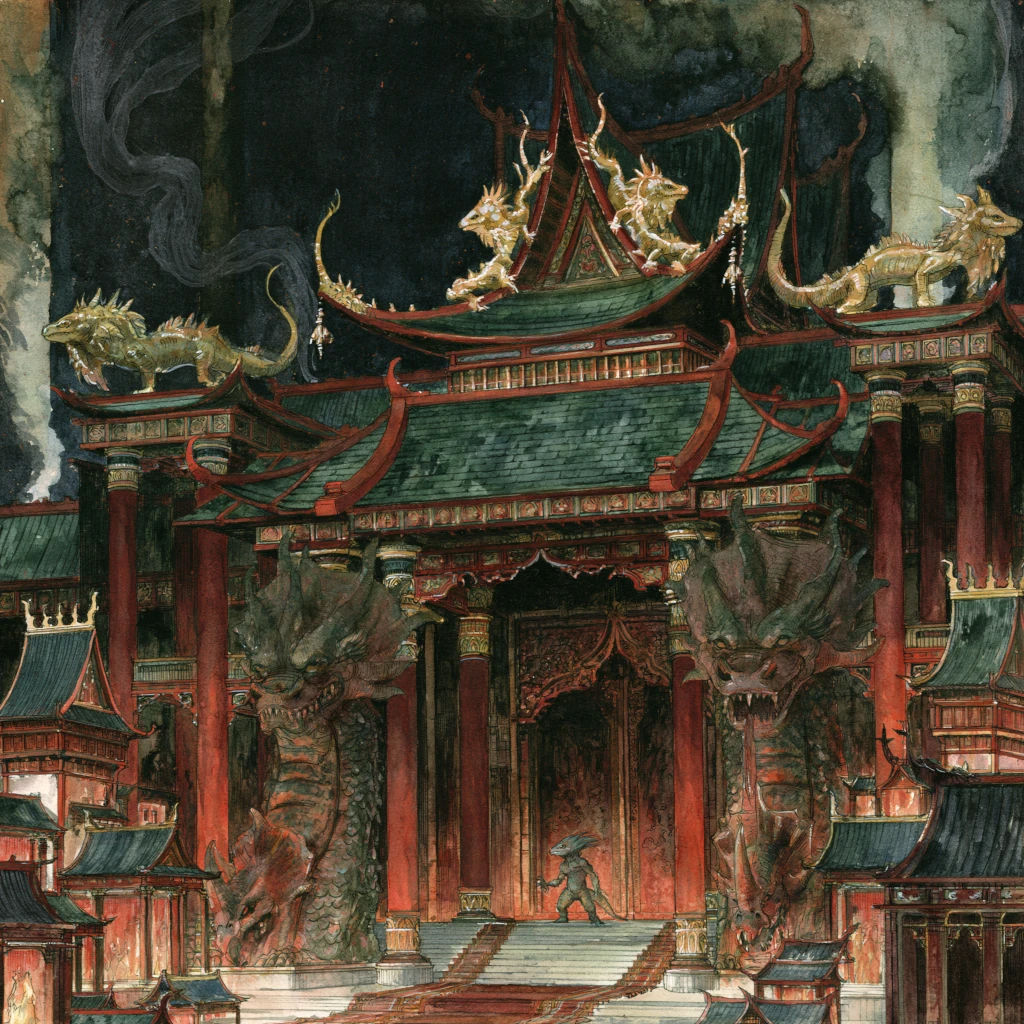
IO: The high priest of Io is a native of Slaan, Gershal Nersel (half-crystal dragon lizardfolk cleric [he/him] N). He is an aged cutter who stands like a rock as the turbulent sea of smoke moved around him. He’s concerned with the welfare of all, and that ‘his’ city remain strong. His clerics preach solidarity, to guard against threats from the outside, and to hold fast to allies who share your blood.
CHRONEPSIS: The high priest of Chronepsis is not a Slaan native, but in fact a scel from Quasi-Elemental Dust, Jenmos Kler (scel cleric heirophant [he/him] / N). His faith is one of watchfulness and quiet concern for others. The judgment of souls comes only at the end of life, he says, but one should live in acceptance and prepare for this fate. The clerics of Chronepsis have only one enemy, the Cult of the Reaver Falazure, who threatens the continuity of all that is—and they work tirelessly trying to rid the city of that faith.
TEMPLE: Io’s House of Dragonkind is a broad, grand temple in the Mouth, while the smaller, but still impressive All Scales Stand of Chronepsis is located in the Boggylands. Both temples can hold thousands of worshippers, and are filled to capacity at important ceremonies—mostly the deaths of key city figures, or celebrations of major victories for Slaan. The temples are constructed in the swirling tower style imported from Hoard, and were constructed with the aid of mighty elementals and dragons.
The Druids
While the Druids might lack the history and potency of the dragon gods, their faith is the most prevalent in Slaan, found as it is among all populations and races, from the most cringing of kobolds to the richest elgar duelists. While Smoke represents a particularly inhospitable form of Nature, it is nonetheless a natural element, and the druids celebrate the precarious balance of mortal life amidst the Smoke. There is faith to draw upon here, especially among the farmers of the exterior, and among the pogdrac, a lizardkin people who count a significant number of druids among them. The compassionate philosophical balance that is practiced by the pogdrac clergy have made them popular with the locals, even those who do not follow the Way of Nature. The prevalence of pogdrac within the Ministry of Religion is secure, and supports the druids amiably. Secure in this position the druids exert a subtle influence to stable Slaan against the sort of sweeping religious trends common in so many other places on the planes. By being balanced they prevent radicalism.
HIGH PRIEST: The archdruid of Slaan is Rela (pogdrac druid [she/her] / N). The majority of the city’s druids are pogdrac, though iruxi, xulgath, moloch’phrynn, and dact druids are also common. The druids work quietly in the city, aiding the farmers, the Ministry of Water, and generally looking out for the health of the population. Many leave the city frequently, mindful that the environment there is artificial, usually to parlay with the mazuku ruvoka.
TEMPLE: The druids have no single temple, though they have constructed a ‘temporary’ (despite being thousands of years old) grove in the Blacksands, as far from traffic as possible. Their faith is highly dispersed throughout the city, celebrated in tiny shrines and groves in the homes and gardens of the faithful rather than grand buildings.
Ptah the Opener of the Way
The Ethereal power Ptah is commonly called the ‘planewalker’s god’, and indeed the Opener is well suited as a guiding light in dark places, as he opens doors to unexplored corners of the multiverse. Popular with cutters who pass through Slaan regularly, and especially with etherfarer traders, Ptah has a rather smaller following among permanent residents. While thechurch of Ptah is too restrained to try and poach worshippers from other faiths, they are looking further afield to spread their good word. As more beings travel the Inner Planes the church seeks to build a power base and promote a power considered in some circles to be a neglected, forgotten god. Ptah is particularly popular among the non-reptilian residents of Slaan who do not identify with the draconic powers.
HIGH PRIEST: Lady Hala Brightglaze (aasimar nephilim cleric [she/her] / LN) is the First Opener in Slaan. She has few subordinates, the most important being a group of nathri siblings who all work as clerics of the faith. The priests and other temple folk keep mostly to the Mouth, so they can keep their ears to the ground and pick up the latest chant from planewalkers passing through the burg.
TEMPLE: The Open Door is a small temple in the Mouth, a great hall whose large windows are designed to make use of Slaan’s dim light as much as possible, supplemented with many magical lighting devices as well. It cannot hold a large congregation, perhaps three hundred at most, and has only a few other antechambers. It abuts the temple of Lao Tzu.
Semuanya
In a city of lizardfolk one might expect that their creator power would be among the most powerful of faiths, and worshipped with great fervour. This is not in fact the case in Slaan. Semuanya, the creator of lizardfolk and power of survival has only a small following here, and it seems to be fading more as the years pass. Distant, uncaring, and too primal for the educated and successful lizardfolk of Slaan, the survival god has fallen from favour and been replaced by druidic nature worship and the draconic gods. Nevertheless, a number of iruxi, particularly the city’s poor and destitute, still worship Semuanya, perhaps hoping for his aid in the struggle of life. This faith is also relatively strong among helod and elgar lizardfolk, who seem to prefer the more savage Semuanya to the decadent dragon powers.
HIGH PRIEST: Greal (iruxi heirophant cleric [she/her] / N) is a powerful priest of Semuanya from the Prime world of Toril. She’s been on the planes for several years but settled only recently in Slaan. Her faith in the god of survival is incredibly strong and she greatly outranks all her subordinates. The helod and elgar parishioners appreciate her severe view on life and her “one step from desperation” speeches. Her leadership has not increased the faithful in number, but it has increased their fervour. Chant goes that Greal is the most powerful cleric in the city, of any power.
TEMPLE: The Bog Cathedral is located at the centre of the Boggylands, amongst the great municipal buildings. It is a great artificial swamp, enclosed within a wall of stone. It was built long ago, perhaps even in the original settlement of the city, and could easily hold ten thousand within its muddy confines—though few apart from lizardfolk are likely to feel comfortable in its ankle-deep muddy water.
Lao Tzu
This Chinese power of mystic insight who resides in the Ethereal has a small, but not insignificant following in Slaan. Affiliated with nature as well, the god has a following among the more mindful of planewalkers, and especially dact and moloch’phryn lizard-kin. A reclusive god—like all the Chinese powers—this member of the Celestial Bureaucracy has only the most slender of ties to Slaan, but his faith do occasionally step in to settle disputes of a magical nature, and judges of mystic duels consult with the priests of this faith. A few of Slaan’s more powerful wizards are also members of this faith, since no other god of magic has real presence here.
HIGH PRIEST: Herest the Quiet (moloch’pryn cleric [he/him] / LN) is the high priest of Lao Tzu, and is renowned for speaking as little as once a week, and even then rarely saying more than is absolutely necessary. His clergy consists of only one other priest and four initiates, all of whom are humans. They rarely intervene in outside affairs, as they struggle to keep their small faith stable.
TEMPLE: The Chamber of Contemplation is really nothing more than a single room; the priests must rent lodging elsewhere. The room is quiet and open, and is designed to hold only a few dozen cutters in floor spaces and alcoves, where they can contemplate the multiverse and seek insight.
Laogzed
The Great Eater, demipower of the xulgath, can be considered to have not so much a faith as a stranglehold on the xulgath of the city. The city has not banished worship of the Eater because in the past when they tried so many xulgath flocked to the worship of Falazure instead. Instead, worship and ceremonies to the All-Consuming Hunger go on in the depths of the warrens, where the xulgath eat the city’s dead to bring themselves power. It is unsavoury in the extreme, but worship is ostracised and common among only the poorest of the troglodytes even in the Warrens. Only xulgath and kobolds worship Laogzed, and only out of site of others. This power has suffered from a long slow loss of worshippers to the druids, much as Kurtulmak of the kobolds did previously (the kobold god is no longer worshipped in Slaan). It seems that eventually the worship of Laogzed is likely to go the same way, but for now the faith remains a real danger for berks who venture into the Warrens.
HIGH PRIEST: The worship of Laogzed is not nearly so organised to have any leadership. The few adepts and shamans who cast his spells and praise his name roam about in the Warrens searching for sacrifices and food. They rarely get along with each other, and try to keep worshippers to themselves.
TEMPLE: There is no organised site of worship for Laogzed, though several of the larger xulgath caverns have shrines in his honour.
The Hidden Faiths
These cults are formally banned by the Council of the City, and condemned by all upstanding citizens of Slaan. They’re responsible for many of the dark whispers that work to destabilise the city from the shadows. Officially, membership of any of them is punishable by years of hard labour, and active participation in cult rituals, by death. Despite this, these cults have never gone away, indeed, they often grow many tendrils of manipulative power—at least until they overreach themselves and are driven back into hiding once again. The cults of Slaan generally avoid fighting amongst themselves. This is not to say they’re allies, but they recognise that collectively enough enemies without needing to combat each other as well.
Falazure the Reaver
The oldest and most powerful of the cults of Slaan is also the most feared—worship of the undead dragon reaver Falazure—he who eats dragon souls. His promise of unlimited foul powers and eternal existence (through undeath) appeals to many. And then there are those who don’t follow the Reaver of their own will who are cowed into serving him through fear, or force. The night dragon’s power has continuously grown over the years, enough that the Church of Chronepsis is forced to consider him a threat to the continuity of the draconic life cycle. The Cult of the Reaver meets in dark places and sacrifice any berk they can lay their hands on, re-animating them as horrid servants of undeath. The Cult is particularly popular among the more brutal xulgath, helods, mon’varan, and elgar, who consider Falazure’s offer to escape life’s struggles a great reward. They have links to many of the criminal enterprises of Slaan, and most of its darkest practices have them at the source.
HIGH PRIEST: The current High Priest of Falazure here is Raslay (half-shadow dragon human cleric heirophant [she/her] / NE) a villainous woman who has positioned herself solidly in charge of the faith. All members of the Cult know the absoluteness of her will. She’s not a native of Slaan, but has lived there for many years. She never leaves the Warrens unless she’s forced to. She’s said to consider Falazure the parent she never had, and is decidedly mentally unstable. She is however also both shrewd and vicious, and possesses a frightening charisma that has drawn many to the Reaver’s worship.
TEMPLE: The Mausoleum of Black Vapours is a mobile temple constructed from illusions that is conjured up in darkness of the Warrens once per week. Its size and location changes regularly, but the Cultists seem to always be able to find the place. Cutters who do not follow the Reaver should expect no less than the destruction of their souls should they happen upon it accidentally.
Merrshaulk
Serpentfolk who live in Slaan, and the poor sods they’ve managed to bind into servitude, revere Merrshaulk, the snake god of the yuan-ti. Though the number of faithful is small, and few of the yuant-ti are priests, the dark god has gained a foothold here. The priests of this poisonous power have lured many helod to his service, and have managed to position servants in key positions in the slave and drug trades of Slaan. Yuan-ti influence in the slave trade blends in with the proxies of the dao so closely that it can be hard to determin which masters many of the slavers even serve. The faith of Merrshaulk is only loosely united at best, with many of the followers serving the power only for their own selfish purposes, unwilling to advance the cause of the faith as a whole. However, the Cult of Merrshaulk has been behind several of unsuccessful yuan-ti efforts to insert servants into the city council and take possession of pieces of it by force.
HIGH PRIEST: The greatest secret of the Cult of Merrshaulk is that the secretary to the yuan-ti ambassador is their high priest. This cutter, a pureblood named Frossha (pureblood yuan-ti cleric [he/him] / LE) is among only a few purebloods to rise so high. Frossha is cunning and keeps his religious activities well hidden. Not even the ambassador knows his true identity.
TEMPLE: The yuan-ti have no temples or shrines, but hold their secret meetings in all sorts of hidden places. The mobile slave market of the Warrens is one of the most common and secure for them, so they tend to hold large meetings there. They may also occupy a shrine of Laogzed for their rituals—assuming the xulgath priests accept the garnish, or bow to the threats.
Sess’innek
Last, and least, of the cults of Slaan is that of the Abyssal lord Sess’innek. Worshipped only by the most depraved and power-hungry of the lizardfolk, the cult is tiny and its power mercifully limited. There are no lizard kings in the city, so no one shaman has yet been able to capitalise and charge of the worshippers. Nevertheless, there are lizardfolk who hear the Abyssal Lord’s dark voice calling, and seek to bring forth domination and destruction in his name. The cult’s activities are therefore conducted on an individual level, or at most a small group of zealots. Despite their low numbers however, the Cult of Sess’innek has been able to indulge in orgies of destruction before. While this is the least dangerous cult in the city by numbers, it is the most hated, and the most guarded against. Any indication of either a lizard king entering the burg, or of an open gathering of the servants of Sess’innek is ruthlessly put down. This cult’s chief goal, beyond its own survival, is finding a way to corrupt the xantu. Thankfully, this seems an unlikely prospect.
HIGH PRIEST: This group is too individualised to follow any single leader—at least in the absence of a lizard king—and standing among them is determined only by personal power, usually through secret duels.
TEMPLE: Nothing physical exists in the Abyssal Lord’s name. The city watch is too tight, and Sess’innek’s servants to few tofor them to have even household shrines.
Source: Inner Planes [2e] p13 (brief mention), expanded upon by Mechalich, edited by Jon Winter-Holt. Canonwatch: ‡ The expanded details for this location are homebrew and were rescued from the dead-booked Planewalker.com site.
Slaan isn’t actually a homebrew location, according to Mechalich it’s from a one off line from The Inner Planes, “Slaan, a glass-covered lizard man burg in the para-plane of Smoke (chant says it was built by something other than lizard men, but no one knows what)” it’s on page 13 1st/2nd paragraph, he just added to it
Yes that’s right, I’ll make the blurb more clear, thanks 🙂