[ Wood ] [ Mapping Infinity | Pockets | Bestiary | Flora ]
The Elemental Plane of Wood
The Eternal Forest, the Fractal Forest
Philosophically the element of Wood represents—naturally!—growth and flexibility, but also connection and interconnected complexity. All of the other elements can exist on their own (well, except perhaps for fire), but wood’s structure needs to be properly ordained and nurtured by water, earth and air in order to thrive. If you grind a log into sawdust, you can’t just stick it back together, berk! Wood is immensely complex, which is perhaps the reason why it took graybeards so long to realise it was truly an element. At some point wood was believed to be merely a demiplane, where all four of the elements had been mixed into a living form and animated by Positive Energy. While now we know this isn’t true, it is theorised by many elementalists that Wood and Metal are presently still misaligned in relation to the energy planes. Metal is closer to Negative Energy, and Wood to Positive. Whether this is a natural order of things or something that’s been brought about by planar calamities, remains to be seen.
Physical Conditions
SUBSTANCE: The elemental realm of Wood is an endless thicket of intertwined tree trunks and branches, big and small. These boughs are made of different wood types, some common like oak or pine, some rare like peachwood and sugi, and some utterly alien to Primes. Strangely enough, they all grow out from and into each other, and form a joined-up system of branches, despite being completely different species (although, of course, it isn’t unknown for plants to accept grafts from other species, even on the Prime). These are living trees with bark, sap, resin, heartwood and all other attributes of a plant. It isn’t exactly clear where the nutrients for maintaining such biomass actually come from, although it seems obvious they’re at least partly supplied by the leaves of the Canopy and the Forest of Roots near Earth. Regardless, branches grow with incredible speed here, and small traumas to the plane are very quickly healed.
GRAVITY: The plane has localised gravity—any sufficiently large tree trunk has its own gravitational tug, which allows cutter with a good sense of balance to walk along its twists and turns without much trouble.
AIR: Forests are associated with fresh air, but in the Plane of Wood it’s only half-true. The Canopy is obviously full of refreshing wind (in some places the air can even be too fresh—be careful with fire up there) and Flowerboughs, while known for its choking pollen, are not too bad as well. But in the rest of the plane things get more complicated. Sure, the plane isn’t as impenetrable as Earth, so you have some air, but this air is stale and exhausting to breathe. See, it’s the leaves that refresh the air, but deep in the Eternal Forest there are fewer leaves, and more stems. And while they don’t refresh air, they do breathe themselves, consuming far more air than adventurers do. It’s especially bad in the Leaf Litter, where constant rotting also burns away precious oxygen. All that said, there are still some leafy plants deep in the Wood, especially around pockets and portals, so the breathable air doesn’t run out entirely. But still, some bottled breaths can go a long way.
LIGHT: Once again, the Canopy and Flowerboughs are awash with soft light that feeds plant life, while other regions are much darker. Still, the wood itself does emit a bit of light, and glowing lichens and mushrooms also help, altogether creating an impression of everlasting dusk. Epiphytic plants, mosses and beautiful dark flowers are adapted to such low-light conditions and constitute most of the flora down there (if you don’t count the giant tree branches that is). Another way to survive for the plants is to parasitize, plunging roots into the flowing sap beneath the great tree’s bark. In fact, quite a lot of the smaller branches in darker places may turn out to be parasitic plants such as mistletoe. Unfortunately, some of those plants aren’t satisfied by sap and must supplement their diet with minerals from elsewhere—hence the large amount of carnivorous plants in this grimly harmonious realm.
Advice for Planewalkers
Don’t flaunt open fire without absolute necessity. It is feared by all wooden creatures, which obviously invites animosity. And even ignoring that—the fire also burns away oxygen, and your supply of that isn’t unlimited. The same goes for bladed metal weapons. Metal is anathema for Wood, and wearing unsheathed swords, or especially axes, is unsettling to all forest creatures.
Be wary of getting lost. Few visiting creatures can phase through wood, so you’ll most likely have to walk along the treetrunk, which can curve in ways that would make even an experienced ranger lose their mind and their path. I swear, these blasted Inner Planes do something with the space! Or with the head… And if you lose your way, don’t even bother to turn back—any path you carved through the thicket grows over in a few days, if not hours. The best way I know to map your path is to get a dozen of those steel spikes for disarming traps. Drive them into the wood as you go—it would take a lot of time for a tree to expel or absorb them. Of course, if any intellegent wood elemental notices this… you may as well wave a sign with fiery letters saying “put us in the dead-book”. Chant goes, the ruvoka have ways to weave three-dimensional maps from twigs, and use them to navigate. If you want to take this route, don’t forget to ask them how to read these maps, because they sure don’t look like anything you can navigate without knowing the dark of how it works.
Or you can use the spell like one with plants. It is very handy for travel inside the trunk—but even then there’s a catch. See, if you merge your body with the giant plant, you have to negotiate with all the wood spirits that are already there – and the Elemental Plane of Wood has them in spades. They are not always aggressive or territorial, but, well, they communicate with each other completely differently from what a humanoid might imagine, so a great deal of knowledge and charisma is needed to go past them.
The Empires of Oak
- Arboreal Copses tend to their realms in quiet observation, often so well disguised that unobservant planewalkers could walk right through their realms without knowing they had company.
- Dryads and many other nature-loving fey weave beautiful wild gardens.
- Wildens, harvest regimens, thorns and other braver fey and wood elementals forge alliances to protect the plane and launch attacks on potential enemies.
- Kizhidars reshape wood to craft immense palaces of incredible beauty and complexity. Unlike other genies, they don’t have an organised system of government. Instead, each kizhidar builds their own palace and fill them with sycophants and admirers.
- Wood elves, forest giants and volodni make their own little realms, trading between each other.
- Adu’ja live as nomads, making constant piligrimage to various corners of the plane.
- Vrskava ruvoka build communities around rare and mystical trees and branches that they swear to protect.
- Evil creatures of a despoiled nature, from blights to splinterwaifs, work with surprising coordination to undermine the entire plane and spend the Blightlands far and wide
The Laws
With no plane-spanning government there are no universal social rules for the plane, beyond the generally accepted etiquette that use of fire magic and axes are taboo.
In terms of the nebulous arcane laws that govern magic itself, plant and wood magic is enhanced on the plane. Magic that draws on naturally-occurring poisons (plant-based, rather than based on chemical or void effects) are also enhanced. Magic based on the element of metal is less effective here, as the two planes are in opposition. [In game terms, neither 5e not PF2e systems have hard-coded effects of magic from travel to Inner Planes. Suggested rules for AD&D 2e are below]
AD&D 2e Magic Rules
Alterations to wizard schools are as follows:
- Diminished (<) Fire (outside of the Canopy), Metal — these spells as if cast by a caster of one level lower than the caster’s actual level, and spells higher than 4th level cannot be cast at all.
- Enhanced (+) Wood, Plant — these spells are cast as if the caster was one level higher, and the target of the spell suffers a –1 penalty to any saving throw.
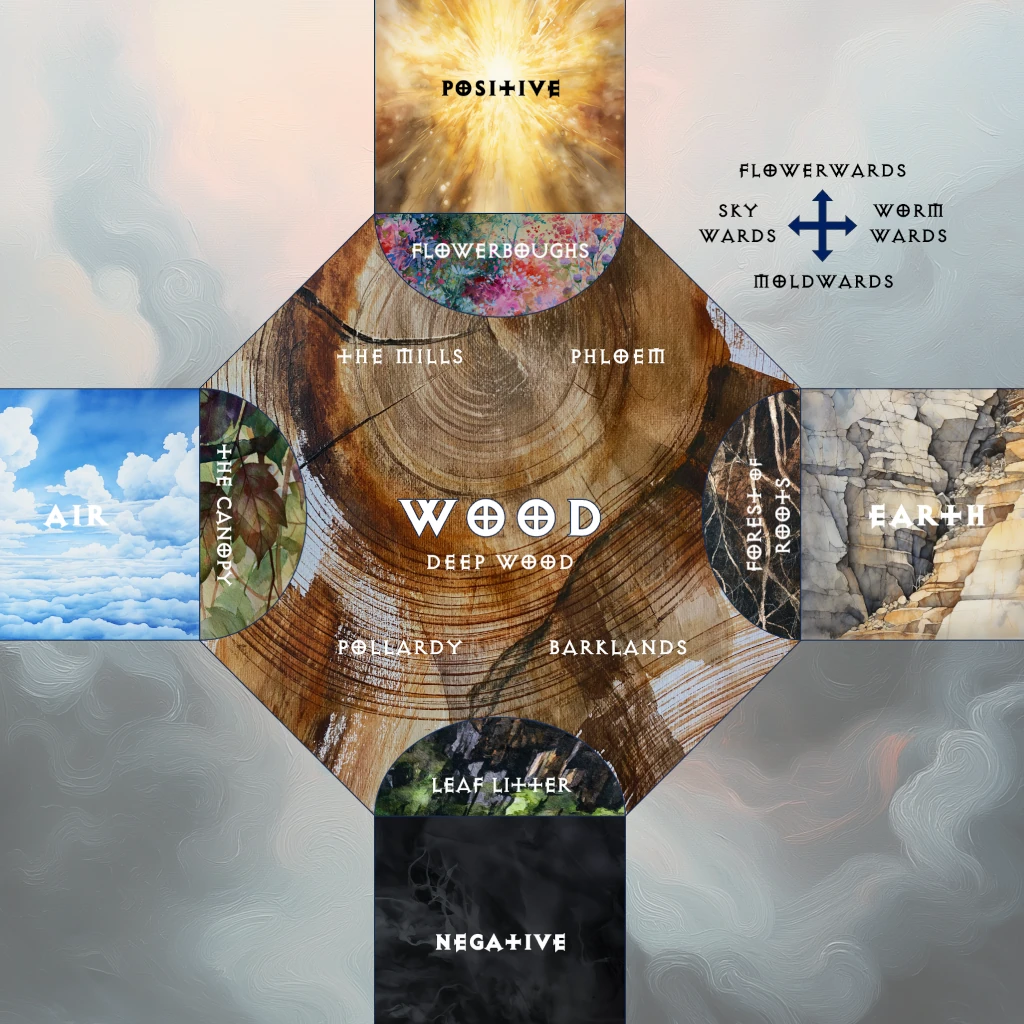
Mapping Infinity — Wood and its Environs
- Core Wood ‡
- Barklands (region of deep canyons and gorges) ‡
- A labyrinthine region where colossal trunks have thickened into cliff-like formations of living bark, creating a landscape of deep canyons, vertical gorges, and sheltered microclimates within the furrowed flesh of trees so vast their surfaces form lands unto themselves.
- The Mills (region of deforestation and lumber) ‡
- A scarred industrial wasteland where the Planar Trade Consortium’s logging operations have clear-cut ancient fractal forests for profit, filling the air with choking sawdust and the screams of dying trees while wood elementals wage a desperate guerrilla war against the axes that devour their kin.
- Phloem (region rich in natural saps and oils) ‡
- The vascular heart of the plane, a vast network of glowing sap-rivers and oil-lakes where fluids pulse through living channels, sustaining the plane’s ecosystems.
- Pollardy (region of coppiced wicker and living sculpture) ‡
- A region where willows and bamboo grow in dense stands that are coppiced and woven into living architecture—cities, bridges, and homes.
- Barklands (region of deep canyons and gorges) ‡
- Deep Wood ‡
- The plane’s mysterious centre, a solid, continuous block of Heartwood where all kinds of wood are twisted and knotted together into an impenetrable mass.
- Canopy, the (border with Air) ‡
- The skyward border region of ever-thinning branches and dense leaves that simply ends when the endless sky looms above it.
- Forest of Roots (border with Earth) ‡
- The earthward border region, a three-dimensional maze of massive roots intertwining with rich loamy soil, where the Great Barrier of Soil marks the gradual transition from living wood to solid earth.
- Flowerboughs (border with Positive) ‡
- The life-ward border region, an explosion of floral abundance where every surface blooms in impossible colours, pollen storms choke the air with reproductive clouds, and the vitality of existence becomes dangerously ecstatic in its excess.
- Leaf Litter (border with Negative) ‡
- The deathward border region of spreading entropy where sap turns black and corrosive, leaves fall and rot with supernatural speed.
Wooden Places
- Blackmire (realm of the archomental Murgremir; Leaf Litter) ‡
- Murgremir’s fetid realm in the Leaf Litter, a vast swamp of decomposing sludge where sentient oozes, fungal colonies, and slime molds thrive in the muck, embodying the philosophy that all life is just future compost in the eternal cycle of death-feeding-new-growth.
- Blightlands (scattered regions across the plane) †
- Scarred regions of the plane corrupted by the aeons-old poison of Ayrzul’s blight, where the sap has turned black and corrosive, leaves wither to ashes at the touch, and the wood seems to recoil from life. These are zones of dead and poisoned wood that spread like cancerous growths through the Everforest. Berks who enter these areas without powerful protection risk contracting the Blight themselves, a wasting disease that causes flesh to crack and flake like diseased bark, their blood to thicken into black sludge, and their bodies to slowly transform into twisted, blighted forms before death claims them only to regurgitate them back as blightspawns. Even with protection, the Blightlands are treacherous, as the poison lingers in the air, wood and water. The only safe passage is through carefully maintained corridors purified by ardande wood elementalists who patrol the borders, pruning away infected growth and containing the spread at terrible cost to themselves.
- Rage of Elements [PF2e] p190–194
- Burl Imperfect (burg in the Barklands) ‡
- A kizidhar burg where the trunks have grown into massive, gnarled swellings—living burls of twisted grain and dense, figured wood that embody the plane’s capacity for flawed beauty. Their swirling patterns create a labyrinthine settlement of organic chambers and spiral passages that grow with the slow, tumorous expansion of the town itself.
- Chaff (burg in the Mills) ‡
- Chaff is a beleaguered vrksava ruvoka burg in the Mills region of Core Wood, downwind from where the Planar Trade Consortium’s relentless lumber harvesting fills the air with a choking blizzard of sawdust and wood-chips. These days, the place embodies the bitter residue of industrial exploitation. The settlement of shanty structures has been built from waste-wood and scrap, where the inhabitants breathe in the dust of their dying kin and their skin is perpetually coated in the dry, splintered tears of the forest. The vrksava refuse to leave this place, and are preparing themselves for the inevitable confrontation with the woodcutters. Chant goes they are assembling a small army of ambush copses to defend the burg.
- Cloud Forest (area of the Canopy) ‡
- The Cloud Forest is a region suspended high the Canopy occupied by arboreals who dwell among the dense, mist-drenched leaves. Here the winds blow in from Virga in the plane of Air, creating an ethereal environment of permanently fog-kissed treetops, where the boundary between wood and sky blurs in the vapour and aerial roots.
- Coppice Cottage (realm of Verilorn in Pollardy) ‡
- The Coppice Cottage is the little-known home of the wood archomental Verilorn. While he is the architect of many of the huge tree-cities of the plane, his little-known actual home is a modest dwelling of twisted living willow and hazel nestled within perfectly tended gardens where every plant has been pruned with mathematical precision, each hedge clipped to geometric perfection, and every row of vegetables neatly aligned. Verilorn’s sanctuary embodies his philosophy that true mastery of Wood lies in the patient, reverent act of shaping life into perfect forms.
- Compost Pits, the (site in Leaf Litter) ‡
- A region where organic matter accumulates and decomposes with supernatural speed, creating pools of hyper-fertile slurry that can heal wounds and accelerate growth—or corrupt flesh and sprout parasitic vines, depending on how they’re used. These steaming, nutrient-rich bogs are inhabited by myconid colonies that harvest the slurry, shambling mounds that regenerate endlessly in the fertile muck, compost oozes that digest matter into pure life-energy, and dasanu, colonies of necrotic fungi animate the skeletons of cutters unlucky enough to get put in the dead-book here bu the other denizens.
- Court of Transcendence (realm of the archomental Shumunue; the Canopy) †
- This is Shumunue’s grotto-sanctuary, where the Carved Lady of Mimicry transformed a realm of immobile plants into a vibrant ecosystem by teaching the flowers and leaves to mimic animals. She created the first wooden insects, mammals and birds, all delicately carved and then granted the gift of motion. Her realm erases traditional boundaries between plant and animal, and new animated life-forms still emerge from her ongoing experiments in carpentry, camouflage, and the artistic recreation of life in wood. The Animated Garden is the only part of Shumunue’s abode accessible to planewalkers. It’s sanctuary that aspiring sculptors and mimicry artists dream of entering. Each year, a single artist is allowed to enter and work here for one cycle, and after this time Shumunue visits the garden to breathe life into a creation of her choosing. Many of these awakened sculptured have become new species of the plane.
- Rage of Elements [PF2e] p191,194
- Crypts of the Tuber Lords (site in the Forest of Roots) †
- A hollowed-out maze within the Forest of Roots, consisting of an interconnected network of caverns inside a dense root system. Six greedy lords once ruled over vast wealth they had accumulated from trade and tribute—until Ayrzul’s blight reached even this deep refuge. In desperate panic, the Tuber Lords collapsed the cavern entrances, but this futile attempt failed to seal out the corruption. Now the tunnels are guarded by blighted residents—twisted, diseased creatures who jealously protect the allegedly massive hoards of their departed rulers, their minds utterly warped by poison.
- Rage of Elements [PF2e] p191
- Decidua (region of the Canopy) ‡
- A burg of arboreals uncommon in the Canopy for undergoing true seasonal cycles—its inhabitants burst forth with lush green leaves in spring, blaze with autumn colours, then shed their leaves, huddle together, and enter dormancy in winter. This phenomenon is caused by the settlement’s precarious location where cold winds blow in from the para-elemental Plane of Ice, bringing frost and the transformational rhythm of seasons that most Wood-dwellers never experience.
- Dragonfruit (site of Flowerboughs) ‡
- This weird orchard is a place where the boundary between dragon and plant dissolves entirely—the fruit that grows here does not merely resemble dragon eggs but actually contains draconic essence. Each piece of fruit holds magic that awakens when the fruit is consumed, temporarily transforming the eater into a dragon or granting them draconic features like wings, claws, or breath weapons. The groves themselves are tended to (and guarded by) harvest dragon leshies, strange creatures that are related to gourd leshies. The fruits fetch a great price in the markets of Sigil and the City of Brass.
- Battlezoo Leshy Dragons [5e |PF2e]
- Evergreen Plains (region in the Mills) †
- The Evergreen Plains are a vast region where the branches of the fractal forests have gives way (or been harvested) to leave endless carpets of fir needles that grow horizontally across the great trunks in dense mats like grass. Here, herds of wooden bison thunder across the plain, while vrksava ruvoka nomads follow their migrations, living out of wagons whose wheels are bent from living branches. At night the entire plain glows faintly, as the wood-grass releases the day’s stored sunlight in a soft, green radiance that makes the Evergreen Plains look like a carpet of emeralds.
- Rage of Elements [PF2e] p191 (brief mention)
- Florid Riot, the (realm of the archomental Corbicula; the Flowerboughs) ‡
- Corbicula’s realm in the Flowerboughs is a kaleidoscopic explosion of colours and scents that shift with the viewer’s emotions, releasing pollen that induces ecstatic visions and causes the air to shimmer with visible waves of euphoria that ripple like heat haze. Here, the boundaries between senses dissolve into synesthesiac bliss—flowers taste like laughter, colours feel like silk, and the scent of blossoms can trigger memories so vivid they manifest as enticing floral mindscapes that can trap an unwary berk inside, potentially forever.
- Forest of Faces (site in Deep Wood) †
- This eerie place is home to some of the most ancient trees of the plane. Their bark resembles grimacing, screaming or smiling humanoid faces. Some trunks bear a single massive visage, others are carved with thousands of countenances that move throughout the wood, apparently following berks with their fixed, unblinking gazes. Cutters are drawn by an inexplicable urge to enter this place, but the few who’ve returned have been forever changed by the experience—and refuse to speak of what transpired.
- Rage of Elements [PF2e] p191
- Fractal Forest (area in Core Wood) †
- The Fractal Forest is the dominant landscape of much of Wood’s core, where trees branch into smaller trees in perfect self-similar patterns that seem to repeat infinitely. Planewalkers who venture too deep into the Fractal Forest report losing their sense of scale entirely, unable to tell if they are walking among colossal trees or tiny twigs, as the recursive patterns blur the boundary between the vast and the infinitesimal.
- Hinted at in the Rage of Elements [PF2e] p191,193
- Kernel of Life (site in Deep Wood) ‡
- The Kernel of Life is a secretive vault of seeds hidden in the Deep Wood. Established in a rare ancient hollow trunk that has been carefully lined with a thick layer of enchanted lead, it houses countless numbers of seeds—chant goes there are samples from almost every plant species from across the multiverse. Each is preserved in an amber resin pod that hangs from the ceiling like a constellation of glassy fruit. They have been collected by the Seedwardens, an order of kizidhar who took a sacred oath after witnessing the devastation of the Blightlands, to ensure that no plant species would ever go extinct—even if the multiverse itself should fall. The Seedwardens work in secret alliance with nature deities across the multiverse—Silvanus, Ehlonna, Chauntea, and the elven power Rillifane Rallathil—who have all contributed seeds and blessings to the Kernel as a cosmic insurance policy. When entropy comes to claim the multiverse, the plan is the Kernel will remain as an ark of life’s potential, waiting for the day when the seeds can be scattered anew across a healed cosmos.
- Kolobo Rainforest (area in Phloem) †
- This particularly moist part of the plane is high in trees which produce kolobo oil, a viscous tree sap that is a key ingredient in salves to protect vegetation from Aryzul’s Blight. It doesn’t reverse the effects of the sickness, but it can reduce the symptoms in infected plants.
- Rage of Elements [PF2e] p192
- Laurel Labyrinth (site in the Pollardy) ‡
- A well-pruned hedge maze of impossible scale, with tunnels of living laurel that rising tens of feet high and stretch across miles. Cutters who enter are tested on their ability to surrender to the maze’s fractal logic, to become part of the pattern rather than try to reason their way through. Walkers of the paths report seeing vague faces in the dense foliage, and that the maze tends to grow closed behind them as they travel. Chant goes the labyrinth likes to pose riddles, and guides wanderers depending on whether they solve them—or become another lost soul absorbed into the green walls forever. Its inhabitants are laurel dryads who are the only beings who can step through the foliage at will. Topiary golems, originally created by Shumunue, shape from the hedges and patrol the corridors, and mahogany minotaurs, wooden constructs with bark-hide and flowering branch antlers, hunt cutters who try to damage the laurels.
- Mycelial Web (planar pathway, realm of Hederax) ‡
- The realm of the archomental Hederax, and a planar pathway woven from countless fungal threads that stretch across the Plane of Wood like a living nervous system, connecting the Leaf Litter, the Forest of Roots, Core Wood, and even distant border regions of neighbouring planes through a vast underground network. The hyphae carry both nutrients and information, memories, and chant goes, the consciousness of the archomental lord themself, allowing messages to travel instantaneously across the plane. Planewalkers who know the proper ritual can step into one thread and emerge from another half a plane away. Cutters who journey through the Web report visions of the entire plane as a single organism, being able to briefly see the flow of life and death through the network, and hearing the echoes of countless dead-booked creatures whose corpses have been absorbed by the mycelium.
- Nodollin, the Glowing Infinity (city of Core Wood) †
- The largest city on the Plane of Wood, Nodollin is a series of connected burgs grown within the trunk and branches of a single colossal jammjuree tree. It is enormous, rivalling even Sigil in population. Each branch-burg specialises in a different craft, and are connected by the Arbor, a system of wooden clockwork lifts, gondolas and trams that transports non-flying visitors between the different branch-burgs. A group of peace-keepers known as the Pollards ensure that order is maintained, although they are too few in number to cover the whole city.
- The pulp mills of Deckle produce paper, one of the main exports of the city.
- The Guild of Xylography creates the finest woodcuts for printing found anywhere in the planes.
- The Marquetry Quarter specialises in fine arts and woodcraft.
- The Pith District is the centre of learning, where the Ptereceltis Library can be found, located in the higher boughs. It is a transactional library, sharing its secrets in return for new information, rather than jink. The School of Willow, the foremost academy of wood elementalism, is also located here.
- The Reeds is a district renowned for its artisan weavers.
- The lowest branch of Nodollin is the Rookery, an area of poverty and deprivation. Hidden here in plain sight is the Dance of Crawling Ivy, a secretive elementalist school that specialises in spycraft and subterfuge run by ardande elementalist Nasreen al-Shamsi. Chant goes it has links to the archomental lord Hederax.
- The Siviculture Quarter is where cutters can learn about forestcraft and protection of the plane from wood-destroying pests.
- Rage of Elements [PF2e] p192
- The largest city on the Plane of Wood, Nodollin is a series of connected burgs grown within the trunk and branches of a single colossal jammjuree tree. It is enormous, rivalling even Sigil in population. Each branch-burg specialises in a different craft, and are connected by the Arbor, a system of wooden clockwork lifts, gondolas and trams that transports non-flying visitors between the different branch-burgs. A group of peace-keepers known as the Pollards ensure that order is maintained, although they are too few in number to cover the whole city.
- Sakura (burg of the Flowerboughs) ‡
- This is a burg on the edge of the Flowerboughs where the cherry blossoms never fall, their pink petals suspended in eternal bloom. Here the trees grow in perfect rows along streets paved with fallen petals that never decay. The climate is perpetual Spring of warm breezes and a sweetness in the air so intense it can be tasted. Chant goes that this used to be a realm of Izanami, before her descent into Yomi. These days it is associated with Konohanasakuya-hime, a kami of Mount Fujiyama, who originated from the burg and frequently returns. Whenever the cherry blossoms bloom on Fujiyama, the planar pathway connects to Sakura and Konohanasakuya-hime returns to her birthplace.
- Sea of Sap (area in Phloem) ‡
- The Sea of Sap is a vast expanse in the Phloem region where rivers of sap converge into a delta of viscous, glowing fluids—golden maple-sap shallows that taste of caramel and sunlight, dark pine-resins that will preserve anything submerged in them, amber teak-oil pools said to grant hallucinogenic visions to those who drink, milky rubber-tree latex that hardens into a temporary armour on the skin, and black tung-oil trenches that can waterproof any material. Where these living liquids flow together they form a shimmering, nutrient-rich syrup called balsam that natives of Wood drink like a fine wine. They are unaffected by the alkaloids and psychoactive compounds that unfortunately send fleshy mortals into euphoric delirium—before the inevitable crash. Balsam is highly addictive for non-woodfolk, and the brutal detoxification processes involves purging through every pore, vomiting resinous sap for hours, and enduring fungal blooms which erupting from the skin as the body expels the toxic nutrients.
- Rage of Elements [PF2e] p191
- Shodokar (burg in the Barklands) †
- This relatively new burg has sprung up organically around one of the first, and currently the busiest, rediscovered portal into the Plane of Wood. It is located in the hollow caldera of a candlenut tree—originally volcanic but thought to be dormant—and is a thriving hub of planewalkers, trade and entertainment. The other end of the portal moves between Sigil, the Marketplace Eternal, and Dis on a predictable schedule, bringing a glut of merchants, adventurers, and troublemakers with each shift.
- Rage of Elements [PF2e] p192
- Spalting (burg of wood elemental offcuts in the Leaf Litter) ‡
- Equal parts burg, hospice, and prison, this is a burg of wood elemental offcasts in the Leaf Litter. It’s a tragic settlement of misshapen, diseased, and blight-touched arboreals whose forms have been corrupted by fungal infections, rot, or the poison of Ayrzul’s Blight. Perhaps their bark is crumbling and flaking, their sap runs black, or their heartwood is riddled with the colourful streaks of fungi that mark them as contagious and dangerous. The Pollards of Nodollin have exiled them to this place, where they huddle together in a community of the unclean. Neither fully alive nor fully dead, the blighted elementals here are tended by those few with enough compassion to care. Perhaps ironically, these wardens tend to be druids of the fleshy races, who are largely unaffected by diseases that befall woodfolk. The Bleak Cabal also maintain an almshouse here. While the folk of Spalding are free inside the burg, the walls are guarded by wardens of Verilorn, wood elementals and ardandes who patrol the perimeter—not to keep the burg safe from outsiders, but to keep the outside world safe from contagion.
- Sweat and Sawdust (burg in the Mills) ‡
- A well-defended lumber town in the Mills region, Sweat and Sawdust is the primary outpost of the Planar Trade Consortium on the plane of Wood. The theme here is environmental exploitation as pristine ancient trees are felled for export and profit. The air is perpetually choked with a blizzard of sawdust and the smell of labour. The burg sells unique equipment like saws enchanted with protective wards to prevent elemental retaliation, contracts of safe passage (PTC mercenaries who escort logging convoys to portals through hostile territory), black-market sap and oil refining (processing illicit resources tapped from the Phloem), and disposal services for bodies of workers who die in accidents or elemental attacks—no questions asked. The burg operates despite wood elemental opposition through a combination of brute force (the PTC hires mages specialising in protection from elementals and deploys armies of metal golems), corruption (bribing kizidhar shuyookhs in Nodollin to turn a blind eye), magical suppression (anti-fungal warding magics that repel the Mycelial Web in a broad radius around logging sites), and ideological warfare (propaganda claiming that the “sustainable harvesting” of the PTC benefits the plane by pruning deadwood and encouraging new growth, a lie that some ardandes and impoverished kizidhars have come to believe, and the archomental Verilorn has curiously not opposed).
- Thornbriar (burg of the Barklands) ‡
- A burg that embodies all things sharp and spiky, Thornbriar is a mephit settlement grown entirely from brambles that have been twisted into defensive walls, barbed archways, and needle-sharp spires. Some say it was inspired by Sigil’s bladed Lady herself, although truth is, it was grown long before the Plane of Wood returned. Thornbriar is a place where any surface might cut, pierce, or snag. Its inhabitants have learned to move through the razor-maze without injury but the same cannot be said for visitors.
- Wickerwork (area of Pollardy) ‡
- This wood elf burg specialises in weaving with living coppiced hazel wicker. Every structure here has been grown and then woven rather than built—hedgerows and walls of interlaced branches that breathe and flex with the wind, roofs that bloom in spring and shed their leaves in autumn, and furniture grown in place from bent saplings. The burg is a living organism, constantly growing, healing, and reshaping itself with the slow patience of the hazel groves that birthed it.
- Wormhalls (site in the Forest of Roots) ‡
- A vast network of tunnels and chambers carved through the decomposing matter, where the walls are compost, the floors are rich humus that shifts like it is breathing and the air is thick with the smell of decay. It is lit only by bioluminescent fungi that glow with the soft green light of decomposition. The Worm Lord, cut off from the Beastlands when the Plane of Wood was sealed away eons ago, made this realm his own, ruling over the worms and maggots that thrive in the rot. His philosophy is that all things return to the soil, all glory is temporary, and even high-born flesh eventually becomes food for the lowly. The worm that consumes the king is no different from the worm that consumes the beggar, for in the end all are equal in the soil. The Worm Lord’s humble work of decomposition is just as sacred and important as the grand work of Creation—perhaps more so—for without the worm there is no nutrient for the tree, without decay there can be no rebirth, and without the lowly there can be no lofty. So says the Worm Lord, anyway.
- Yggdrasil’s Root (planar pathway in the Forest of Roots) ‡
- This is a terminus of the famous planar pathway that has branches and roots all across the multiverse. In the Forest of Roots is a vast subterranean artery of the World Ash that burrows through the fabric of reality itself, emerging in forests, groves, and wooded places on countless worlds. Its surface is a living road of silver-barked wood wide enough for caravans, lit by fireflies and the soft glow of colour pools that shimmer at junctions where the root passes near other planes. Now an important trade route, the root is patrolled by ratatosk who know every twist and hollow, and frequented by druids and planar merchants who have built occasional waystations in hollowed-out knots. It’s one of the few planar highways where a merchant can walk from a frost giant’s holdfast to a mortal forest to the edge of Hades without ever needing a gate or a spell—so long as they have the stamina to climb and the good sense to spend their jink on the right guide.
Bestiary of Wood
- See the dedicated entry on the many creatures who call Wood home, here [coming soon].
- Three key ancestries of the plane:
- Arboreals †
- Guardians and shepherds of the forest who resemble sentient humanoid-shaped trees, who are slow and methodical in normal movement but terrifyingly swift when defending their woods. They are live enough time to take the long view of history.
- Ardande (Wood Genasi) †
- Also known as wood genasi, ardande are geniekin descended from the union of mortal humanoids and beings of the Plane of Wood—wood elementals, kizidhars, dryads, and forest dragons, or even mortals born in circumstances where they were touched by the plane itself. They may have been born with wood for flesh, leaves or grasses for hair, or sap-like blood flowing through their veins. Ardande from the Phloem region are often of the ambersoul lineage; those from the Leaf Litter tend to be moldersouls, and those from the Flowerboughs are often springsouls.
- Genie, Kizidhar †
- These genies of Elemental Wood are overbearing, cutters who specialise in mastery of carpentry. They appear as well-worked walking trees with branches twisted to form arms and faces. They are capable of merging with plants and inhabiting trees to watch mortals undetected, vain beyond measure and loving flattery even more than other genies.
- Arboreals †
Flora of Wood
- In terms of flora, most of the plane’s fauna are plants themselves, so the distinction breaks down. Assume that any plant-based creature can be found here in some niche or other. Some novel plants that you may not have heard of before are described below:
- Aoskar’s Folly — a plant that can turn doorways into portals ‡
- Cackling Willow — a mean-spirited plant that can summon and command baatezu ‡
- Doppelganger Toadstool — a clever plant that can polymorph itself into foods to tempt mortals to eat it and spread its seeds ‡
- Eternity Tree — a legendary, immortal, plane-shifting fortune-telling tree ‡
- Power’s Flower — a proxy of a secretive floral deity ‡
- Sandman’s Curse — a dangerous cocoon vine that sends berks to sleep, for good ‡
- Siren Thorn — a flower with an alluring song, that will trap unwary sods with its spines ‡
Wooden Powers
- Bowolg the Cosmic Rot (archomental of rot) [missing]
- Turn of Fortune’s Wheel
- Corbicula (archomental of flowers, pollen and fury) ‡
- Emmantiensien (power of magic and treants)
- Green Men (ancient avatars of the primeval forest, paragons of nature and almost demipowers in their own right—also called Leshy Kings)
- Bestiary 6 [PF1e] p152; Monster Core 2 [PF2e] p174
- Hederax (archomental of sap, subtlety and poison) ‡
- Kings of the Trees (a parliament of tree lords who currently reside on the Outlands, but are sniffing around the Plane of Wood considering a move) ‡
- Mielikki (power of dryads, rangers and forest creatures)
- Murgremir (archomental of rot)
- Obad-Hai (Oerthian power of nature, woodlands and hunting)
- Rillifane Rallathil (Seldarine power of wild elves, druids and woodlands)
- Silvanus (Celtic power of nature, druids and forests)
- Shumunue (archomental of camouflage and carpentry) †
- Verilorn (archomental of cultivation) †
Wood Cutters
- Asim bint Attaar (alchemist [she/her] expert in treating Ayrzul’s Blight) †
- Rage of Elements [PF2e] p193
- Faaiz ibn Waseem (kizidhar merchant [he/him] owner of a large kolobo oil distillery, has linka to the Planar Trade Consortium) †
- Rage of Elements [PF2e] p193
- Master Yip Chi-Laan (ardande elementalist [she/her] headmistress of the School of Willow in Nodollin) †
- Rage of Elements [PF2e] p190
- Nasreen al-Shamsi (ardande elementalist [she/her] instructor at the Dance of Crawling Ivy, a school of subterfuge) †
- Rage of Elements [PF2e] p193
- Voch Caron (ardande diplomat [they/them]) †
- Rage of Elements [PF2e] p193
- Yumna and Zahir al-Shamsi (ardande bards [they/them] a pair of conjoined twins who perform marimba and flute music) †
- Rage of Elements [PF2e] p193
Organisations of Wood
- Blackboard Regiment — a wood elementalist magical school charged with maintaining the defence of the plane †
- Rage of Elements [PF2e] p189 (brief mention)
- Blooms of a Hundred — a wood elementalist magical school from the Flowerboughs who channel raw emotion into their plant magics †
- Rage of Elements [PF2e] p189 (brief mention)
- Planar Trade Consortium
- A multi-planar merchant cartel incorporated in Sigil comprised of a strategic gathering of the wealthiest traders who seek to control commerce across the multiverse with one goal: profit. By monopolizing portal routes, trade goods, and the flow of jink from the Lower Planes to the Upper, the PTC cares little for the consequences of their exploitation whether it be blighted forests, enslaved genies, or worlds stripped bare for magic and ore
- The Pollard — a group of peace-keepers in Nodollin who ensure that order is maintained, although they are too few in number to cover the whole city
- Rage of Elements [PF2e] p192
- School of Willow — a wood elementalist magical school in Nodollin †
- Rage of Elements [PF2e] p189 (brief mention)
See Also
Canonical Sources: Start with the excellent Rage of Elements [PF2e] book. Canonwatch: † denotes lore from the Pathfinder setting, ‡ is a homebrew creation. D&D Canon has previously considered Wood and Metal as elements in the Kara-Tur setting, where the local beliefs held that there were five elements: fire, metal, water, wind, and wood (ie. not including earth) in 1e, which later changed to earth, fire, metal, water, and wood (ie. not including air) in 3e. The latter is a better reflection of real world Chinese philosophy, where air was either seen as empty space that allowed the other elements to exist, or as a part of wood. Pathfinder 1e used the same four element (air, earth, fire, water) system as most D&D settings, based on ancient Greek philosophy. Starting with Rage of Elements, Pathfinder 2 amalgamated all of these real world elemental philosophies, integrating Metal and Wood as elemental planes alongside the other four. I really like the additions, not least because they bring in more mythologies, add extra opportunities for new planes, and create some interesting lore about why the planes were inaccessible in the first place, where they went, and why they came back. Rather than using the Pathfinder cosmology of concentric circles of Elemental Planes, I prefer to base my cosmology on 2e Planescape. I suggest Wood has been locked away in the Elemental Chaos (itself only ‘discovered’ in the era of 4e D&D) and is slowly returning to its original position between the planes of Air and Wood, where the leaves and roots interact. Perhaps one day there will be fully-fledged Para- and Quasi-Elemental planes between Wood and its neighbouring planes, but at present, as the Inner Planes slowly rearrange themselves, the border regions are relatively small and confined to being within the plane of Wood itself. This both prevents an enormous proliferation of additional Para- and Quasi-Elemental Planes which are supported by no canon, plus probably innumerate more overlapping border zones—but also leaves room for future in-game changes to a new status quo, which could themselves be part of adventure plots.
Other Sources: Margarita and Jon Winter-Holt.