
[ Vacuum ] [ Mapping Infinity | Pockets | Bestiary | Flora ]
[ Redoubts | Hollowings | Frozen Stars | Disjoints | Chronal Bubbles | Reifications | Simplicities ]
Pockets of Nothing
Every elemental plane has its pockets of imperfection; places that are less pure—and therefore more interesting—than raw elemental material or unrestrained energies. The plane of Vacuum, for all that it’s defined as elemental absence of anything, is no exception. The stable collections of outside matter are rarer here, true; for the nature of Vacuum is to slowly erode, demolish and disperse anything it comes in contact with, and preventing this is not straightforward. Still, pockets exist even in Vacuum, and are prime sites for adventure.
I. Redoubts
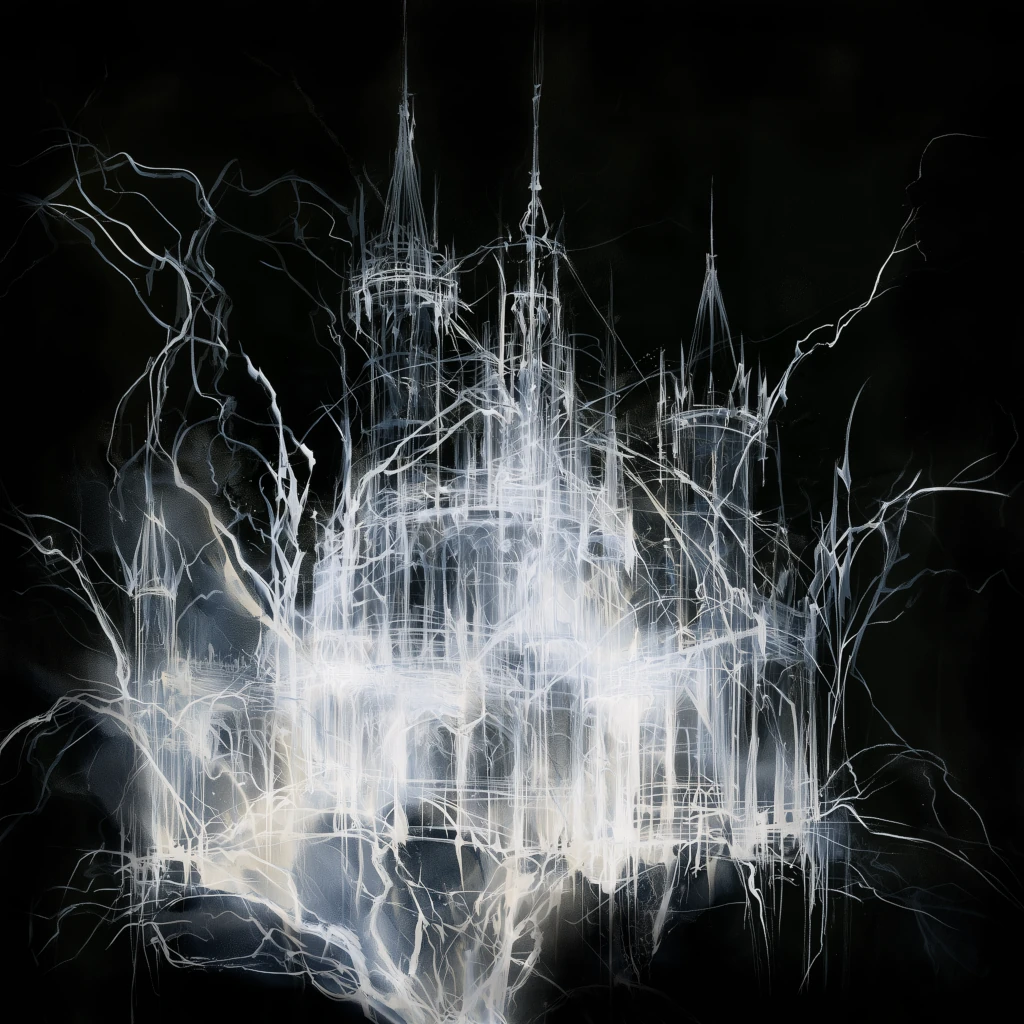
Of the types of landmarks found in Vacuum, redoubts are the most comprehensible to mortals—and with good reason, since mortals are generally responsible for creating them. A redoubt begins when a cutter brings a large quantity of outside matter into Vacuum… and then when they realise the degree of constant effort required to keep this matter in place and intact in the face of Vacuum’s depredations, they devise a plan to do so.
Redoubts can take many forms, from the citadels of Vecna or the Doomguard, to the hollow cinder cities of the abduldinach efreet, to the spindle of frozen lightning conjured by the aasimon Matariel. All redoubts, though, are ultimately defined by the measures taken by their residents to hold back the emptiness beyond their borders. The simplest such method is use of spells, which must be powerful, varied, and ceaselessly renewed. Conjurations to feed and misdirect the encroaching vacuum with sacrificial material, or evocations and transmutations that can compact and restrain the redoubt’s foundations, are the most commonly used tools here. While no redoubt can last for long with only a single engineer maintaining it, groups of spellcasters fare little better, given the liklihood of envy and internal discord. To try to keep an isolated redoubt reinforced using merely mortal tools is a difficult proposition.
Other means exist, of course. More than one redoubt has been built around a caged artifact. Perhaps a chunk of comatose godstuff stolen away from Anubis, a source of some primal Positive energy, or yet weirder means. The Convent of Unwhispered Secrets, for instance, is said to have as its foundation stone the seed of an entire unborn Prime Plane, and so pushes back Vacuum’s consumptive influence. Even these greater means, though, require directive attention to function properly, and can be rapidly breached if managed incompetently or left unattended. Once the protection fails, a redoubt’s outer workings are quickly stripped away, leaving only tangled remnants of material surrounding the quiescent power source. Moreover, anything powerful enough to maintain a redoubt is likely also powerful enough to serve other ends, and is at risk of being seized or stolen by those who would seek to shape the wider multiverse. If this happens, the redoubt collapses upon itself, and its wreckage eventually erodes away into Vacuum once more.
In the long run, simply put: No redoubt can hope to survive indefinitely. They are strictly temporary constructs, yes, often outlasting the life of a human or even an entire ruling dynasty—but eventually doomed to disaster of one kind or another. Once breached or abandoned, a redoubt generally suffers irreparable damage, and eventually disperses to back nothingness.
II. Hollowings
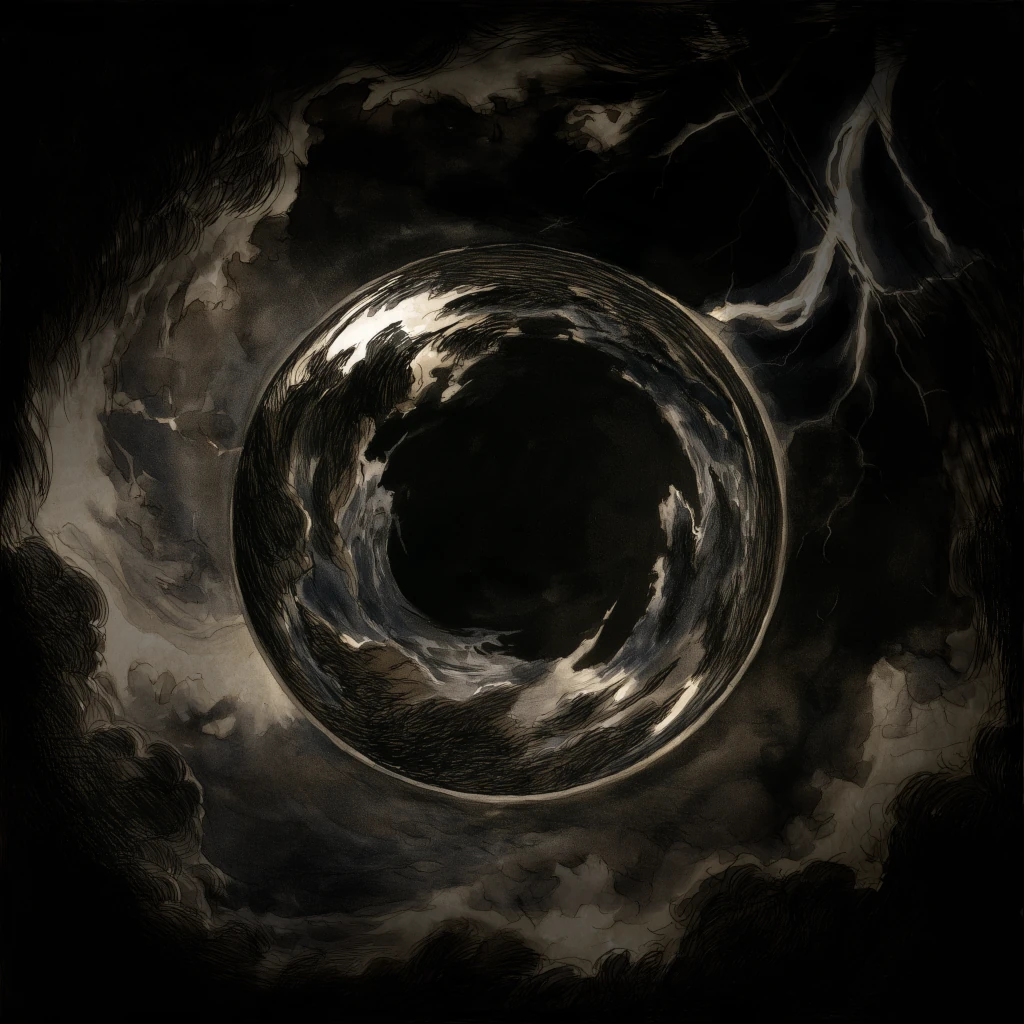
Not all Vacuum is created equal. While large parts of the plane of Vacuum are merely passive, empty spaces that simply remain unfilled by the nature of their home plane, there are areas where reified nothingness is far fiercer, pulverising and eventually annihilating anything that gets too close. And yet, like hurricanes that have an eye of calm at their centres and suns whose cores burn less fiercely than their coronas, there are places where Vacuum becomes so destructive that it forms a repulsive shell around an area of placid stability. The interior of these areas are called hollowings, and they can—with proper care and preparation—be quite comfortable places to live. For a time, at least.
The first challenge with regards to exploiting a hollowing is simply to find one in the first place. By their very nature, they’re in parts of the plane that are not safe to traverse, requiring a cutter to have substantial magical protection. What’s more, they are effectively invisible, even to most magical means—until one is actually inside a hollowing, it merely appears to be an especially volatile area of Vacuum. One favoured means of detection is to use native wildlife as trackers—experts within the Doomguard, for instance, have taken to breeding ghostwings, albino batlike creatures able to shriek and listen through Vacuum itself. It’s rumoured that the Mercykillers have begun a project to acquire their own ghostwings, to use in tracking escaped criminals who’ve fled to the quasiplane… something that the Doomguard have not taken too kindly to.
Once a hollowing has been located, there’s still the considerable task of getting inside. Teleportation and plane-shifting magic might work, of course, but for large inanimate cargoes and the magic-averse, an alternate means of entry is to construct or conjure a protective casing of some tough but disposable material, and physically push it through the hollowing’s destructive shell. It’s important to note, though, that this trick only works for getting in. When approached from within, the shell of a hollowing behaves very differently. It exerts a mild repulsive effect that’s enough to keep gases enclosed, but any object that has sufficient momentum to overcome this repulsion and make contact with the shell will find itself instantly disintegrated.
[A living creature thrown against the inner shell of a hollowing should get a saving throw (vs. wands / dexterity / reflex) to avoid contact. Failure means that a wish is needed just to get enough of a body back to case raise dead.]
The last trick with a hollowing is keeping it in balance, long-term. The interior of a hollowing is absolutely a closed system—nothing gets in except through deliberate action, and nothing leaves unless deliberately removed or destroyed. Therefore, left unattended for too long, a hollowing’s air will foul and its interior will overheat. Even if these factors are controlled for, a hollowing can be overrun by vermin, run out of food or other raw materials and be abandoned, or suffer a magical catastrophe that makes its environment impossible to maintain. Hollowings that have become uninhabitable in this way can make for… interesting reclamation projects, with potential threats ranging from environmental hazards to leftover magical traps, to natives of Vacuum that have somehow found a way inside, to Prime vermin that have adapted to their new home.
III. Frozen Stars
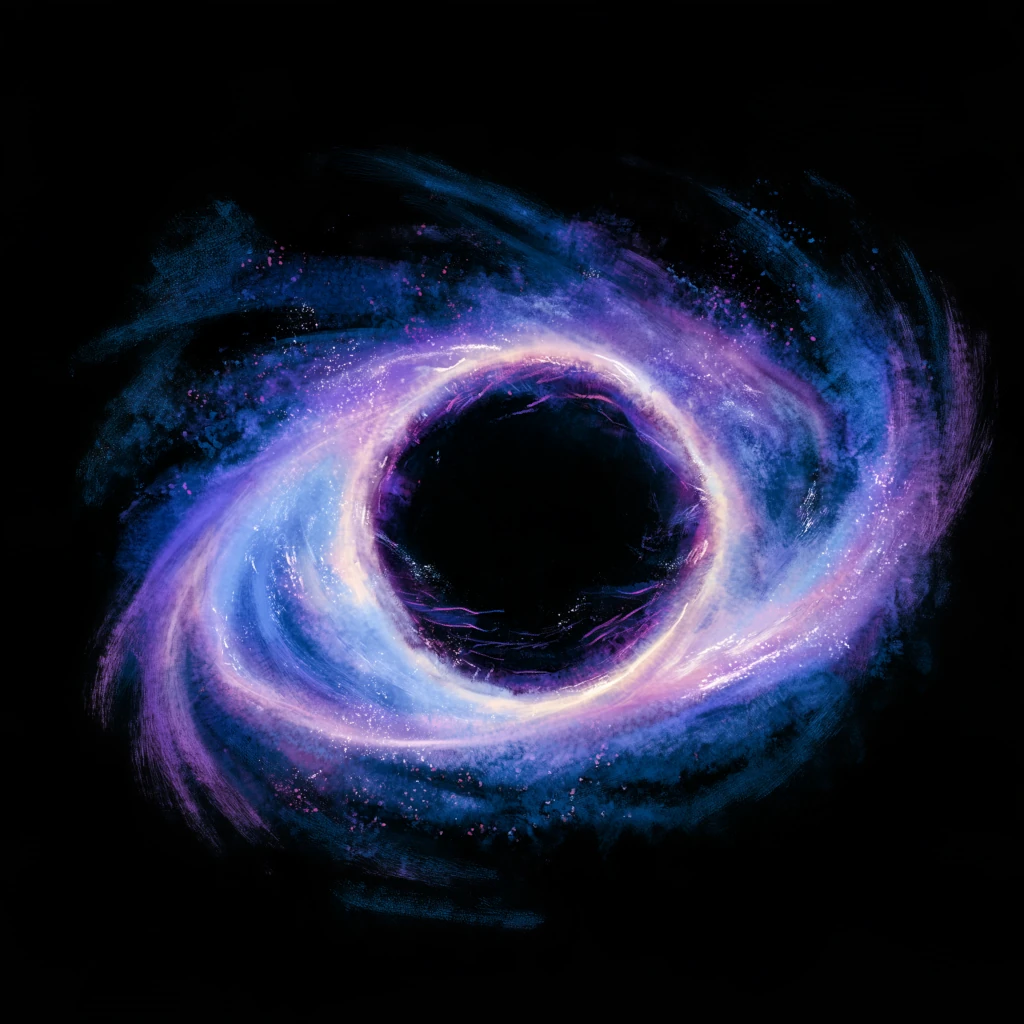
Many attempts have been made, over the years, by natives of other planes, to transform Vacuum—or at least to find some way of filling it with hospitable outside matter. None have been particularly successful, but some have come close in their own way. One such effort, a twisting and collapsing of literal emptiness in upon itself by some long-forgotten Prime civilization, managed to alter the local fabric of the plane in such a way that matter coming close to it was not simply destroyed, but instead dragged inexorably towards an infinitely small central point. Either the experiment has been duplicated, or these things can now spawn spontaneously, because the chora ruvoka have mapped many such anomalies now. They call them frozen stars.
As it turns out, not all frozen stars are equally useful. Some are small and relatively weak, their influence only partially offsetting Vacuum’s destructive influence—they are useless except as landmarks. Others are dangerously powerful, able to suck in any matter that comes close, and crush it down to nothingness in a matter of moments. Between the two extremes, though, are a handful of known frozen stars that can actually preserve outside matter for a non-trivial span of time. These frozen stars often have a corona of solid mass surrounding them, atmosphere and sometimes even inhabitants. Chant goes that a strange kind of fey nymph calling themselves gwereiad have occasionally been sighted near frozen stars.
Living around a frozen star is often chaotic, if not outright dangerous. While it’s entirely possible for air, heat, solid ground, drinkable liquid and the other necessities of life to all be trapped within a frozen star’s ambit, there’s no guarantee that these will be arranged in any sort of accessible manner, or even continue to stay in the same place from day to day. Waking up to discover that the reservoir pond’s evaporated off, or that the atmosphere only fills half the space it used to, are uncommon but not unheard of events near a frozen star.
One special longer-term hazard is the possibility of being bodily altered by the frozen star—having one’s physical form compressed in on itself.
AD&D 2e rules
In game terms, a character gains a bonus to Strength (their muscles are more dense), but a penalty to Constitution (due to the stress on their skeleton and organs) and to all saving throws (due to strain on the nervous system and limbic disorientation). In addition, the DM may choose to call for a system shock roll at each time interval after 1 week. The Strength bonus and saving throw penalty are lost once a character departs the environs of the frozen star, but the Constitution penalty remains until the cutter is magically healed (usually involving regeneration or similarly potent effects). Also note that the time intervals below are averages; for a particular frozen star, they can be anywhere from half as long (if the frozen star is particularly powerful) to three times as long (for weak or erratic frozen stars).
| After Being in a Frozen Star For… | Change from Original Size | Bonus to Strength Score | Penalty to Con and Saving Throws |
| 1 hour | x 0.95 | None | None |
| 1 day | x 0.90 | +1 | -1 |
| 1 week | x 0.75 | +2 | -2 |
| 1 month | x 0.50 | +3 | -3 |
| 1 year | x 0.25 | +4 | -4 |
Pathfinder 2e rules
In game terms, a character gains a bonus to Strength (their muscles are more dense), but a penalty to Constitution (due to the stress on their skeleton and organs) and to all saving throws (due to strain on the nervous system and limbic disorientation). In addition, the DM may choose to call for a system shock roll at each time interval after 1 week. The Strength bonus and saving throw penalty are lost once a character departs the environs of the frozen star, but the Constitution penalty remains until the cutter is magically healed (usually involving regeneration or similarly potent effects). Also note that the time intervals below are averages; for a particular frozen star, they can be anywhere from half as long (if the frozen star is particularly powerful) to three times as long (for weak or erratic frozen stars).
Spaghettification Sickness | Disease 11 | Saving Throw DC 28 Fortitude. Onset 1 hour. Stage 1 you shrink in height slightly and your body feels more solid (no mechanical effect) (1 day). Stage 2 you decrease by one size category, add +1 to Strength but also become Drained 1 (1 week). Stage 3 you decrease by another size category if possible, gain an additional +1 to Strength but also become Drained 2 (1 month). Stage 4 you decrease by another size category if possible, gain an additional +1 to Strength but also become Drained 3.
The final risk involved in visiting a frozen star occurs when a cutter tries to leave. While seemingly straightforward, teleportation is risky; something in the frozen star’s structure tends to disrupt such magics. [Anyone attempting to teleport away from a frozen star must (AD&D) save vs. spells / (PF2e) pass a DC 28 Fortitude save; on a failure, the teleportation effect fails, and the subject instantly adds their character level in days to the actual length of their stay for determining the frozen star’s effect on their body (as per the rules above). Even if the save succeeds, chances of a botched teleport are doubled (roll twice, take the least favourable of the two rolls).] Plane shift is somewhat more reliable, in that it will always enable the caster’s departure. [However, a saving throw is still required as with teleport, on a failure the destination of the plane shift is off-target—DM’s discretion as to where the traveller ends up]. The simplest and safest way to escape a frozen star involves use of the reverse gravity spell—being careful, of course, to cast it in a place where no barriers can interfere with the caster’s departure. Failing that, extremely high speed flight [a speed of at least (AD&D) 72 / (PF2e) 70] is sufficient to escape, which will likely involves some combination of haste magic and custom spell research.
IV. Disjoints
Avoiding the ravages of Vacuum isn’t always a matter of brute force or twisting local physical laws. There are always places—usually tiny—that are less vulnerable to the touch of the plane. Creating a disjoint is simply a matter of finding several of those places, making them habitable… and then tying them all together with spell effects that distort distance or otherwise make remote locations adjacent to one another. Simple!
Needless to say, while many disjoints are perfectly pleasant places to reside, and all are invariably much more hospitable than naked Vacuum, most humanoids still tend to avoid them if they can. The idea that one’s head could at any moment be one persistent spell’s failure away from being forcibly separated from one’s body by thousands or miles is not a pleasant one. This is especially true considering that, like almost everything else in Vacuum, disjoints aren’t truly stable, and need their nodes regularly pruned and spells recast to keep fluctuation in space-time from putting the entire structure at risk. The deliberate dissolution of a disjoint’s node usually happens with enough warning to allow evacuation to occur, ensuring the probable safety of all involved. Usually.
It’s little surprise, then, that the main residents and makers of disjoints are decidedly nonhuman. The majority of these sapients fall into one of two main clades—the ool’qA’hatch, who are a breed of intelligent oozes with amazing powers of natural regeneration, and the dreamheards, a race of mobile fungi with a gestalt collective mind. Neither the dreamheards nor the ool’qA’hatch are natives of Vacuum. Both claim to be the original inventors of disjoints, though, and cast the other as interlopers who’ve stolen territory and magical secrets. Relations between the ool’qA’hatch and the dreamheards are every bit as frosty as one might expect. In fact, the only things stopping an all-out war of annihilation from breaking out are political divisions within each race which prevent the kind of unity needed for a concerted crusade against such a foe.
This isn’t to say that disjoints hold no interest to humanoids—far from it. While they make poor residences, they can greatly help planewalkers who need a safe shortcut through Vacuum’s emptiness. Both the dreamheards and the ool’qA’hatch tolerate such outsider visits… for a price in gold or gems. They generally use these to hire mercenaries for attacks on their enemies, or reclamation of a lost disjoint. Working as a disjoint sellsword can be a profitable living, if a dangerous one.
An interesting development has occurred recently with the appearance of an unnamed race, possibly originating from the Far Realms given their distinctly unsettling appearance, that has started to take possession of disjoints away from both dreamheards and ool’qA’hatch alike. These invaders don’t seem to speak or communicate in any way, and can apparently strike suddenly and irresistibly—the only evidence any cutter has ever found of their attacks is arriving after the fact to find a disjoint under worrying new ownership. Getting away after such a discovery is, of course, a problem in itself.
V. Chronal Bubbles
Of all the methods cutters have used to carve out habitable pockets in the plane of Vacuum, the chronal bubble is perhaps the most audacious. It is arguably to time what a disjoint is to space—a habitable environment is assembled in some relatively placid region of Vacuum, allowed to persist there as long as is safe. When conditions worsen, it vanishes entirely from existence, flitting forwards in time to some moment of renewed safety. For those within the chronal bubble, time appears continuous—there is no visible clue or indication of temporary nonexistence. For those outside, of course, it’s a different matter.
Even by the standards of Vacuum, chronal bubbles are rare. Their inhabitants are those unworried by the potential risks associated with months, or years, of the rest of the multiverse passing them by in an eyeblink. Moreover, such occurrences are startlingly common, as even the most hospitable sites for chronal bubbles can rarely sustain one for a period of more than a few hours before needing to separate from sidereal reality. It might seem to be a paradox that any blood with the magical skill to create a chronal bubble would willingly inhabit one, but a few exceptions exist—grey elves, ahn-githyanki, and rouvven have been known to do this.
More likely inhabitants are bashers who have taken up residence in a chronal bubble hoping to see the future arrive and the multiverse change. These souls are adherents of ur-prophecies, keepers of dying godsparks, seekers of unborn artifacts and those who want vengeance against the immortal—they don’t care about how the multiverse might change across millennia, so long as the ends they seek are ultimately met. As a result, while chronal bubble-dwellers stand apart from the affairs of the larger multiverse, they still have a keen interest in its doings, and are willing to pay well for messages, news and other tales from the outside delivered by trustworthy bloods. The risk, of course, is finding a way to deliver such without being caught within the bubble as it makes one of its jumps through time.
A persistent rumour in Sigil is that one or another of the factions—which one depends on who’s telling the story—was actually founded by refugees from a long-lived chronal bubble. Chant goes they fled to it along during some time of traumatic change across the multiverse, only emerging (with their philosophy) many millennia later. It’s a story that’s initially appealing but ultimately treacherous, and it’s no surprise that none of the factions actually admit to it being part of their history—after all, who wants to admit that at a time when existence itself was remade in some larger image, the champions of your creed ran away and hid?
No discussion of chronal bubbles would be complete, of course, without mentioning the possibility of bubbles that don’t confine their chronal jumps to a single direction in time. To any logical thinker, such an embellishment is ludicrous, but since to most outsiders the fundamental notion of a chronal bubble is already ludicrous, it’s not much of a step. These rumours are undoubtedly helped along by stories from the Ue Lakothimos, a chronal bubble whose inhabitants are apparently engaged in some kind of cosmic con game. Chant goes they invite in visitors at any opportunity, then seek to convince those visitors that they come from the future and that every jump will carry them further into the past. Why they would attempt such a deception is unclear, but they do so well enough to pull in their share of rubes from even among experienced planar travellers. And even those aware of the Lakothimes’ deception may hold out hope of an actual backwards-travelling bubble out there, somewhere…
VI. Reifications
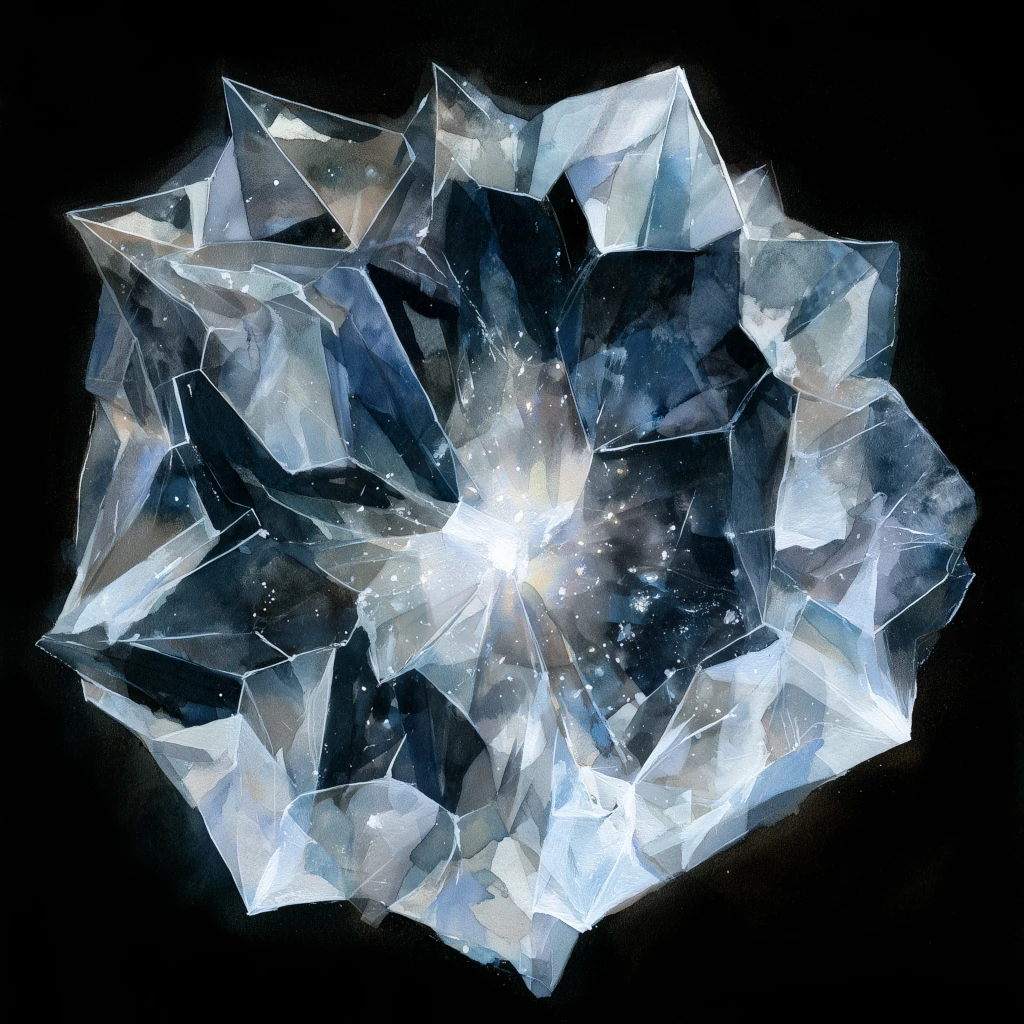
If chronal bubbles are the most audacious kind of landmark within Vacuum, reifications are arguably the weirdest. Rather than trying to anhcor solid matter within the quasiplane, a reification dispenses with the idea of material, and instead twists the substance of Vacuum itself to construct a realm of pure thought. With no substance to attack or erase, Vacuum’s inimical nature becomes irrelevant.
To the outside observer, the presence of a reification is marked by some abstract image—of what, exactly, depends on who’s observing. Mortals seem to see reifications as intricate enormous crystalline geodes, gigantic many-fronded flowering plants, or tumbling, ever-shifting constructs of waves or cloudstuff. Fiends have described reifications as cages of blood, barbed fire, or ululating pain; celestials see them as sculptures of pure light or embodied serenity. Though a reification seems to take up space, its actual size is infinitesimal, and even a slight change in perceptive angle is enough to drastically revise its apparent shape.
Entering a reification is simple—a cutter just needs to make contact. One distinct downside: The subject’s physical body is destroyed, and their mind, memory and personality takes up residence inside the reification. If the journey is not intended to be a one-way trip, a substitute body (via magic jar, for instance, or a planar projection similar to that created by astral spell) is highly recommended. Failing this, clone or wish to recover the lost body may suffice. Alternately, purely mental contact (via any of several psionic talents, or custom-purpose magical spells—simple ESP is insufficiently powerful to work) can get a visitor’s consciousness inside, though this does require leaving one’s comatose physical body outside in Vacuum for the duration of your stay.
The interior of a reification is limited only by imagination. Its size, shape, appearance and environment are dictated by the wills of the inhabitants. Exactly who sets the form of the reification in the event of a dispute varies from place to place. Some reifications practice a rule of seniority; others go by consensus or majority opinion; some are willpower-backed anarchy where the strongest and most determined minds triumph. One reification even exists where the newest, least experienced residents receive precedence, to ease them into the community and encourage them to reshape their new home. Generally, though, self-identity is strong and difficult to wholly reshape. Most who enter a reification find their appearances and capabilities roughly equal to what they were in the wider multiverse, at least to start with. Githzerai, though, are generally watched carefully. Certain zerth adepts have proven quite capable indeed at reshaping reified space while still relative novices.
Just as nothing material can enter into a reification, nothing other than thoughts and ideas can leave. This limits commerce somewhat—but there is a lively trade in information; which includes not just facts and hearsay but also blueprints, mechanical specifications, and reagent lists for constructions or magical experiments that would be absurdly expensive, insanely risky or simply futile to conduct in the outside world but are simplicity itself inside the observer-dictates-all environment of a reification. Which, of course, means that anyone departing a reification may be suspected by their enemies of bringing valuable secrets with them. This is reason enough to retain bodyguards, or set a counter-ambush or similar ruse.
Finally, there is the risk of false reifications. These are constructs set up that do not provide a haven for mind and thought at all, but simply obliterate them. A cabal of archons and aasimar known as the Argent Peak is accused with first coming up with the notion, as a trap for yugoloth agents who were felt to be working too closely with reifications. Whatever the truth, the concept of a false reification is now a known ruse of war. Fortunately, destroying a false reification is relatively simple—the sort of task that can be delegated to even moderately competent mortal agents. The chief trick is finding some way to be certain that the target is, in fact, not a real reification after all.
VII. Simplicities
This last form of landmark holds the rare distinction of being one of the few kinds of thing in Vacuum possibly more dangerous than the plane itself. The area of a simplicity might appear to a naïve observer to be reasonably safe, for material objects are in fact preserved inside; the cruel truth, however, is that Vacuum’s destructive nature is merely altered, not held in abeyance. Within a simplicity, what is attacked is not structure, but distinctiveness.
An example will probably help here. Say a field of corn were somehow transported entire into a simplicity, each and every ear of corn would gradually become identical—same height, same thickness, same tilt against the non-existent wind, same number of ears on each stalk and same number of kernels on each ear. The field mice, likewise, would all too quickly converge on a single size, weight, shape of eye, ear and head, length of tail and hue of fur. Over the longer term, stalks of corn, unplucked weeds, the willow trees lining one edge of the field and the river reeds along the opposite side would all devolve down to one single hybrid plant form, just as the field mice, worms and beetles, visiting crows and the farmer’s cat would all grow more and more alike, ending up as something usually only found in wizard’s laboratories. Even the soil itself would sift itself down to a sort of silt-sand, composed of endless repetitions of the same exact dust grain.
This, then, is why almost no sane traveller in Vacuum gets too close to a simplicity, once its true nature is known. A short visit might be relatively safe, even a chance to escape the plane’s usual continuous attack on material structure… but then again, if the simplicity acts first on a visitor’s rational mind and sense of purpose, a brief stayover could all too easily turn permanent. Best to stay away—unless, of course, one’s going in after a colleague who risked getting too close and got stuck.
Simplicities aren’t wholly without use, though, at least, not if one is amoral enough. More than one villain in the multiverse has proven willing to use a simplicity as a prison and torture device, dropping in truly loathed enemies so that they don’t simply die, but gradually have their minds and eventually bodies stripped from them as they’re transformed into some grotesquery. Less directly cruel, though still thoroughly ruthless, is to trick a foe into entering a simplicity of their own accord. There’s only one consolation for those trapped in a simplicity in such a manner —the nature of their prison is such that it’s more or less impossible to keep a close guard in place, and that offers a slim hope of rescue. Assuming, of course, that any rescuer is daring enough.
Simplicities offer one more potential prize to the ambitious outsider. If a simplicity is seeded with the proper mix of matter, then left alone with nothing new added for a sufficiently long period of time, it will eventually begin to reduce its contents into raw, unadulterated ylem—protean ur-stuff, the building blocks of everything. Finding ylem is normally quite difficult since it was mostly consumed in the creation of the multiverse. Keeping it uncontaminated long enough to put it to good use is harder still—but a properly managed simplicity obviates these problems. It does pose the new question of how to safely retrieve the ylem, but if the answer to that was easy then anyone could play.
Sources: ElderSphinx and Jon Winter-Holt. Originally posted on planewalker.com. Canonwatch: ‘Frozen star’—(застывшая звезда – zastyvshaya zvezda) was the original name used by Soviet physicists to describe what we now call ‘black holes’. The name ool’qA’hatch was inspired by Larry Niven’s Chirpsithra aliens. ‘Abduldinach’ efreeti—compare to the origins and meaning of the real-world ‘Abdullah’ (servant of Allah). Then reflect on the fact that Aldinach is a tanar’ri, and draw your own conclusions. Ahn-githyanki—Once or twice in a generation, an otherwise mostly-unexceptional githyanki will suddenly gain 8-12 levels of experience in a single instant. The ones smart enough to strike out on their own in the wider planes, rather than challenging Vlaakith directly (and proving anew the old dictum about old age and treachery versus youth and vigour) become ahn-githyanki. They’re powerful, paranoid, eccentric, reclusive and mildly sadistic.