
[ Earth ] [ Mapping Infinity | Pockets | Bestiary | Flora ]
Bestiary of Earth

Life on the Elemental Planes comes in many forms, planewalker. There are three general kinds of creatures who inhabit them—there are those like you who are purely flesh, humanoids like yourself or animals; there are those who are purely composed of elemental matter and energy; and there are those in whom these two natures are melded together. However, it turns out that on the Plane of Earth, the border between those last two categories is even more vague than usual. Earth is the element of variety see, and as such, it can be arranged in a myriad of shapes that mimic life—all without incorporating any of the substances that are typical for fleshy creatures. Galeb duhr (and their numerous cousins) are prime example of such curious beings—they have skin and innards sure, but they are all made of rock. They breathe sand, and they eat stones and they are fully elemental, but just not as disembodied as true earth elementals are.
However, not all earthen creatures are so unusual. We shad, used to be simply tree-dwelling creatures on the Prime Material Plane—until the conclave of druids brought us to the Anvil. The Plane of Earth has altered us—made us more resilient, and able to endure shortages of air, food and water. Elementally-infused creatures slike us and earth genasi have thick skin, dense bones and a strong immunities to disease. Some healers claim this boon comes with an increased risk of gout and blood clotting, but on the plus side, shad rarely live long enough to suffer such consequences.
And of course we must not forget the innately magical creatures, such as despicable dao and meddling mephits. They are sustained by the elemental energy that flows through the Inner Planes, and rarely need to eat at all.
— Tam Aran, the Guvner shad
Gadabouts of the Inner Planes
Not every creature that dwells in the Inner Planes is composed of a single element. Some beings are planewalking wanderes who’ve made the Inner Planes their home by choice or necessity; others are composites of multiple elements, neither wholly fire nor earth nor air nor water; still others are political operatives, philosophers, or mercenaries whose interests span the whole elemental spectrum. All of these creatures can be found on the Plane of Earth occasionally… get the chant here…
Agrawgh

One of the many relatives of the galeb duhr are the agrawghs (AG-rork). They appear as dark snake-like bests with copper rings tightly wrapped around their bodies. Agrawghs tunnel through the plane, constantly consuming earth like giant earthworms. Some of that earth is expelled from their rear end as loose soil, but most of it is digested by the agrawgh. Their stomach contains powerful acid that they can vomit up on others for the purposes of self-defence.
Agrawghs are important in the Anvil’s ecology, since they’re among the major tunnel-creators of the plane. The metallic rings encircling their body leave obvious marks on the walls of their tunnel, which has the side effect of dramatically slowing the natural healing-over and sealing-up of the tunnel.
Stats: [ Pathfinder 1e; CR 5 ] Planes of Power p52
Animental, Earth

Animentals are born when an animal soul gets swallowed up by an elemental vortex before it can depart to the Outer Planes. Such creatures can be of any species, but typically animentals are born from the animals that lived among their respective element to begin with. Earth animentals are often moles, bugs and worms. There’s a breathless rumour going round among chant-mongers that describes an animental purple worm that ravages distant parts of the plane.
Stats: [ D&D 2e ] Planescape Monstrous Compendium Vol. 3 [2e] p14-15. Pathfinder has the Element Infused Creature template, which lets you turn any creature into a earth version with this monster template. [ Pathfinder 1e ] Planes of Power [PF1e] p56-57
Annelid, Great

One of the strangest beings in the eyes of the most learned scholars, annelids are giant elementaloid worms, who feed on minerals. This isn’t what’s strange about them, though. Their life cycle is much more fascinating, for they have an ability to lay eggs inside of elemental creatures of Earth. They create some sort of signal, likely a sound, that attracts elementals, xorns, weirds, crysmals and other similar creatures to their location. Then, annelid permanently paralyses them with a bite and lays its eggs right into their bodies. It seems, their young needs to consume lifeforce alongside stones. Most creatures in the Anvil hate and fear great annelids, but they have no way to escape its venom. However, creatures of flesh are not affected by the toxin, so an adventurer can earn some goodwill among heartfolk by slaying these worms (provided they can take on a 1000 feet long worm that can easily swallow a berk). Lastly, it should be said that dao are also affected by annelids’ venom, and they sometimes use it in their political intrigues. Annelid venom fetches quite a large sum of jink in the Great Dismal Delve (and even larger on some other elemental marketplaces).
Stats: [ D&D 2e ] Monstrous Compendium Mystara Appendix [2e]. This book also features some other worms that can also be potentially found in the Plane of Earth
Archon, Rockhammer

Now, this is one of those conundrums that drive us Guvners right up the wall. Rockhammers are archon high-ups, who protect Mount Celestia in times of dire need. However, there’s also another kind of much weaker hammer archons—specialised underground warriors, who oppose Chaos and Evil with their earth-based magic and titular hammers. Only encountered here on the Plane of Earth fighting the forces of Elemental Evil, they stand outside of the holy Congregations of Celestia.
Get the chant on the rockhammer archon here
Asag

It may not be entirely correct to list asags (AY-sag) here, since they were banished from the Plane of Earth by xiomorns millenia ago. Asags were created by the tanar’ri lord of the same name from the remains of corrupted xorns. They look similar to xorns, except their mouth is much smaller and their body is covered in eyes. When their creator was slain by Ninurta, asags retreated into the Anvil. Using their natural magic they subjugated xorns and formed an entire army that could rival even battalions of the dao. However, seeing the threat these cruel creatures posed, xiomorns (who at that time were still loyal to Sunnis) placed a powerful enchantment that banished all asags from the Plane of Earth and to this day still prevents them from returning. Now asags prowl other planes, having no way to increase their numbers and longing for their lost kingdom. Asags are powerful sorcerers, who can cause a wasting disease with their touch or summon xorns to their aid. But one thing they can’t do is use their plane shift ability to return to the Plane of Earth. Despite this, some asags do manage to sneak in every once in a while. Chant goes, one of them has taken control of several xorn tribes and now intents to pay a visit to that so-called king of xorns.
Stats: [ D&D 3e; CR 11 ] Dragon Magazine #334 [3e] p37. Mythwatch: Asag was a demon in Sumerian mythology. He wasn’t tied to earth himself, but led an army of rock offspring, which I assume was an inspiration for this monster.
Bi-Nou

Among all the mysterious creatures of the Anvil, bi-nou are one of the least appealing. These are strange stalagmite-like creatures with short arms and almost unnoticeable legs. While they have something that appears as eye sockets, they are seemingly blind and deaf, instead relying only on infravision and tremorsense which they have developed to a precise degree. Despite looking like columns of stone, bi-nou are beings of flesh, who nonetheless incorporate minerals into their durable hide and—what’s more important, into their shells of their eggs—that look a lot like gems.
Get the chant on the bi-nou here…
Black Rock Triskellon

Black rock triskellons were created by the archelemental Ogremoch at the will of the Elder Elemental Eye. Compared with other Avatars of Elemental Evil, triskellons are more powerful and have a signature look of a stone pyramid with three legs and three pick-like appendages. Thir claws are magically durable and have the properties of cold iron, silver and adamantine all at once.
Stats: [ D&D 3e; CR 18 | Pathfinder 1e ] Monster Manual IV
Chaggrin / Earth Grue

Chaggrin, also known as earth grues or soil beasts are elemental creatures that can consume almost any substance and turn it into earth and stone inside their stomachs. Chaggrin are made of clay, but can change their own shape and composition at will. Their preferred forms are humanoid or hedgehog-like, and they have an unpleasant habit of shaping their heads to look like freakish malformed skulls. Chaggrin are lazy creatures, who seek only food—and for them, that is most materials, including air and water, but also many minerals that they consider impure forms of earth. For some puzzling reason, earth grues can’t glide through earth like other elemental creatures, but they are great diggers. They don’t much like to dig though, and prefer wandering through tunnels in search of things to devour. Dao and other spell-slingers sometimes enslave chaggrin, and Ogremoch has a dozen of earth grue battalions at his disposal.
Stats: [ D&D 2e | 3e ; CR 2 ] Planescape Monstrous Compendium [2e] p50; Complete Arcane [3e] p153-154
Cobble Mite; Cobbleswarm

Despite having a similar name, cobble mites have nothing to do with mineral mites or, seemingly, with any other kind of mundane elemental. They look like simple pebbles with a toothed maw. Cobble mites burrow through the soil, devouring worms, bugs and any other tiny critters they come across. When threatened, a singular cobble mite simply closes its mouth, trying to camouflage by looking just like one of the surrounding stones. However, when a large concentration of cobble mites occurs in one place, they become much braver and will join together in a swarm to defend themselves. Cobble mite biology is poorly understood by the graybeards—cutting them open reveals a single inner cavity without any internal organs or differentiated tissues. How these creatures feed and reproduce remains a mystery, despite their seeming abundance. Some cutters go as far as to call them aberrations, though others disagree, pointing out how well cobble mites have integrated themselves into the ecosystem of Elemental Earth. Chant goes that cobbleswarms which remain in a cohesive swarm for many years can become deadly sturzstrommer, or living landslides.
Stats: [ Pathfinder 2e; CR 2 ] Bestiary 3 [PF2e] p52; Pathfinder #157: Devil at the Dreaming Palace p83
Crawler—Elemental Vermin

Often simply dubbed earth elemental vermin, crawlers are elementaloid burrowing creatures, that superficially resemble dogs and mustelids. They are creatures of flesh, but the elemental power of earth runs through their veins—which means they have to eat both minerals and small animals. This is what’s earned them the moniker ‘vermin’ among dao and dwarves. My people have more respect for these creatures—we shad hunt crawlers for food, hides and valuable claws. Despite their diminutive size, a crawler is a dangerous prey, known for being extremely reckless and aggressive, especially when caught off-guard. They can easily maneuver through dark tunnels thanks to their sensory vibrissae and precise tremorsense.
Stats: [ D&D 2e ] Monstrous Compendium, 1994 Annual, Volume 1 [2e] see Elemental Vermin
Creeping Stone
While their name may be confusing, creeping stones are actually elementally infused oozes. They are distantly related to Prime creatures known as stone puddings, and may as well have something in common with razhaks, who seem to also be stone-born oozes. Creeping stones are slow, grey-colored creatures of lacking intellegence, whose behaviour has very few differences from that of other oozes. They slowly crawl through rock, feeding on it as they go, but can be of mediocre danger to living creatures, as a bothered ooze may try to engulf its foe, petrify them with its digestive fluid and then consume their remains.
Stats: [ D&D 3e ] Dragon Magazine #314 p30
Crysmal

Crysmals or cullitox are peculiar beings, resembling strange scorpions built entirely out of glowing crystals. Crysmals are psionically endowed and much more intelligent than their behaviour and appearance might suggest. They lack any distinctive internal organs and are more closely related to regular elementals than to galeb duhr or to mephits.
Get the chant on the crysmal here…
Dao / Shaitan / Jabali

No essay on the topic of Elemental Earth would be complete without mentioning dao (DOWH), the genies of Earth. The oppressive presence of their Khanate defines the political scene of this plane and that of the Inner Sphere as a whole. I should preface this chapter by saying that dao aren’t inherently evil in a same way fiends are. I personally know multiple dao (or, as they prefer to call themselves, jabali), who have forsaken their nation’s ways and took refuge on other planes. However, most dao live under the Great Khan, and his regime is one celebrating greed, slavery and brutal, dispassionate cruelty. But I’m getting carried away. Dao are born, like other genies, from the souls that were claimed by the Elemental Planes before they could pass on to their destined afterlife. They appear like tall and muscular humanoids with broad noses and sparse hair. Their hands are big and have trouble performing complex gestures (canny bashers know this impairment persists even in magically disguised genies and can sometimes give them away). Dao flesh is brown or grey in colour and very dense, allowing them to easily endure blunt trauma. Should the need arise, the dao can discorporate their legs or their entire body into the storm of dust and pebbles and fly for as long as they wish to. Dao can eat almost anything from rock to meat, but they rarely do so, as they need no food and don’t want to be distracted from their pursuits. Even the lowliest dao is richer than many human kings (despite everything, dao are surprisingly respectful towards each other and those who they deem worthy enough) and owns dozens of slaves. But almost all of them want more wealth and power for themselves. It doesn’t take a Guvner to realise that this hunger leads to a constant carousel of competition and betrayals withing their society and constant raiding and plundering of natural resources from all around it. No other faction in the Plane is happy about these exploits, but even archomentals will not dare to challenge the magical might and political influence of the Great Khan and his cronies. Of course, these factions would be more than happy to let outsiders try and undermine genies’ schemes.
More chant on genies here…
Stats: [ D&D 2e | 3e | 5e; CR 5/8/19 ] [ Pathfinder 1e | 2e; CR 7/12 ]. Monstrous Manual [2e] p126 (dao); Manual of the Planes [3e] p172-173 (dao); Manual of the Planes [5e] p370 (dao) p373 (dao monarch); Bestiary [PF1e] p143 (shaitan); Bestiary [PF2e] p163-164 (shaitan); Monster Core [PF2e] p158 (jabali); Rage of Elements [PF2e] p106 (jabali shuyookh)
Variants: [ Jabali Shuyookh | Dao Monarch ]
Daolani / Sand Gen / Gennayn

Gen (JENN) (or, more formally, gennayan) are diminutive spirits that are employed by genies as messengers or assistants. The earth gen, or daolani (dow-LAHN-ee) take after their progenitors in many ways. They are direct and concise in their speech and practical in their approach. They are loyal to their dao masters (though not necessarily to masters of other races), carrying out their orders without questioning, but will bluntly tell them if they think their plan is stupid. If any other servant would try to do the same, they will surely be dead or worse, but it is considered dishonorable to punish a daolani for such words. The only thing in which daolani don’t resemble their masters is their greed, or rather the absence thereof. The only capacity in which gems may interest the sand gen is as diet supplements. Undoubtedly, they were created in such a way to prevent thievery.
Stats: [ D&D 2e | 3e; CR 1/2 ] [ Pathfinder 2e; CR 2 ] Al Qadim Monstrous Compendium Appendix [2e] (sand gen); Rage of Elements [PF2e] p226 (gennayn)
Denzelian

In the purview of natural philosophy denzelians (den-ZELL-ians) are among the weirdest natural beings to ever exist, even compared with many other aberrations. These things look like featureless, grey thin sheets of stony flesh. They only move in a slow crawl and can change shape on a whim (though they must always remain two-dimensional). The largest denzelians grow up to 10 square feet in size. They feed on minerals, likely with the aid of symbiotic microorganisms. To digest them, they secret a powerful acid and absorb dissolved elements with their whole body.
Get the chant on the denzelian here
Dharum Suhn

Dharum suhn (darr-um SOON)—also known as Rockfathers, Rockmothers, or Lords of the Earthheart—are enigmatic creatures found way down in Deep Earth. They are disembodied spirits that can reveal themselves by sculpting their body from the surrounding stone. How are they different from earth elementals then? Well, first of all, dharum suhn wield magic as powerful as a time stop. Next, they are very clearly defined as separate from the elemental political arrangement. They pay no homage to Grumbar or archomentals and seem to exist all on their own. However, dharum suhn are held in immense respect by many races and especially by galeb duhr, who consider them something akin to a progenitor race. This seems odd, as galeb duhr are not spirits and avoid earth elementals. Genasi, who dabble into the galeb duhr culture, theorise that dharum suhn are manifestations of the “earth power” galeb duhr believe in. Perhaps, they are similar in concept to Powers of the more conventional races. The last important thing to mention about dharum suhn is their linguistic association with waiting. Many epic stories and proverbs describe Lords of the Earthheart as The Waiting Ones, and even their name may mean “those who wait”. But what are they waiting for (if they do) is unknown. Perhaps it would be that long-prophesied invasion of the Yith race? In this case, dharum suhn’s assistance may be invaluable.
Stats: [ D&D 2e ] Planescape Monstrous Compendium Vol. III [2e] p34-35
Dragon, Earthquake
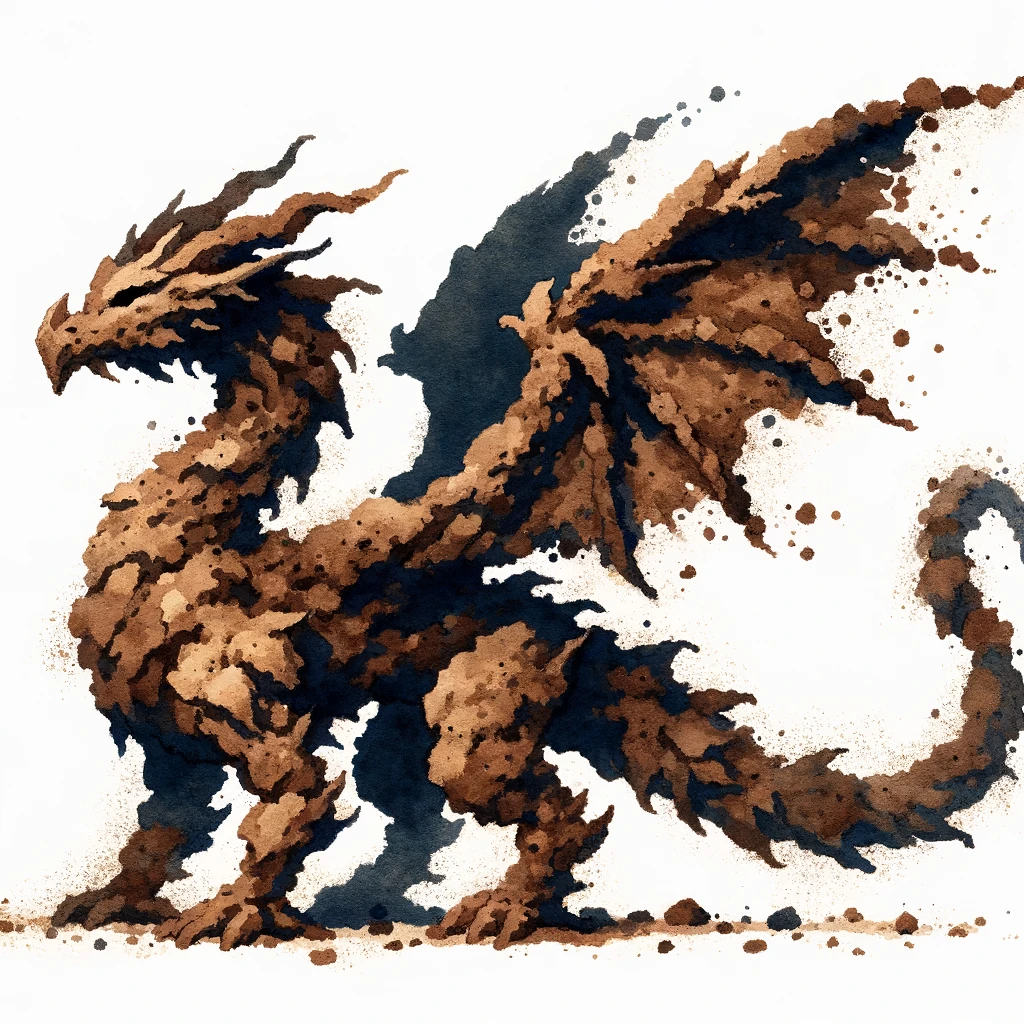
Dragons are not unusual on the Plane of Earth, but only the earthquake dragons are true natives of this place. Their ancestors have come here long ago, when they have struck a bargain with Grumbar and other Primordial Powers. In the Anvil, earthquake dragons are extremely slow-paced and disinterested in any mortal affairs. However, when time comes, they burrow their way through the plane in search of vortices to the Prime Material Plane. Once they get to Prime, they unleash the true scope of their power by causing titanic earthquakes and avalanches. They do this with one purpose in mind—after their catastrophe ends, new dragon eggs spontaneously appear below the earth. Wyrmlings, who hatch from them, will live on their own, growing quickly on organic diet, until they are mature enough to find their way back to their elemental home.
Get the chant on the earthquake dragon here
Stats: Mimir.net [2e]. Canonwatch: This dragon is a combination of 2e-era homebrew elemental dragons and 4e earthquake dragons.
Dragger

Draggers are close relatives of galeb duhr, and they have similar physiology. Their bodies are built from packed soil and stones. They have a circular shape and only two appendages, that serve both as arms and as legs. Draggers are solitary hunters, who ambush humanoids and animals from below, using their innate ability to create illusions to hide themselves. When they manage to catch some unfortunate creature, they grab it with their powerful jaws and burrow into the ground, where they can swallow and digest their meal. When not in the mood for flesh, draggers supplement their diet with fungi, dirt and soft rock. Weirdly enough, they can’t digest harder materials like gems, so it’s not uncommon to find a collection of trinkets inside the dead dragger’s stomach. Due to this, draggers are especially common in Mudhills, where the soil is loose and prey is abundant.
Stats: [ D&D 2e ] Forgotten Realms City of Raven’s Bluff [2e] p94
Drake, Earth

Drakes can easily be mistaken for young dragons by someone, who is unfamiliar with those creatures. They have four legs and two wings, though unlike their true dragon cousins they reach much smaller sizes and lack intelligence or innate magic. Earth drakes have powerful limbs they use to dig tunnels. Their wings are small and have flexible cartilage in place of bones, so they don’t get in the way of digging, but still provide some measure of flight. Like dragons, drakes keep lairs with a small amount of shiny treasure inside. Unlike dragons, though, they can’t distinguish value of different objects and may be tricked with cheap, but shiny materials such as brass or quartz. I suppose, drakes collect these items as a part of their courtship rituals. All of this isn’t to say drakes are stupid. They are smart predators with an acute tremorsense, and they have an innate understanding of Draconic language. For a long time it was thought that earth drakes are less intelligent than other elemental drakes, but nowadays it has become clear that they are merely slower and more ponderous—most likely due to their cold-blooded nature. Sufficiently large prey is rare in the Plane of Earth, and unlike other native monsters, drakes can’t fully subsist on minerals, so they must conserve their energy by all means. This, consequently, means that they like make their lairs near pockets of Magma. Earth drakes can reproduce naturally or be created from the shed piece of the earthquake dragon’s body. The largest and oldest drake specimens were reported to aquire psionic abilities or shape-shifting powers (not unlike gem and metallic dragons respectively), though they still lack the intelligence to utilise them to their full potential.
Stats: [ D&D 2e | 3e | 5e; CR 11,3] [ Pathfinder 1e | 2e; CR 10,8 ] Dark Sun Monstrous Compendium Appendix I [2e]; Compendium Imaginarium [PF1e] (mountain drake); Monster Core [PF2e] p133 (desert drake). Variants: [ Psionic drake | Shape-shifting drake ]
Earthdelver

These elemental creatures resemble wolf-sized pangolins. Earthdelvers are built out of pebbles and gravel, with jaws and snout made of razor-sharp obsidian. Being full elementals, earthdelvers don’t need to eat or rest, and they can effortlessly phase through earth as if it was air. They don’t seem to have any goals as a species and are even less intelligent than many animals. However, they were seen paying homage to Grumbar and answering the calls of elemental clerics. There’s a chant going around the Anvil, claiming that earthdelvers are created and controlled by Grumbar to spy Ogremoch and Sunnis and on their war. Archomentals themselves don’t seem to be worried—although you can never be certain with heartfolk.
Stats: [ D&D 3e ] Dungeon Magazine #111 p90
Earthen Destrier

Shaped like a warhorse with a headless rider on top of it, earthen destriers may seem like two different beings, when they are in fact one. These elementals are (or at least are claimed to be) created by dao, and most of them are still in their service. Earthen destriers are ideal soldiers, as they don’t need any sustenance and have no interests except for following commands. Or, to be precise, following military commands. These equine lookalikes are still earth elementals, they’ve just been reshaped, and selected to channel their thoughtfulness and obsessiveness into one goal. Destriers will gladly charge at any foe, but they will revolt against a summoner, who’d try to force them into pulling carts or collecting gems. They may be useful as guards, but will sometimes attack non-threatening creatures and objects out of boredom. After all, they may be tactically-minded, but they aren’t smart. It is dark to me how new destriers come to be. Some dao claim there’s limited amount of them, but they’re almost immortal—when an earthen destrier is destroyed, its spirit simply leaves its body and wanders for a while, before sculpting itself a new one.
Stats: [ Pathfinder 2e; CR 4 ] Bestiary 2 [PF2e] p108
Earth Glider

While the Inner Planes are thought by some to be generally free of Outer planar influence, it is undeniable that there’s at least some fiendish taint that exists here and there. One such example is the earth glider. This ray-like monster resembles an ixitxachitl, though solitary and much more powerful. Earth gliders have an innate ability to, well, glide through any earth or stone. Additionally, their fangs can deliver a poison that causes the flesh to be painfully and slowly petrified. Unlike ixitxachitls, their possible progenitors, earth gliders are solitary (and not very intelligent either). They viciously attack animals, humanoids and elementals alike, and have a habit of toying with their prey. It seems that, like fiends, earth gliders receive at least some sustenance from the pain, fear and despair of their victims.
Stats: [ D&D 3e; CR 12 ] Forgotten Realms Underdark [3e]
Earth Whisper

At a glance, an earth whisper looks like a ghost of an earth elemental. While undead elementals can exist, no ghosts have ever been observed. Parallelists claim that earth whispers are analogous to mihstu of Air and hearth fiends of Fire, though (as it’s often the case with this theory) this proposition does nothing to actually explain how these creatures come to be. There are dark rumors about them being souls of lost miners, stranded somewhere in Deep Earth, but they’re likely merely screed. Anyway, earth whispers are incorporeal creatures, who prowl the remote uninhabited reaches of the plane. They absolutely despise all fleshy beings and most elementals, viewing them as plunderers, despoiling their pristine plane. Unsurprisingly, all creatures either flee earth whispers or fight them on sight (although there’s some dark chant about especially radical conclaves of earth weirds allying with whispers going around). Ironically, being incorporeal, whispers themselves exist simultaneously on the Plane of Earth and in the Border Ethereal. This allows them to easily move through almost all non-magical materials. Another one of their abilities is mind control over earth elementals, in a same way as evil clerics control undead. When it comes to other creatures, the earth whisper can’t affect them directly, however it can implant certain thoughts in folks’ brains—to horrifying results. Their favourite tricks are inciting avarice to bring strife and causing cavern fear—a condition, where a sod becomes afraid of all open spaces and seeks to dig themselves into earth however deep is possible. Finally, earth whispers can magically control stone. It is unknown why earth whispers attack—they don’t seem to eat anything or use treasures they so jealously protect in any way.
Stats: [ D&D 3e; CR 5 ] Races of Stone [3e] p187
Eladrin, Aeolaeka
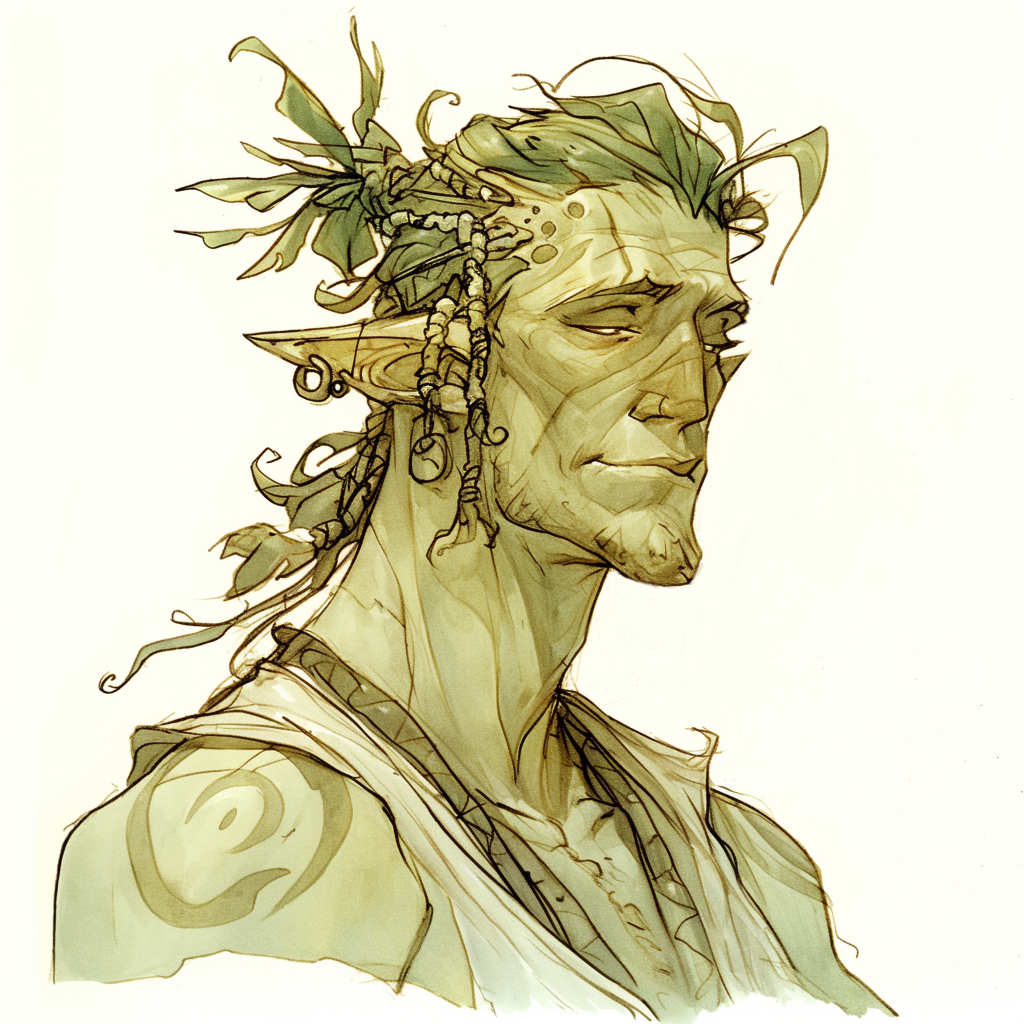
The most pleasant among all celestials that frequent the plane, aeolaekas are eladrin, who feel the connection with the “chaos, inherent to Earth”. While I may disagree with their stances on philosophy, I cannot deny that eladrin are an easygoing, kind and surprisingly patient bunch. Once again, their full description falls way beyond the purview of this treatise, but it is important to note that eladrin assistance remains invaluable to forces of the Elemental Good and perhaps the only voice keeping Elemental Princes from falling prey into strife between each other.
Stats: [ Pathfinder 2e; CR 12 ] Monster Core [PF2e] p35 (aeolaeka or stone azata); see also mimir.net entry here. Variants: [ Laene ]
Elemental, Ravenloft—Grave

When the corruption of Shadowfell touches an earth elemental, a grave elemental can be born. Such a being is more powerful, and can magically sink creatures into stone, or shatter stone foundations of buildings. Grave elementals aren’t always malicious, but they are unpredictable, dangerous and overall poorly understood.
Stats: [ D&D 2e ] Ravenloft Monstrous Compendium Vol. I [2e]
Elemental, Earth

Like any other Elemental Plane, the Plane of Earth is full of elementals—sentient spirits that embody their elements. They range from tiny elementites to enormous primal elementals, from almost mindless elemental beasts to godlike archomentals. Earth elementals (or heartfolk, as they are called among shad) are powerful, but slow—just like their own element. Of course, slow doesn’t necessarily mean stupid. Earth elementals may very well be the most intelligent out of all standard elementals. When other elementals constantly shift and travel, changing their interests and occupations, earth elementals tend to hyperfixate on specific topics or tasks. This is why earth elementals are used in golems—they are naturally receptive to repetitive tasks. Another quirk of theirs is their preference for certain types of rock. While you can certainly meet a fire elemental, who is exclusively composed of blue fire, most of them don’t care much about which kind of flames they are made of at every single moment. Meanwhile, many earth elementals have a clear preference for granite, sandstone or some other type of rock. This makes them especially irritable when summoned to Prime—conjurers rarely use the exact kind of rock they like. Of course, if your goal was to unleash a siege monster onto your foes, you likely would appreciate an angered elemental, especially if you’re up against encampments—these creatures of solid stone are especially good at leveling buildings.
Stats: [ D&D 2e | 3e | 5e; CR 5 ] [ Pathfinder 1e | 2e; CR varies ] Monstrous Manual [2e] p99; Monster Manual [3e]; Monster Manual [5e] p123; Bestiary [PF1e] p122; Monster Core [PF2e] p142
Variants: [ Monolith | Primal | Elemental Avalanche | Elementite Swarm ]
Elemental Beast, Earth

Elemental beasts are simply less intelligent elementals. Depending on their disposition in each moment, they may be aggressive, curious or completely passive. Elemental beasts roam their home plane, beholden to no one.
Stats: [ D&D 2e ] Dark Sun Appendix II [2e] p39
Erdeen—Elemental of Chaos

Elementals of Earth rarely take sides in philosophical conflicts of Outer Planes, but when they do, they can become profoundly changed by it. Erdeens are elementals of chaos, who are thought to represent variability and unseen instability of earth and stone. Unlike their non-chaotic kin, erdeens love to mix many different minerals within their bodies and thus appear like walking heaps of various stones adorned with metal nuggets and crystals. Erdeens are often obsessed with chaos and pay no mind to moral alignments. On their home plane they build bizarre mazes, utilising their innate magical powers, and trap passerby adventurers in them for a quick philosophical chat. Quick for an earth elemental, that is. Erdeens oppose hordes and, weirdly enough, galeb duhr, though even they themselves can’t explain why do they hate these generally inoffensive beings.
Stats: [ D&D 2e | 3e ] Mystara Monstrous Compendium [2e] p37; Planescape Inner Planar Denizens [3e] p26
Farimba

Worms are the bedrock of the Anvil’s ecosystem. Or, rather, that part of it that is made of flesh and thus lives in soft and wet regions such as Mudhills. Farimba are blue earthworms that reach up to 5 feet in length (though usually they are much smaller). They burrow through the loose soil, feeding on tiny organisms, detritus and clay itself (which they digest with the help of symbiotic archaea). Farimba are absolutely harmless and very much edible. They are very sensitive to toxins and harmful metals—thus, a lot of these worms is a sign of healthy earth.
Source: Planescape Monstrous Compendium Vol. III [2e] p122
Flail Snail

These molluscs are elementaloid creatures, which means they are infused with the elemental energy of Earth. Their name comes from their tentacles, each of which ends with a mineralized club-like appendage. Flail snails are known for their reflective shells that protect them from most forms of magic. These shells can be collected, although it is a dangerous endeavour—these flails aren’t just for show. The snail also uses other distraction tactics—it can create a flash of magical light from its shell or let out a very loud shriek. Both of these maneuvers aren’t especially harmful, but are enough to deter most dim-witted predators. This does nothing to protect the snail from hunters though, who hunt them for their shells. Flail snails have a complex, multichambered gut that hosts symbiotic archaea. The snail feeds almost exclusively on minerals and as such depends on its gut microbes to survive. These microbes, in turn, require magic to transmute stones into organic material, so flail snails inhabit areas, where the ambient magic is especially strong. They especially prefer living around pockets of Positive Energy. Last thing that deserves a mention is their mucus. It protects snails from fire, acid, poison, salt and dehydration, but also helps them crawl. A flail snail leaves behind a trace of mucus wherever it goes. As this slimy substance dries out, it hardens, becoming something resembling glass. While not nearly as precious as the snail’s shell, this glass still sells for quite a price and can be harvested in bulk. Unfortunately, all of these means flail snails were brought to near-extinction by hunters and looters. Brajeti ruvoka are rumoured to breed a small population in some unexplored corner of the plane, but their efforts are barely enough. Giant shells found in treasuries of the Great Dismal Delve indicate that modern flail snails are the last surviving member of a prolific family of geological gastropods.
Stats: [ D&D 2e | 5e; CR 3 ] [ Pathfinder 1e; CR 4 ] Greyhawk Monstrous Compendium [2e]; Bestiary 3 [PF1e] p118
Fundamental, Earth

Fundamentals are elemental beings that resemble two paper-thin wings of their native element. They glide through their respective materials, paying no attention to anything around them. Fundamentals seem different enough from regular elementals, but no one has found out what exactly is their nature yet.
Source:
Stats: [ D&D 2e ] Planescape Monstrous Compendium Vol. III [2e] p46-47
Galeb Duhr

Aside from earth elementals, galeb duhr (gallub DOO-er) are probably the most iconic inhabitants of the Anvil. On the surface, they look very similar to common elementals, but in truth they are a completely different kind of creatures. Galeb duhr have organs and tissues, but unlike organs and tissues of genies and mephits, their flesh isn’t just imbued with Elemental Earth, it’s fully elemental. Their skin is granite, their muscles are magnetite, their brains are quartz. They breathe sand and eat rocks. Unique diversity of Earth lets such creatures exist alongside the more familiar ones. Galeb duhr live deceptively simple lives. To outsiders they appear as slow, lumbering boulders, not much different from any other rocky creature. And they are indeed slow to move, as their food is abundant in every corner. Additionally, galeb duhr have plenty of enemies like xorn and erdeen, so they prefer to mimic boulders when they are idle. But if action is needed, rock shepherds will deliver a crushing blow. By the way, galeb duhr are indeed the shepherds of rocks. Large and small chunks of stone begin to stir around them and sometimes even leap to their defence. While this may look like galeb duhr simply control rocks with telekinesis, they are in fact doing something much more awesome—they stir the consciousness inside inanimate fragments of earth, making them into simple-minded elemental beasts. The relationship between galeb duhr and these primitive elemental spirit is hard to explain in flesh-folk terms. In some ways, a galeb duhr is like a shaman, calling upon ancestral ghosts, in others it is like a monarch giving orders to their subjects. Whatever words you use to describe it, it seems that galeb duhr don’t view their elemental flock as equals, but rather as underlings or pets. They even can sometimes eat them (galeb duhr consume rocks for sustenance).
Galeb duhr are loners, but at the same time they have a strange kind of society. They can communicate with each other through sounds that are so low, they are imperceptible to most beings. These sounds travel through solid materials for many miles, so rock shepherds can chat and form friendships without ever coming close to each other. Those few creatures, who can hear galeb duhr speaches, compare them to somber songs, although these songs aren’t just aesthetic and can hold many meanings like warning friends of danger. Of course, galeb duhr can also speak with other creatures in their own dialect of Terran, but they very rarely do so. One of the key concepts of galeb duhr culture that isn’t quite translatable to other creatures is their “earth power“. This power may be understood as being similar to ki, mana or the Weave of different Prime worlds, but tied entirely to elemental Earth. Each galeb duhr depends on earth and stone around them like a human depends on the air. Galeb duhr flung into the Plane of Vacuum will eventually wither and die. Conversely, those galeb duhr who live deep in the Plane of Earth have more earth power than those on Prime (there are individual exceptions—seems that some galeb duhr naturally have more power than others). Earth power around galeb duhr directly correlates to their ability to control stone. It seems that galeb duhr both revere this strange elemental power and use it as a scale to judge their environment and themselves. Earth power slowly increases with age, though not indefinitely. Galeb duhr have an age limit of a few millenia. When they grow old enough, they simply split into multiple smaller galeb duhr. Each of them has only two appendages (not unlike the dragger) and retains no memories of their progenitors. Newborns then go each on their own way, almost never sticking together.
Stats: [ D&D 2e | 3e | 5e ] Monstrous Manual [2e] p122; Monster Manual II [3e].,Canonwatch: In this version galeb duhr are what is called “silicon-based lifeforms”.
Gargoyle

Ogremoch claims the dubious honor of being the most creative of all Elemental Princes, and gargoyles are his magnum opus. Made to mock the creatures of Elemental Air way back in days of the Dawn War, gargoyles are demon-like monstrous things with large wings of stone. Of course, such a creature shouldn’t be able to fly on its own, but their innate magic propels them even through vacuum. They can even fly without their wings, though maybe not as well. Gargoyles are created to be cruel and wicked and to relentlessly hunt their prey. They may imitate feasting on the flesh, but cannot actually digest it—everything they swallow is left in their non-functioning stomaches to rot, exuding a horrible smell. I should note, however, that the secret of gargoyle creation have long since been known to bloods outside of Ogremoch’s domain. This lead to the creation of many different kinds of gargoyles—dog-like stone flyers, underwater kapoacinths, four-armed gargoyles of Toril and so on. There are even instances of gargoyles being pacified through dwelling in temples, dedicated to good Powers (though much more often gargoyles would leave the place like that, being disturbed by changes in their personality). This isn’t to say gargoyles in the Plane of Earth are neutral—most of them still serve Ogremoch, whose minions sculpt hundreds of gargoyles deep in his domain. The territories of the Prince of Black Earth teem with gargoyles, who sit motionless, pretending to be statues, until they spot a trespasser to attack. However, gargoyles aren’t very loyal, and many of them desert. This is especially true for margoyles—more powerful and rarer version of these creatures. Chant goes, some of them have stole a recipe for building more gargoyles, and these creatures are close to building their own population. Gargoyles are typically solitary, but when a strong leader presents itself, they may become a terrifying pack colloquially known as “nastiness”.
Stats: [ D&D 2e | 3e | 5e; CR 4,2 ] [ Pathfinder 1e | 2e; CR 4 ] Monstrous Manual [2e] p125; Monster Manual [3e]; Bestiary [PF1e] p137; Bestiary [PF2e] p155. Variants: [ Margoyle | Kapoacinth | Four-Armed Gargoyle | Stone Flier ]
Genasi, Earth

Rock prince, oread, stone child
Genasi are planetouched humanoids, affected by the Inner Planes, most likely through having a genie in the family tree. Earth genasi (also known as stone princes, oreads or stone children) are the least common of the main four, since most dao consider any such interaction with mortals to be beneath them. Earth genasi have sturdy bodies and durable skin. They feel at home in cramped spaces, need less air and wield some minor elemental magic. This comes at a cost of them being slightly less dexterous and having joint problems later in life. Stone princes are often stoic and reliable, but also stubborn and slow to react—something that alchemists call phlegmatic personality.
Playable Ancestry: [ D&D 2e | 5e ] as earth genasi: Planewalker’s Handbook [2e] p71-73; Princes of the Apocalypse [5e] p227; [ Pathfinder 1e | 2e ] as oread: Advanced Race Guide [PF1e] p144 (oread); Ancestry Guide (PF2e) p104 (oread versatile heritage). Canonwatch: Stone children from 3e are not directly described as genasi, but in all regards they are the same elemental humanoids.
Geodite, Elemental Steward

It is said that when a powerful earthquake rumbles through the Plane of Earth, invisible elemental spirits of sound and vibration are born. They race through the Anvil at breakneck speed. Most wither away as quickly as they appear, but some hit crystals of quartz near the border with the Plane of Mineral. When hidden forces align just right, sound resonates with quartz and attains a physical form as a geodite. It’s hard to test whether this myth is true or not, but groups of geodites do spontaneously appear after massive earthquakes. These crystal-laden humanoid elementals carve homes for themselves using their sonic powers. They are psionically endowed, but just enough to feel all the different psychic symbols, coming from the Multiverse outside their cavernous home. Most geodites have no love for the Plane of Earth. They are eaten or enslaved by many creatures here—and even if they weren’t, they would have nothing to do but suffer from immense boredom. That’s why when psionics send their calls to elemental stewards of Earth, geodites are the first to answer. In the meantime, they constantly compete with each other in various activities from sports to stone-cutting, to prove themselves most useful for their potential employers. Geodites love nothing more than an adventure and have a reputation for being a bit too curious.
Stats: [ D&D 3e; CR 2 ] Complete Psionic [3e] p131
Geonid

Geonids are diminutive creatures, that are currently making their first steps towards civilization. On the outside they appear like small stones (they were even initially thought to be a variation of galeb duhr), but their insides are made of flesh. Only their limbs can be seen from the outside—unless the geonid has been scared and retracted its appendages back into the shell. Geonid arms can hold tools and weapons, but aren’t suitable for digging. Because of it, those creatures seek natural or artificial caves and burrows. They know techniques needed to stop their sealing, but often wait to use them until passageways are too narrow for most potential foes—diminutive size of the geonids is their strongest defense. When the geonid tribe is attacked, geonids simply hide and mimic regular boulders. Of course, attackers may take some valuables, but lives will be retained. Overall, geonids like to remain as unnoticeable as possible. This made them the reputation of shy creatures, but they are in fact very sociable and have strong communal bonds, willing to risk their lives for the safety of the tribe. I wager, this has something to do with their birth—geonid mother birth living offspring, but they have no shell and are very underdeveloped. So, a mother (or another family member if the mother has died) carries them on her underside, until they mature. Geonid diet mostly consists of meat, but they do also enjoy mosses and fungi (they also supplement their diet with rocks needed to form their shells). Many geonid colonies grow stoneshrooms, and some have even been observed to use stolen sources of light to farm lampad mosses. Geonids make simple stone tools and even weapons, though they can still fight with their claws. They have proven themselves to be resourceful and intelligent, moreover, they have started to develop their own religion. Geonids build crude shrines and lay offerings of coins, gems and other shiny objects of varying value. The biggest geonid in the colony is chosen to be a “priest”, although they don’t receive any spells. Unfortunately, due to geonid language being mostly gesture-based, these creatures have trouble with learning Common, but those few, who can somewhat speak it, claim that they worship geonid Immortals, whatever they are. There’s no reason to believe that these immortals actually exist as of now, but it is possible that their belief can manifest some kind of a demipower. It is also possible, if very unlikely, that these demipowers can be dharum suhn. Geonids like to live around galeb duhr, after all. I believe that geonids have the potential to become a little civilization in their own right. Word goes, Sunnis thinks the same and has made attempts to convince these rock people to join her cause. She may very well be successful, especially if dwarves and dao continue to hunt young geonids for their durable and flexible shells.
Stats: [ D&D 2e | 5e; CR 1/4 ] Mystara Monstrous Compendium [2e]; Tortle Package [5e]
Giggag

Giggags are small insectile pests, closely resembling common earwigs, if a bit larger (up to two inches in length). They have no wings nor eyes, and they inhabit places, where the soil is on the softer side. Giggags feed on carrion and detritus and are in turn preyed on by larger animals. There’s a widespread superstition among planars that claims that giggags can crawl into the basher’s skull and devour their brain. For many years this was dismissed as unrealistic and impossible, but recently Bleakers have performed an autopsy of one of their patients and found a huge purple insect devouring their grey matter. Fortunately, it looks quite different from normal giggags and seems to be artificially modified. I suspect neogi are behind this, but have nothing to confirm this suspicion as of yet.
Stats: [ D&D 2e | 3e; CR 3 ] mentioned in brief in Planescape Monstrous Compendium Vol. 3 p122; [3e] conversion to giggag swarm in Inner Planar Denizens netbook p59
Granite Glyptodont

Granite glyptodonts are rare and secretive creatures of unknown origin. They are true elementals—made purely from stone and able to effortlessly glide through earth. One could have classified them as simply a weird coterie of earth elementals obsessed with mimicking giant armadillos, if not for their one unusual ability. Any creature, hit by the glyptodont’s strike becomes partially petrified. Repeated strikes turn a body into a granite statue. Granite glyptodonts are loners, and they are very quick to anger. They seem to enjoy turning foes into statues and linger around them for a while, but they don’t actively hunt for “prey” (and clearly, they don’t need to sustain themselves in any way aside from being around their element). No one knows how granite glyptodonts came to be, but if I had to guess, they may be manifestations of fossilization process itself (or, perhaps, a sect of earth elementals devoted to mastering it, somewhat like flame spirits).
Stats: [ Pathfinder 2e; CR 8 ] Bestiary 2 [PF2e] p109
Grikkitog

One of Ogremoch’s most infamous experiments gone awry, the grikkitog or the “hungry earth” is a truly aberrant creature. It starts its life as a formless blob of ectoplasm, but quickly merges with a patch of earth or stone up to 240 feet in all directions. Once implanted, the grikkitog can effortlessly manipulate the earth that constitutes it. And wouldn’t you know it, it uses those powers to trap, maul and consume creatures. Once a living being is killed by the grikkitog, its meat is absorbed by the earth, presumably consumed by the monster. What’s especially horrible is that grikkitogs can destroy and even possess earth elementals. Fortunately, heartfolk and especially weirds battle “hungry earth” relentlessly, but it still remains a terrible opponent. It is said that Ogremoch has retrieved first grikkitogs from some far-flung demiplane. He wanted to unleash it on his enemies, but grikkitogs proved to be too alien and too fearsome for anyone to control. They escape his containment and now roam the planes. Grikkitogs reproduce by simple splitting and have the potential to engulf the entire plane. Fortunately, they are kept in check by all natives of the Anvil from weirds to dao to even hordes.
Stats: [ Pathfinder 1e | 2e; CR 14 ] Monster Core [PF2e] p183
Gritblight

When Ogremoch first heard of radiation, he was delighted to put this horrible phenomenon to good use. Gritblights are favourite earth elemental servants of Ogremoch, who were awarded with the ability to constantly spread flakes of radioactive dust around them. Of course, radiation only harms beings of flesh, so for his elemental foes Ogremoch outfitted gritblights with a magical ability to project images of the Blistering Labyrinth (the horrible birthplace of gritblights) into foes’ minds, disorientating and potentially even blinding them. Fortunately for all of us, creation of gritblights requires rare and precious materials. As such, it is rare for your average basher to meet those elementals, unless they somehow angered Ogremoch beyond any reasonable point.
Stats: [ Pathfinder 2e; CR 13 ] Pathfinder #203 Shepherd of Decay [PF2e] p84
Gulgar

I have already somewhat extensively described galeb duhr and their isolationist way of life. But their close relatives used to be much more social. Gulgars are creatures of stone. Much like galeb duhr, they are inorganic creatures, whose composition mimics organic life. In many ways they resemble galeb duhr: they have rocky organs, consume rocks and can communicate through infrasound. But their differences are plentiful as well. First of all, gulgars cannot speak on a frequency that can be heard by humans. Or, rather, they can try, but would have to shout with such intensity, the sound of their voice will deafen and hurt everyone around them. Only creatures with tremorsense or another kind of ability to perceive incredibly low sounds can understand gulgars (they don’t breathe and as such don’t move their lips while speaking, unless they have specifically trained to do so). Next, they have a much weaker connection to the earth power. They still believe in it in some form and become stronger and more energetic around large quantities of elemental earth, but they can’t summon elemental spirits. Fortunately, gulgars are much more willing to engage in physical combat. Their knuckles are adorned with sharp bony protrusions that are hard enough to grind stone (in fact, all gulgar bones are hard as adamantine, although only while their tissues are alive). But most importantly, gulgars live in clans and have a social structure. They are surprisingly emotional creatures, capable of expressing deep love for their kin and hatred for their enemies. Due to their natural toughness, gulgars feel little to no pain and thus can be very reckless in combat. They can also make stone and metal tools—sometimes they don’t even need forges or anvils, but simply hammer raw materials with their bare hands. Unfortunately, all of gulgars’ bravado wasn’t enough to protect them. Their growing civilization got on the bad side of the Great Khan of Dao. In a woefully one-sided conflict almost all gulgars were wiped out. Those, who weren’t, ran to the Prime Material Plane, where they survived to this day. Few gulgars nowadays wish to return to their ancestral home, and even promises of the archomentals failed to sway them.
Stats: [ D&D 3e; CR 9 ] Monster Manual III p78
Horde, the

The multiverse is full of horrible and dangerous things, but on the Plane of Earth few things are as terrible as hordes. They are beings made solely out of stone (much like galeb duhr and gulgar) and likewise they feast on it—but also on living beings. It seems that they digest minerals in their bodies, leaving behind a smidge of water, air and heat. Swarms of hordes furiously devour everything in their path, while simultaneously multiplying by splitting in half. Each horde belongs to a hive mind, although a better way to put it would be to say that each horde is a single mind in hundreds of bodies. Unlike bees or mindflayers, hordes don’t have a queen of any sorts. Instead, their consciousness is spread through all bodies, and each body has a potential to create more of itself. Moreover, when hordes reach sufficient numbers, they become able to communally cast psionic spells such as ESP and telekinesis. Each group of hordes has a unique look. Variations within each group are very slim, but different swarms can have a very different appearance. When one swarm splits in half, both of them become slightly different from each other over time. Hordes don’t have individual personalities, but rather one single mind shared by every body in a particular swarm. For this mind bodies are expendable and can be sacrificed to ensure the survival of the swarm. Hordes are quite intelligent, but they don’t view any other creature as sapient. They may be pressed into retreating by an overwhelming force, but will not give up or change their behaviour. Eating and killing is the only way of life hordes know, and they have no desire to entertain other ideas.
On the Plane of Earth the biggest horde swarm is Caliris Swarm, colloquially known as the Golden Horde—its members resemble huge gilded praying mantises, each at least as powerful as a juvenile earth drake. Caliris Swarm controls a vast portion of the plane near the border with the Plane of Mineral (for an unknown reason it prefers consuming metals that give it its golden shine) full one hundred miles in diameter (the biggest area the collective mind of hordes can spread out onto). It constantly moves forward, devastating one place after another. Local geodites, krysts, erdeen and even rogue mineral quasielementals have tried to halt the Caliris Swarm’s movement, but were utterly obliterated. Recently, however, hordes changed their course towards more populated areas of the plane. Now, Sunnis, Ogremoch and dao Khanate all become much more worried, especially as Caliris Swarm proves itself to be much more intelligent and psionically powerful than it was thought to be. Other hordes exist in the Anvil as well, but they are much smaller both individually and numbers-wise. Some even seem to be beneficial, being more decomposers than predators.
Stats: [ D&D 2e ] Mystara Monstrous Compendium [2e]
Khargra

Khargra are weird, even by planar standards. Resembling an unholy hybrid between a fish, a dragon, a worm and a lead pipe, they spot three retractable tentacles, each with a small pincer on its end. Most creatures able to naturally glide through earth do this by discorporating themselves. They become even more earth than they already are and thus overlap with it as effortlessly as electric currents that run through a copper wire. Khargra do that too, but in a slightly different way. Their teeth remain semi-corporeal when they travel, constantly grazing earth they come across. This means a khargra leaves a trace of softer earth behind, which can be used to notice their presence and track them down. Khargra are elementaloid creatures, meaning they are creatures of dual nature and have both elemental and biological body parts.
Unlike many other similar creatures, khargra do not need to eat any flesh—their dietary needs are fulfilled by metals and minerals. Khargra guts are full of ferrovores—magical archaea (bacteria-like creature known for their transmutation magic), who consume metal and transform it into edible substance. And so, these fish-like critters swim all throughout the plane, seeking ore veins they can feast upon. Khargra are especially keen on pure and processed metal—everyone, who wields steel weapons or wears iron armour should beware—for they are known to leap out of the stone and bite off the metal parts. Poor sods in armour may be especially unlucky—a khargra can easily bite a hand off right through the armoured glove. Fortunately for all treasure-hunters, khargra dislike gold and silver and cannot digest platinum and adamantine. They are still quite partial to copper, tin and lead. Khargra live in schools and travel together to better protect themselves from predators. They breed by exchanging gametes stored in their pincer-tentacles and lay eggs in small cracks and empty pockets. They regurgitate some of their stomach content onto their eggs to pass on symbiots to their larvae. Khargra are hunted by many creatures including both metal-eaters such as xorn and flesh-eaters like pech. Shad fish for khargra use intricate traps with metallic lures. While the scales of khargra are built of mineral (and can be made into fire-resistant armour), their innards are perfectly edible, unless of course khargra consumed toxic metals like lead that can accumulate in their meat. In any case, it is appropriate to describe khargra as the basis of the plane’s ecosystem, that in a way replaces plants as the productive part of it.
Stats: [ D&D 2e | 3e | 5e; CR 4 ] [ Pathfinder 1e; CR 4 ] Planescape Monstrous Compendium Vol. III [2e] p54; Tome of Horrors Complete [PF1e] p396
Kryst

Krysts are earth elementals, dedicated to the cause of law. They are obsessed with crystals and take the shape of the crystalline cluster of twelve golden spikes, protruding from a single central core. Krysts are peaceful creatures with complex societies, and most of them are on the side of Elemental Good. Most of the time, their communities stay inside of solid stone, discussing philosophy and latest moves against the hordes, with whom they fight relentlessly. Sometimes they deign to contact other beings through telepathy, often to deliver information somewhere outside krysts’ sphere of influence.
Stats: [ D&D 2e ] Mystara Monstrous Compendium [2e] p39
Lampad

Subterranean fey, who carry magical lights, lampads are known for their regular outbursts of weeping. Born where capricious energies of Feywild meet gloomy darkness of the Anvil, lampads are bound to their caves and often suffer from loneliness. Those, who offer them company, may find lampads nice and helpful, but quite aggravating with their somber and laughless nature. Nonetheless, many peaceful residents of the plane live around lampads. Fey are prone to gardening and collecting curiosities, so it is easy to get on their good side. Most lampads live in cave networks ruled by a single queen. Lampad queens are powerful fey, whose influence keeps their caves from sealing and fosters nature living in them. Shy lampads will rather flee than fight, and hordes and evil elementals threaten them constantly. However, they aren’t as defenseless as they seem—many lampad queens serve Powers of the Greek Underworld, most notably Persephone, Hecate and Melinoë. Best be sure these bloods aren’t playing around with those, who would offend their beloved nymphs.
Stats: [ Pathfinder 1e | 2e; CR 5 ] Bestiary 4 [PF1e] p178; Bestiary 3 [PF2e] p188. Variant: [ Lampad Queen ]
Lithic Locus

It might be strange for a clueless to think of the Prime Material Plane as having its own innate magical power, but it is true nonetheless. No one knows the whole dark of lithic loci, but most suspect it is something of a collective spirit of an entire civilisation. A lithic locus appears when the Plane of Earth swallows an entire culture in a cataclysmic vortex. The poor cutters of this place rarely survive this, but their collective beliefs and emotions make the elemental forces of the Anvil stir. After ages of slow decay and fossilisation, an elemental spirit, a lithic locus forms. This being is typically only concerned with the survival of its culture. Most will viciously attack anyone they perceive as desecrators. Some, however, can instead seek out people, who could unearth the artifacts of the lost civilization and potentially revive it (at least in memory). Of course, the lithic locus cannot live the site of its birth, and so its only option is to wait for someone to stumble upon it.
Stats: [ Pathfinder 2e; CR 14 ] Rage of Elements [PF2e] p107
Marble Guard

To answer the threat posed by black rock triskellons and gritblights, Sunnis created marble guards—powerful envoys of Good. While every bit as strong as any earth elemental, marble guards have an additional trick up their sleeves. Their forms are covered in bas-reliefs, some of which are actually imbued with magic spells. Marble guards don’t have to perform any incantations to cast these spells and can combine spellcasting with powerful physical attacks.
Source: Homebrew
Mephit, Earth
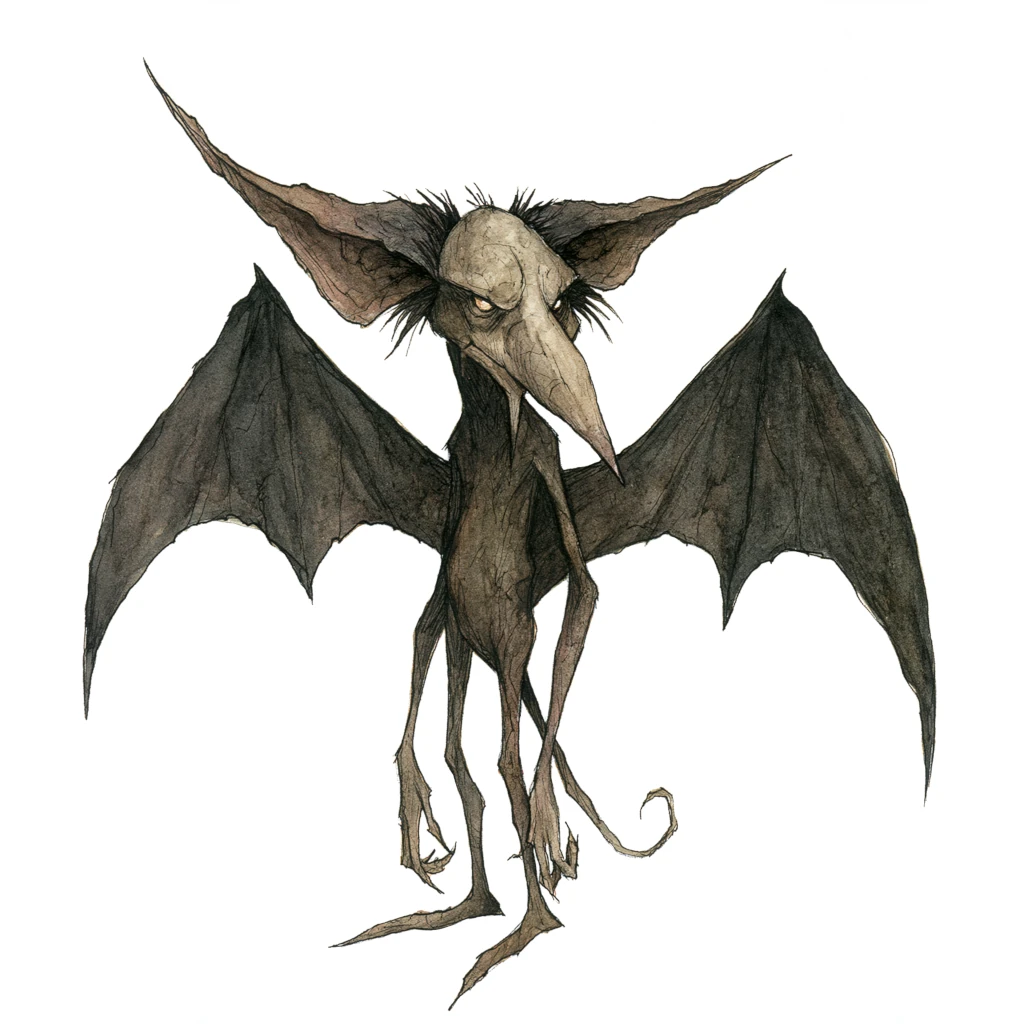
N | Small | Earth | Elemental | Mephit | CR 1
Earth mephits (may-FITT) (called “scamps” by some) are humourless misers, who care only for earning and eating treasure. Mephits are created by less moral spellcasters to run small errands, although sometimes they escape and can even reproduce on their own. Earth mephits are less annoying than others of their kind, which is not saying much. They aren’t as useful as fire, ice or water mephits, but at least they are able to vomit up pebbles drawn right from the Anvil. Not as useful on the Plane of Earth itself, but perhaps someone in need of construction materials will appreciate it. Mephits vary heavily in their appearance, but most of them resemble small crooked humanoids with bat wings. Earth mephits have wings of stone and don’t flap them when they fly. Instead, their flight is entirely magical. Earth mephits really don’t like to fly, and they prefer to stay buried in dirt. Stone mephits are a variation of earth ones. They are sturdier and can pretend to be statues like gargoyles. Due to the ability to stand still, they are also marginally more bearable to interact with. Fortunately for all of us, mephits don’t have much power in the Plane of Earth, and many of them exist in servitude. Other types of mephits, such as magma, mineral, dust and sand ones also may be encountered in the Anvil, but they are much rarer.
Meaning: A sign that the giver will not concede to demands; a stubborn answer of ‘No!’ to a request.
Stats: [ D&D 2e | 3e | 5e | PF 1e | 2e ] Planescape Monstrous Compendium Appendix I [2e] p72; Monster Manual [3e]p132-134; City of Brass [5e]; Bestiary [PF1e] p202; Bestiary [PF2e] p150 (as mephit); see also Monster Core [PF2e] p146 (as scamp)
Mephit, Stone
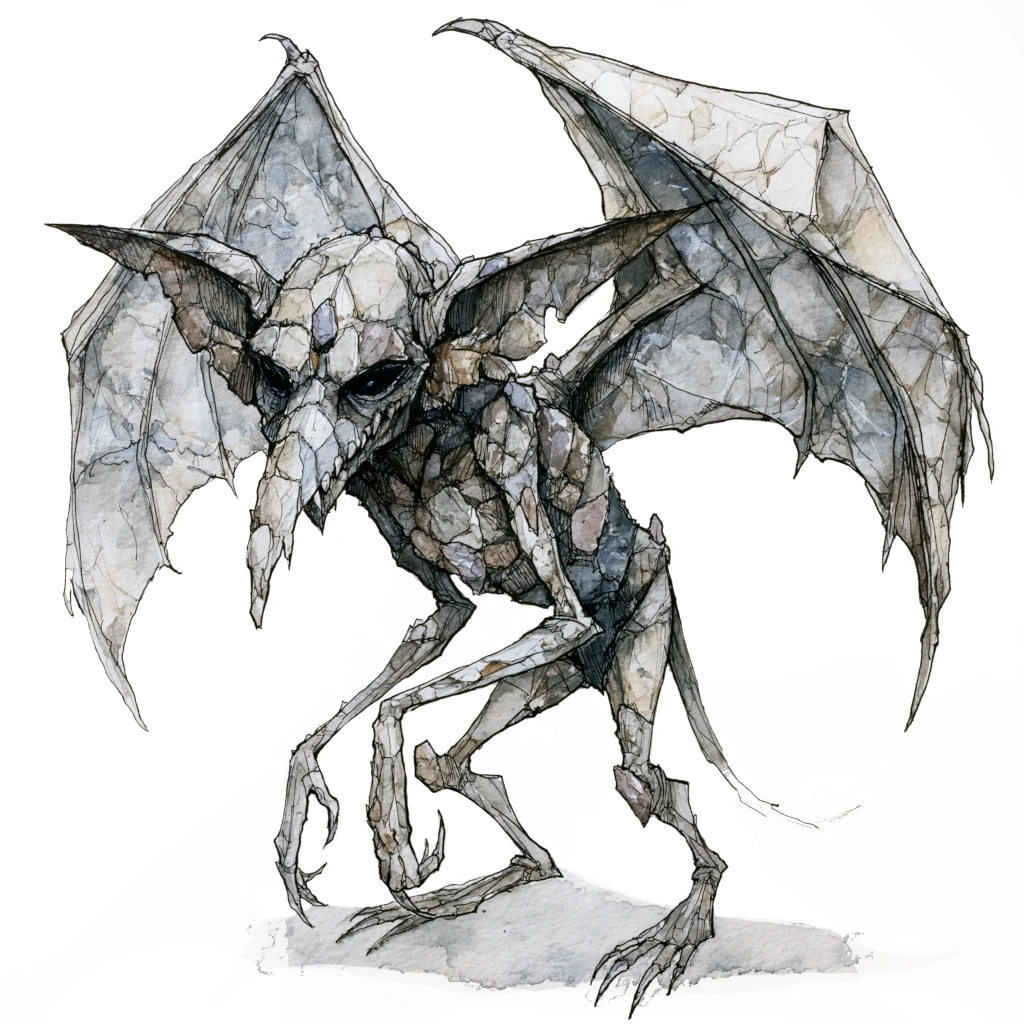
N | Small | Earth | Elemental | Mephit | CR 1 †
Whereas an earth mephit is composed of compressed soil and grit, stone mephits are rockier in constitution. Looking like statues carved quickly and crudely from low-quality blocks of rock, they are covered in cracks and gaps where chunks are missing and pebbles have been pushed in to fill the gaps. Their wings are stiff membranes of slate, with flexibility more like a shield than a bat’s wing. Their faces are elongated and ugly, with long noses and ears. Most stone mephits would be given a job as a church gargoyle pretty quickly, although they wouldn’t hold it for long, because they obsess about the most trivial things. They can’t help but count things, for starters, like the number of pebbles in their body, the number of leaves on a tree, or the number of stars in the sky. Perhaps because they are so distracted by this they are slow to speak, answer questions or react to other cutters. As a result, a stone mephit always seems to be in the way, getting under other cutters’ feet or accidentally tipping them up.
Meaning: A stone mephit sent as a message should be interpreted as a stern warning: This is not the moment for surprises.
Stats: [ D&D 5e ] Chelimber’s Descent [5e] p22 (variant mud mephit) † See also: Parlez-Vous Mephit? — a treatise on the Lower Planar Mephit Code
Mephling, Earth
Supposedly, a mephling is an offspring of a small humanoid (say, a halfling) and a mephit. I am inclined to believe such folks are misinformed and that so-called ‘mephlings’ are actually genasi—if only to avoid the question of how such a hybrid might come to be.
Stats: [ D&D 3e] Planar Handbook [3e] p10
Mole Cricket, Giant

Mole crickets are among the more common insects in the Anvil. For those in the dark, these are the borrowing crickets with large and powerful forelimbs. In the Plane of Earth mole crickets can reach the size of a donkey. They are a bit different from those living on Prime—their wings are underdeveloped, and they are more resistant to the lack of air. Large predators like drakes and humanoid natives like pech hunt giant mole crickets. Despite their size, they are timid and prefer to run (well, dig) to escape predators. Of course, if it fails, mole crickets can bite with their mandibles or fire off the stinking liquid like a skunk.
Source: Homebrew
Necromental, Earth

When negative energy infuses the corpse of an elemental, it corrupts it into an undead-like state. Such necromentals corrupt the elements around themselves, hunting elementals and mortals alike to satisfy their endless hunger. These beings are especially common near the Plane of Dust and around Negative Energy pockets.
Stats: [ D&D 3e; CR +1 ] Libris Mortis [3e] p112-114
Nerephtys

Among the strangest elemental beings in the plane is the nerephtys. This creature is an ooze-like blob of liquefied earth with teeth made of crystal. It has mineral-based organs and tissues not unlike galeb duhr. However, it is barely sentient and mostly interested in preying on everything that comes its way. When the nerephtys attacks, its razor-sharp teeth pierce the flesh of its victim and slightly liquefy before crystallising again. It is almost impossible to get out of such a grab without tearing out your own flesh. Nerephtys attack both creatures made of flesh and the likes of galeb duhr and agrawghs. When consuming the former, they don’t digest, but petrify them with the oily substance in their intestinal gland. Some bloods hunt nerephtys for these glands, but it is a hard job—when threatened, the nerephtys petrifies itself, becoming extremely durable (though, unable to move at all). Additionally, these elemental creatures have powerful magic resistance of unknown origin. Nerephtys are feared by many natives on the Anvil, but Ogremoch’s forces are rumored to tame a couple of those.
Stats: [ D&D 3e; CR 7 ] Dragon Magazine #276 [3e] p87
Onyx Scourge

Negative energy is known to produce many strange and terrible effects, and onyx scourges are among them. Dao legends claim that these destructive elementals can trace their lineage to a single pocket of Negative Energy. Around this pocket was formed a sphere of black onyx. When one elder elemental went to investigate it, they weren’t destroyed, but modified. Veins of black onyx infused with negative energy covered their body, while desire for destruction occupied their mind. Other onyx scourges are said to be elementals, convinced or forced by the first onyx scourge to go through the same onyx sphere. Now, there’s no actual proof any of these has happened. Onyx scourges behave in the same way other negatively infused creatures act—cause constant destruction, heal off of negative energy attacks and attack everything on sight. They have no allies, and when they speak to anyone, they tend to compulsively lie, as if out of love for entropy even in language.
Stats: [ Pathfinder 1e; CR 16 ] Pathfinder Adventure Path #120 Vault of the Onyx Citadel
Oread

Oreads are an another kind of nymph native to earthen environments, the spirits of mountains. Of course, the Plane of Earth doesn’t really have mountains (aside from the ones briefly forming in Tumbling Rocks). However, it still has large and relatively unmoving continent-sized rocks, whose friction seems to be the primary cause of the infamous earthquakes. Primes have come to call them “mountains”, despite having no apparent resemblance. Oreads in the Anvil inhabit such rocks in large numbers. Unlike lampads, they don’t live in caves, but instead spend their time inside the stones. Oreads in the Plane of Earth face a conundrum. They naturally tend to protect their mountains from destruction and on Prime they attack miners. However, they also appreciate natural beauty of many plants and animals that inhabit such mountains. As creatures of the natural world, who still belong to Feywild more than to the Plane of Earth, oreads can’t simply exist among barren rock, even when having each other and elementals to keep their company. So, some of them allow or even encourage tunnelling through their realms—with certain limits, of course. Oreads and lampads frequently come in conflict with each other—not only are their habitat preferences differ considerably, but their personalities as well—stern and stoic oreads are often annoyed by lampads’ constant weeping.
Stats: [ D&D 2e | 5e; CR 4 ] Planes of Chaos [2e] Monstrous Supplement p20. Canonwatch: The lore here is pretty confusing. The Greek oreads were nymphs of the mountains, and that’s the Planescape 2e interpretation. For some reason 5e associates them with fire and volcanoes. Pathfinder uses the word ‘oread’ to refer to what D&D calls earth genasi. We’ve got with the Planescape 2e interpretation here.
Ozimat

Golems are typically created by capturing an elemental spirit and binding it. Earth elementals are especially predisposed to this kind of servitude due to their connection to clay and stone and focused nature. Golem builders try to bind mindless elemental spirits to prevent golems from rising up. However, sometimes this process goes awry. Whether the spell-slinger have bound a sapient elemental, or the elemental spark have manifested sentience on its own, a golem may end up being self-aware. Of course, enchantments placed on the golem prevent it from going rogue. But should the golem be destroyed, its animating spirit may rarely survive and be drawn back to its home plane. In these extraordinarily rare circumstances an ozimat is born. This incorporeal green humanoid can petrify creatures with its touch and briefly inhabit stone objects like it used to in its golem days. Ozimats’ motivations vary greatly between individuals. Some of them seek revenge for mistreatments and will hunt spellcasters or even all humanoids. Others strive to instead find a new purpose in their life and may be quite friendly. Many retreat in the Deep Earth, where they can lay dormant far from anything that might hurt them again. The possibility of disturbing these ozimats is yet another reason to avoid digging too deep into our plane.
Stats: [ Pathfinder 1e; CR 11 ] Planes of Power [PF1e] p62.
Pech—Elemental, Earth-Kin

It’s amusing to think such seemingly insignificant humanoids are among the most numerous non-elementals in our plane. Oh, for sure, at a glance they resemble scrawny (and sometimes hairy) elementals, but this is merely due to their granite-like skin. It is infused with minerals and provides protection from many kinds of damage. Pech (PESH) are not as tied to earth as, say, mephits are. They don’t eat rocks, but instead feed on those few plants and animals they can find—mosses, mushrooms, worms, khargra and so on. Such animals typically have enough nutrients in them for pech to grow their stony hide. While pech have very little apparent sexual dimorphism, they still breed and birth offspring much like humans do. Overall, they are quite farther from elemental earth than other major players of the plane, and may be some kind of planar migrants. But should this assessment be true, then pech would have to had migrated to the Anvil eons ago, as the exposure to the Plane of Earth have still altered them significantly.
Pech are natural mages, especially when they come together. They can manipulate and transform stone, and multiple pech can combine their powers to much greater effect. Pech also use more subtle magic to infuse their pickaxes, making them sharper and more durable, able to damage even hardest rock. Unfortunately for them, pech tribes rarely have the capacity for forging metal items in bulk. Most tribes trade minerals, services and planar curiosities for tools and food. Pech can often be found around unattended portals. They rarely venture out to other planes for too long due to being very sensitive to the bright light of the day. Overall, pech are good-natured people, who are friendly and dislike fighting. However, it heavily depends on the disposition of their tribal leaders, and some communities were shown to be very violent.
Stats: [ D&D 2e | 3e | 5e; CR 4 ] [ Pathfinder 1e; CR 3 ] Monstrous Manual [2e] p102; Quests from the Infinite Staircase [5e] p13; Bestiary 2 [PF1e] p206
Plasm, Earth

Earth plasms appear as human (or, rarely, giant) skeletons covered in dirt, but they aren’t undead. Plasms were observed to appear when an ethereal storm collides with the ethereal curtain of a corresponding element, though what they are and how exactly they appear is dark. Plasms are intelligent, but they seem to seek only destruction and only briefly cooperate with the like-minded creatures. It’s no surprise that no community, elementals or not, welcomes them, and even Doomguard have deemed them to be unworthy of attention.
Stats: [ D&D 2e ] Mystara Monstrous Compendium [2e]
Pneuma, Earth

Pneumas are petitioners that find their place in the Inner Planes, and on the Plane of Earth, they assume stony or crystalline ethereal forms. Most of them are short-lived, as they quickly transform into dao and find their way to their kin. Those, who serve Powers, can linger for a bit longer as a rocky image of their previous life. However, most Powers prefer to transform their petitioners into other, more convenient forms.
Stats: [ Pathfinder 1e | 2e; CR 1 ] Bestiary 2 [PF1e]; Bestiary 2 [PF2e] p198
Razhak

In all superficial ways razhaks appear identical to earth elementals—they are slightly humanoid aggregations of solid rock. However, there are very important differences between them. Earth elementals are spirits that can inhabit any kind of earth from rubies to dirt, while razhaks are a specific kind of stone unique to them. It wouldn’t be a very accurate analogy, but I can describe razhaks as oozes or giant single-celled organisms, except made of stone that gained sentience. Razhaks can become malleable to attain any shape, while still retaining their durability. This may mean they are an ancestral form or a relative of sorts to nerephtys, but proofs are scarce. But unlike nerephtys, razhaks are peaceful creatures. They feed on stone by absorbing it as the sponge absorbs water. They move in roughly the same way—by absorbing rock on one end and excreting it on another, leaving no trace of their passing.
Razhaks can easily leave behind their body parts and build new ones at the same time. This means it’s nearly impossible to defeat a razhak as long as it has stone to consume. This invincibility made razhaks disinterested in political affairs of the Anvil. However, they are known to venerate both dharum suhn and Sunnis and have sometimes came to aid to their dwarven friends. Due to the way razhaks move, they can very quickly build crude, but durable structures of stone (though this stone is still passable with earth glide and as such is only useful on other planes). Razhaks form communities of up to 100 members, though each member is solitary and can be miles away from any other razhak. Despite this, they constantly communicate through some sort of telepathy, telling each other news and such. Only in times of trouble do razhaks come together.
Stats: [ AD&D 2e ] Dragonlance Otherlands
Rilmani, Abiorach

Rilmani are monitors, who act to maintain true neutrality on the Planes. While most of their actions target the Outer Planes, one of their species centres the Inner Planes and the balance of the elements. Abiorachs feel right at home on any Elemental Plane, and they act to prevent one of them from encroaching on others too much. Most abiorachs on the Plane of Earth adhere to the philosophy called The Foundation of Freedom. They seek to attain balance between stillness of Earth and movement of Air, between stability and freedom.
More chant on the abiorach rilmani here
Stats: [ D&D 2e | 5e; CR 5 ] Planescape Monstrous Compendium Vol. II [2e] p86; Manual of the Planes [5e] p397
Rockworm / Rocklord

As if bi-nou weren’t bad enough, they’ve got some relatives as well. Rockworms look like stone snakes with two clawed arms. They are carnivores, who live in small packs. Like bi-nou, they hunt animals and humanoids for food, but can also often attack them unprovoked to protect their eggs and their territory. Strangely, they don’t have the same kind of animosity towards crawling creatures like snakes. Perhaps, they view them as equals? Rockworms are most known for their eggs—the same beautiful gemstones as those of bi-nou. They have a slightly lighter tint, but sell for much higher—all because of the higher risk involved. See, both bi-nou and rockworms must “warm” their eggs (which is weird, since they exude no body heat, but nonetheless must stay next to eggs to somehow nurture them). Bi-Nou leave one of their own to take care of all of their offspring, but rockworms guard their nests collectively. They are already ferocious when hunting, but any threats to their unborn children makes them truly unstoppable.
Now, rocklords are giant rockworms with huge forelimbs, who stand upright when they attack. For a long time they were thought to be exceptionally old or mutated rockworms, but careful observation revealed that rocklords are merely males of the Rockworm species. They leave their packs at a young age and hunt alone or in small groups, growing to twice the size of their female peers. Rocklords search for a mate every couple of years. When they come across the pack of rockworms (and fight off other rocklords, who lay their claim on them), they mate with every female in the pack and leave again after a pretty short time. Rocklords obviously don’t lay eggs, but they are valuable in another way—their hides are extremely tough and can be fashioned into armour or weapons.
Find more chant about the bi-nou here
Stats: [ D&D 2e ] Monstrous Compendium Annual Volume Two
Rukarazyll

At first glance, a rukarazyll doesn’t appear to have any connections with the Elemental Earth. This horrible fungal being is a mass of protoplasm with tentacles protruding from it. The head of its snakelike body resembles a ram’s skull, with fungus poking out from its eye sockets. The touch of the rukarazyll infects living things with the fungal disease it carries. When in need, a rukarazyll can spit out a glob of sentient gray ooze that serves as its minion. But even if it looks like something out of the Abyss, the rukarazyll was actually created by Ogremoch, as so many other horrors are. They are very intelligent for their looks, and their purpose is to create false cults. A rukarazyll starts by assuming humanoid shape and entering a remote settlement as a pilgrim or a prophet. It begins spreading its faith by masquerading it as a beneficial service to some good-aligned minor power. However, as the cult gains power, its worship becomes darker, and rituals turn obsene. All belief is channeled to Ogremoch, granting him that divine power. Rukarazylls delight in corrupting societies, but they rarely get the chance to do so on the Plane of Earth. Aside from natives being not very religious, everyone is wisened to their tricks by now. However, rukarazylls are also great infiltrators, who grant the Elemental Evil an unexpected advantage.
Stats: [ D&D 3e; CR 14 ] Monster Manual II [3e] p181
Ruvoka—Brajeti and Zathosi
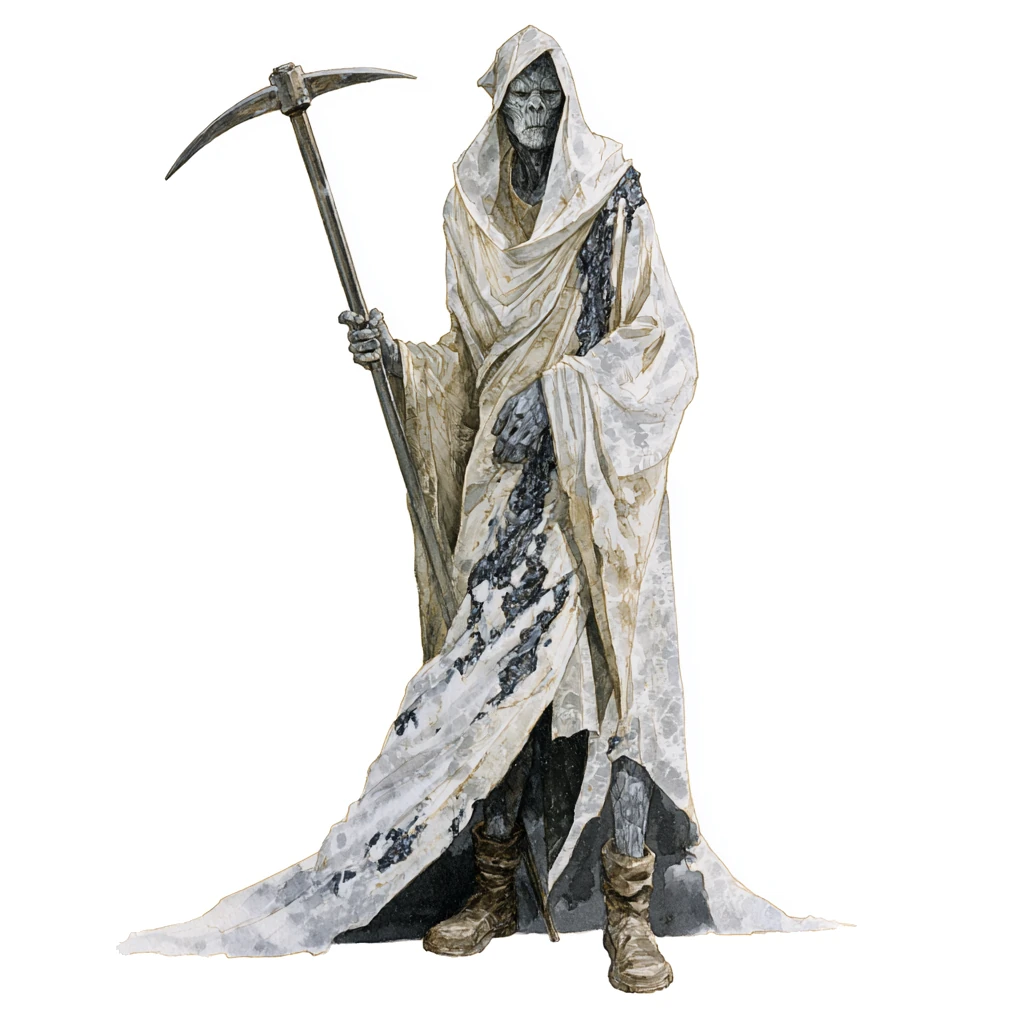
Ruvoka are mysterious humanoids found throughout the Inner Planes. They don’t align themselves with any faction, but sometimes support the Elemental Good. Ruvoka are powerful spellcasters, who can speak to anyone through telepathy. They live in egalitarian tribes, where each member seems to somehow know their duty. Chant goes, ruvoka were powerful druids, transformed by the noble efreeti into elementaloids they are now. While the truth of this origin is uncertain, ruvoka do care for the nature of their planes, each tribe in their own way. Zathosi are especially notable in that regard—these wrinkly humanoids in stone-coloured robes ally with crysmals, xorns, agrawghs and even chaggrin grues—everything that eats stone (much to the annoyance of earth weirds). See, they know that many creatures need tunnels and caves to live in the Anvil. Zathosi carve new tunnels and populate them with life. They are quiet and very secretive about it, and they don’t care for how dangerous fauna they spread may be.
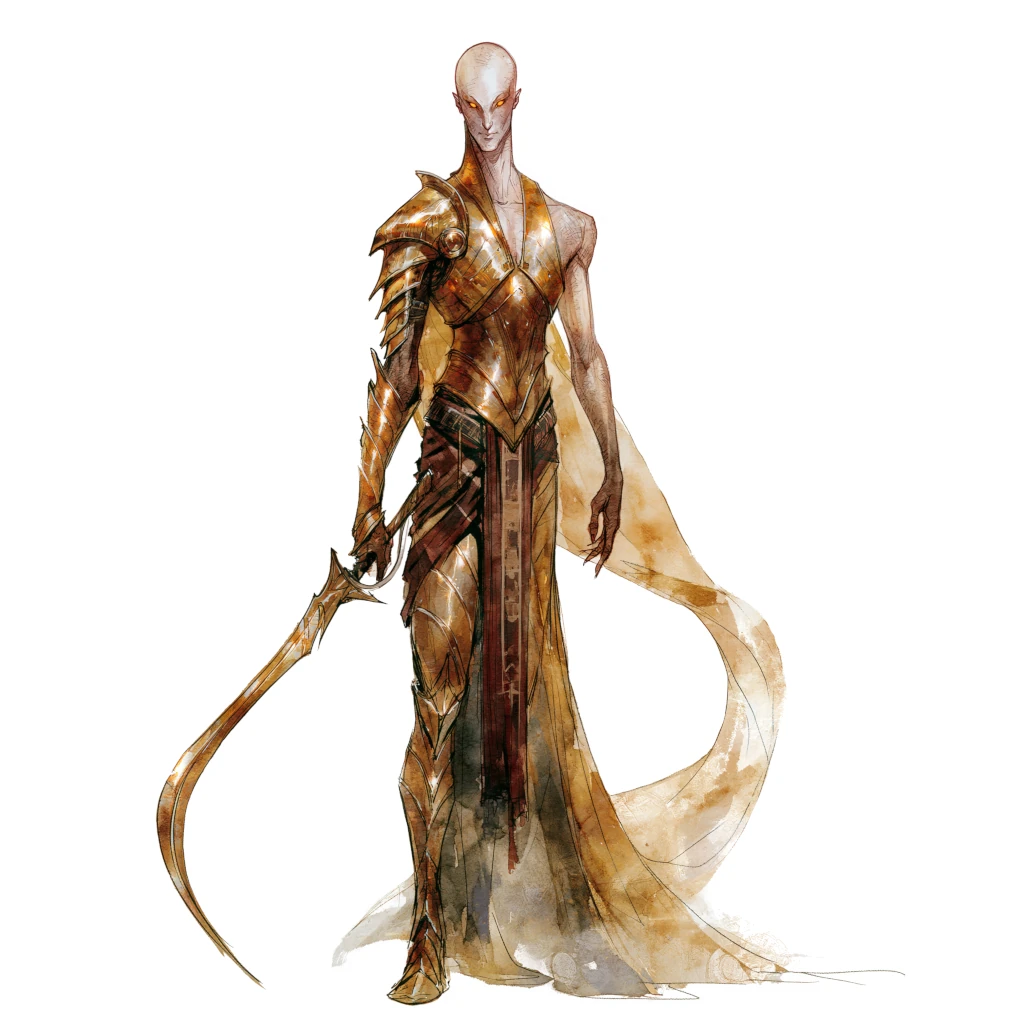
Brajeti are the second major tribe in Earth. They are tall bronze-skinned humanoids, who establish their outposts around certain places of natural wonder—huge caves, congregations of giant crystals, adamantine algae growths and so on. Sometimes they seek out rare minerals they believe need protection from exploitation and hide them in secret places. No one has the dark on such places, but many speculate it may be the Plane of Metal or some location in the Elemental Chaos. Chant goes, brajeti found a brand new elemental plane and now search for things to fill it with. I find this notion laughable at best, but I cannot deny that ruvoka are among the most mysterious races of the Anvil.
Stats: [ D&D 2e ] Planescape Monstrous Compendium Vol. III [2e] p90-91
Sandling

Sandlings appear like a single elemental of sand, but in truth they are a swarm of hundreds of thousands of living sand grains, each being its own being, similar to galeb duhr, if much more primitive. Together those living sand grains have a shared mind, much like hordes. Unlike hordes, however, sandlings consume only minerals and at a slow pace. They are loners and stay away from everything, especially organic life. Most encounters with sandlings involve them being aggressively territorial. Sandlings are common in the Sandstones, where few beings ever disturb them and where they can be safe from water—liquid substances make them extremely uncomfortable.
Stats: [ D&D 2e | 3e; CR 2 ] [ Pathfinder 1e; CR 2 ] Monstrous Compendium Vol. 2 [2e]; Tome of Horrors Complete [PF1e]
Sandknight

One of the reasons to avoid the Sandstones region (and Quasi-Elemental Dust, for that matter) is sandknights. Build of pebbles and sand, they are true elementals. But unlike true elementals, sandknights aren’t passive. They are violent warriors, who carve out their own realms near the Plane of Dust. Sandknights form bladed weapons out of compressed sand. Such weapons have abrasive properties and can damage earth elementals and other similarly tough creatures. The sandknight’s touch is abrasive too, and they use it to create long-lasting tunnels and caves. It seems, sandknights used to be soldiers for some planar mages, until they escaped and became able to create more of themselves from sand. There are spells allow casters to raise temporary sand warriors, and those beings bear much resemblance to sandknights.
Source: Dungeon Magazine #110
Sandman

Another possible progenitors of sandknights are the sandmen. These humanoid figures of fine sand are created by dao from enslaved earth elementals and imbued with magic. Sandmen are obviously very unhappy about their position and hate dao. However, dao have managed to pull off a little trick—through magic and indoctrination they convinced sandmen of the simple lie—that only those strong enough deserve freedom. This (and the fact that humanoids often slay sandmen to gain ingredients for their sleep-based magic) makes sandmen despise humans and other such beings even more and hunt them at every opportunity. Not only that, dao promise that a sandman, who brings them a better slave-taker than it, will be rewarded with freedom (and sometimes this promise is even kept). It is hard to find someone better suited for kidnapped though—the main magical ability of sandmen is their aura of sleep. Every being that can will fall asleep, if it touches the sandman or just exists in general proximity of it. This is insanely valuable if the goal is to deliver the slaves unharmed. Sandmen are weak in direct combat and they rely heavily on their powers, being terrified of those, who can resist their enchantments. It’s truly saddening to think of the minds of those wretched, deeply traumatised beings, but it is also wise to keep your distance from them.
Stats: [ D&D 2e | 3e; CR 3 ] [ Pathfinder 1e; CR 3 ] Monstrous Compendium Annual Vol. 1 [2e]; Bestiary 2 [PF1e]
Shad
Finally, the time has come for me to talk about my own people. Shad are the relative newcomers to the plane—we appear in records no more than two millennia ago. By all accounts, our history have started on the Prime world called Verdorth. A circle of druids from that world set out to colonise the Plane of Earth to create a place where plant life would reign supreme. While this attempt was laughably misguided, they were persistent enough to create a little ecosystem, sustained by artificial portals. This ecosystem, combined with the Anvil’s unique conditions, gave rise to marvellous plants and animals. There’s no shortage of screed surrounding supposed wonders of that place, but it doesn’t matter—the druids were slaughtered by some unknown enemy, and everything in their garden withered away (unless brajeti stowed something away, which some berks claim they did). Everything, except for us. Shad used to be semi-sapient creatures with strange biology reminiscent both mammals and insects. They lived hidden inside the giant trees, observing druids and their magic. So when their unknowing caretakers were gone, shad persevered through channeling this power. They evolved, formed a culture, using primal and divine magic to cultivate food and carve new tunnels. This, of course, doesn’t mean we rely exclusively on magic to survive. Shad have become experts of the Anvil, and a lot of tunnels are explored and marked by us. We are a peaceful folk who rely on plants and small animals for subsistence. We also eat our dead—something which disturbs many other races. Don’t worry, we do not kill our own, though starved tribes can attack humanoids for food. I could talk for hours about our culture, about the markings we leave on tunnel walls or about our earrings that are so important for every shad. However, I’ll try to swallow my national pride and simply advise you to not underestimate even the most simple of races. Nowadays shad are open to new experiences, and if a blood can pay them a visit, they can learn a lot from my people.
Stats: [ D&D 2e ] Planescape Monstrous Compendium Vol. III [2e] p96-97
Shubin

Pockets of explosive gas are among the most dangerous hazards in the Anvil. However, there’s a creature that is dedicated to protecting berks from exactly this kind of danger. Shubins are mysterious spirits—some say they are fey, some claim they are undead and some even believe that there’s only one shubin, and it’s a minor power. They are benevolent and mostly seen wandering around in the tunnels, observing wildlife and tending to plants, appearing like dwarves with white beards and shiny silvery pickaxes. However, the mere presence of a shubin is a bad sign—they only appear near the pockets of gas. Now, such pockets often accompany veins of coal, which is almost as sought after by dwarves and other miners as iron ore. For this reason, canny miners designate one crew member as a gas-burner. Their job is to run forward with a torch and burn the leaking gas before it can add up and cause an explosion. Of course, it is a very dangerous thing to do, and many gas-burners have died from flaming gas. Fortunately, shubins often come to the rescue. They warn miners in their own way—like mimicking various sounds—and can even magically protect them from fire. Miners, in turn, leave them treats as gifts of gratitude. Of course, being chaotic creatures, shubins are somewhat mischievous and vindictive, and they won’t help especially wicked berks.
Source: Homebrew. Mythwatch: A shubin is a helpful spirit in the folklore of the coal miners of Ukraine (though similar creatures are known in other places as well).
Sod Hound

Sod hounds are elemental beasts, created by dao in the same way sandmen and earthen destriers were. They are built of soil and pebbles and used as loyal guards and hunting assistants.
Stats: [ Pathfinder 2e; CR 3 ] Monster Core [PF2e] p142
Stonesinger / Tralusk

These bizarre creatures share some similarities with earth elemental creatures, but otherwise are completely aberrant and likely not even native to the Plane of Earth. Looking like a hybrid between a scorpion and a mindflayer with a lamprey for a tail, stonesingers are most known for their haunting song-like cry. They are obsessed with music (and rhythmic sound in general) and often join together in small choirs. Stonesingers sometimes kidnap creatures just to bury them into the ground, leaving only head exposed, and making them listen to their songs. Fortunately, these songs are not harmful and even somewhat beautiful, even though some claim the prolonged exposure can drive a sod insane. Unfortunately, after their “concert” stonesingers tend to eat their audience. They go about it by injecting victims with their petrifying venom and then eating them (much like basilisks do). They can also eat naturally petrified fossils, though they don’t prefer them. Stonesingers are frightening combatants, boasting a durable stony hide and minor magical abilities. But if you aren’t strong enough to fight them, your last chance of survival may be to impress them with your own singing—sometimes this may convince them to leave you alone or even show a modicum of respect.
Stats: [ D&D 3e; CR 7 ] Monster Manual III [3e] p168; Dragon Magazine #285 p78
Stone-Eater

Stone-eaters, known as horgar by dwarves and storgin by gnomes, are rock-like slugs, who belong among the distant relatives of flail snails. They slowly borrow through the rock by constantly producing heat and acid. It isn’t clear whether stone-eaters evolved in the Plane of Earth or were brought in by settlers. Stone-eaters consume only earth and stone, which they digest with the help of bacterial symbionts. Their waste actually includes breathable air, which makes them quite valuable to many races. Another useful thing are their eggs that radiate heat and are covered with an acidic slime. Due to their size and acidic envelope it is dangerous to hurt stone-eaters, but their eggs are easier to aquire, since gastropods do not have any kind of maternal instincts. Dwarves, drow and deep gnomes actually keep domesticated stone-eaters, housing them in glass-lined pits that are impervious to acid, and they herd them with glass spears. Some stone-eaters are known to reach truly enormous sizes of up to 100 feet in length. A number of such worms are accompanied by ruvoka, geonids and shad tribes, who view them with reverence for their tunnel-carving role.
Stats: [ D&D 2e ] Greyhawk Monstrous Compendium [2e]
Stone Maiden

From a distance stone maidens (sometimes called a stone sister) appear very similar to oreads or true earth weirds. In fact they may very well be oreads, for the difference between them is very slight. Stone maidens are linked to a much smaller stone formation, and they are loners, who have no queens or communities. The most notable thing about stone maidens is a widespread legend that claims that they are actually cursed human women. More than a few Clueless tried and failed to retrieve some magic item believed to be able to bring stone maidens to their previous form from noble dao. Considering stone maidens themselves don’t show any desire to be ‘saved’, it looks like this legend is a screed, spread by the dao to attract would-be slaves.
Stats: [ D&D 2e | 3e; CR 8 ] [ Pathfinder 1e | 2e; CR 6 ] Al-Qadim Monstrous Compendium [2e]; Tome of Horrors Complete [PF1e]; Impossible Lands [PF2e] p338
Stone Snake

Another cousin of the galeb duhr, the stone snake is a medium-sized predator with a petrifying bite. Like stonesingers and basilisks, they primarily feed on petrified flesh. Against creatures with protection from petrification it instead uses its own snout that is also useful for digging. Being made out of stone, stone snakes are generally useless, but their eggs find some use among mages.
Stats: [ D&D 2e ] Dragon Mountain [2e]
Stone Spike

Stone spikes are relatively weak earth elementals, who form maul-like hands covered in spikes. They are equivalent to other earth elementals in almost all regards. I suppose they are something akin to an artistic movement or a faction among elementals, although stone spikes themselves just say they enjoy assuming this spiky exterior.
Stats: [ D&D 3e; CR 2 ] Monster Manual II [3e] p191
Stone Spirit

Stone spirits are merely an another name for regular (typically evil-aligned) elementals, who inhabit stone statues. Sometimes they have minor magical abilities such as flying. Stone spirits often fancy objects of art, such as statues and jewellery. They shouldn’t be confused with Spirits of Earth—a form that powerful earth elementals may assume on the Prime Material Plane.
Stats: [ D&D 2e ] Kara-Tur Monstrous Compendium [2e]
Sturzstromer

When enough cobble mites remain together for a long time, something strange happens. Their unsophisticated minds meld together, becoming greater than a sum of swarm’s parts. Thus, a sturzstromer is born. This giant living avalanche is not merely a powerful monster—it can call forth the powers of Earth to cause a magical earthquake. According to those few sturzstromers, who were willing to chat, they view themselves as the artists of creation and destruction (well, mostly destruction). They spend centuries slowly building caves and mountains and then destroy them in seconds. This destructiveness obviously endears them to Ogremoch, but also to many other factions, who hire sturzstromers as demolition engines.
Stats: [ Pathfinder 2e; CR 19 ] Bestiary 3 [PF2e] p52
Thomil, Rock Spirit

Thomil to me seem very similar to flame spirits, except made from earth. They are regular elementals, who are summoned and modified by certain arcane groups, such as vremyonni of Toril. Thomil make excellent guardians of natural sites, and are notably resistant to magic. In other ways they barely differ from their elemental kin.
Stats: [ D&D 2e ] Monstrous Compendium Vol. 3 [2e] p99
Thoqqua

Thoqquas are best described by someone more familiar with the Plane of Magma than I am, for it is the birthplace of those creatures. These worms feed on the stone they melt with their fiery body. I can, however, describe how thoqquas are treated in the Anvil. As it is the case with most tunneling creatures, weirds and elementals despise them and often attack on sight. Dao and humanoids also don’t like thoqquas but for another reason—these creatures rarely care where they dig and sometimes melt their way right into the cavernous palaces and mines. For shad, however, a thoqqua’s sight is a great sign. Their tunnels are smooth, long-healing and are often free from predators. Some of our clerics and druids even charm them to dig new tunnels with ease.
Stats: [ D&D 2e | 3e; CR 2 ] [ Pathfinder 1e | 2e; CR 2 ] Planescape Monstrous Compendium Vol. III [2e] p106-107; Monster Manual [3e]; Crown of the Kobold King [PF2e] p123
Tosh

A tosh is a tiny (10 inches in length) armoured mammal closely related to armadillos. They are almost blind, but have great sense of smell and hearing. Tosh are solitary and keep away from large caves. They prey on worms and insects and are in turn being preyed on by many creatures from crawlers and shad to even dao, who consider them quite delectable (hungry planewalkers can try them too). Despite all this, tosh are very prolific on the Plane of Earth and on many other planes.
Source: Planescape Monstrous Compendium Vol. III [2e] p122
Thrum Worm

Despite having “worm” in the name, thrum worms aren’t worms (neither they are wyrms, for that matter). In fact, they are giant burrowing legless lizards. They prowl the softer parts of the plane, burrowing through it with their plated snout and hunting worms and other small animals. Most humanoids are just a little too big for them to attack, although shad, deep gnomes and pech can end up as their prey (most of them, however, know better than to mess with two-legged creatures). This only makes it more awesome that gnomes were able to domesticate thrum worms and use them as mounts and tunnel-diggers. Thrum worms aren’t very intelligent nor do they have good vision, yet they have a great sense of vibration. They communicate with each other through loud sounds, and they can use those sounds as an attack to defend themselves as well. Overall, thrum worms are very useful in life and in death—they are edible, if a bit unusual to the taste.
Stats: [ D&D 3e; CR 2 ] Races of Stone [3e] p190
Veela, Earth

One of the more enigmatic—and certainly one of the most alluring—of the Inner Planes’ denizens are the veela, elemental spirits who embody the raw, unbridled joy of existence itself. These captivating creatures dance in the crucible of creation, where the fundamental forces of reality converge and swirl in eternal motion. Neither fully fey nor purely elemental, veela occupy a curious position in the Grand Scheme of Things—for they are the laughter of the planes made manifest, and the embodiment of elemental exuberance. Born from the myths of the Slavic Pantheon, the elemental veela represent the primal joy of nature. While Prime fairy stories speak of veela as nature spirits dwelling in forests and rivers, the veela of the Inner Planes are actually creatures of pure elemental essence.
Get the chant on the earth veela here
Weird, Lesser—Earth

These lesser weirds are natives of elemental Earth, but can also be encountered on the Prime. It’s thought that they are the immature larval form of the oracular trueweird, although it took graybeards a long time to tumble to this dark as they appear so different. Lesser earth weirds manifest as curious serpentine creatures formed from soil and pebbles, with shiny black eyes and grass growing on their rocky hides. They can be as large at ten feet long—but they are also masters of camouflage. They are able to earth glide, which means they can effectively merge into soil or stone without leaving a trace, or a tunnel. They use this ability to hide, to surprise, or to ambush.
Get the chant on the lesser earth weird here
Weird, True—Earth

True weirds are paragons of their species, in whom the inherent energy of the elemental plane reaches a higher potential. These intelligent elementals can assume a humanoid form, speak all the languages of the Primes, and most importantly for the aforementioned mortals, the so-called oracular weirds can foretell the future. Earth true weirds typically take the form of statues, where their upper half is a female humanoid, and their lower half is a snake. Weirds themselves don’t seem to have a concept of gender.
Get the chant on the true earth weird here
Wysp, Earth

Earth wysps are shy, guarded and slow to trust, but become fiercely loyal, and will often sacrifice themselves to save those with whom they resonate. They look like small rolling spheres of muddy rock, with large dark eyes. They might try to disguise themselves as stones by closing their eyes and pretending not to be there, but there’s something unmistakable about their shape. While they are relatively slow moving and unable to fly, they can burrow underground quickly, and indeed their preferred habitat seems to be the lightless places of the planes—caverns, tunnels, dungeons and the like.
Get the chant on wysps here
Xiomorn

Essentially advanced earth elementals in an insectile form, the xiomorns possess great magical powers, especially over stone and crystal. Xiomorns are tall and slender humanoid insect hybrids, with green exoskeletons, multiple insectile limbs and emerald compound eyes which glow faintly. They are perfectly adapted for life underground, being able to see in complete darkness, sense vibrations in the ground, and glide through solid rock without leaving a trace. There are two castes of xiomorn, the Vault Builder and the Vault Keeper. The mythic Vault Builders are masters of crystalline magic, and able to extend their own lifespan indefinitely with an ancient magical item called the Generation Stone. The Vault Keepers are a subservient caste, who are left behind by the Builders to watch over experiments while the Builders move on to invent and construct ever more bizarre vaults.
Get the chant on the xiomorn here
Xorn

One of the most well-known creatures of the Plane of Earth is, of course, the xorn. These three-sided stone-based beings biologically resemble galeb duhr, yet they are much more active, and insatiable. Xorns are sapient and surprisingly communicable. The xorns prefer to live on the Plane of Elemental Earth, where they hunt gemstones. While they would surely have richer pickings on the Quasi-Elemental Plane of Minerals, they are mercilessly hunted there by Quasi-Elementals, and few xorn apparently think this is worth the risk. Xorns often form small nomadic communities. Sometimes these communities even ally, forming small, constantly moving “kingdoms” that may even have a central palace.
Get the chant on the xorn here
Stats: [ 2e | PF2e ] Bestiary [PF2e] p146-147 (see elemental, earth)
Other Creatures of Earth
- Animals: There are few animals who can survive in the Anvil. Worms and burrowing arthropods are the most common of them, but mammals such as moles can also be found.
- Elementals: There are plenty of elemental creatures, who can visit the plane. Magma and Ooze paraelementals, Dust and Mineral quasielementals and metal elemental beings are the most common of them.
- Monstrosities: While it is hard for them to find food here, beasts such as gorgons, medusae, basilisks and cave worms are not unknown in the Crushing Deep.
- Aberrations: Neogi have made their presence known in the Plane not too long ago, although I suspect they won’t be here for long. Otherwise, ropers and piercers live in caves along with some beholderkin and even gogiteth.
- Outsiders: While I described celestials and rilmani in detail, other outer-planar races can be found in the Plane of Earth. Modrons are somewhat frequent due to the Plane of Earth being connected to Mechanus through a major portal. Fiends are often found in Ogremoch’s court, while likhoradkas sometimes visit the Plane simply to hunt—the dusty, lightless and cold tunnels are great for spreading diseases.
- Giants: Stone giants’ colonies are numerous, for quite obvious reasons.
- Dragons: Dragons, aside for catastrophic ones, don’t like venturing out of the Prime Material Plane, but there is a sizeable population of gem dragons. They try to keep low to prevent confrontation with earthquake dragons, but, being dragons, they aren’t exactly humble about it.
- Humanoids: Lastly, humanoids are, as always, prolific all throughout the plane. Deep gnomes are practically natives by now, while dwarves, drow, goliaths, orcs and, of course, humans venture out in search of treasure.
A Bestiary of Earth
The following creatures are described in more detail…




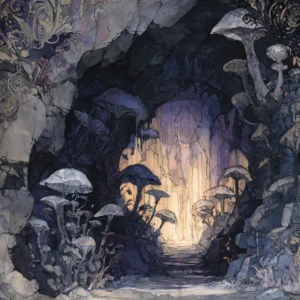
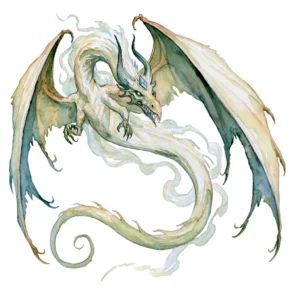
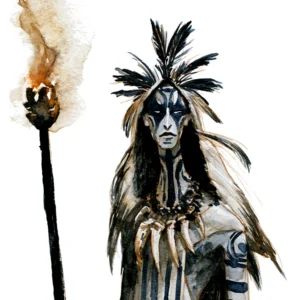





Canonical Sources: Start with the excellent Planescape Inner Planes [2e] book. Other references from D&D and Pathfinder lore are mentioned on the relevant entries.
Other Sources: Margarita, Jon Winter-Holt