
[ Elemental Chaos ] [ Mapping Infinity | Bestiary | Flora ]
Bestiary of the Elemental Chaos
Almost every elemental creature can be found somewhere in the Churn of Chaos, but only a few of them can truly be called natives. Most of those who are not natives are looking for a way out…something you’ll come to understand when you realise just how many of the locals are entropy-obsessed destructive monstrosities.
Abomination

Outsider; any alignment. CR 20+
An abomination is a grotesque, misshapen being born from a catastrophic mistake—perhaps the unwanted offspring of an ill-conceived divine union, or maybe one of the living weapons forged by primordials during the Dawn War against the the gods. Themselves possessing a spark of godhood—but also cursed by both the Heavens and the Hells—abominations are virtually immortal entities of pure hatred that project their self-loathing onto the multiverse in general. They seek the complete eradication of life, death, and existence itself through apocalyptic destruction. These beings come in many terrible and unique forms, each one shaped by its traumatic birth. Most of them remain sealed away by divine decree forevermore, imprisoned in Carceri or the Elemental Chaos. However some unique specimens like the infamous Tarrasque, Xixecal the Living Glacier, Annak-Kur the Empty Blade, the formless thunder-being Thrasvarrun, and the mysterious Engakar have escaped or were accidentally freed. These beings are now scattered across the multiverse, powerful enough to can panic entire nations, worlds, or even planes with their appearance. Abominations gain a twisted satisfaction from feeding on living victims, despite rarely needing sustenance. While they cannot grant spells to followers, some accumulate cults of mortal worshipers who are drawn to their near-divine power.
Stats: [ D&D 3e ] Epic Level Handbook [3e] p157-158; The Plane Below [4e] p128-129
Aoa

N Outsider; CR 3–15
The aoa is a strange entity that resembles a massive floating orb of quicksilver. Its mirror-like surface reflects light, and is surrounded by small silver droplets that continuously drift out of and reabsorb into the main sphere. They’re most often found in the Elemental Chaos, but also the Astral and Ethereal Planes—particularly at the turbulent boundaries where planar energies swirl and clash. Typically, aoa drift along lazily, until they detect a aura of magic. At that point they become erratic and rush toward the source, instinctively intercepting spells and touching enchanted items. Graybeards believe aoa are the neutral counterparts to energons, born from the rare friction between the Positive and Negative Energy Planes, although they embody the reflection rather than the emission of energy. Highly resistant to harm, aoa naturally reflect most attacks and spells, bouncing magical forces back at their source. Some cutters reckon that aoa are not truly sentient, at least not as mortals understand it, and like the energons, they seem to possess no language. Aoa are sometimes bound by skilled spellcasters as guardians, sustained by steady but modest sources of magic.
Stats: [ D&D 3e droplet CR3; sphere CR15 ] Fiend Folio [3e] p14-16
Chaos Falcon

N Elemental beast; CR 10
A solitary elemental bird born from extreme weather—or elemental—conditions, the chaos falcon is a contradictory creature of both fire and ice, lightning and ash. It thrives in temperatures ranging from extreme heat to bitter cold, and can wield the power of lightning and magma as well as flame and water. These unpredictable raptors nest in volcanic vents and geothermal areas where the heat of magma incubates their eggs. They travel vast distances to frolic in volcanic eruptions or whirl around in hurricanes. Experienced planewalkers see them as harbingers of both storms and tectonic activity, while clueless primes fear them as omens. Chaos falcons generally prefer to avoid civilisation, and only attack when their nesting grounds are disturbed or they feel threatened. The variability of their nature makes them dangerous opponents even for well-prepared planewalkers, as their ability to seamlessly switch between opposing elemental forces keeps their enemies off-balance.
Stats: [ PF2e ] Howl of the Wild [PF2e] p143
Diabolus

CG Humanoid; CR 3
The diaboli are a race of rarely-encountered, red-skinned, hairless humanoids native to the Dimension of Dreams (or Nightmares) but often live in the fifth-dimensional space of the Elemental Chaos. Their feet are split hooves, they have three-fingered hands, vertical-slit pupils, a forked sensory tongue, vestigial horns, and a poisonous tail. Despite their demonic appearance to humans—who they likewise view as monstrous due to their opposed dimensional perspectives—diaboli are a unexpectedly cheerful and peaceful, if chaotic, race with a moral code of non-interference. They have a sophisticated philosophy that in many ways surpasses humanity’s, though their technology remains primitive. They wield barbless tridents in combat, communicate through complex twirling motions, and excel at running acrobatic cartwheels, using their tails for balance. Curiously, diaboli and humans seem to exist in mutual dimensional isolation with incompatible magic systems—spells from one dimension cannot affect creatures of the other. This has contributed to the rare encounters between human and diabolus being marked by mutual horror, and resulting in exaggerated legends that paint diaboli as some kind of fiend, and conversely, humans as destructive monsters. The chant goes that Immortals secretly maintain diaboli as a potential replacement for humanity should humans’ self-destructive tendencies lead to their downfall. The diaboli remain unaware of this cosmic contingency plan however, and won’t likely be ready for such responsibility for many eons.
Stats: [ D&D BECMI | 2e | 3e | 5e ] DM’s Guide to Immortals [BECMI D&D ] p37; Mystara Monstrous Compendium [2e] p26; Dragon Magazine #327 [3e] p62-65 (presented as a playable ancestry)
Dimensional
LN Outsider; CR 9–13
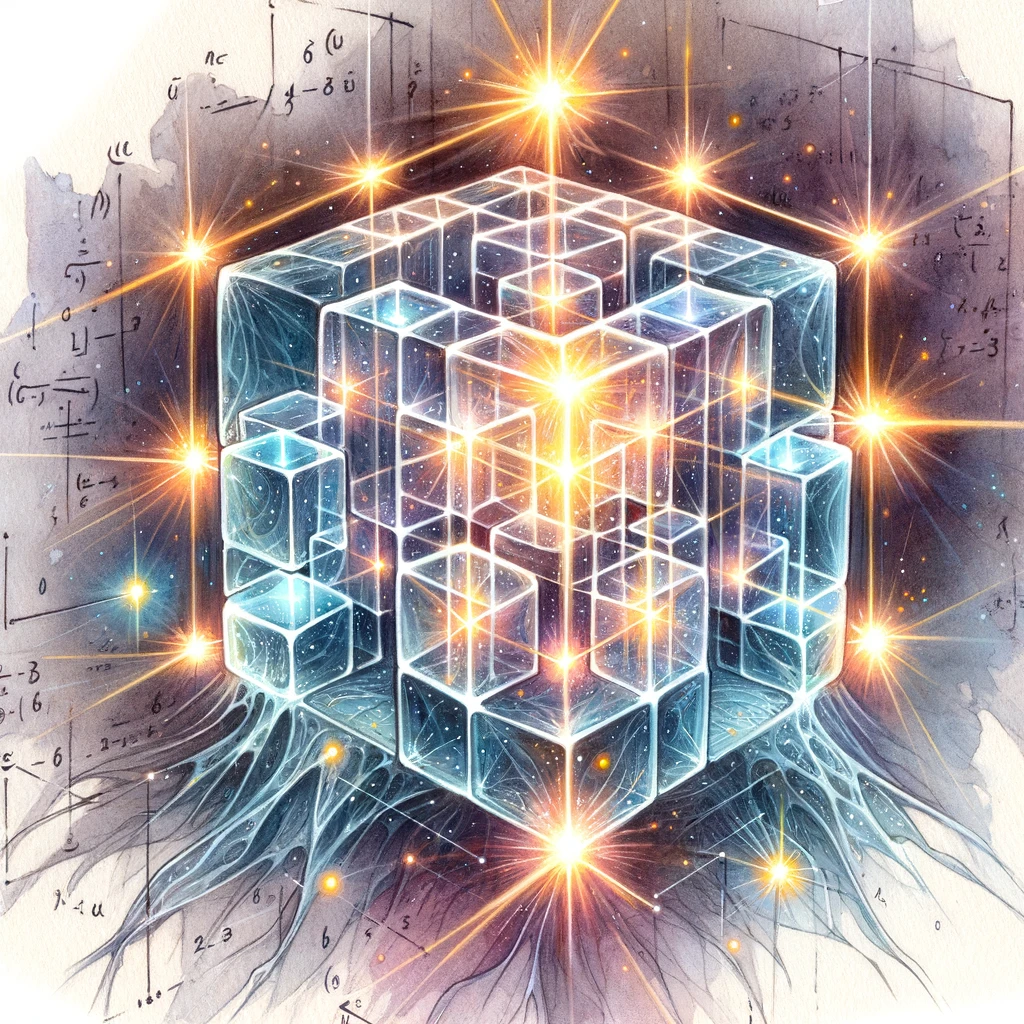
Five types of dimensional are known to exist, and they seem to be drawn to the extradimensional flux of the Elemental Chaos. The nat is a zero-dimensional point lacking length, width, and height. If it weren’t for its concept of its own existence it might as well not exist at all. An uti is a one dimensional line (usually straight) that exists only as length. It has no apparent end, though if asked a higher dimensional will say they do end eventually. A dimmir is a two-dimensional shape that must exist on a surface. A dimmir can change its appearance at will, but it tends to prefer a square. A quot is a three-dimensional cube, while an ataero appears as a strange changing blob that morphs in seemingly impossible ways. That’s because it’s four-dimensional, and us regular mortals can see only three of its dimensions at once. To other four-dimensional beings, an ataero looks like a cube within a cube.
Elemental Cataclysm
See Omnimental, below.
Elemental, Composite
Strange, often magically constructed elementals made of multiple elements mashed together. Omnimentals, nature elementals, tempests and skriaxit are among such creatures (see individual entries).
Elemental, Grease

CE Elemental; CR 9
The grease elemental is a composite being formed from of sludgy earth, slick water, oily fire, and animated by a faint positive spark. They take the shape of a glistening, ever-dripping mass of gelatinous semi-liquid that smears rainbow sheens across surfaces as it flows. Their amorphous bodies constantly reshape themselves with sluggish waves, bubbles, and tendrils, as they slop through gutters and along sewers. Grease elementals maliciously clog up pipes with clotted tides of fat, ash, and oil, and then gleefully ignite them to cause deadly infernos in the least expected places. Philosophically, grease elementals embody the indignity of refuse, given motion and free will. They prefer to use dirty tactics to cling to, trip up, or fling muck in the eyes of opponents rather than attacking honestly. Grease elementals are delighted by seeing proud, clean creatures flail helplessly as they become overwhelmed by dirt, and seem to revel in the disgust that they inspire. Drawn from the Elemental Chaos to places where civilisation’s waste is dumped, they hold a worldview in which all structures eventually collapse into sludge. Like the Doomguard, grease elementals see order and purity as temporary illusions destined to be softened, smeared, and finally swallowed by the creeping, messy entropy they represent. Whether they are truly elementals at all, or indeed how to classify them if they are not, is a matter of debate amongst Guvners who should probably know better.
Stats: [ D&D 5e ] Baldur’s Gate III
Elemental Myrmidon
N Elemental; CR 7
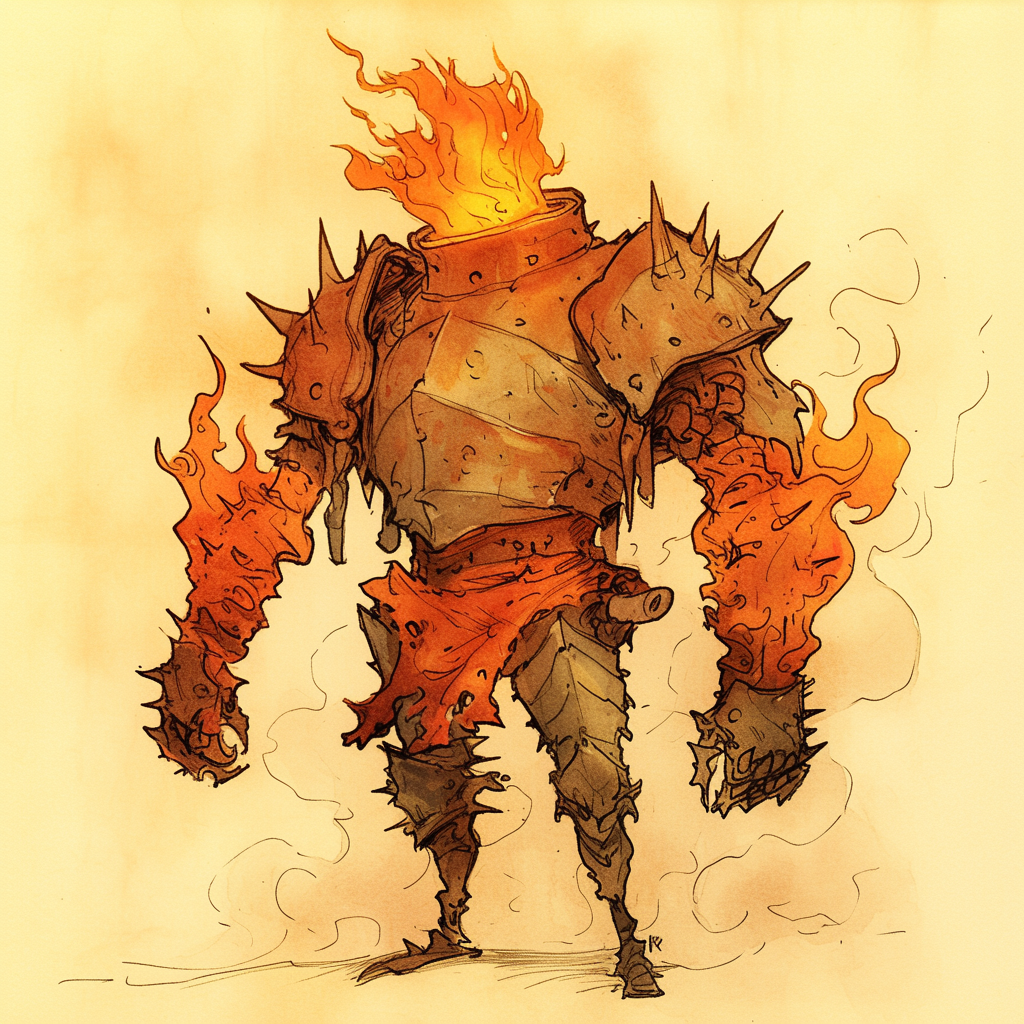
Elemental myrmidons are suits of armour which moves with precision despite the absence of any visible creature to pilot it. Each appears as a faceless, hollow knight whose joints leak flame or smoke, crackle with lightning, drip with seawater, or grind with dust and stone. Their metal shells are etched with runes of compulsion designed to imprison an elemental spirit within the armour. Myrmidons were created when Primordials tore elementals from their native chaos and force them into a full plate cage. They represent pure, roiling freedom that has been hammered into an obedient shape, their whole existence defined by enslavement. Myrmidons march at the command of their masters, fighting with disciplined, soldierly tactics that contrast sharply with the wild, unpredictable nature of unbound elementals. Inside their cages however, the captives seethe with resentment; an elemental myrmidon’s planesview is one of grim inevitability. They see mortals and gods alike as transient tyrants in a multiverse where, given enough time, all armour and chains will melt back into their raw, free elements.
Stats: [ D&D 5e Air | Earth | Fire | Water ] The Plane Below [4e] p130-131; Monster Manual [4e]; Mordenkainen’s Tome of Foes [5e] p202–203
Entrope
CN Magical beast; CR 11
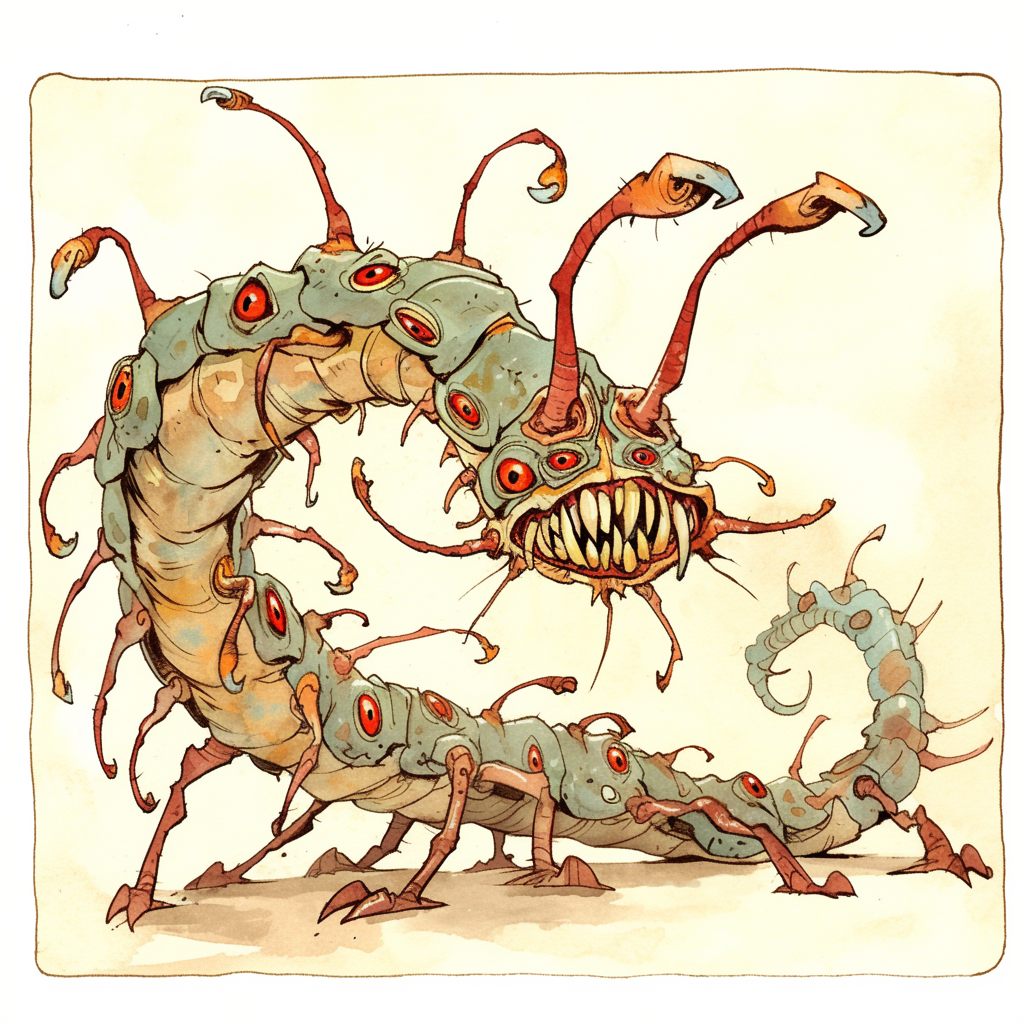
Entropes are terrifying, worm-like creatures engineered by the Doomguard to hasten the collapse of the multiverse’s planar boundaries. Measuring twenty feet in length, their segmented bodies are grotesquely adorned with numerous arms, eyes, and mouths. At least one pair of arms ends in massive claws, while a prominent mouth is filled with razor-sharp teeth. Designed without aesthetic consideration, entropes are living embodiments of entropy itself, with a form reminiscent of a gibbering mouthers crossed with a monstrous centipede. Despite their intelligence, they lack the ability to communicate.
Created to dissolve the barriers between the Inner Planes, entropes feed on the fabric of reality, introducing bubbles of foreign elements into alien planes. This process weakens planar borders, advancing the Doomguard’s philosophical goal of merging all elements into a chaotic whole. The first batch of entropes escaped Doomguard control and now roam freely across the Inner Planes, indiscriminately consuming planar boundaries and wreaking havoc. While a second batch is kept under stricter supervision, the Doomguard has embraced the chaos unleashed by their creations. Entropes exist solely to accelerate entropy and destruction, making them relentless forces of annihilation with no ecology or purpose beyond their creators’ grim vision for the multiverse.
Stats: [ D&D 2e ] Planescape Monstrous Compendium Vol. 3 [2e] p38-39
Filth Fire

NE Elemental; CR 4
Born from the unholy amalgamation of discarded waste and environmental pollution, filth fires embody urban decay and elemental destruction. Composite elementals of Para-Elemental Smoke and Ooze, they appear as reeking and smouldering piles of toxic sludge—a roiling cloud of choking fumes which hangs above a stinking pile of burning rubbish. Sinister faces form and dissolve in the acrid fumes, leering and jeering. The trash heap below pulsates constantly with spasmodic movements, while dark flames play across its surface. A filth fire is somehow both of these at once—simultaneously poisonous smoke and burning, writhing rubbish. It is also a versatile combatant, able to create a searing beam of flame, spray jagged shrapnel, or choke its victims with toxic fumes—and cunning enough to take advantage of the weaknesses of its enemies.
Stats: [ Pathfinder 2e ] Bestiary 2 [PF2e] p110
Gleamtail Jack

Unaligned Animal
The gleamtail jacks are curious, sleek-bodied flying fish of the Elemental Chaos. Their alabaster white scales catch and refract light as they dart and glide through the Churn like shards of rainbow glass. Their oversized fins trail behind them like luminous streamers, and their tails blaze with a gleam that leaves shimmering afterimages behind them. Despite their diminutive size—no larger than a cutter’s thumb—they sport impressive abilities. Completely immune to any kind of elemental harm, gleamtail jacks can “swim” through any elemental medium with effortless grace, be it flame, magma, lightning storms, razor wind, or crushing waves. With effortless grace, they are able to treat solid, liquid, gas or even plasma as simply another current to ride. They represent pure, carefree liberty: gleamtail jacks neither fight for nor serve any being. Instead, they roam playfully across the roiling vistas of chaos, regarding even the most apocalyptic elemental upheavals as nothing more than interesting weather along their endless migratory routes.
Source: City of Torment [novel]
Hound of Tindalos

NE Aberration; CR 7
Hounds of Tindalos are gaunt, angular and ravenous predators from beyond normal time. They are emaciated canine creatures whose eyes burn with a malign, alien intelligence, and their bodies seep thin, acrid mist which wreaths them in smoke. They move with an unnatural gait, jerky movements, and surreal pauses. Their flesh likewise seems made up from sharp planes and impossible angles rather than curves. They have the disturbing ability to squeeze through corners and acute angles, literally emerging from the sharp points of space-time. Weirdly, they are repelled by circles and spirals. While their true purpose is dark, hounds of Tindalos seem to be driven by retribution against berks who trespass into forbidden time, or meddled with dimensional forces. They care nothing about morality, law or chaos—only about the violation of linearity. The hounds are patient and inexorable, relentlessly tracking down and pursuing any creature they deem has travelled too far through time, space, or possibility.
Stats: [ PF2e | 5e ] Bestiary 2 p146. Canonwatch: Hounds of Tindalos are originally from the Cthulhu mythos. Whether Tindalos is a Great Old One, or a location, or something else entirely, is never revealed.
Immortal

Quasi-power; any alignment; CR varies
Immortals (that’s with a capital I, berk) are ascended beings—former mortals who have transcended death, aging, and conventional limits through epic quests, trials, and sponsorship by existing Immortals. Some of them are thought to be former Godsmen who ascended. Some Prime worlds treat these bloods as their gods—fact is, the boundary between Immortals and Powers is pretty blurry. Chant goes that each Immortal belongs to a Sphere (such as Matter, Energy, Time, Thought, or Entropy). They embody that cosmic principle as they pursuing long-scale agendas that shape civilisations, worlds, and even planar structure, rather than merely answering prayers. Their philosophies are each unique—perhaps by definition—but they have this much in common: they’re less about morality and more about purpose. Immortals might sponsor mortal heroes as experiments or even their successors, manipulate cultures as long-term projects, and participate in vast, often opaque games of influence between themselves, whose stakes are measured in epochs rather than lifetimes. To mortals, they appear as distant patrons, enigmatic tormentors, or mythic ideals—but among themselves the Immortals exist in a complex hierarchy and constantly-evolving landscape of philosopho-politics.
Stats: [ D&D BECMI ] DM’s Guide to Immortals [BECMI D&D] p41
Jann

Elemental genie; any alignment; CR 4
Jann (singular: janni) might be seen as weaklings by the ‘pure-blooded’ elemental genies, because they embody mixing of all of the elements—but in the Elemental Chaos these cutters really come into their own. They may be less physically strong than single-element genies, but some of them still have the power to grant wishes. Their mixed composition gives jann the freedom to travel across elemental boundaries in ways other genies cannot, making them natural wanderers between worlds. Tending to congregate in nomadic tribes rather than tying themselves down by building fixed settlements, jann culture is organised by kin and clan. The Churn even has its own indigenous jann population. When a local tribe sets up camp, they’ll typically choose the eye of a swirling elemental tornado, where the winds are calmer and there’s a refreshing balance of multiple elements. The jann call these places oases of harmony, but to most other planewalkers it’s still chaos. Nonetheless, the jann seem to find this kind of environment invigorating, even as it challenges the protective magics of more mundane travellers. Comfortable though they may be though, the innate wanderlust of the jann means they’ll move on before too long. Quite what they are moving towards, in a plane of cacophonous elemental catastrophe, is anyone’s guess.
Stats: [ D&D 2e | 3e | 5e ] [ Pathfinder 1e | 2e ] Monstrous Manual [2e] p126; Bestiary [PF1e]; Monster Core [PF2e] p156
Living Lahar

CE Elemental; CR 8
Half landslide and half lava flow, a living lahar is one of the most cruel and dangerous of the elementals from the Churn. Although they possess limited intelligence, every part of that is malevolent, and they seek to envelop, crush and consume anything they encounter. Their favourite attack strategy is to ambush prey from higher ground, using gravity to pick up speed rapidly as they roll and careen down steep slopes in a barely-controlled manner. When at full pelt, few victims can outrun a living lahar. However, they are only dangerous when moving. Should a lahar ever come to a stop, perhaps in a valley or canyon, or run out of the seismic energy upon which it feeds, it will die. In the Elemental Chaos, or on the eternal slopes of Gehenna or Sheol, however, lahars are at their most deadly. They can exist in these places for many years, while conversely when encountered on the Prime, they’re usually short-lived elementals drawn through vortices that spontaneously occur when glaciers are melted by volcanic eruptions.
Stats: [ D&D 3e ] Dragon Magazine #265 p45
Menglis

N Outsider; CR 9
Menglis are weird transparent spirits that can only be found where one Inner Plane borders another, or any part of the fifth dimension Menglis can be dangerous to most non-elementals, as their mere presence causes flesh to dissolve into base elements. Fortunately, they are fairly passive, never attack without being provoked and almost never speak with anybody.
Stats: [ D&D 2e ] Planescape Monstrous Compendium Vol. III [2e] p60
Mephit

NE Elemental; CR 1/2 – 1
An innumerable and insufferable number of different mephits can be found in the Elemental Chaos. While they are not invulnerable to all conditions in the Churn, the changeable nature of the plane seems to thrill the small creatures. They also have a habit of playing pranks on one another that result in the victim being thrown into to the chaos to fend for themselves.
Planewalkers will be dismayed to discover that there are more of these horrid little creatures unique to the Churn, such as grease, sulfur and glass mephits. Graybeards are split on whether these creatures are truly new sub-species of mephits, or whether the individuals encountered have just undergone strange transformations in the Elemental Chaos. It’s possible a dust mephit could have been flame-grilled and turned into glass perhaps, or an ooze mephit.
See also: Parlez-Vous Mephit? — a treatise on the Lower Planar Mephit Code
Stats: [ D&D 2e | 3e | 5e; CR 1/2 ] [ Pathfinder 1e | 2e; CR 1 ] Planescape Monstrous Compendium [2e] p70-72; Monster Manual [3e]; Bestiary [PF1e] p202; Monster Core [PF2e] p146; Baldur’s Gate III (grease mephit); Sandstorm [3e] (glass and sulfur mephits).
Nature Elemental

N Elemental; CR 12+
Unlike other composite elementals, nature elementals are normally peaceful creatures that embody productive merging of all kinds of elemental matter. They manifest as gargantuan humanoid figures of densely packed earth, sod, and stone. A typical nature elemental stands at least thirty feet in height and teems with all manner of ecosystems—rivulets of water flow upward across its form in defiance of gravity, while vegetation and wildlife crawl across its surface. They’re thought to be a living, breathing representation of the the living environment itself. Their true origin remains enigmatic, though some graybeards theorise that the Elemental Chaos may serve as the primordial home for the animating force of these entities before their summoning to the Material Plane. Unlike simpler elementals born from a single plane of Fire, Water, Wood, or so on, the nature elemental synthesises all primary elements, plus the spark of life, which presumable comes from the Positive Material Plane. Once summoned to the Prime, nature elementals cannot be controlled by the druid or wizard who called them, beyond not harming them. These elemental spirits are driven instead by an insatiable urge to restore the environment in which they find themselves to its primal state, unmaking or downright destroying any signs of civilisation they might come across.
Stats: [ D&D 2e ] Monstrous Compendium Annual Vol. 2 [2e]
Nightmare Creatures

Aberrations; alignment varies
More a (frankly insensitive) classification of a number of species than a race of their own, so-called nightmare creatures are beings of the fifth dimension. Heralds of dimensional barriers, nightmare creatures lurk in the strangest distortions of time and space, deeply afraid of ‘normal’ forms of life from the first three dimensions, whose flesh is poisonous to them. Their flesh is, likewise, deadly for anything from the Multiverse which we perceive. Diabolus (q.v.) are one such type of nightmare creature, as are malfera and neh-thalggu, though the latter tend to dwell on the Prime and the Ethereal planes.
Stats: [ D&D BECMI ] DM’s Guide to Immortals [1e] p43
Omnimental
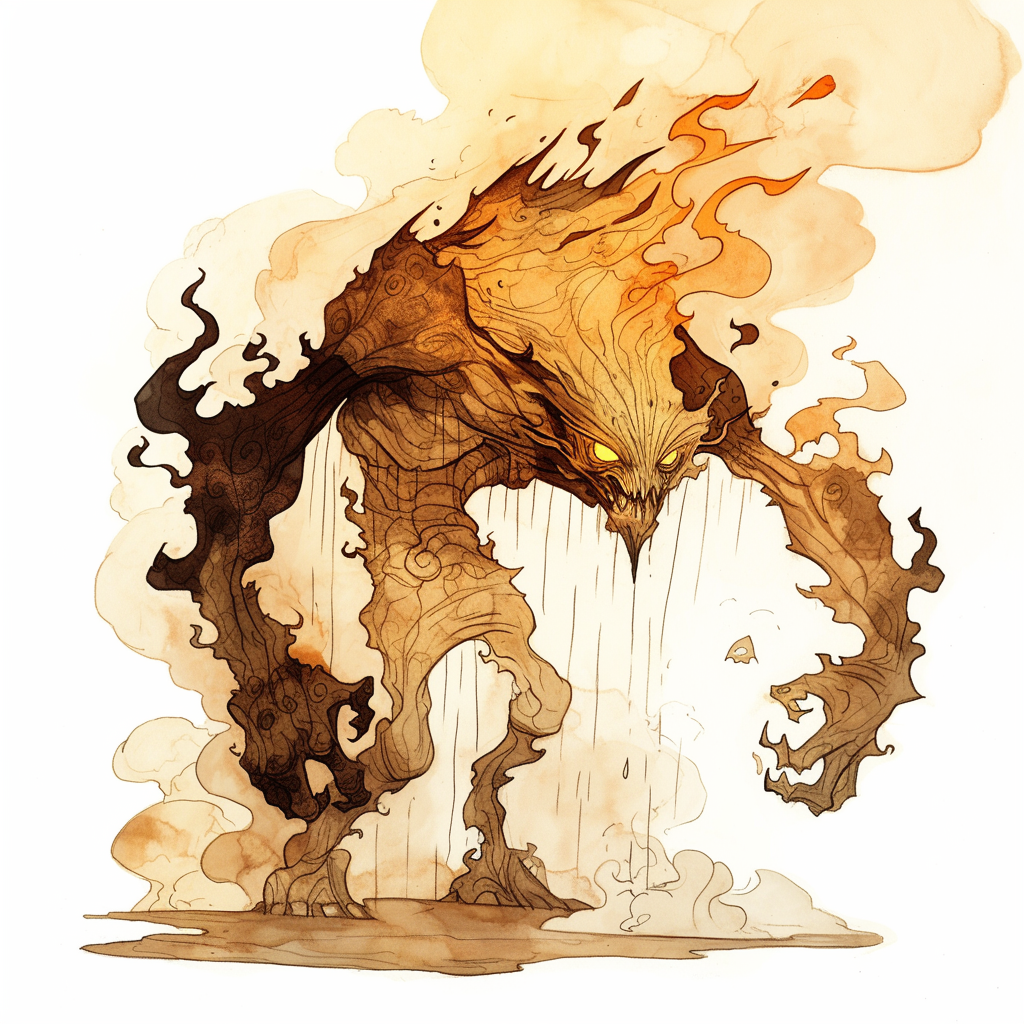
N Elemental | Air | Earth | Fire | Water; CR 15–22
True natives of the mysterious Elemental Chaos, omnimentals are terrible chaotic monsters, made of all of the base elements that strangely do not mix. Perhaps this contradictory nature is what drives them to commit acts of mass destruction. The largest omnimentals are quite literally called elemental cataclysms. Fortunately, they are rare outside of the Elemental Chaos, and when they leave it, they can’t usually go too far. Despite being part earth elemental, their mixed nature means they can’t glide through solid matter like pure elementals can.
Stats: [ D&D 3e; CR 15 ] Monster Manual III [3e] p118. Variants: [ Elemental Cataclysm 5e; CR22] Monster Manual 2025 [5e] p111. Canonwatch: Elemental Cataclysms aren’t omnimentals, but their basic concept is similar enough to merge them together.
Primal

Humanoid, any alignment; CR varies
A strange and secretive sect (I’d call them a cult myself though) that is rumoured to have connections with Immortals and possibly even with the Old Ones on the other side of the vortex. The Primals are so secretive that their true purpose seems to be unknown even after all this time. And you never meet an ex-member—what happens to berks who change their mind is also dark, but likely to be unpleasant.
Stats: [ D&D 2e ] Planescape Monstrous Compendium Vol. 3 [2e] p74-75
Primeval Ooze

Unaligned Elemental beast
The primeval ooze is a massive, blind and acid-filled amoeboid blob. A primitive, viscid lifeform, it seeps across the ground in a slick creeping tide of corrosive slime, even able to soften rocks with its secretions. When threatened, it lashes out with long pseudopods and squirts torrents of corrosive sludge, dissolving anything it touches. It then tries to engulf immobilised victims into its own bubbling bulk, to slowly digest them while it continues to ooze onward. Born as a weapon of the Primordials that was reshaped from the earliest forms of life, chant goes the primeval ooze was crafted to hunt and consume the servants of the gods. Fortunately, only a few such horrors still exist in the wilds of the Prime, or the remote wastes of the Elemental Chaos. The primeval ooze embodies raw, envious hunger and ancient resentment. It “remembers” only that more complex creatures came after it, and thus it exists solely to drag all their sophistication and structure back down into undifferentiated sludge.
Stats: [ D&D 4e ] The Plane Below [4e] p128
Primordial Blot

CN Elemental
A primordial blot is as a roiling, amorphous mass that defies classification—a writhing amalgamation of fire, earth, water, and air bound within a churning form and imbued with dim but malevolent sentience. These entities seem to embody an uncontrolled force of creation itself. Each element within them is locked in eternal war with the others. This results in a weird restless energy that annihilates all structures and creatures it encounters, reducing them back to chaos-stuff. Graybeards remain divided on the origin of these dangerous menaces: Some cutters theorise that primordial blots represent stillborn worlds—incomplete genesis events that failed to coalesce into functioning dimensions. yet retain the inconceivable reserves of power required for world-creation. Other sages offer a more mechanistic explanation, proposing that blots arise through rare confluences of elemental energies in the Churn, much like lesser elementals but with an exponentially greater complexity and devastating potential. Perhaps a blot originates when several omnimentals are merged by accident, or design? A third, more sinister theory holds that primordial blots are fragmented remnants of ancient primordials who fused their bodies during the Dawn War and were subsequently shattered by divine assault, their essence now persisting as sentient chaos that eternally seeks to unmake the creations of the powers who destroyed them.
Stats: [ D&D 4e ] The Plane Below [4e] p140-141
Rilmani, Abiorach

N Monitor Outsider; CR 5
Rilmani are monitors, who act to maintain true neutrality on the Planes. While most of their actions target the Outer Planes, one of their species centres on the Inner Planes and the balance of the elements. Abiorachs feel right at home on any Elemental Plane, even the Elemental Chaos. Here, they are tasked with watching over the balance of elemental forces, exploring the plane and mapping out new locations and demi-elements. It seems likely they knew of the existence of the Elemental Chaos long before other planars.
More chant on the abiorach rilmani here
Stats: [ D&D 2e | 5e; CR 5 ] Planescape Monstrous Compendium Vol. II [2e] p86; Manual of the Planes [5e] p397
Scorchwind Phantom

CN Elemental
Likely a remnant of the Para-Elemental Steam, scorchwind phantoms appear as the vaguest of humanoid shapes formed from steam, with flashes and streamers of fire coiling around them. Like many denizens of the Churn, they are predatory and aggressive, attacking any living flesh that has water they can evaporate. Planewalkers are warned that these ‘phantoms’ are not undead, but they are able to become incorporeal, even moving right through their enemies as part of a surging attack strategy. They are also known to blind opponents with scalding burst of steam. Magical protection is highly advised, if you can’t avoid them altogether.
Stats: [ D&D 4e ] The Plane Below [4e] p138
Skrixiat

NE Elemental; CR 16
Skrixiats are vicious, pack‑minded blackstorms: Towering, ten‑foot pillars of shrieking wind choked with obsidian sand and dust, and a pair of hungry, malevolent eyes somewhere in the midst of the vortex. Chant goes they’re ancient and evil air elementals polluted by dust and with a poisoned seed of vacuum. Or perhaps something whipped up the Primordials way back in the Dawn War, and then forgotten about. They exist only to scour away structures, flense flesh, erode stone, and even wear down magic until only raw, eroded wasteland remains. The Primes believe that skrixiat feed on the chaos and carnage they cause, and then hide away to sleep for centuries. In fact, the creatures return to the Elemental Chaos where they continue to create havoc.
Stats: [ D&D 2e ] FR10 Old Empires [2e] p94
Slaad, Flux

CN Monitor Outsider
The flux slaad are a sub-species of slaadi that seem to have mistaken the Nightmare Dimension for Limbo. They have adapted well to the plane, and their bodies have become attuned to churn of elements. However, their chaotic nature can’t help but show through—flux slaad are resistant to all elements bar one, and each time they take damage their weakness mutates to a different element. While this evolution serves them well in the Elemental Chaos, they are regarded with scorn by their more physically powerful Outer Planar slaadi brethren. Flux slaad use their ability to slip through the cracks between planes and infest the Prime, where they have developed a natural affinity for bullywugs, who seem to regard them as worthy of worship.
Stats: [ D&D 4e ] Monster Manual 2 [4e] p184
Storm That Walks

CE Primordial elemental
The storm that walks is an cacophony of elemental fury—a mass of dark, boiling clouds gathered into a vaguely humanoid form, and wreathed in flickering fire and lightning. Booming thunder punctuates its every step, and it leaves a trail of ice behind it. Its presence warps the air; creatures within its aura find movement treacherous and their bodies vulnerable to electricity damage These creature were first conceived during the dawn of creation as autonomous instrument of destruction, seeking only to annihilate. Devoid of mercy, storms that walk are intelligent enough to fight tactically, although their nihilistic callousness means they will gleefully harm allies as well as enemies should the opportunity arise. prioritise devastation over cooperation, though its considerable intelligence enables tactical alliances when opportunity for greater carnage presents itself. Within the Elemental Chaos, storms that walks function as something of an apex predator. They tolerate the presence of lesser elementals, but despise Primes, planewalkers and frankly, all non-elementals alike.
Stats: [ D&D 4e ] The Plane Below [4e] p129
Tempest

CN | Gargantuan | Air | Earth | Elemental | Fire | Water | CR 16+
A tempest is a living storm of roiling dark clouds infused with terrible consciousness and purpose. Unlike most elementals, tempests embody a composite nature: four elements coexist within their form, with wind and lightning, swirling sand and debris, searing gouts of flame, and relentless rain. Silver veins extend throughout their cloudy bodies like circulatory systems, conducting the electrical impulses that fuel them. These creatures are territorial, domineering and aggressive by nature, seldom encountering non-tempests without immediate conflict ensuing. They are volatile and uncommunicative, rarely capable of more than a handful of Common words, speaking instead in the ancient languages of elementals. Tempests sustain themselves on moisture drawn from corpses, scavenging after battles to drain water from the dead. Genies and elementals count them as enemies, though some ambitious djinn and marids have successfully subjugated individual tempests as elite guards.
Stats: [ D&D 3e ] Monster Manual II [3e] p193-194
Totum Font
Totum fonts are awesome beings of six elements (those being Air, Earth, Fire, Metal, Water and Wood), who represent the creative portion of the Elemental Chaos. They are said to be among those elementals, who have betrayed the Primordials and instead chose to ally with the Gods in hopes of forging creations more beautiful that the cold elemental powers had promised them. Each totum font has six faces, each representing one of their elements. Healthy fonts constantly shift between them, but when the elements of the Multiverse are thrown off balance, they become stuck in one of their forms. When the Planes of Wood and Metal were drawn into the Churn, totum fonts were drawn with them—at least that’s how greybeards make sense of their sudden reappearance. Nowadays, some of them were able to leave the Elemental Chaos, but most of them stay there, seemingly tending to the demi-Elemental Planes, practicing their world-smithing craft. Janni treat totum fonts with utmost respect, believing them to be the ancestors of all genies, and abiorachs seek them out in order to persuade these ancient beings to act alongside them.
Stats: [ Pathfinder 2e ] Monster Core 2 [PF2e] p325
Umbral Blot

Blackball; Vortex Creature; Deadly Sphere; Assassin of the Elder Gods. N Construct; CR 32
The umbral blot or blackball is an enigma wrapped in absolute darkness—a featureless sphere of perfect blackness roughly five feet in diameter. It seems to exist at the intersection of dimensional space and reality. Whether they are truly alive remains unknowable even to Immortals; they defy conventional definition of life itself, classified broadly as creatures of the Entropy sphere. Others reckon the blackball is a manifestation of the Negative Energy Plane itself. Whatever its origin, it is found in the Churn too. Blackballs do not communicate, though whether by choice or inability remains mysterious. If they think, it seems only to decide what to annihilate next. Within dimensional space, blackballs serve as agents of the Old Ones—mysterious elder entities said to have created the Dimensional Vortex itself. They move toward concentrated power sources and systematically disintegrate all matter they contact, converting substance into pure entropy. Chant goes they can even damage or destroy Powers themselves!
More optimistic graybeards suggest that blackballs patrol the boundaries between dimensions, correcting or destroying threats to the cosmic order. They represent perhaps one of the most terrible predators in the known multiverse: inevitable, incomprehensible, and absolutely unstoppable. What the aeons think of them is not known…
Stats: [ D&D 2e | 3e ] DM’s Guide to Immortals [BECMI] p50; Inner Planes [2e] p66; Mystara Monstrous Compendium [2e] p16; Epic Level Handbook [3e] p223.
Sources: Margarita & Jon Winter-Holt
Aon has been updated and now we’ve got to add these guys:
https://2e.aonprd.com/Monsters.aspx?ID=4586
The Diabolus / Diabolii were given some 3e/3.5 treatment (particularly as a player ancestry) in the Dragon Magazine Compendium.