
[ Elemental Bestiaries ] [ Air | Earth | Fire | Metal | Water | Wood ]
Gadabouts of the Inner Planes
Also called Trailblazers, Drifters, Rolling Stones, depending on who you ask
Not every creature that dwells in the Inner Planes is composed of a single element. Some beings are planewalking wanderes who’ve made the Inner Planes their home by choice or necessity; others are composites of multiple elements, neither wholly fire nor earth nor air nor water; still others are political operatives, philosophers, or mercenaries whose interests span the whole elemental spectrum. These are the so-called Gadabouts of the Inner Planes—beings aligned to the elements but with no fixed affinity for any single one over the others. They drift, scheme, and survive across the volatile boundaries between Fire, Earth, Air, Water, the Elemental Chaos and the myriad Para- and Quasi-Elemental planes.
Where true elementals embody a single primal force at a time, and elementaloids like genies, mephits, and salamanders are deeply married to one particular element, the gadabouts are defined by their flexibility and their indifference. They may be born of mixtures of elements (such as the jann or suli genies, or the omnimentals); entirely extrinsic outsiders aligned to the elemental planes (such as the monadic devas or abiorach rilmani); or the descendants of mortal settlers who have learned to co-exist with the Inner Planes without being consumed by them (such as the ruvoka or primals). Some of these cutters are motivated by pragmatic ideals like trade or exploration, others by philosophical concepts like maintaining balance, spreading or stopping entropy, and yet more by political motives like influencing the eternal struggle between good and evil no matter where it arises. The gadabouts are real wildcards of the Inner Planes—they can be found virtually anywhere, their motivations are as varied as their shapes, and they may turn out to be friend or foe.
The following creatures are just as likely to be found of any of the elemental planes…
Aasimon, Monadic Deva
Soul Angel | LG NG CG | Medium | Aasimon | Celestial | Holy | CR 10
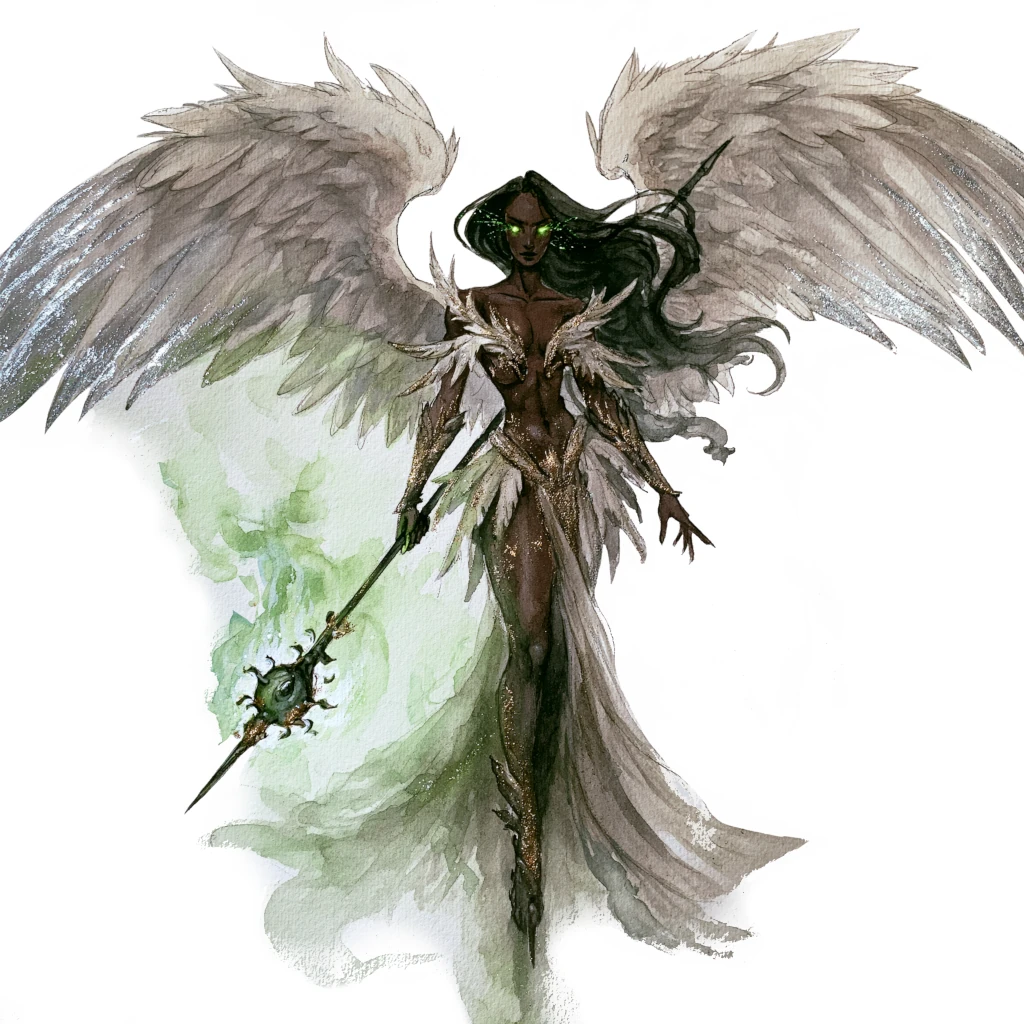
Monadic devas are powerfully built celestials, standing up to seven feet tall. Their broad, muscular frames seem designed for strength over agility. Their skin tones ranges from light to dark brown, and their striking faces are framed by jet-black hair and decorate with a pair of piercing jade-green eyes. Their large pair of feathered wings glitter with a silvery-white sheen, and spread out wide from their shoulders. Like other devas, the typical clothing of the monadic deva is more glitter and feathers than armour or robes, although they’ll don simple coverings when travelling, especially when the environment is harsh. While among mortalkind, monadic devas typically polymorph into the forms of unremarkable humanoids or animals so they can move around unnoticed. In battle, they usually wield an enchanted metal rod or mace of smiting—which they can ignite with emerald green flames at will.
Monadic devas are stewards of Upper Planar powers, who have been tasked with serving as guardians of the Ethereal and Elemental Planes. Sent by their patrons to monitor the balance of power on the Inner Planes, it’s their role to support the nascent and scattered Good-aligned elemental forces. Monadic devas must remain vigilant against the influence of fiends and extra-planar invaders, as well as the forces of Elemental Evil. In practice however, they seem to do far more watching than intervening. Rather than crusading in yet another battleground, monadic devas try to preserve the delicate equilibrium in the volatile Inner Planes, and to protect enclaves of goodness when it looks like the balance is tipping the wrong way. On the Ethereal Plane, they are more militant, fighting to protect souls from being stolen or consumed by creatures who would prevent the newly deceased from finding their way to the River of Souls and their final fate in the Outer Planes. Sometimes they will work with psychopomps in this regard, although both groups remain somewhat suspicious of the other.
Stats: [ D&D 2e | 3e | 5e ] [ Pathfinder 1e | 2e ] Planescape Monstrous Compendium [2e] p5,7; Bestiary 2 [PF1e]; Bestiary 2 [PF2e] p14
Chososion
N | Rare | Medium | Aberration | Elemental | HD 8
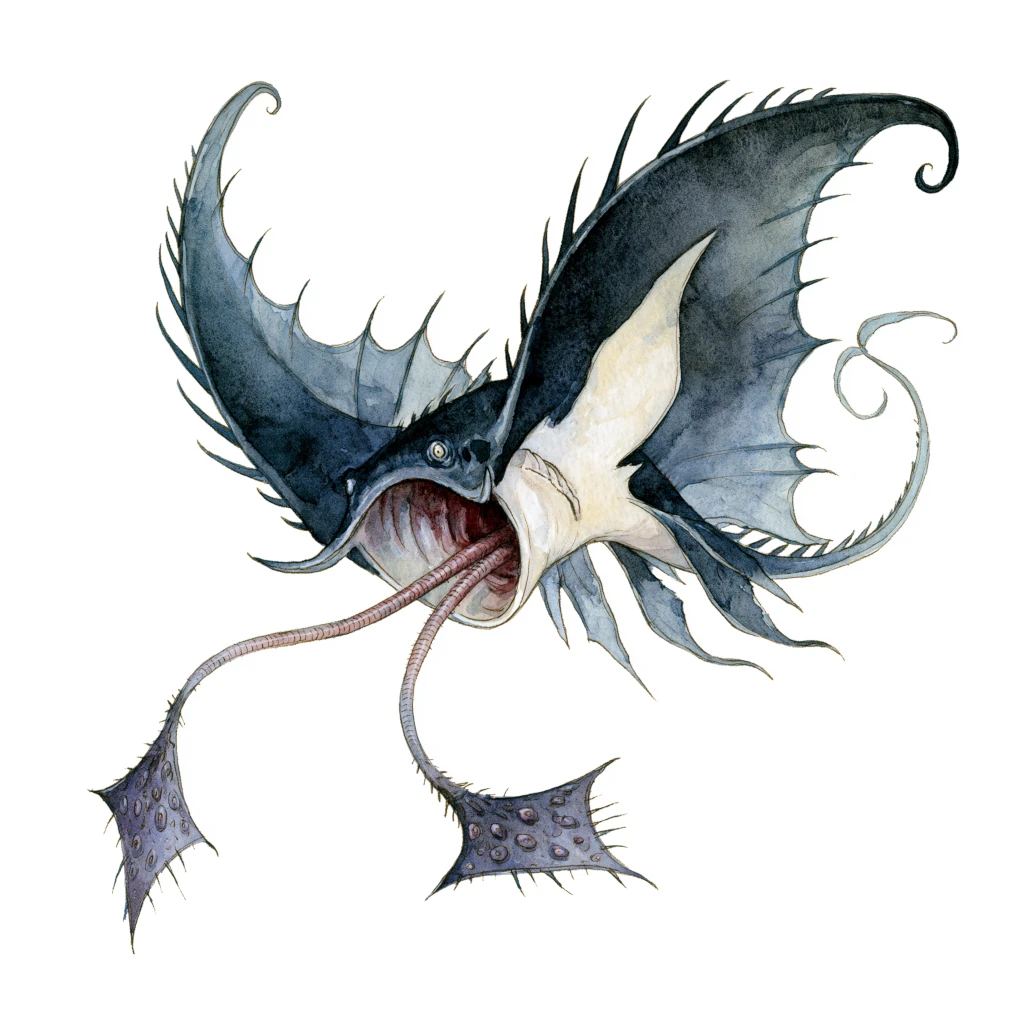
The chososion [cho-SOE-see-on] is an extraordinarily rare, alien creature seen only on the Ethereal and Inner Planes—if “seen” is even the right word. Its broad, dark-blue-black body resembles a manta ray assembled from dozens of rippling, winglike flaps of flesh, with a mouth hidden somewhere within the fluttering mass. The movement of those fins may be what keeps the creature at least partially present in reality; chant goes that if they ever stopped moving, the chososion might simply slip out of existence. Its name comes from the Shad word for “out of reach,” which is an apt description for a creature that is intangible on every plane and never entirely occupies the space around itself.
The chososion appears to feed on the primal nature of the Inner Planes themselves, rather than on creatures or matter, drifting through any element without ill effect or hinderance. They have no known society, do not communicate, and are always encountered alone. Most encounters are accidental: a planewalker stumbles into its path, the creature mistakes their presence for a threat, and two beings that barely share reality come into conflict. The only fully corporeal anatomy of the chososion consists of the two long pseudopods that emerge from inside its mouth, ending in hook-covered pads capable of delivering a paralysing poison that in the worst case can completely discorporate its victim, never to be seen again.
Planewalkers are warned that chososion are tricky sods to fight. Ordinary attacks and environmental dangers pass through them, while even magic has only a small chance of affecting its body—only exceptionally powerful weapons can harm its intangible body. The pseudopods are its one reliable vulnerability, but the creature can sacrifice and regrow them when necessary. Some graybeards speculate that chososion originate in an unknown plane that touches reality only through the Inner Planes—while others insist that it is simply an aberration native to some unreachable layer of existence liken the Far Realm, or the Ordial Plane. Whatever the truth, the chososion’s purpose seems unknowable: it may be grazing on the raw foundations of the multiverse, fleeing from a danger beyond the known planes, or treating the Inner Planes as nothing more than an alien environment to be crossed.
Stats: [ D&D 2e ] Planescape Monstrous Compendium Vol. III [2e] p26-27
Chwinga
N | Tiny | Elemental | CR 0
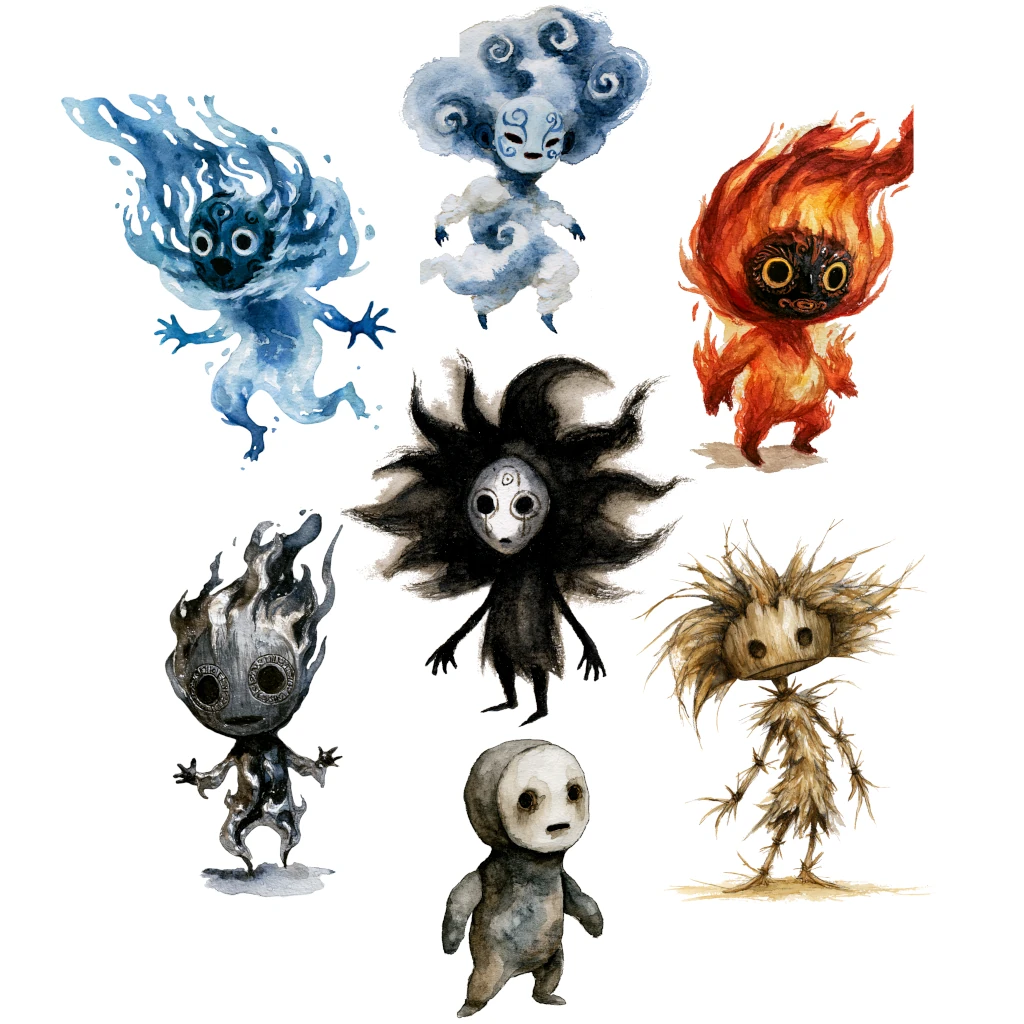
Chwingas are tiny elemental spirits, usually no more than six inches tall. They resemble animated tiny dolls with spindly limbs, wild hair, and face masks painted or engraved with abstract patterns. You might know them from the Prime Material Plane, where the adorable nature spirits love to frolic in tundra, jungle and desert alike. Well, it turns out chwingas are also found on the Inner Planes, where they’re just as shy as their Prime cousins. Their appearance mirrors their environment—a chwinga on the Plane of Air might be little more than a tiny cloud sporting a porcelain mask, while one on the Plane of Fire might have flickering flame hair and body, and a mask made from charcoal. Wood chwingas are straw dolls with a carved oak mask, while the rare vacuum chwinga, who are also found in Wildspace, are shadowy black figures with bleached white bone masks and painted eyes.
On the Elemental Planes, chwingas make their homes inside modest natural wonders such as crystal formations, hydrothermal vents, floating stones, freshwater springs, or perfect fluffy clouds. They apparently require no food, drink, or air, being able to sustain themselves purely on the elements, and they can retreat into their elemental abode for safety. Silent, shy, and intensely curious, they’ll watch planewalkers from hiding and then imitate whatever catches their attention—whether that means copying the solemn voice of a dao, the crude jokes of a fire mephit, or mimicking the funny way that passing planewalkers walk.
Chwingas have little interest in elemental politics, but they are instinctive caretakers of their local surroundings. As well as protecting their chosen homes, chwingas like to care for places where different elements meet and mix, but preventing one from devouring the other, repairing small disturbances, and guiding lost creatures. They can cast minor helpful spells such as druidcraft, guidance, and resistance, and if they take a liking to a planewalker they might grant them a supernatural charm once per day, as a rewards for kindness shown, or simply for treating the chwinga’s home with respect.
Stats: [ D&D 5e ] Tomb of Annihilation [5e] p216–217 (jungle); Rime of the Frostmaiden [5e] p282 (ice); Spelljammer [5e] Boo’s Astral Menagerie p17 (astronaut chwinga)
Entrope
Rare | CN | Huge | Aberration | Elemental | Negative | HD 11
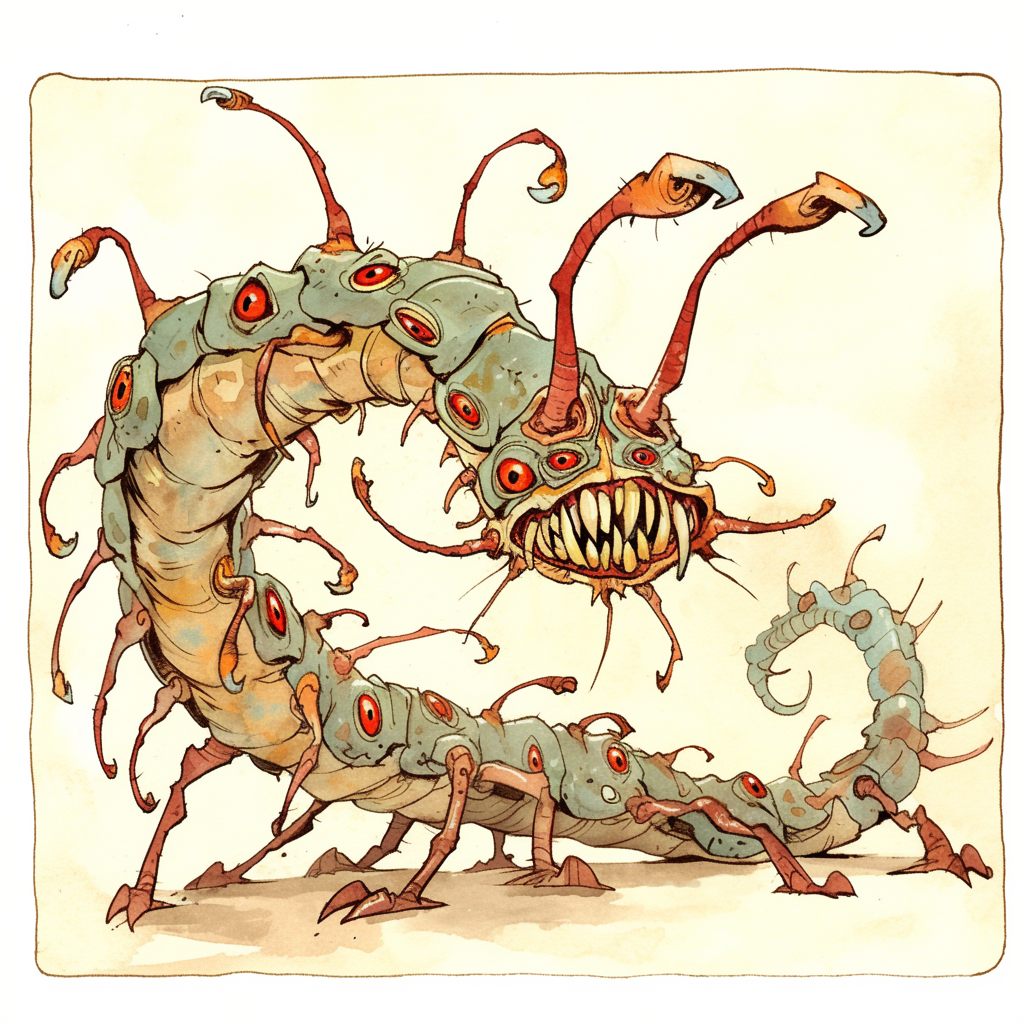
What do you get if you cross a gibbering mouther with a monstrous centipede? No cutter, it’s not a joke, it’s an entrope. Terrifying worm-like creatures, entropes seem to have been engineered by barmy Doomguard fleshwarpers to hasten the collapse of the multiverse’s planar boundaries. Measuring twenty feet in length, their segmented bodies are grotesquely adorned with numerous arms, eyes, and mouths. At least one pair of arms ends in vicious claws, while their prominent primary mouth is filled with razor-sharp teeth. Designed without any kind of aesthetic consideration, entropes are living embodiments of entropy, Despite their intelligence, they apparenty lack the ability to communicate.
With the bizarre ability to dissolve the barriers between the Inner Planes, entropes feed on the fabric of reality, introducing bubbles of foreign elements into alien planes. This process weakens the planar borders, advancing the Doomguard’s ultimate goal of merging all elements into a chaotic whole, effectively making the Elemental Chaos the only Inner Plane. The first batch of entropes escaped Doomguard control and now roam freely across the Inner Planes, indiscriminately consuming planar boundaries and generally wreaking all kinds of havoc. While a second brood is apparently being kept under stricter supervision, the Doomguard has embraced the chaos unleashed by their creations. Entropes exist solely to accelerate entropy and destruction, with no ecology or purpose beyond their creators’ grim vision for the multiverse.
Stats: [ D&D 2e ] Planescape Monstrous Compendium Vol. III [2e] p38-39
Genie, Janni

N | Medium | Amphibious | Elemental | Genie | CR 4
Jann (singular: janni) are genies that embody the mixing of all elements. While in the natural forms, jann are imposing humanoids with a distinct aura of majesty, they are able to polymorph into more mundane forms and pass for humans if they wish. Thought to originate from the Elemental Chaos, jann are much weaker than single-element genies. However, janni-kind is also far older than the single element genies, and they have the power to grant wishes. Jann are typically gregarious sorts, and often ally themselves with the local genies on the planes they trave through, although when their backs are turned, single-element genies often look down their noses at them. Jann will also journey the Inner Planes on their own, in nomadic caravans. Born with an insatiable wanderlust, the jann don’t have any burgs that they call their own, but they integrate well into other communities and make excellent planewalkers. In fact, chant goes that many famous planewalkers are actually jann in disguise, or at least suli—the offspring of jann and mortals, who are also linked to all six elements.
Stats: [ D&D 2e | 3e | 5e | PF 1e | 2e ] Monstrous Manual [2e] (janni / Zakharan janni); Monster Manual [3e]; City of Brass [5e]†; Bestiary 1 [PF1e] p141; Monster Core [PF2e] p156
Menglis

Rare | N | Large | Elemental | Ethereal | Outsider | HD 9
Menglis are weird transparent spirits born from the opposition between two Inner Panes. They can only be found where one Inner Plane borders another—or in isolated pockets of contradiction, like a smoke vortex trapped within Earth or steam storm drifting through Fire, or indeed any part of the fifth dimension (also known as the Elemental Chaos). They appear as colourless, amorphous humanoids roughly ten feet tall, and are normally invisible, except to those able to perceive hidden or supernatural things.
Menglis can be dangerous to most non-elementals, as their mere presence can cause mortal flesh to dissolve into its base elemental substances. They can suppress this effect briefly to communicate, but doing so requires concentration. Fortunately, they are fairly passive, never attack without being provoked and almost never speak with anybody. It seems they have no language of their own, and communicate only through telepathy on the rare occasions they do choose to acknowledge another creature. The philosophy of the menglis is a curious one. Like they rilmani, they are utterly neutral in outlook but rather than believing in balance they are creatures of opposition. They embody the tension created where incompatible realities meet. They cannot willingly leave their border zone. If the transition between the elements is destroyed, or if the menglis is forced away from it, the creature simply ceases to exist. Their natural enemies are entropes, who seek to break down the barriers between elemental planes—which also results in the death of any nearby menglis.
Stats: [ D&D 2e ] Planescape Monstrous Compendium Vol. III [2e] p60
Omnimental
Rare | N | Gargantuan | Elemental | Air | Earth | Fire | Water | CR 15–22
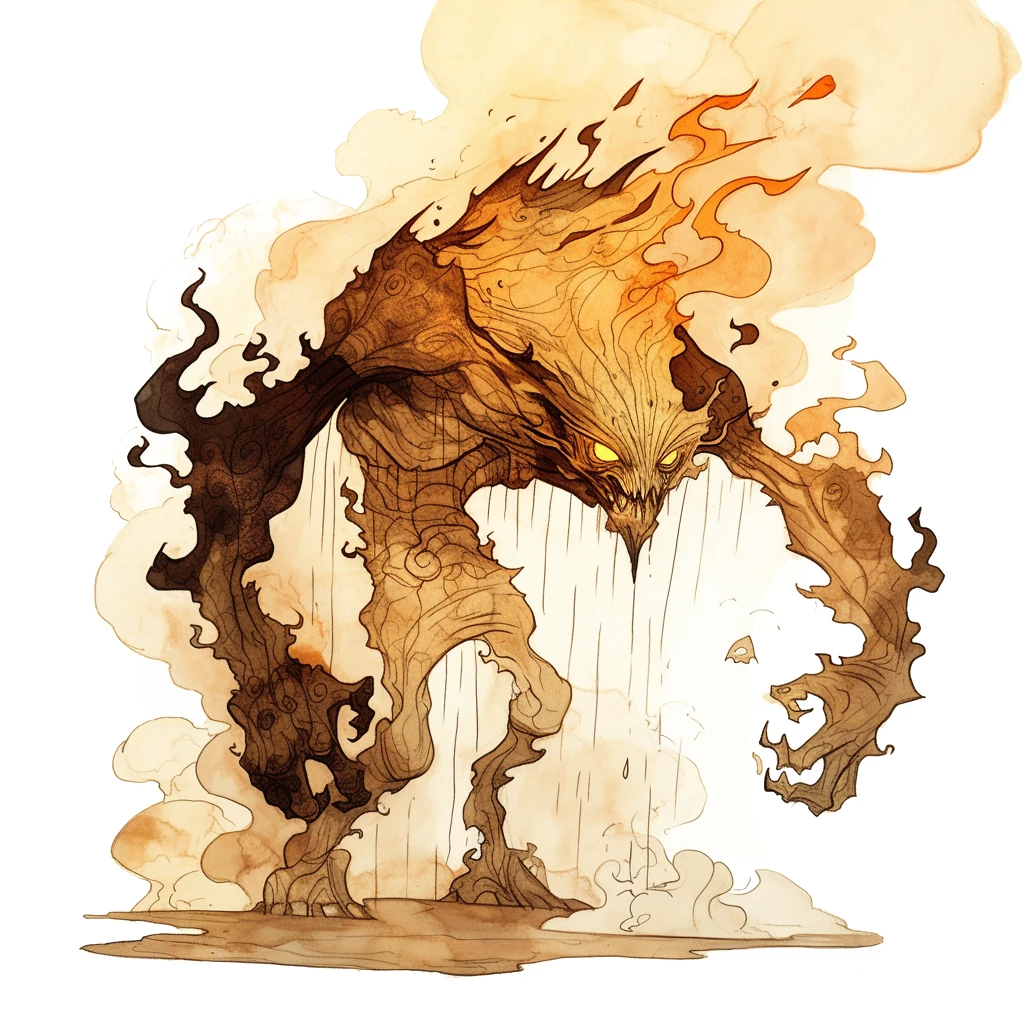
Originally natives of the mysterious Elemental Chaos, omnimentals are particularly chaotic elementals, made of a swirling melange of all of the base elements, that strangely do not mix. Perhaps this contradictory nature is what drives them to commit acts of mass destruction. The largest omnimentals are quite literally called elemental cataclysms. Fortunately, they are rare in the Elemental Planes themselves, perhaps because they find the purity environments of single elements uncomfortable. Some graybeards reckon that omnimentals only seek to create destruction as an escape from their accursed existence—unfortunately that makes them aggressive and violent as they provoke cutters they see as worthy challenges. Other philosophers reckon that’s apologist nonsense and hold that these creatures are just irredeemably destructive. If anything, since the re-emergence of the elemental planes of Wood and Metal, omnimentals seem to have become even more barmy, perhaps feeling threatened by the dynamic nature of the Inner Planes themselves?
Stats: [ D&D 3e | 5e ] Monster Manual III [3e] p118 (as CR 15 omnimental); Monster Manual 2025 [5e] p111 (as CR 22 elemental cataclysm). Canonwatch: Elemental cataclysms aren’t omnimentals canonically, but their basic concept is similar enough to merge them together.
Primal

Rare | Any alignment | Medium | Humanoid | CR varies
A strange and secretive sect (I’d call them a cult myself ) that is rumoured to have connections with Immortals and possibly even with the Old Ones on the other side of the vortex. The Primals are so secretive that their true purpose seems to be unknown even after all this time. Some cutters joke that perhaps even the Primals themselves don’t fully know the dark of what they believe. With many such mystery cults, new inducees are not told the full dark, just given a taste of it. Only after many years of faithful service do the juicer secrets get revealed. And you never seem to meet an ex-member—what happens to berks who change their mind is also dark, but likely to be unpleasant. Unlike most cults. however, Primals don’t seem to be interested in recruiting new members. Maybe the thought of sharing all that secret power they are trying to grab is just too much to stomach. In any case, you’re not going to be recruited by a Primal, if you’re interested in joining then it’s going to be a bit of a mission.
Stats: [ D&D 2e ] Planescape Monstrous Compendium Vol. 3 [2e] p74-75
Rilmani, Abiorach

N | Medium | Monitor | Rilmani | CR 5
Rilmani are monitors, who act to maintain the philosophical neutrality of the Planes. While most of their actions target the Outer Planes, some of their kind focus on the Inner Planes and the equilibrium of the elements. The abiorachs feel right at home on any Elemental Plane, even the Elemental Chaos. Wherever they go, they are tasked with watching over the balance of elemental forces, exploring the planes and mapping out new locations and demi-elements. It seems likely they knew of the existence of the Elemental Chaos long before other planars, and chant goes it was a secretive team of abiorachs who recently mapped out the way to find the plane of Metal.
More chant on the abiorach rilmani here
Stats: [ D&D 2e | 5e ] Planescape Monstrous Compendium Vol. II [2e] p86; Manual of the Planes [5e] p397
Ruvoka

N | Medium | Amphibious | Elemental | Humanoid | CR varies
Ruvoka (sometimes spelled ruvkova) are mysterious humanoids found throughout the Inner Planes. The chant goes that ruvoka were once powerful druids (perhaps a single cutter or maybe an order) who were transformed by a rogue efreeti’ ‘s wish into the elementaloids they are now. While the truth of this origin is uncertain, ruvoka do seem to care for the Inner Planes, with each tribe being uniquely adapted to one Elemental Plane in their own way. Most of the elemental planes has at least one tribe of ruvoka living in them. Notoriously neutral, they tend not to align themselves with any particular faction, being more interested in living in harmony with their environment and preventing malign forces from establishing a foothold. Ruvoka are powerful spellcasters, and as well as knowing the local elemental languages, can speak to anyone through telepathy. They live in egalitarian tribes, where each member has a role—in the harsh environments of the Inner Planes, it is essential that every individual pulls their weight lest the entire tribe suffers.
More chant on the many tribes of the ruvoka here…
Stats: [ D&D 2e ] Planescape Monstrous Compendium Vol. III
Suli

Any alignment | Medium | Amphibious | Air | Earth | Elemental | Fire | Metal | Water | Wood | Any CR
A curious kind of genasi, the suli are tied to all six of the main elements—air, earth, fire, metal, water and wood. They’re the offspring of jann and mortals, but as children suli typically appear as unremarkable youngsters of their mortal heritage. They tend to manifest their elemental natures in adolescence, or even more surprisingly for them, when they first encounter and are awakened by a true genie. Once that cork is out of the bottle, there’s no putting it back, and the newly-woken suli rapidly develops powers over the elements and surprising mastery over their own bodies. It also marks them as outsiders, for once awakened they become more than just mortal—yet also they are regarded as less than true genies. Each society tends to keep them at a distance, the mortals out of fear, envy or suspicion, the genies out of distaste and disapproval, so suli ultimately fit into neither world comfortably. Many sulis end up as adventurers, or migrate to cosmopolitan burgs like Sigil.
Stats: [ PF 1e | 2e ] Inner Sea Races [PF1e] p250, Bestiary 3 [PF1e] p258, Qadira, Gateway to the East [PF1e] p28, Advanced Race Guide [PF1e] p202; Ancestry Guide [PF2e] p108(as a playable versatile heritage)
Tempest

CN | Gargantuan | Air | Earth | Elemental | Fire | Water | CR 16+
A tempest is a living storm of roiling dark clouds infused with terrible consciousness and purpose. Unlike most elementals, tempests embody a composite nature: four elements coexist within their form, with wind and lightning, swirling sand and debris, searing gouts of flame, and relentless rain. Silver veins extend throughout their cloudy bodies like circulatory systems, conducting the electrical impulses that fuel them. These creatures are territorial, domineering and aggressive by nature, seldom encountering non-tempests without immediate conflict ensuing. They are volatile and uncommunicative, rarely capable of more than a handful of Common words, speaking instead in the ancient languages of elementals. Tempests sustain themselves on moisture drawn from corpses, scavenging after battles to drain water from the dead. Genies and elementals count them as enemies, though some ambitious djinn and marids have successfully subjugated individual tempests as elite guards.
Stats: [ D&D 3e ] Monster Manual II [3e] p193-194
Totum Font

N | Large | Air | Earth | Elemental | Fire | Metal | Water | Wood | CR 15
Totum fonts are awesome beings of six elements (those being Air, Earth, Fire, Metal, Water and Wood), who represent the creative portion of the Elemental Chaos. They are said to be among those elementals, who have betrayed the Primordials and instead chose to ally with the Gods in hopes of forging creations more beautiful that the cold elemental powers had promised them. Each totum font has six faces, each representing one of their elements. Healthy fonts constantly shift between them, but when the elements of the Multiverse are thrown off balance, they become stuck in one of their forms. When the Planes of Wood and Metal were drawn into the Churn, totum fonts were drawn with them—at least that’s how greybeards make sense of their sudden reappearance. Nowadays, some of them were able to leave the Elemental Chaos, but most of them stay there, seemingly tending to the Demi-Elemental Planes, practicing their world-smithing craft. Janni treat totum fonts with utmost respect, believing them to be the ancestors of all genies, and abiorachs seek them out in order to persuade these ancient beings to act alongside them.
Stats: [ Pathfinder 2e ] Monster Core 2 [PF2e] p325

Source: Margarita and Jon Winter-Holt