[ Planes of Cordance > Sheol ]
The Institution
The Embodiment of Drudgery and the Realm of Mot
Theme: Erosion of identity, futility, annihilation
Location: Splinterlands / Sheol
Power: Mot (LE Intermediate power of death, drought, sterility, silence, tyranny [He/Him]) ‡
The Institution is the embodiment of the crushingly methodical, impersonal machinery of governance, the futility of banal tasks, and the drudgery of endless assessment. Every soul here is continually assessed, categorised, promoted, demoted, and assessed again. The criteria are never explained. The assessors have no faces. The work seems, almost without exception, completely pointless. The Ugaritic power Mot has his fingers all over the Institution, and has situated his realm, the Palace of Mawt, at the apex of the plane. This whole place is an insidious kind of hell, and one where the petitioners can never seem to catch a break. They are here to be punished, after all—but Mot thinks of himself as a civilised kind of deity, far too genteel to torture or eviscerate berks like some of the other powers of death might. No, he sits at the pinnacle of this plane all self-important like only a power knows how, while his petitioners literally work themselves beyond death in their miserable afterlives.
It’s probably easier to define what the Institution is not—it’s not a religion, nor a company, nor a cult, nor a faction. It doesn’t seem to produce anything of value, or interact much with anything outside Sheol. Petitioners arriving in Sheol are inducted into the Institution whether they want to be or not, and once in, their fate is decided by their Higher-Up, a cutter from the next tier above them who is responsible for assessing them, deciding what work they are assigned, and ultimately whether their performance has been outstanding enough for them to be promoted to the next tier—or more likely, to be demoted if they’re found lacking.
The Lie of the Land
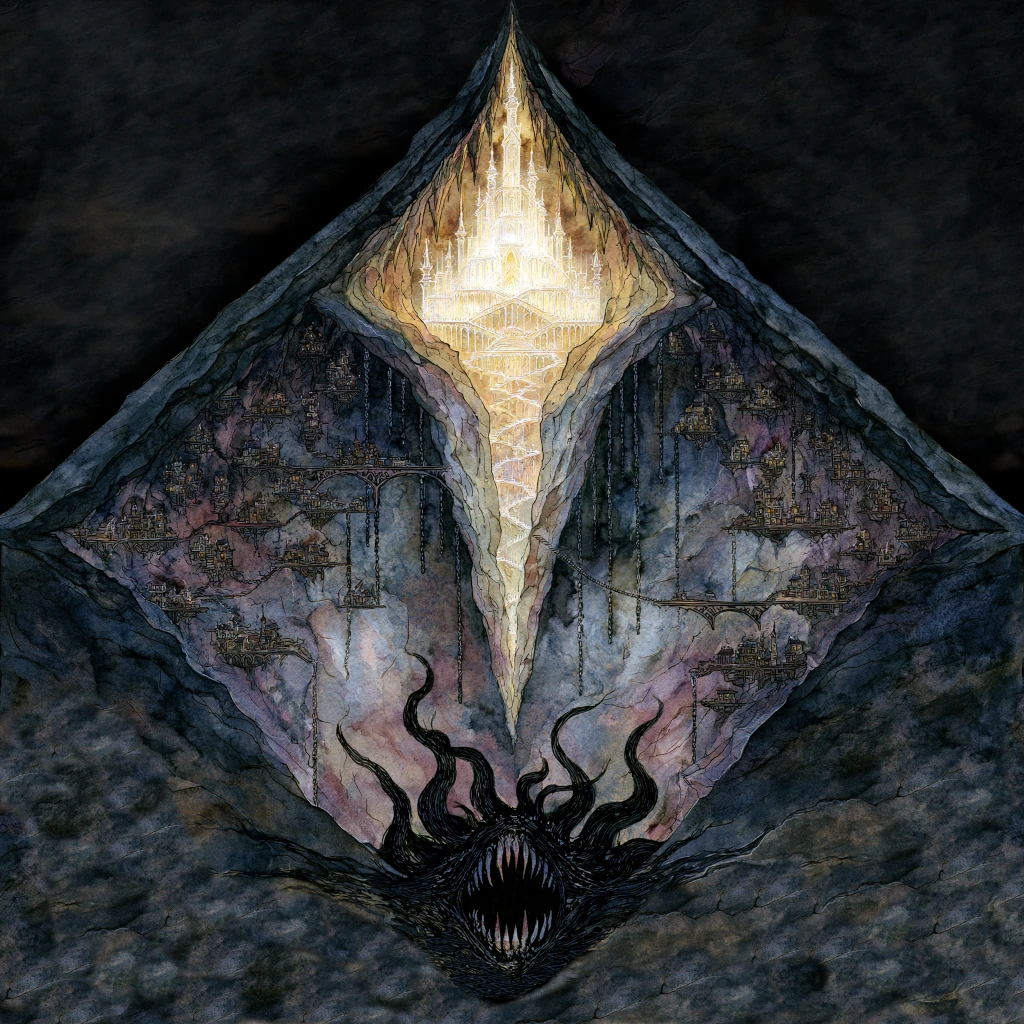
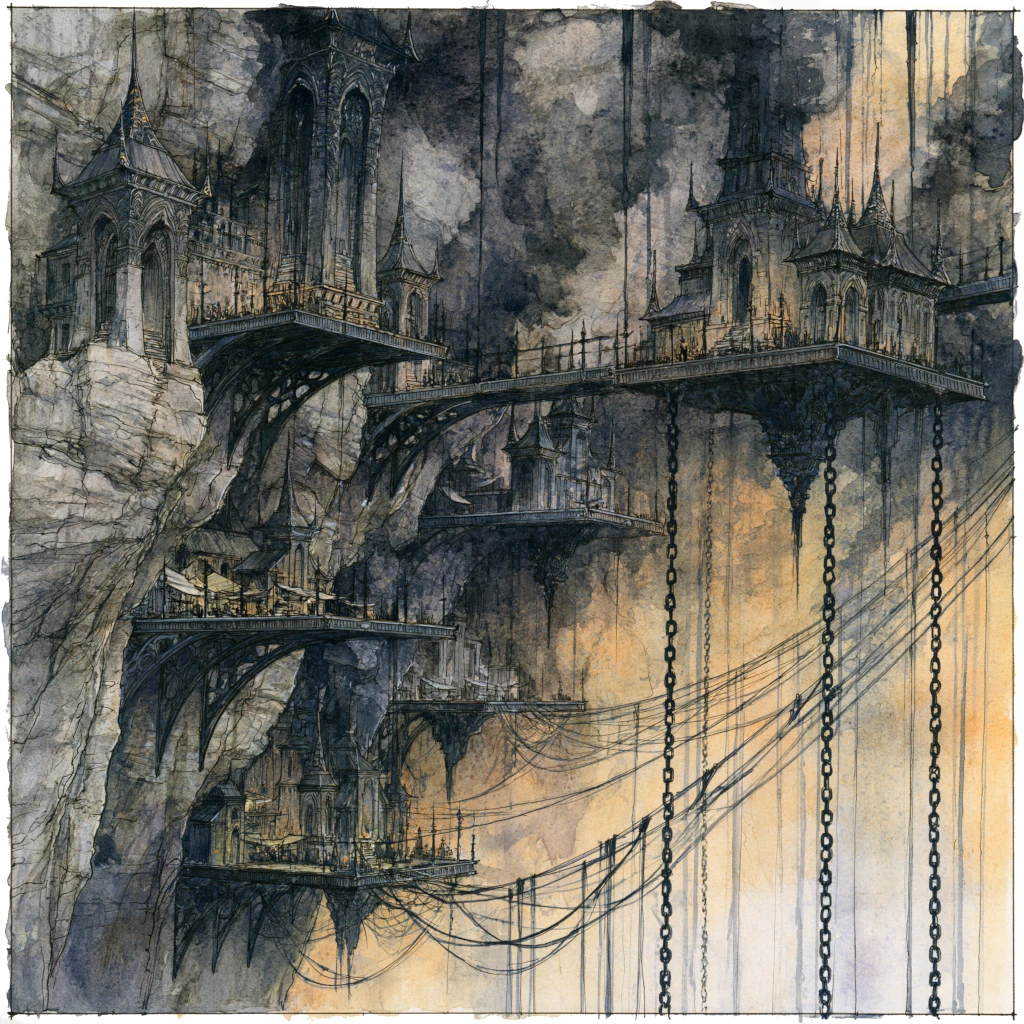
The petitioners of the Institution live precarious existences in dormitory-caverns hacked into the cliffs, platforms which hang from the rock faces with fraying ropes and rusty chains, and galleries carved like shelves into the rock. These perilous terraces are connected by a maze of staircases and tunnels which are bored into and around the mountain, or on the lower levels rope ladders. They are located vertically across seven tiers, and believe me when I tell you that level a cutter is on is everything. You see, the higher the tier a body stands on, the closer they are to Mot, and that’s a good thing, right? Well, we shall see about that. But the converse is very much true, you definitely don’t want to find yourself on the lowest level…
A Hierarchy of Pointlessness
At first, the plane might not seem so bad. There’s almost no crime, and cutters here mostly seem to work together peacefully. However, a berk will quickly discover the concepts of mercy, freedom, or compassion are also absent. The Departments in Sheol are in a constant state of cold war with each other. Some folks are fooled by the cooperative exterior that’s worn by the meek petitioners like a mask, but it has a dark underside that planewalking visitors needs to understand.
The Institute is organised into Departments, Working Groups, Sub-Committees, and Panels, none of which have clear remits, and all of which overlap in ways that require further committees to resolve. Every tier is divided into countless corridors with archive rooms, sorting offices, and assessment chambers. Each is run like a little kingdom by the Higher-Ups, who compete with others of the same rank, and spend as little time as possible with their underlings preferring instead to frequent their own exclusive tier.
The higher tiers are connected by wide, well-maintained staircases; there are narrow, poorly-lit steps or ladders in the middle layers; and the lowest levels are precarious rope bridges, and narrow ledges with no hand-holds. There are no maps, although maps have been requested. The requests are being processed.
I spent two days trying to find a window.
—An unnamed sub-petitioner
Just one window. Something to tell me the mountain had an outside.
I didn’t find one.
The search party the Department of External Orientation sends out every thirty years hasn’t found one either.
They’re still out there, apparently. Somewhere in the corridors, still looking. And still filing their weekly progress reports…
Rank and File
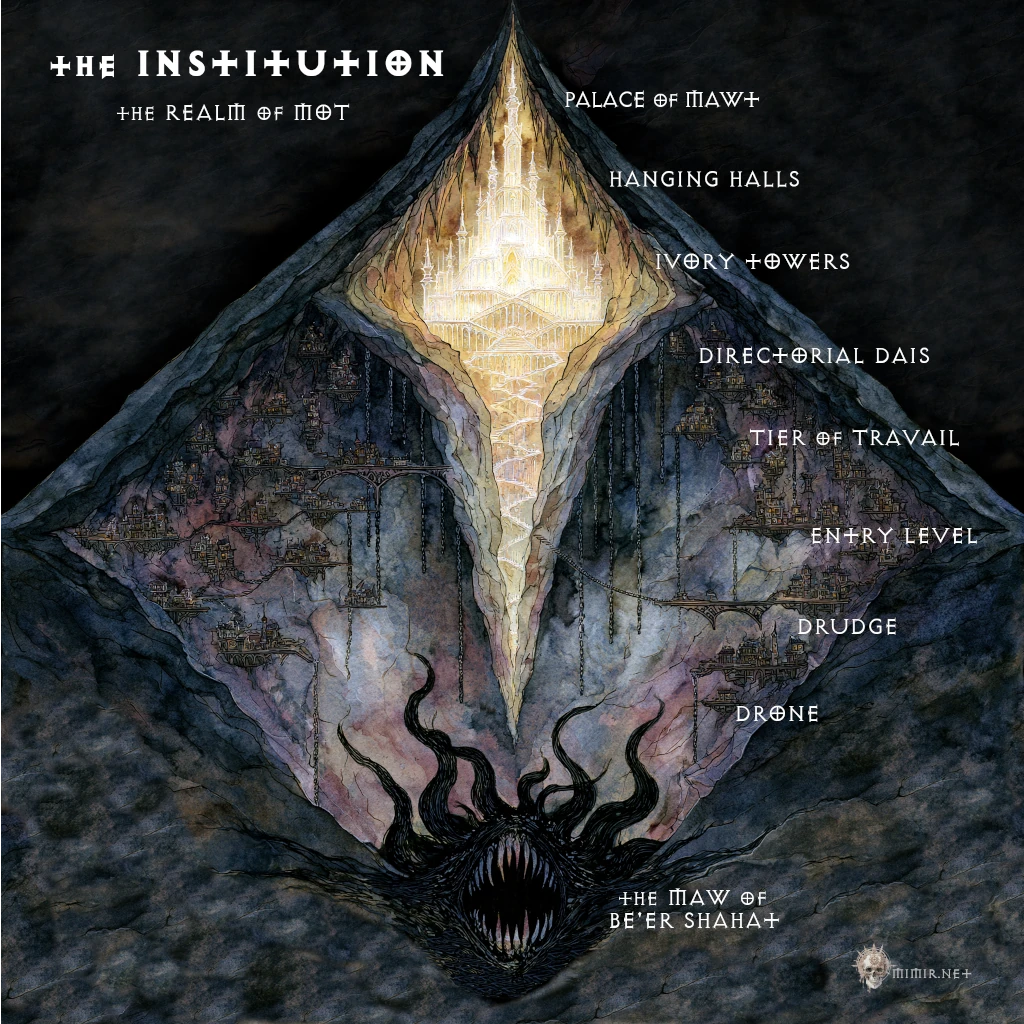
This is a brief overview of the seven (known) tiers of the Institution, with the rank and title of the primary residents of each. A cutter can visit a lower tier freely, but never one above their rank.
- Preeminent Primary Highest-Up Proxy—almost never seen, these near-legendary proxies have unfettered power over the Institute, answering only to Mot himself. They have ascended to this rank presumably by being utterly ruthless. Their names, if known at all, are whispered in fear by their underlings, and they’re more commonly referred to by the name of their departments. If the chant is to be believed, Mot’s proxies live in fabulous Hanging Halls on the edge of Mot’s Palace.
- Senior Principal High-Up—effectively the faces of the Departments, these secretive cutters live in the Ivory Towers level just beyond the grounds of the palace.
- Vice-Principal High-Up—these cutters are obsessed with inter-department politicking and scoring points over their peers in other departments in order to gain favour and perhaps promotion upwards from their coveted offices in the Directorial Dais.
- Higher-up—the lowest level of management, Higher-Ups tend to be pernicious and spiteful to the petitioners in their little empires, in order to defend their position and justify their elevated rank in the Tier of Travail.
- Petitioner—the usual starting point for a new petitioner arriving with no performance history, these cutters are given tasks which are almost impossible to perform, therefore guaranteeing most will be rapidly demoted from the Entry Level.
- Sub-Petitioner—the largest group of workers, who have started to lose their individuality and ambition. They occupy the vast Drudge level.
- Unspeakables—drone-like workers without distinct identities working on the most dangerous Drone tier, which hangs just within of tentacle-reach of the Maw of Be’er Shahat.
On the upper levels, petitioners have distinct identities: names, beliefs, memories, and opinions. Identity here is aggressively preserved by cutters, because rank requires distinctiveness. The inter-factional politics can be vicious. Departments form alliances and bitter rivalries. Petitioners build networks of mentors, and join ideological sub-movements. Interpersonal grudges arise within sub-committees, not because any of it matters, but because advancement matters, and advancement requires being seen to matter by those above you. There are Higher-Up roles, Vice-Principal Higher-Up roles, and Senior Principal Higher-Up roles. The titles grow longer as the work grows more abstract. At the top of the hierarchy are Preeminent Primary Highest-Ups, literal proxies of Mot. In theory it’s possible for any petitioner to ascend to that heady rank. In practise? Well, good luck with that. The policy is strictly one-up-one-down, and the higher-ups jealously guard their status with a jingoistic sense of civic pride.
Every department believes itself superior to every other department of course, each one regarding itself as the true heart of the Institution. The collective sense of institutional self-importance is such most of them have even forgotten that Mot is ultimately in charge. As with most powers, he’s so hands-off that sometimes the only thing that reminds cutters he’s there at all is the light that shines from his palace.
The Work
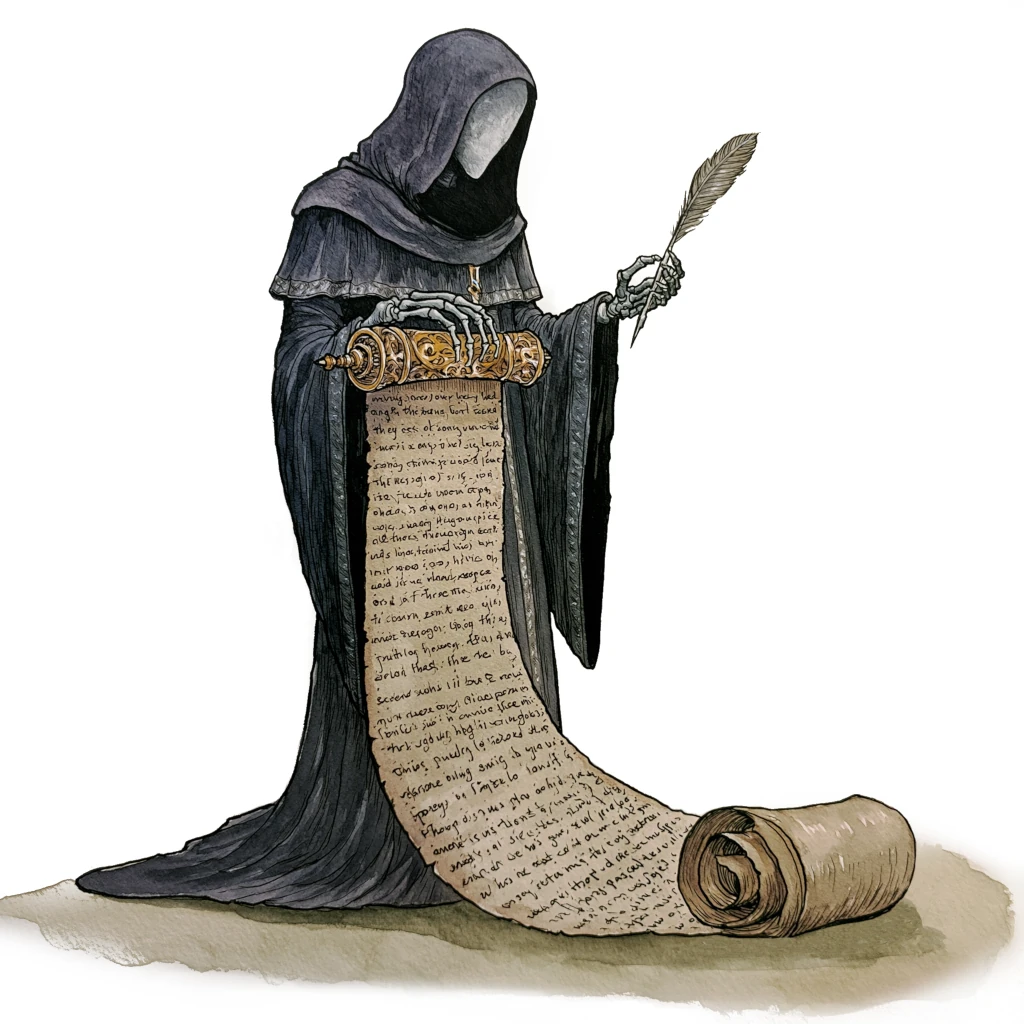
Every petitioner in Sheol is assigned a position upon arrival in their afterlife. Their role is explained in a Document of Welcome which is far too long to read fully, and written in a hand too far small to see comfortably. It’s delivered by a dumah, a silent functionary monitor with a featureless face. They will not answer questions, beyond proffering the document. It’s not so much a contract, which would imply the signee has some kind of choice, as a binding set of conditions that apply to their afterlife. It’s in this document that a tier is assigned to the petitioner, as well as a department, and a particular task. The work assigned depends entirely upon the tier, and it is always mysterious, and unimportant.
The work assigned on the lower levels is the toughest, soul-crushingly pointless, pure physical drudgery with no apparent purpose whatsoever. Petitioners here have largely forgotten why their effort should be rewarded and do these things out of residual habit alone.
- Carrying stones from one end of a corridor to the other, then back again. The stones must be carried one at a time, and the quota will be changed without notice, always upwards.
- Grinding dust more finely. The dust is already fine. There is a specific texture it must reach, which was described in a document nobody can read anymore because the document itself became dust.
- Polishing the walls to a smoothness they already have. The walls of the mountain are already extremely smooth. Petitioners are given inadequate tools, and assessed frequently on their progress.
- Moving archive shelves three inches to the left. All of the scrolls and tablets must be painstakingly removed first, and then reshelved in the same order afterwards. Then, the following week, the shelf must be moved three more inches to the left.
- Carrying water from one basin to another, far apart. The vessels are provided by the Institution, and have holes in them.
- Unspooling and re-spooling vast reels of chain to check for knots. There are rarely any knots, but petitioners who report finding none are marked as having performed an incomplete inspection.
In the middle levels the tasks are tedious beyond endurance. Less physically punishing so much as cognitively annihilatin, as if they have been designed to occupy just enough of the mind to prevent thought about anything else.
- Copying list of petitioner names and identity numbers by hand that are themselves copies of copies, with no original on record. Errors accumulate across generations of copying and must be faithfully reproduced, but correcting them is a disciplinary matter.
- Cross-referencing two identical lists of names to identify duplicates. All duplicates must be reported individually on separate forms, and each form requires a counter-signature.
- Counting entries in ledgers, recording the count in a second ledger, which is then checked by someone else and the results recorded in a third. Discrepancies between counts must be resolved by committee, with the findings recorded in a fourth ledger.
- Re-alphabetising archives that are already alphabetised, because the previous alphabetisation used an outdated ordering convention. The efficacy of each new standard organisational procedure is reassessed mid-task, and then altered to improve it in ways that probably contradict the previous convention and require starting again.
- Attending mandatory refresher briefings on the content of previous mandatory briefings. Detailed notes must be taken, which are collected at the end and destroyed.
- Logging all time spent on tasks, including the time spent logging. The logging itself must be logged. Petitioners quickly discover this creates an infinite regress but are disciplined if they fail to resolve the paradox adequately.
Finally, on the upper levels, petitioners have been promoted to a new dimension of futility, and gained enough of an identity to take small satisfaction in their small dominions.
- Approving or rejecting the work of those below, using criteria one invented oneself and is not required to share. Rejection requires the lower petitioner to redo the work and resubmit. There is of course no guarantee the second submission will be assessed by the same Assessor.
- Redistributing workloads from one’s own level downward under the guise of delegation. The redistributed work returns upward as reports which must be reviewed, and then re-delegated to be summarised by another petitioner.
- Convening disciplinary hearings for petitioners who failed to attend mandatory refresher briefings. Lower ranked petitioners are not usually informed of mandatory briefings. The hearings themselves consists of a mandatory briefing, on which they may later also be disciplined for failing to attend.
- Allocating identity numbers to new arrivals, which replace their names in all official documentation. Their original names are archived.
- Reviewing and selectively redacting the personal records of lower petitioners before the records are passed upward. Petitioners who have been sufficiently redacted may find their own records no longer reflect anything they recognise as themselves.
- Issuing certificates of commendation for pointless tasks completed efficiently, which lower petitioners value enormously and which confer no practical benefit whatsoever.
The purpose of the work is never explained. On the upper levels, the most experienced petitioners eventually deduce the dark of it—the work on each level exists largely to monitor, assess, and control the level below it. The entire structure of the Institution is a machine for generating hierarchy out of nothing, using the labour of those at the bottom to justify the positions of those above them. By the time a petitioner climbs high enough to understand this, they have usually invested so much of their identity in the Institution that this knowledge changes nothing at all.
Promotion and Demotion
The only way for a petitioner to progress in the hierarchy of the Institution is for them to be recommended for promotion, and for it to then be agreed by one or more of the faceless dumah assessors. At no point does the petitioner get to make their case, in fact, often they are not even aware discussions are going on. The criteria by which a petitioner should be considered for promotion are dark, possibly even to the higher-ups. If a unanimous verdict is reached between dumah, the petitioner in question is immediately promoted. If agreement is not reached however, the petitioner is instead demoted to a lower tier. Descent can be rapid.
On the lower levels of Sheol, the identity of petitioners begins to be eroded. The cutters start to forget things—the identity numbers of their peers first, then the name of their Department, their interests and distinctive personalities. They remember that these things once existed, but without being reminded, they cannot reconstruct who they were.
Further demotion drops a petitioner down more levels. The work on each lower tier is more meaningless and more repetitive than the last. The social fabric thins even more on the Drudge tier—there is less to argue about, fewer distinctions to maintain, fewer words are needed for the tasks, and the sub-petitioners here look increasingly alike. The Unspeakables of the Drone tier move in near-silence, their faces slack, their identities completely erased gone from their own memories. The distinctions between them have dissolved into a uniform, grey-clad sameness, and they have effectively become copies of the same bland being, doing the same generic task, somewhere in the flickering gloom.
When their last vestige of selfhood is erased, the petitioner simply stops working. There is nothing left in them that understands why any effort should be made. Then they walk slowly towards the nearest platform edge and wait. Before long, an ever-seeking tentacle from the Maw of Be’er Shahat will discover them, wrap around an ankle, and tug. The drone drops downwards, falling toward the bottom of the cavern and the mouth that waits at the point where the mountain’s walls converge. The higher-ups won’t admit it, but it’s this constant attrition in petitioners that makes room for new arrivals at the Entry Level. They are never seen again.
Upper Management. Petitioners or planewalkers assigned to a Department of the Institution are under a permanent effect similar to the geas spell which was activated upon them signing (or even acknowledging) the Welcome Document. The command is simply to follow all the orders of a higher-up, and failing to comply has the following implications. Additionally the discretion of their manager, they may be subject to disciplinary procedures and demotion. This geas lasts until dispelled in the usual way, or the basher leaves the plane.
- D&D 5e: Treat as the Geas spell, with the following modifications. Make on a DC 11 Wisdom save. On a failure the creature takes 2d10 psychic damage, on a success it takes half the damage. The command follows the same rules as the Charmed condition and isn’t considered magical.
- PF2e: Treat as if the Geas ritual has been successfully enforced, with the target growing increasingly sickened each day they fail to follow instructions. Use an appropriate hard DC for the character’s level to dispel it.
The Dumah
Angels of Silence and the Stillness of Death
The dumah [DOOM-uh] are a peculiar kind of outsider unique to Sheol who occupy a liminal middle ground between psychopomp and inevitable. They’re responsible for the fate of the petitioners, ensuring the higher-ups do not overstep any rules of the Institution, approving promotion or demotion requests, and making sure the number of souls on each tier is kept in balance. They are simultaneously part of the Institution and outside of it, seem to have no rank of their own, and can make judgements on members of tiers of any seniority, should they wish. These bureaucrats are literally faceless and nameless themselves, and their purpose seems to be to erase identities and homogenise souls.
More chant on the dumah assessors and the nameless paragon of the dumah here…
The Boss
- Mot (LE Intermediate power of death, drought, sterility, silence, tyranny [He/Him]) ‡
Locations in the Institute
- Be’er Shahat (site/creature) ‡
- Directorial Dais (tier of the Vice-Principal Higher-Ups) ‡
- Drone Tier (tier of the unspeakables) ‡
- Drudge Tier (tier of the sub-petitioners) ‡
- Entry Level (tier of the petitioners) ‡
- Gate to Ceras (gate). Sheol actually has a gate town. It’s called Ceras, and it’s situated between two giant stone horns. They may well be from the same creature that gave Ribcage its ribs. The berks in Ceras don’t even know they’re sitting on a gate, but you’d swear they’re hiding something. I’ve never seen a more inhospitable, xenophobic indep town. Don’t expect a warm welcome there. In fact, I wonder why they haven’t actually slid into Sheol yet, except they may be even more evil than that plane.
- Hanging Halls (tier of the Proxies) ‡
- Ivory Towers (tier of the Senior Principal High-Ups) ‡
- Palace of Mawt (realm of Mot) ‡
- Tier of Travail (tier of the Higher-ups) ‡
Preeminent Primary Highest-Up Proxies
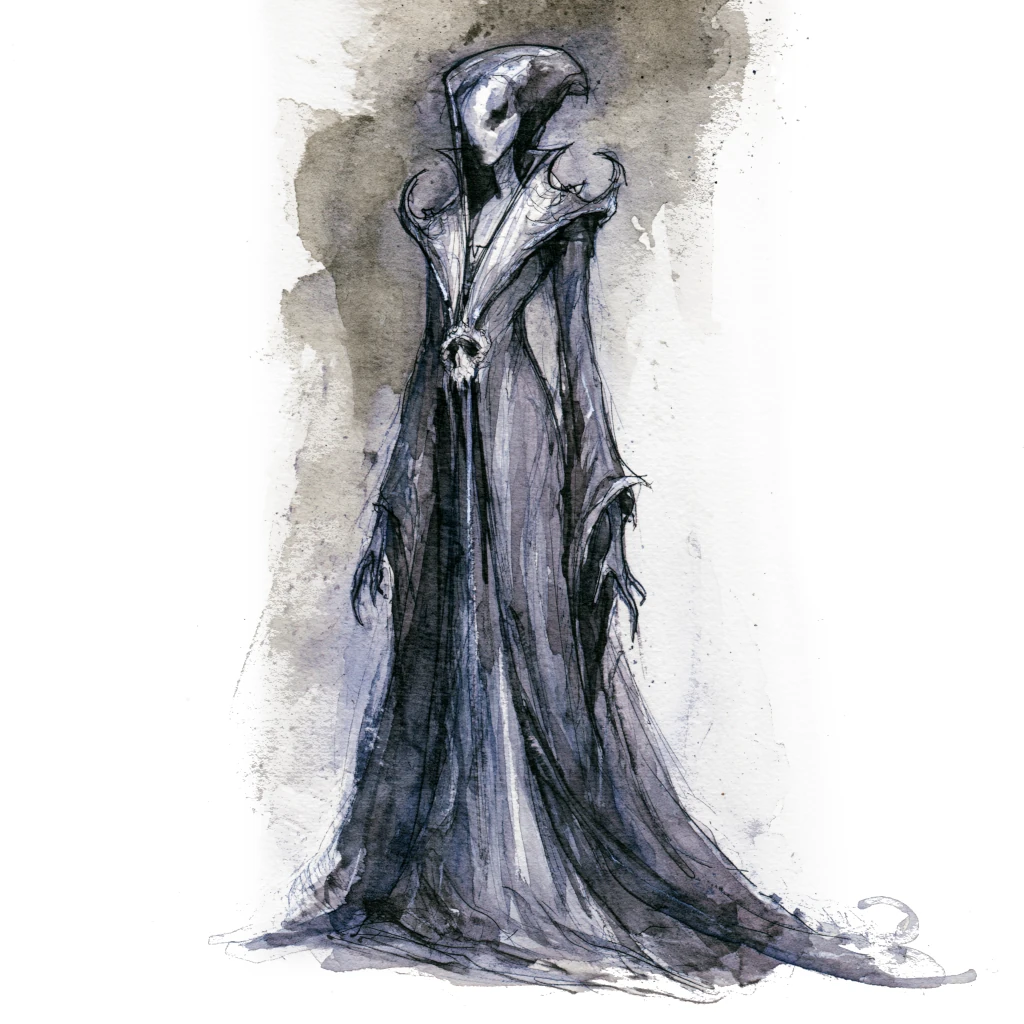
The Aechmalotarch (LE Human proxy of Mot [she/her]) ‡
The Aechmalotarch [ike-MAL-oh-tark] is the director of the Department of Fiendish Taxonomy. She’s a tall woman of indeterminate age, who always dresses in immaculate grey. Her facial features are blurred, as though life in the Institution has been slowly wearing them away but hasn’t quite finished the job yet. Her rise to proxy status somehow concentrated her personality, for she is uncomfortably intense and focused.
The official remit of her department is the study of fiendish taxonomy, and their place within the planar hierarchy of evil, but her interest in them is entirely bureaucratic. She seeks to uncover who outranks whom, and whether the whole tangled mess of baatezu nobles, tanar’ri lords, and yugoloth backstabbers could be rationalised with a proper org chart. Fiends find her unsettling, because she’s the first being most of them have encountered who regards them not with fear but with the slightly disappointed expression of someone who’s seen better filing systems.
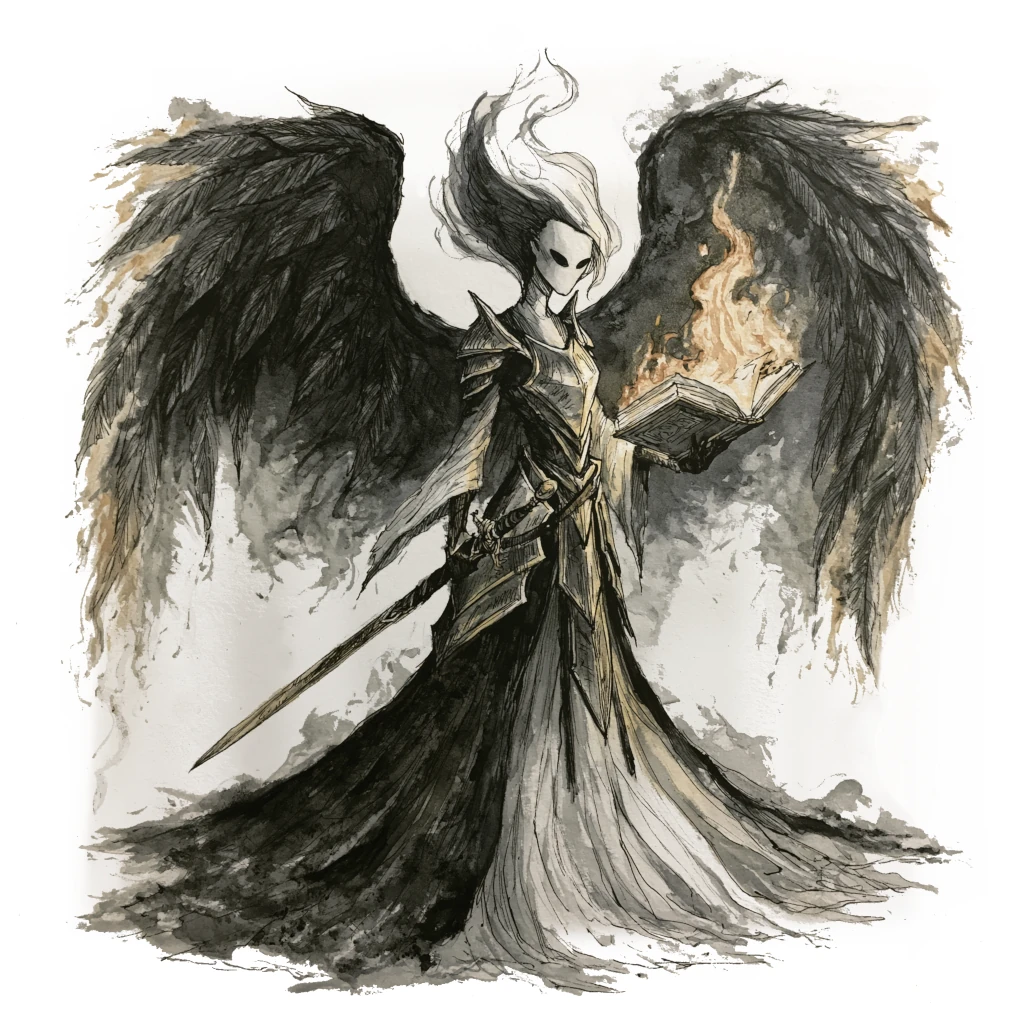
Shevban (LE Exscinder archon (fallen) proxy of Mot [she/her]) ‡
Shevban [SHEV-ban] was once an excinder archon of Mount Celestia, whose divine function was the destruction of corrupt texts. She oversaw the banning and burning of blasphemous scripture, the erasure of dangerous knowledge, the excision of ideas so poisonous that even their written form was a threat of contagion. It is a deeply uncomfortable function for a celestial to perform, and the line between protecting the faithful from corruption and being an censorious tyrant is thin enough that some stop being able to see it at all. Shevban crossed that line when she started erasing things that were merely inconvenient rather than dangerous. She landed in Sheol and now runs the Department of Archival Integrity and Suppression. This department is responsible for reviewing documents, records, and personal correspondence circulating within Sheol and ensuring they conform to institutional standards, which is to say, do not contradict any official records, challenge the hierarchy, or allow a petitioner to recover memories. She has not changed her methods at all since her fall. In fact she does not even seem to have noticed that she is working for a power of death in a plane of institutional misery rather than Mount Celestia. If she has noticed, she has dismissed it as irrelevant to her work.
Shevban is tall, pale, severe, and dresses in gray robes that still holds the memory of once being white. She carries a stylus that burns away what it strikes from the record, and she uses it with the satisfaction of someone who has believes that the multiverse is improved by having less nonsense in it.
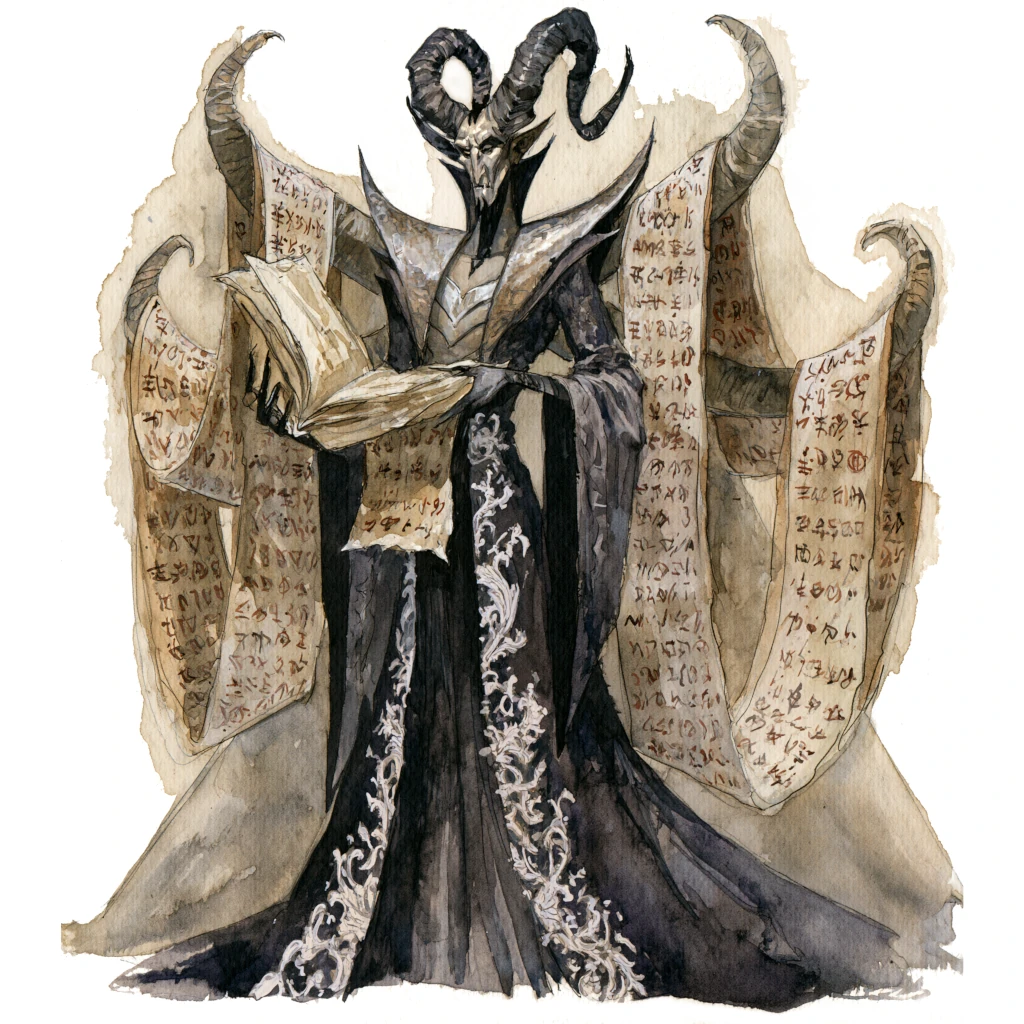
Tsharvirel (LE Phistophilus baatezu proxy of Mot [he/him]) ‡
Tsharvirel [SHA-virell] is a phistophilus, a contract devil of Baator, a creature whose entire existence is the binding of souls to terms and conditions they did not read carefully enough. He is in Sheol on what he will describe, if asked, as a secondment—although he has been on this secondment for longer than most mortal civilisations have existed and he has never once indicated any intention of returning. The arrangement seems to suit everyone. Baator gets an operative embedded in a neighbouring power’s hierarchy with access to Sheol’s archive of soul-records. Mot gets a functionary of supernatural competence in the one area the Institution had always handled with blunt force rather than elegance: the binding of newly arrived souls to their conditions of service. The Document of Welcome that every petitioner receives upon arrival in Sheol was, before Tsharvirel, a crude instrument. Yes, it was comprehensive and impenetrable, but not watertight. Tsharvirel rewrote it, and it is now a contract in the fullest Baatorian sense, closing every metaphysical loophole, preemptively addressing any appeal, and containing a binding clause enforcing even the text that is visible only to creatures with truesight.
Tsharvirel appears as a lean, copper-skinned man with neat horns and the expression of someone who is thinking three sentences ahead of you and is patiently waiting for you to catch up. He’s unfailingly courteous and charming, and the single most dangerous person in Sheol to have a conversation with, because you never quite know when you are entering into a binding verbal agreement.
See also: The Dumah, the Angel of silence and the Stillness of Death
Source: Jon Winter-Holt. Inspired by Franz Kafka, Jewish and Greek mythology, Severance, and general corporate bullshit. Canonwatch: † from the Pathfinder setting; ‡ Homebrew. All of the Planes of Cordance and the concept of the Splinterlands are homebrew and non-canonical. If you don’t want to add additional planes to the cosmology then I suggest you could incorporate Sheol somewhere underground in Gehenna. Expanded from Greg Jensen’s original conception, more information on his Planes of Cordance can be found here.