[ Outsiders > Monitors > Dumah ]
The Dumah
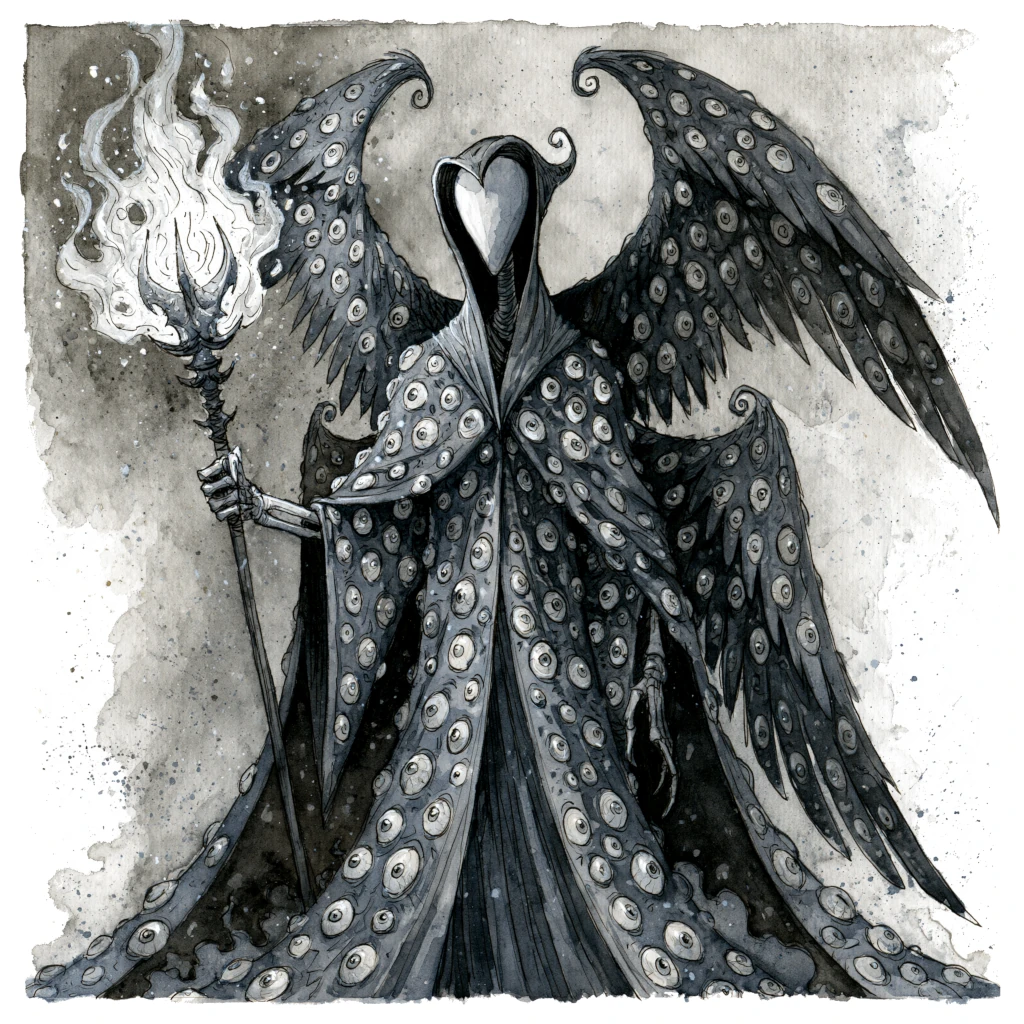
The Angel of Silence and Stillness (planar dumah paragon [it/its] / LE/N) ‡
Portfolio: Unknown
Realm: Splinterlands / Sheol / The Institution
Alignment: Lawful Evil / Neutral
The paragon of the dumah has no name. Now this is not unusual for one of these strange creatures, for none of the cutters seem to have names, but for every other dumah the lack of a name is simply an absence, like a blank slot where something has never been placed. When you consider the paragon though, something is different. It is the kind of namelessness that feels like a weighty decision made so long ago that the even though the decision itself has been forgotten, the consequence still remain. Sure, some cutters call it the Angel of Silence and Stillness, but even that is less a name than an observation of its habits.
The being looks superficially like all the other dumah—apart from the eyes. They too are tall and slender, with a smooth featureless face, and skeletal arms. Unlike dumah assessors, the paragon also has four black wings, although it has never been seen to fly. Most disturbingly though, its wings and robes are completely covered in eyes, from head to toe. They are real eyes too, not just a pattern. They blink, and scrutinise, and follow a berk around the room. The cutter carries a clawed staff too, made from ice but perpetually burning with a gray flame that emits no heat, only flickering monochromatic light.
The paragon is the oldest and first of the dumah. How much older than the others is dark, for the Institution’s records on the subject simply stop, mid-sentence, in a way that suggests the scribe thought better of continuing. Perhaps the paragon was already here and the Institution formed around it, the way a mountain grows up around a fault or a pearl around a grain of sand. What is known is that the other dumah assessors defer to it in a way inconsistent with the absolute equivalence with which they treat each other. Mot’s proxies regard it with unease too, and the chant is that even Mot himself has never, in any document, correspondence, or proclamation, issued it a directive. Not one.
Chant goes that Mot’s proxies have tried, on at least three recorded occasions, to formalise a relationship. The first attempt by Tsharvirel produced a document of remarkable comprehensiveness that was returned the following morning with a single notation in the margin in a spidery handwriting that matched no dumah script on record: this office does not require a charter. His second attempt was more carefully worded, framing the formalisation not as an appointment but as a recognition of pre-existing function. It was a subtle distinction that the paragon apparently found insufficiently subtle, as the document was subsequently filed and cannot be located. The third attempt was never completed. The scribe assigned to the task requested reassignment after two days but before this could be processed there was a terrible accident involving a length of vinegrip and a fall into the Maw of Be’er Shahat.
The only thing the paragon has ever been known to do is watch. It moves through every tier of Sheol on a schedule no one has yet tumbled to, silently observing petitioners but also the dumah themselves—and the higher-ups, the principals, and even the proxies. It sometimes carries a tablet but never writes on it. It lurks quietly at the back of disciplinary hearings, promotion panels and departmental reviews, remaining so motionless that cutters forget it is even there. They always seem to forget, and that is probably the point. However, on the rare occasion that a dumah makes an error, perhaps a demotion applied to the wrong soul, or a decision being unduly influenced by a proxy, the Angel of Stillness will appear within minutes. Nothing is said between the dumah and the paragon, and no notes are filed. The error is simply corrected silently, and the paragon moves on.
The chant among cynical petitioners who’ve have been in Sheol long enough to form opinions—but not long enough to have them ground to into dust—is that the Angel though embodies something the Institution was always meant to serve but has long since stopped worrying about: the principle that every soul must be accurately assessed, not promoted or demoted for political convenience, nor erased before its time, nor held longer than necessary. Maybe, they say, somewhere beneath the institutional machinery of pointless drudgery and identity erosion, Sheol was meant to be fair. This theory is treated by the Institution’s official theological faculty as heretical and filed under High Treason. They say the Angel was present when the filing was done, standing at the back of the archive, and that just before it turned to leave, it made a single mark on its tablet.
Source: Jon Winter-Holt. Homebrew. Dumah (also called ‘the angel of silence and the stillness of death’) is an angel from Rabbinic and Islamic literature who has authority over the wicked dead.