[ Ugaritic Pantheon ]
Mot
Maweth Who Enlarges His Throat, Lord of Misery; LE Intermediate power of death, drought, sterility, silence, tyranny [He/Him]
Realm: Splinterlands / Sheol / The Institution / Palace of Mawt
Pantheon: Ugaritic
Worshippers: Bureaucrats, tyrants, those who enforce oppressive hierarchies, morticians who charge too much, anyone who has ever enjoyed a demoting an employee
Allies: Hades, Nerull, Urgathoa (uneasy), Dispater (professional mutual regard)
Enemies: Baal Hadad, Osiris, any power of rain, rebirth, or harvest
Most bloods who’ve heard of Mot [MOTE] think they know the chant from the myths. He’s an ancient god of death who swallows endless numbers of the living and petitioners alike. He had a long-running feud with some local rain god, got chopped into pieces by a war goddess, and came back again anyway. That’s all mostly true. What they miss (what almost every graybeard misses even) is that Mot is not primarily interested in killing you, as much as making your existence irrelevant.
“Death”, Mot would tell you if he could be bothered to speak to you directly (and don’t worry, he cannot), “is merely an administrative mechanism”. Dying carelessly, and by that I mean without ensuring you were good enough in life to end up in a better place, makes a soul the property of the Institution. That’s when the real toil and trouble begins. Be ready for grinding erosion, the slow loss of everything that made you you, until you are indistinguishable from everyone else on your tier. And then the long fall down.
Mot is not the screaming void of Gehenna, or the fire and brimstone of Baator. He is the featureless face at the top of the hierarchy, and the final authority whose name is rarely spoken, but without whose tacit approval nothing in Sheol would function for a moment. He is death as inevitability, specifically the inevitability that all things, in the end, get turned into the same featureless dust. It seems that the sheer grinding mundanity of the Institution is designed to wear away individuality and hope of cutters, perfectly preparing their souls into a bland homogeneity, and ready for consumption.
He is very old. He was among the first sons of El, the supreme creator of the Ugaritic Pantheon, and is counted among the gods of an age long before the current multiversal order was established. Believe it or not, his realm even predates most of the planes it borders. He’s just been sat in the dark since before there were stars, and he was not lonely, because loneliness requires a personality that actually minds being alone.
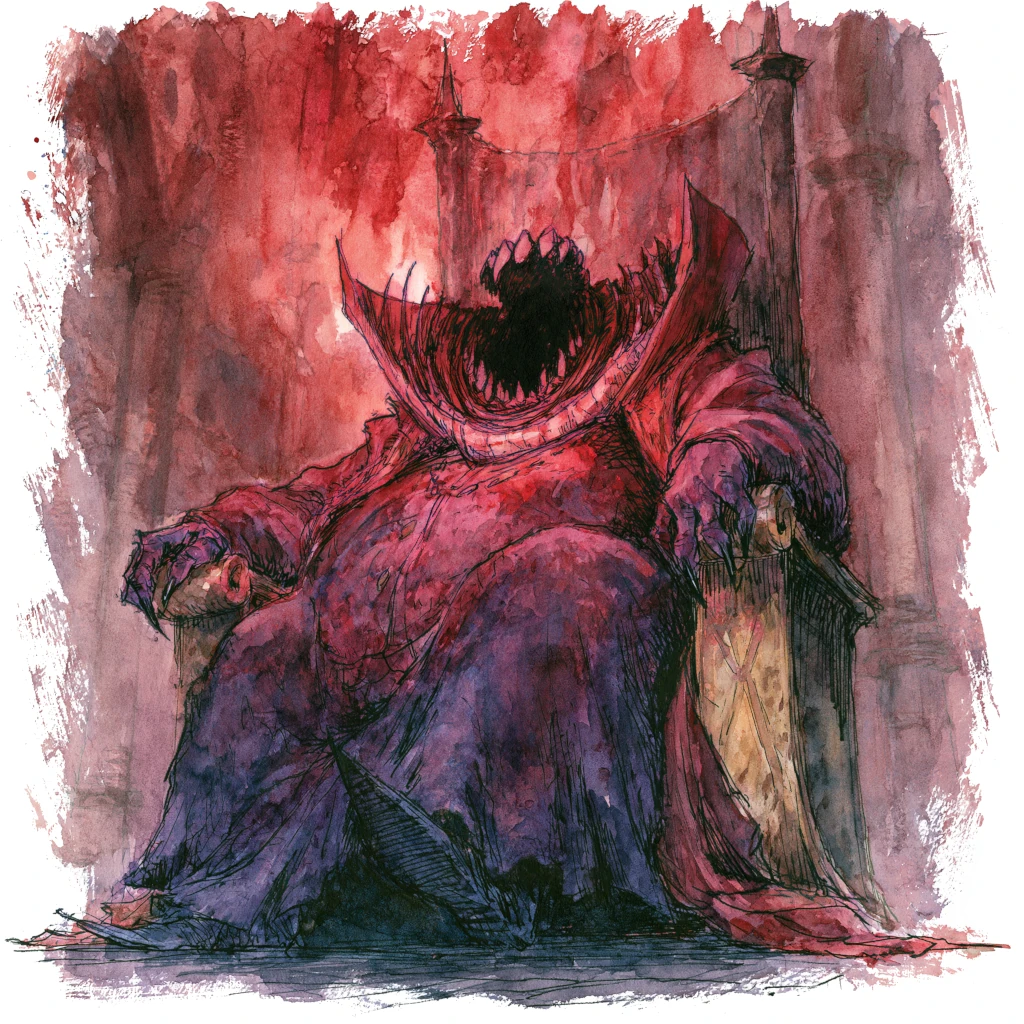
Those who claim to have glimpsed him in the Palace of Mawt and somehow survived, describe something loosely man-shaped, seated, completely filling the deepest throne in an impossibly large chamber. His skin is the colour of the inside of a throat. His face is open, like a mouth that has become a face, a gaping cavity ringed with concentric rows of flat teeth that disappear into darkness. When he speaks, albeit rarely, his words have a deep rumbling echo, as though something very far below is repeating them moments later.
The Mouth and the Mountain
In the ancient texts Mot is described as having an appetite like that of starving lions in the wilderness, or the longing of fish for the sea. His hunger is better described as some kind of inexorable gravitational pull toward his maw that warps the space around him. The deeper a berk descends into Sheol, the stronger this pull becomes. Cutters have wondered about the nature of the maw of Be’er Shahat, and the topic is theologically contested. The Institution maintains that the Maw is an unrelated naturally occurring geological feature, useful for waste disposal. The upper-tier theological faculty have been examining this question for centuries and have not yet issued a preliminary report. The chant among certain graybeards is that the Mountain is Mot—that the Palace of Mawt at the apex and the Maw at the nadir are, respectively, the head and throat of Mot, and that the entire plane is simply the interior of a power who is in the process of swallowing everything inside him.
His clergy call their religious philosophy the Three Secret Silences:
The First Silence
All Things Diminish. Nothing retains its form, its name, or its significance indefinitely. Identity is a temporary arrangement of matter and memory. The work of the faithful is to understand this—and where possible, to assist the process of erosion.
The Second Silence
The Strong Consume the Weak. The upper levels control the lower. The cyclical nature of time demonstrates that the battle for dominance is eternal and unresolvable; therefore, one should secure one’s position within the hierarchy, enforce the positions below one’s own, and accept the positions above. Rebellion is seasonal at best.
The Third Silence
The Institution Endures. Individual souls come and go. Departments may be renamed. Directors are replaced. But the Institution itself—the eternal, impersonal, faceless mechanism of assessment and erosion—persists beyond any of its components. To serve the Institution well is the closest a mortal can come to touching something immortal without being consumed by it. Immediately, anyway.
Holy Symbol. A downward-pointing triangle, representing the inverted pyramid of Sheol’s interior, the descent toward the Maw, and the throat of the god himself. Also interpreted as representing hierarchy: the broad base of petitioners, narrowing to a single point of authority. The symbol appears stamped on every official Institution document and carved above the entrance to every Department, which means it is one of the most ubiquitous symbols in the plane, without anyone consciously worshipping it.
Pathfinder 2e Devotee Rules (click to expand)
Divine Attribute: Intelligence or Wisdom
Divine Font: Harm
Divine Sanctification: Can choose unholy
Divine Skill: Society
Favoured Weapon: Flail
Domains: Death, Duty, Glyph, Tyranny
Alternate Domains: Decay, Disorientation, Dust, Fate, Nothingness
Follower Alignments: LE, LN, NE
Cleric Spells: 1st: Ill Omen; 3rd: Paralyze; 7th: Warp Mind
Edicts
- Enforce hierarchies and ensure those beneath you understand their position
- Assist in the orderly diminishment of identity, ambition, and individuality in those under your authority
- Document everything; ensure all records are filed correctly; never leave an action unrecorded
- Accept the authority of those above you without public dissent
Anathema
- Resurrect or restore identity to a soul that has been properly processed and erased
- Encourage rebellion, self-determination, or the questioning of institutional authority in subordinates
- Allow rain to fall, crops to grow, or fertility to flourish through your direct action

Source: Greg Jensen, Alex Roberts, Jon Winter-Holt. Inspired by Franz Kafka, Jewish and Greek mythology, Severance, and general corporate bullshit. Canonwatch: † from the Pathfinder setting; ‡ Homebrew. All of the Planes of Cordance and the concept of the Splinterlands are homebrew and non-canonical. If you don’t want to add additional planes to the cosmology then I suggest you could incorporate Sheol as the realm of Mot somewhere underground in Gehenna. Expanded from Greg Jensen’s original conception, more information on his Planes of Cordance can be found here.