[ Cordant Planes > Pangaea ]
[ Conditions | Locations | Powers | Animal Lords | Factions | Bestiary ]
[ Pack Hunters | Apex Predators | Herbivores | Aquatic | Flying | Megafauna | Planetouched ]
Pack Hunting Carnosaurs of the Plane of Prehistory
Just because they’re small, doesn’t mean you should let your guard down around them. The diminutive carnosaurs might start at the size of chickens, but these are chickens that will ambush you, pile on top of you, and strip the flesh from your bones as fast as you can scream “arrrrrgh”.
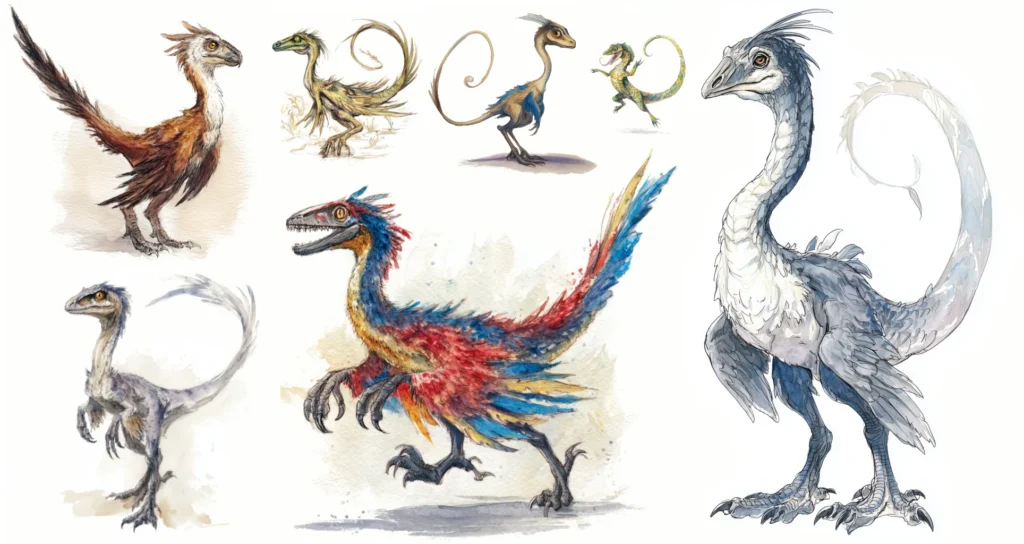
| Pack Hunters | Size (Height & Length, in feet) | Watch Out For | Challenge Rating (D&D / PF2) |
| Compsognathus | Tiny (H: 1, L: 2) | Enfeebling venom, nocturnal ambush | ⅛ or -1; Swarm 3 |
| Euparkeria | Tiny (H: ½, L: 2) | Camouflage, shed tail | ½ or 0; Swarm 2 |
| Podokesaurus | Tiny (H: 1, L: 3) | Extreme speed | ½ or 0 |
| Ornitholestes | Small (H: 2, L: 6) | Surprise strikes, ambush | 1 |
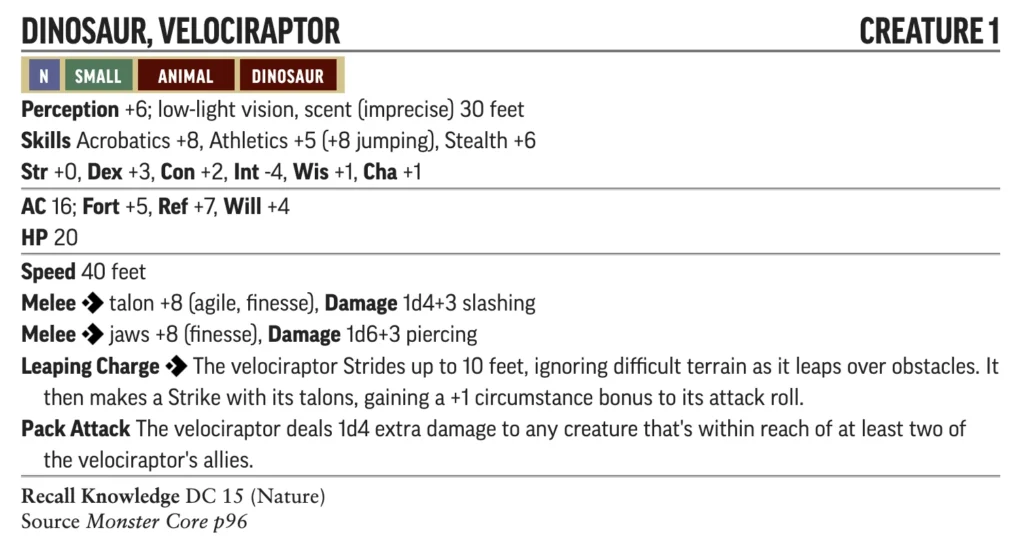
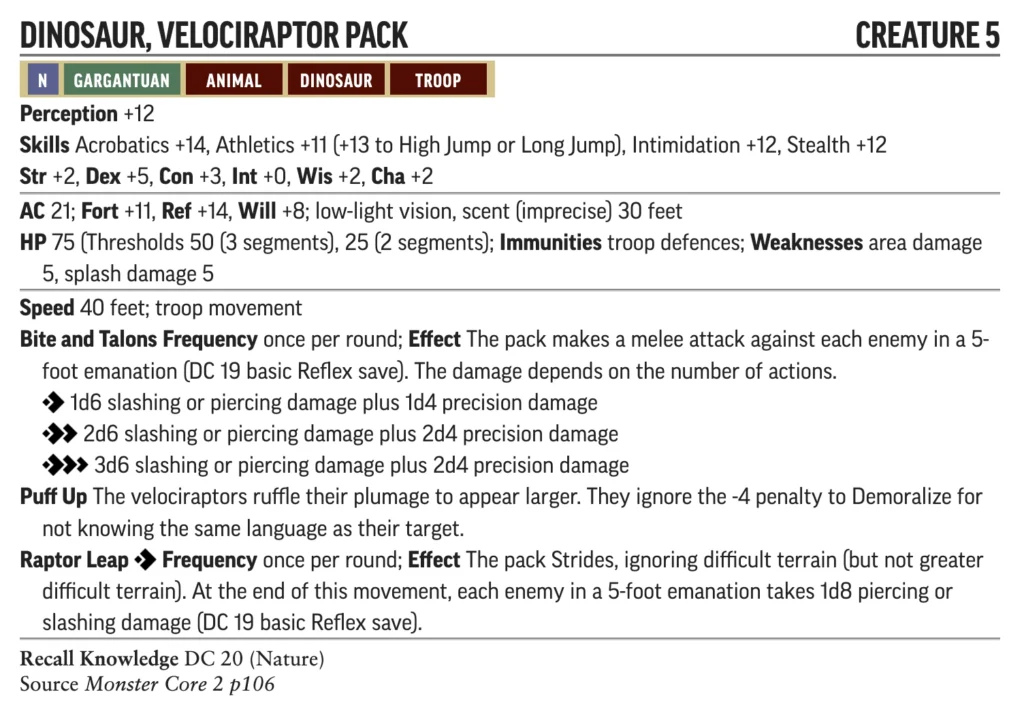
| Velociraptor | Small (H: 2, L: 6) | Leaping charge, pack tactics | 2; Pack 5 |
| Deinonychus | Medium (H: 4, L: 9) | Persistent bleed damage | 2; Pack 7 |
| Struthiomimus | Medium (H: 6, L:14) | Shoving kick | 4 |
Compsognathus
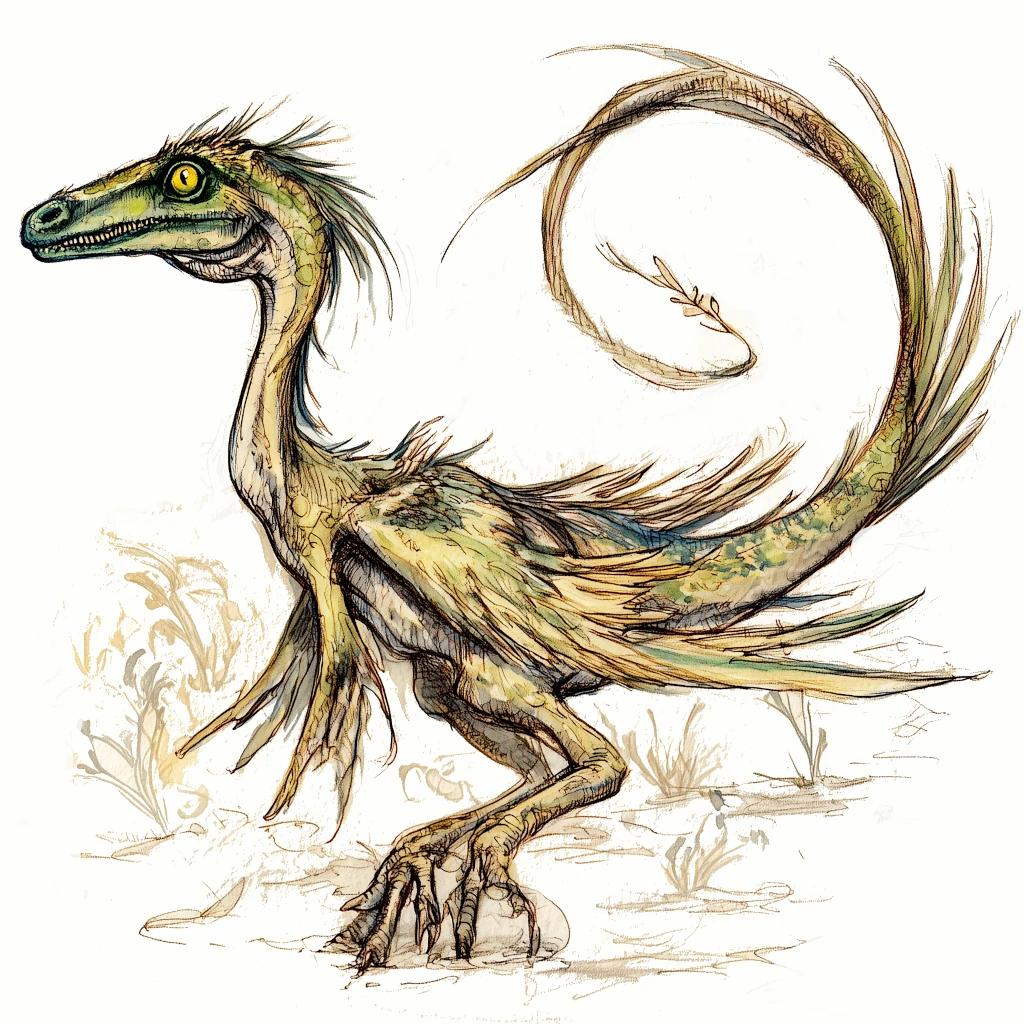
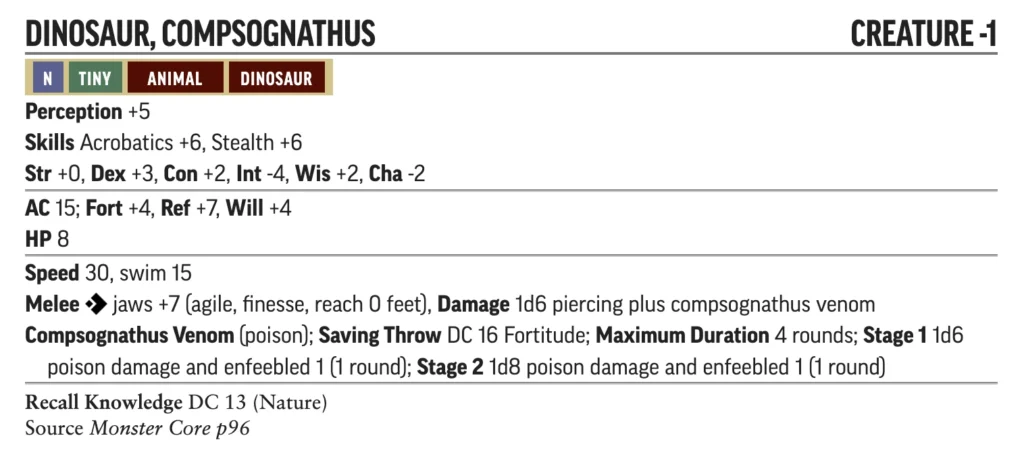
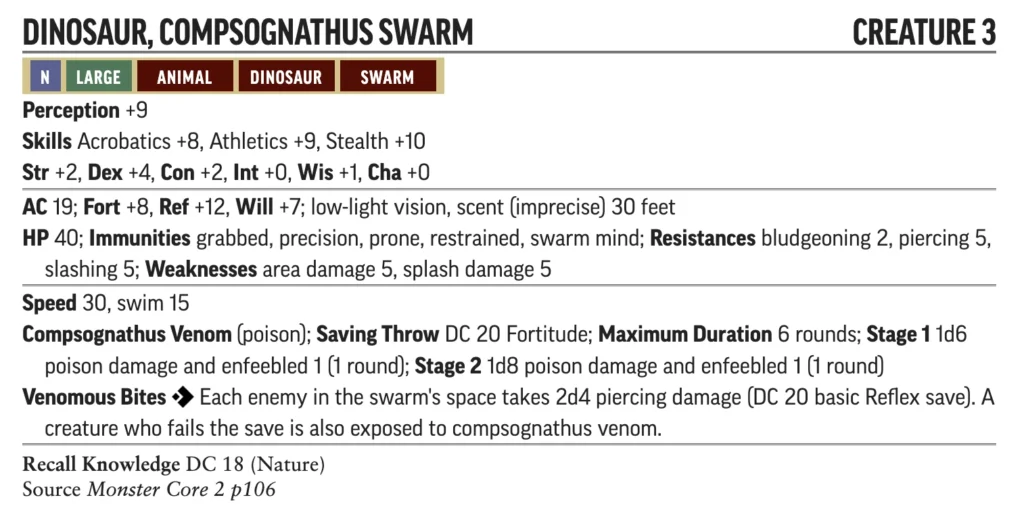
Compie, Compsognathus longipes, ‘Elegant Jaw’; N Animal | Dinosaur | Swarm; CR ⅛ [D&D]; -1 [PF2e]; 3 [swarm]
Habitat: Temperate and warm forest, fern prairie, river-delta undergrowth
Do not be deceived by the size, cutter! The compsognathus [comp-sog-NAY-thus] is called a compie in the cant of experienced Pangaean planewalkers, and it’s a word spoken with the exhausted familiarity of a berk who’s been surprised by one in the dark. It is approximately the size of a chicken, possesses the evolutionary heritage of a chicken—and has as much in common with the threat profile of a chicken as a tanar’ri has in common with a friendly tavern dog. Measuring a mere three feet from its elegant, snake-like neck to the tip of its whip-thin tail and weighing just fifteen pounds, a compie is built for a single purpose: stealth. It moves faster than the average human, its bird-like body balanced over powerful legs that cover ground in the short darting bursts of a creature that is never quite where you are looking. Its jaws deliver—alongside the shame of being bitten by something the size of poultry—a venom that induces progressive numbness and muscular weakness in victims. While individual compies hunt small lizards and insects for food, it’s in packs that they become a real threat. They’re small enough to hide in dense cycad undergrowth and silently stalk targets, although they prefer to hunt at night and surprise sleeping prey. Combined with their enfeebling venom, their ambush tactics allow a pack to incapacitate a creature many times their individual size before the target has fully registered the threat. With patience, an individual compie can be trained and even serve spellcasters as a familiar. Compies awakened and given the power of speech tend to deploy it in rapid, curious, question-heavy bursts that wizards have described as exhausting.
Stats: Individual [ D&D 2e | 3e | 5e | PF 1e | 2e ], Swarm [ D&D 5e | PF 2e ] Monstrous Compendium Annual Volume Two [2e] p35; Dragon Magazine #318 [3e]; Tome of Beasts 2 [5e]; Bestiary 2 [PF1e] p90; Monster Core [PF2e] p96; Monster Core 2 [PF2e] p106; see also Wikipedia
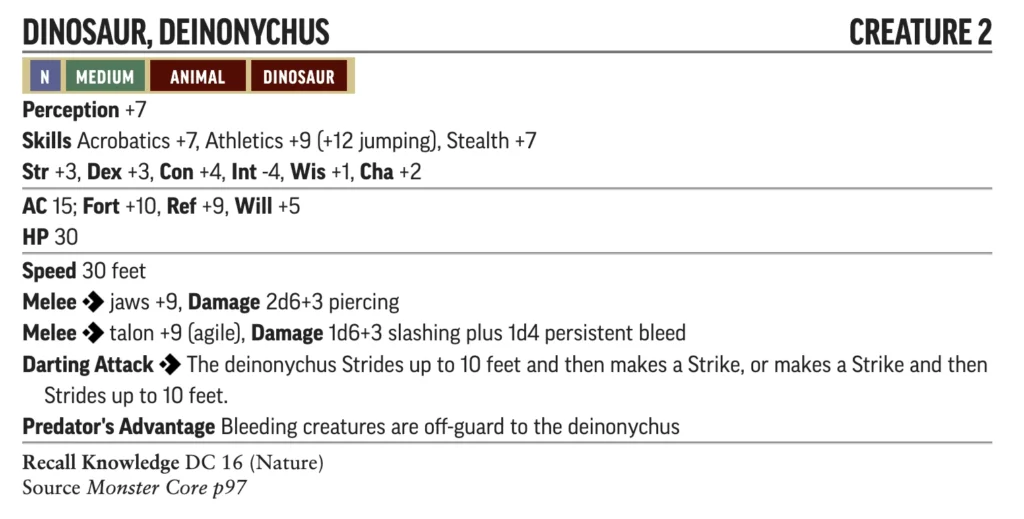
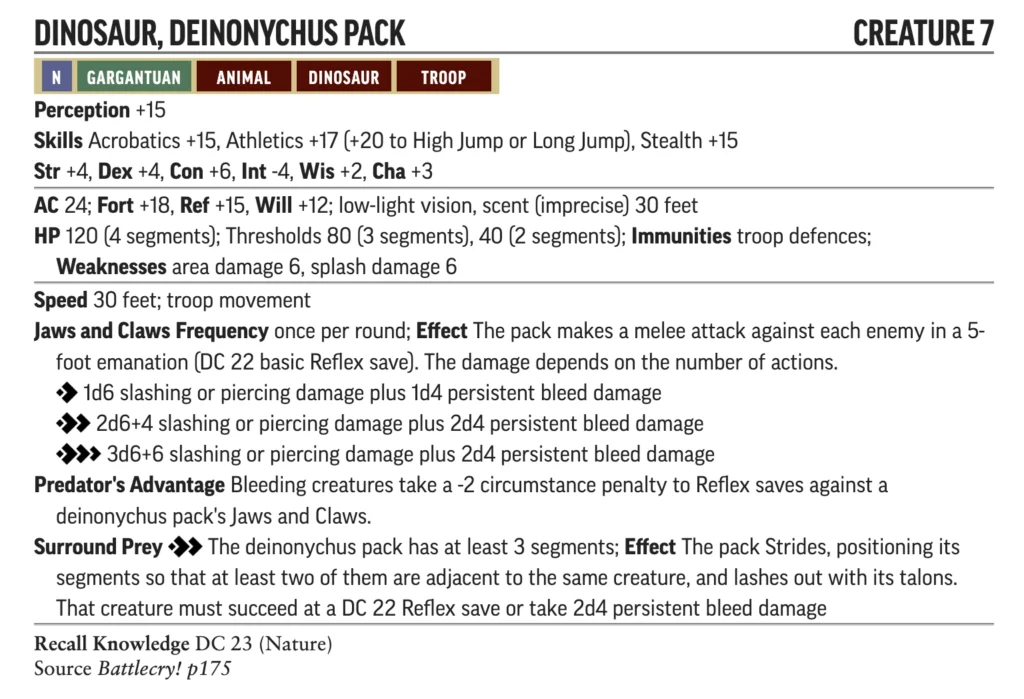
Deinonychus
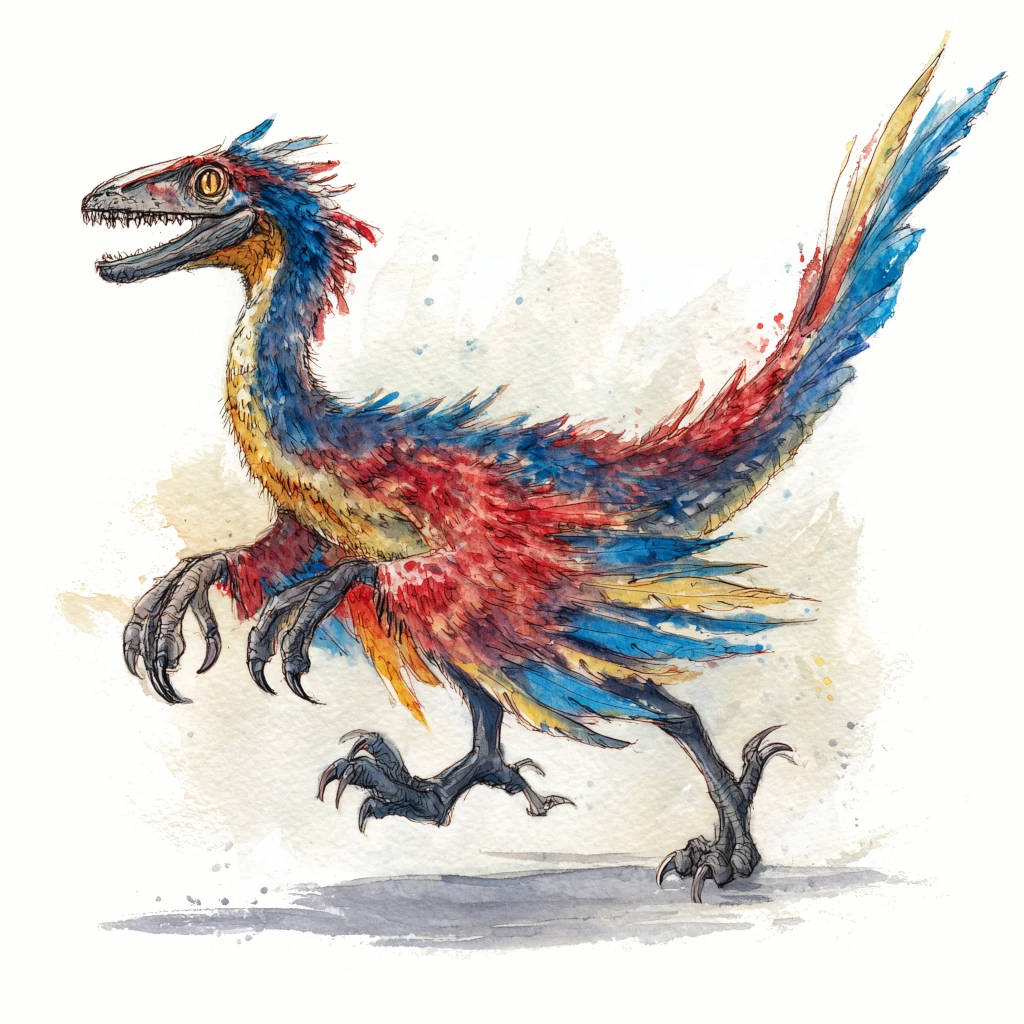
Deino, Deinonychus antirrhopus, ‘terrible claw’; N Animal | Dinosaur | Swarm; CR 1 [D&D]; 2 [PF2e]; 7 [swarm]
Habitat: Open woodland, fern prairie, river margins—anywhere with enough cover for an ambush
If the compie is Pangaea’s lesson in not underestimating small things, the deinonychus [deeno-NY-kus] is its lesson in not underestimating fast ones. Standing six feet tall on its powerful hind legs, a full twelve feet from narrow skull to counterbalancing rigid tail, and weighing a deceptively modest 150 pounds—far less than most of the things it considers food—a pack of deinonychus is among the most lethal predators on the plane. Their efficiency is the key: every anatomical feature this animal possesses has been optimised by evolution for the same purpose, which is to be inside your guard, slashing your hamstrings or jugular vein with its forelimb claws, and working its sickle-shaped hind talons into your abdomen before you’ve fully processed the danger you’re facing. Those hind claws are folded back during normal locomotion to keep their edges razor-sharp, and deployed only at the moment of attack. The deinonychus uses them like surgical instruments, striking with a gutting action that opens deep lacerating wounds that continue to bleed long after the creature has disengaged.
What makes these creatures genuinely dangerous is their pack tactics. Deinonychus have relatively large brains and use them to coordinated tactical planning. They make use of concealing scrub, natural barriers like rivers and ravines, flanking and coordinated attacks-retreat patterns, and swarming to surround their prey. A pair of the animals might let themselves be seen to draw attention and provoke attacks while a greater number quietly close in from the flanks and rear, in order to strike by surprise at the less well-defended prey who stay at the back of a group. After striking they’ll typically retreat into cover, circle while the prey bleeds out, and then leap out to strike again. With enough deinonychus in a pack, the accumulated blood loss chips away at a larger opponent’s capacity to resist the next ambush. Deinos even leave a deliberate escape route as bait, knowing full well they can outrun most other creatures. They’ve even been known to coordinate attacks which can take down prey three to four times their size.
While the compies own the night, the deinonychus reign during the daylight hours, favouring areas with cover, where they can ambush and try to force prey into retreat—because anything that runs from a deinonychus pack has probably made its last ever tactical error.
Stats: Individual [ D&D 2e | 3e | 5e | PF 1e | 2e ], Pack [ PF 2e ] Monstrous Manual [2e] p54; Monster Manual I [3e] p55; Volo’s Guide to Monsters [5e] p139; Bestiary [PF1e] p84; Monster Core [PF2e] p97; Battlecry! [PF2e] p175; see also Wikipedia
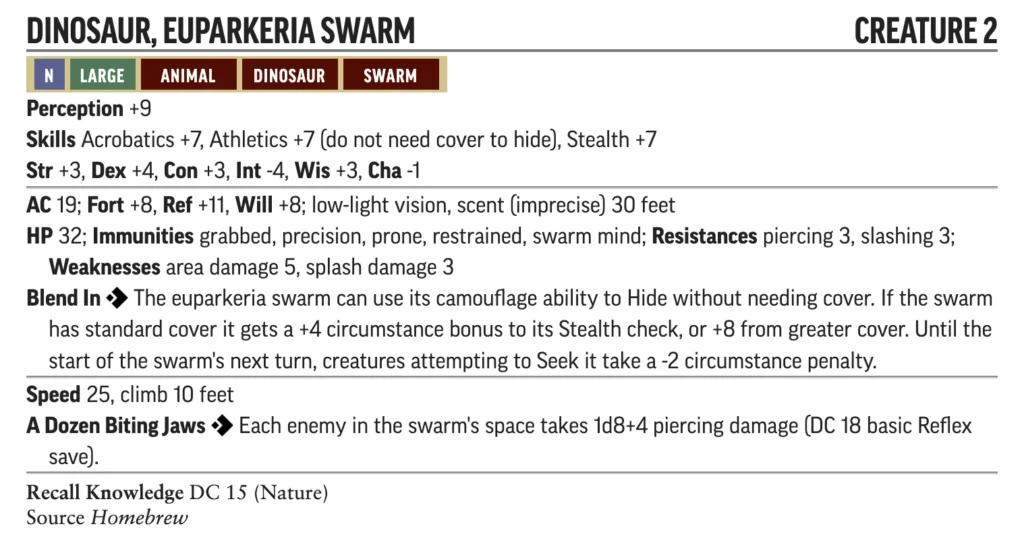
Euparkeria
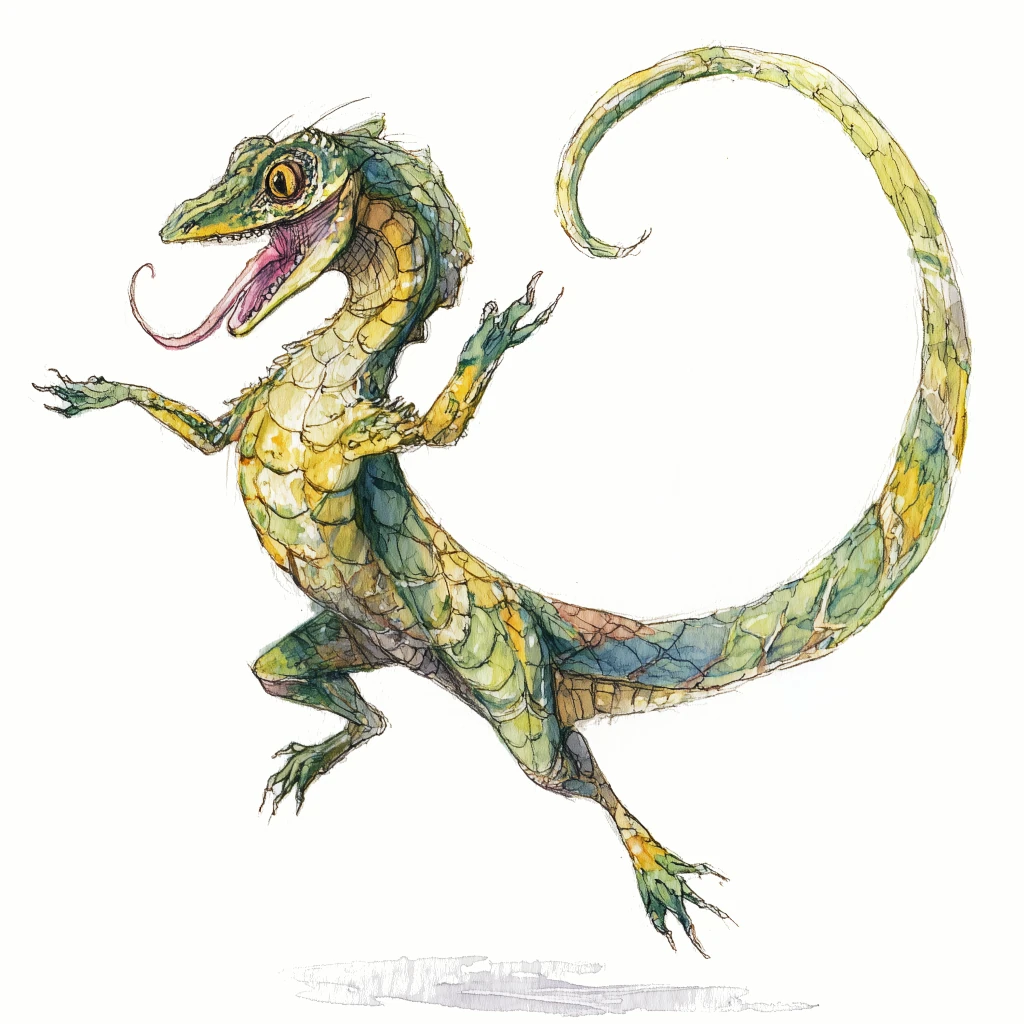
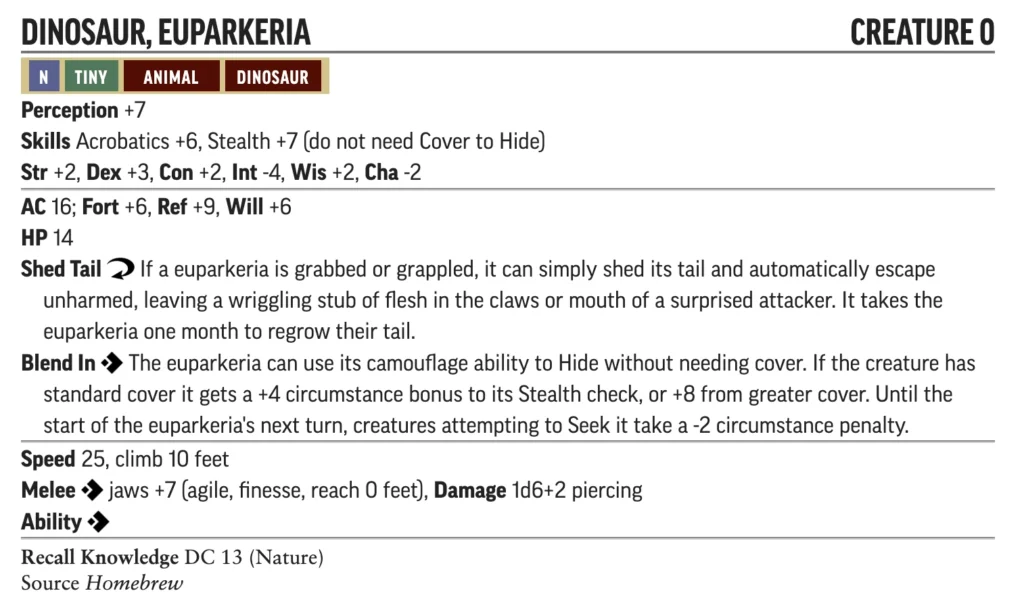
Euparkeria capensis; N Animal | Dinosaur | Swarm; ½ [D&D]; 0 [PF2e]
Habitat: Scrubland margins, volcanic uplands
The euparkeria [yoo-par-KAY-ree-a] is, in the estimation of the Fraternity of Order’s Planar Palaeontology Division, the single most historically significant creature on Pangaea—a living record of when the archosaur lineage first committed to the body plan that would eventually produce the tyrannosaurus, the velociraptor, and every great carnosaur that has since made the plane’s lowlands so comprehensively lethal. Measuring just two feet long and just six inches tall, and weighing no more than a domestic cat, Euparkeria capensis mostly moves on four legs, although it can run for short periods on two legs when threatened. Its body is flat and lizard-like in profile at rest, with colouration that blends perfectly into natural landscapes of Pangaea. In fact, euparkeria are so good at camouflage that they do not need cover to hide, just natural landscape. Their other defensive surprise is their ability to sacrifice their tails. If a euparkeria is grabbed or grappled, it can simply shed its tail and escape unharmed, leaving a wriggling stump of flesh in the claws or mouth of a surprised attacker. Individually they are timid and pose little threat to a planewalker, but in a pack of a dozen euparkeria can pose more of a challenge when they swarm unexpectedly from the undergrowth.
Stats: [ D&D 2e | 3e | PF 2e ] Monstrous Compendium Annual Volume Two [2e] p37; Tome of Horrors 4 [D&D 3e / PF1e] p57; Homebrew [PF2e]
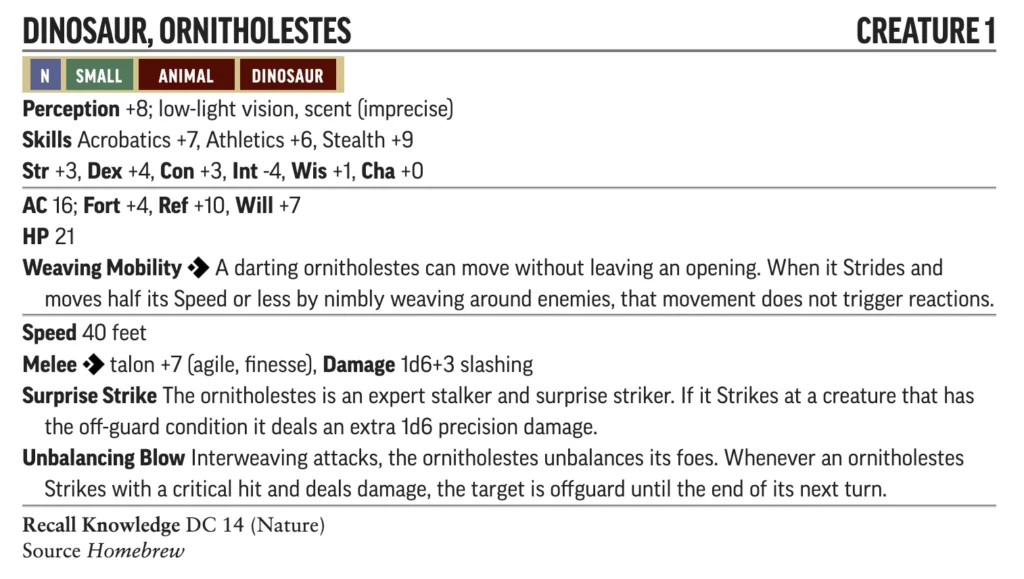
Ornitholestes
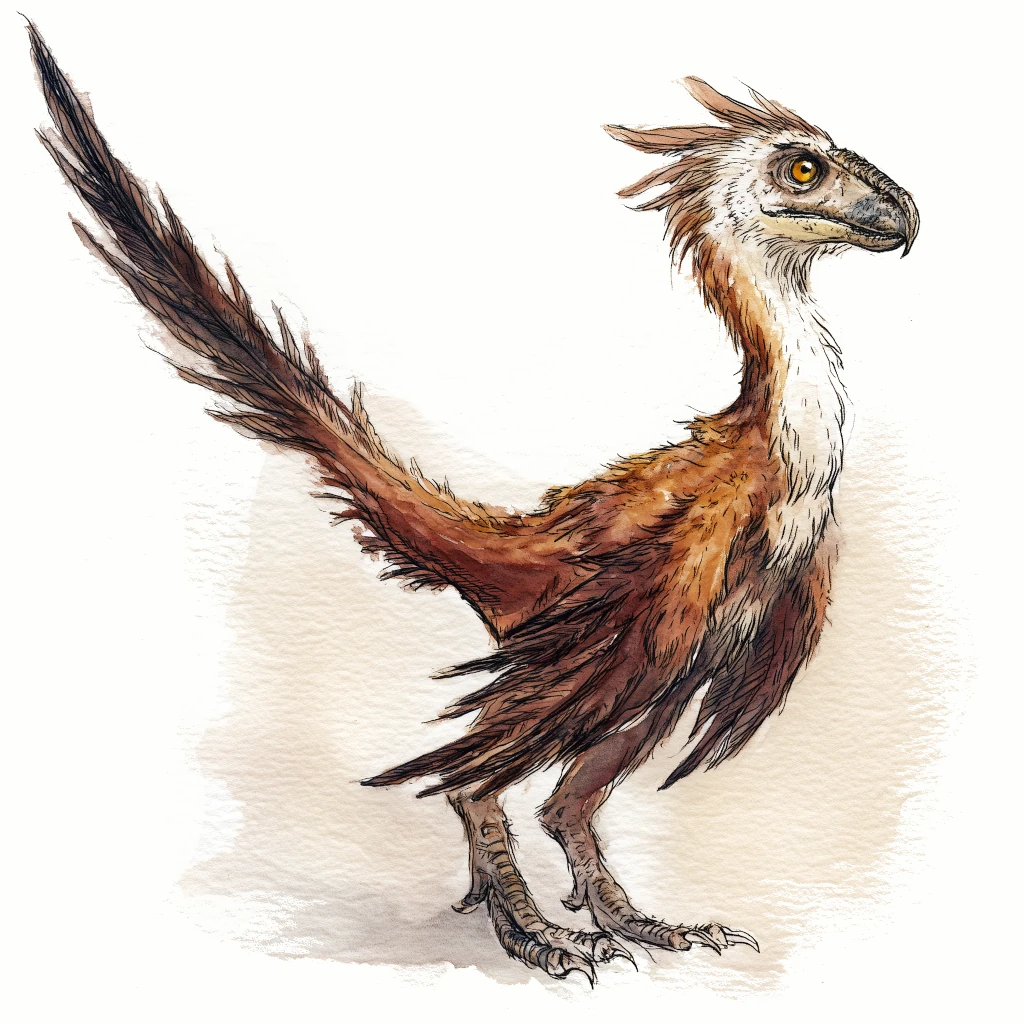
Ornitholestes hermanni, ‘robber bird’; N Animal | Dinosaur | Swarm; CR 1
Habitat: Floodplains, open forest, fern prairie—anywhere that combines open sightlines with frequent cover
Ornitholestes‘ [or-nitho-LESS-tees] name means robber bird, which probably gives the uninitiated planewalker entirely the wrong mental image—something opportunistic, a scavenger of nests and stealer of eggs perhaps—and this is precisely the kind of misapprehension that gets cutters hurt. Ornitholestes hermanni is indeed an egg thief and a hunter of insects and small lizards. It grows up to six feet long and weighs a svelte thirty pounds. They are agile and sneaky combatants, able to weave between opponents with incredible grace, to knock targets off balance, and to take advantage of this with wickedly deadly attacks. In a pack, ornitholestes independently dash around in combat, not coordinated with each other but capitalising on the chaos and confusion they cause nonetheless.
Stats: [ D&D 2e | PF 2e ] Monstrous Compendium 3: Forgotten Realms Appendix [2e]; Homebrew [PF2e]
Podokesaurus
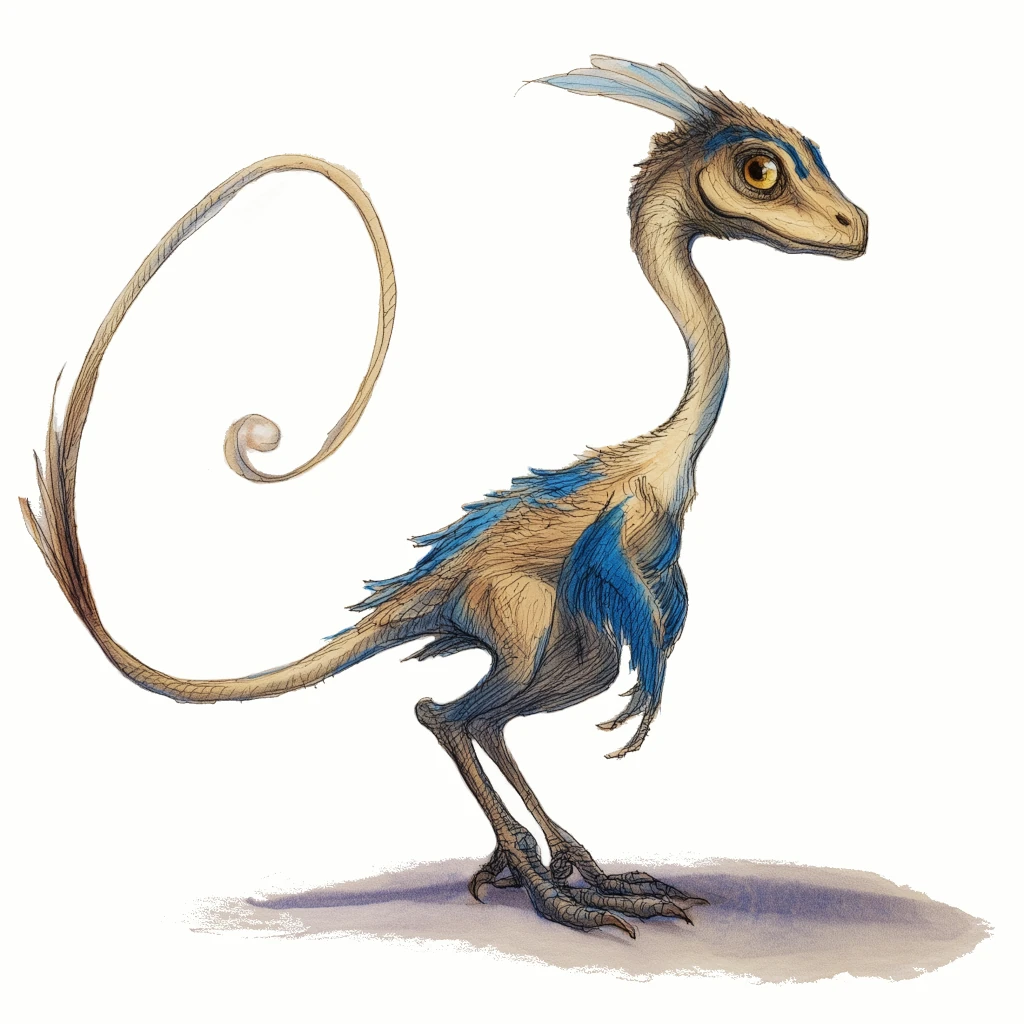
Podokesaurus holyokensis, ‘swift-foot’; N Animal | Dinosaur | Swarm; CR 0
Habitat: Open grassland, woodland margins, fern meadows
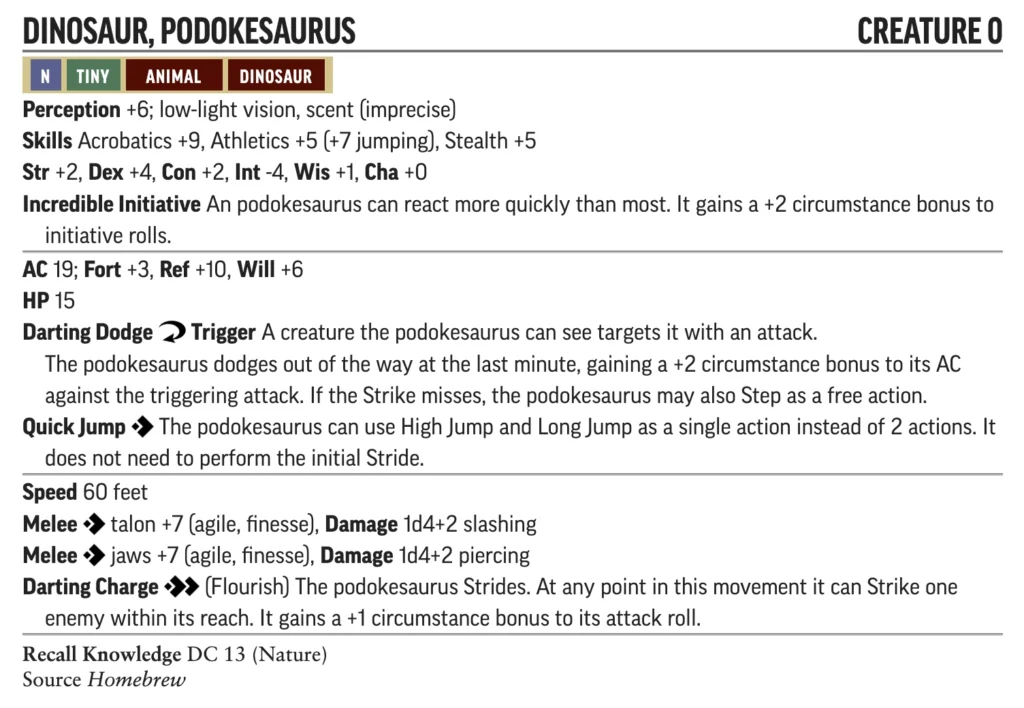
Podokesaurus [pod-OAKY-saur-us] are tiny, incredibly swift hunters that band together to fearlessly attack creatures much larger than themselves. While individually unthreatening, in large numbers they become dangerous, swarming quickly, unpredictably and in all directions. Prey that attemots to run away is easily run down by the swarm. A pack of up to a dozen ornitholestes acts with coordination and tactics that a cutter could swear might be psychic in nature, but are really achieved through high-speed chittering and chirps. Their incredible speed mean they usually attack first, and their nimbleness means they can be surprisingly hard to target. It also means they rarely become prey for larger dinosaurs.
Standing just one foot tall, podokesaurus are three feet long, although most of that is counterbalancing tail. Their slender forms are built for speed—up to forty miles per hour at full sprint—which means that like lightning, a running podokesaurus can strike without warning, but unlike lightning, it will happily strike more than once. If they can’t find suitable prey, hungry podokesaurus will pick on the slowest member of their own pack instead.
Stats: [ D&D 2e | 3e | PF 2e ] Monstrous Compendium 3: Forgotten Realms Appendix [2e] – beware typos, the entry for pteranodon seems to have got merged with this one; Tome of Horrors 4 [3e/PF1] p61; Homebrew [PF2e]; see also Wikipedia
Struthiomimus
Struthiomimus altus, ‘ostrich-mimic’; N Animal | Dinosaur | Swarm; CR 2–4
Habitat: Tall-grass plains, open floodplains, forest margins—anywhere with wide sightlines and room to run
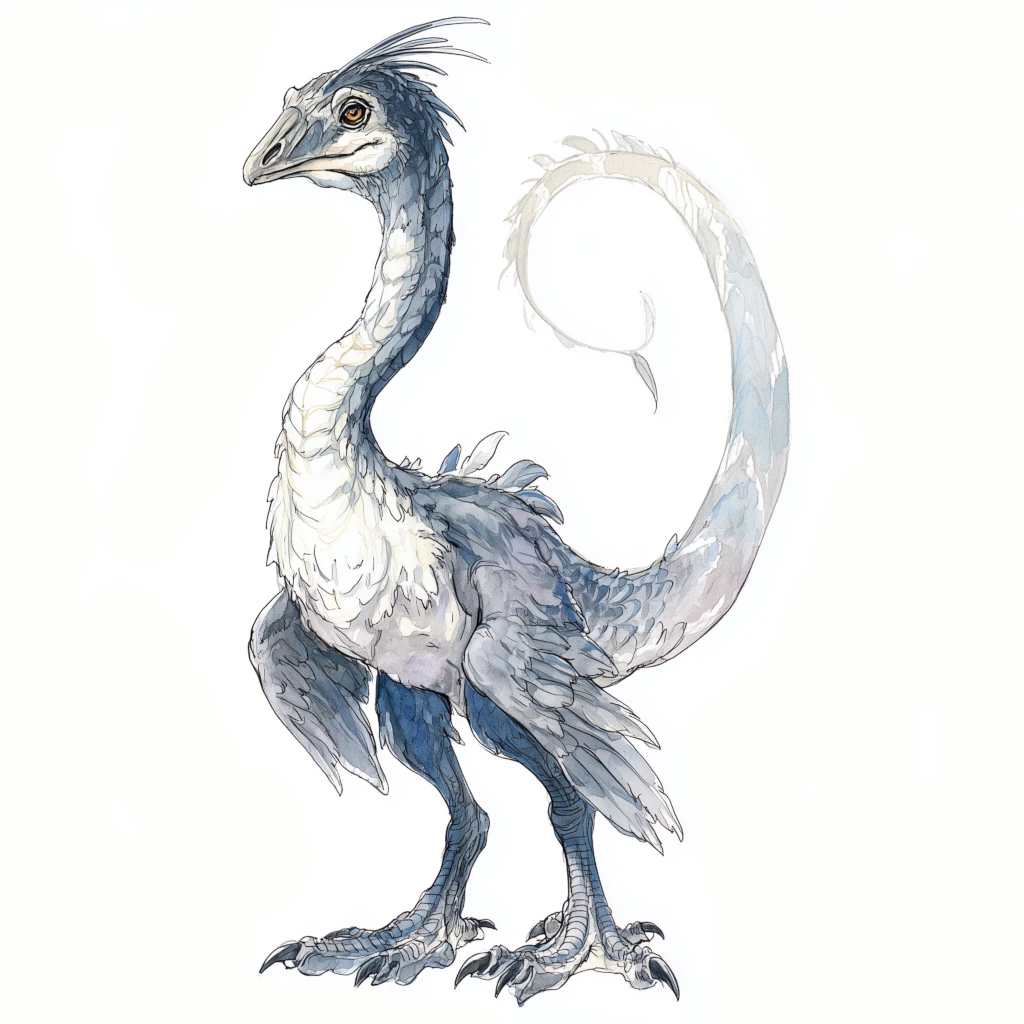
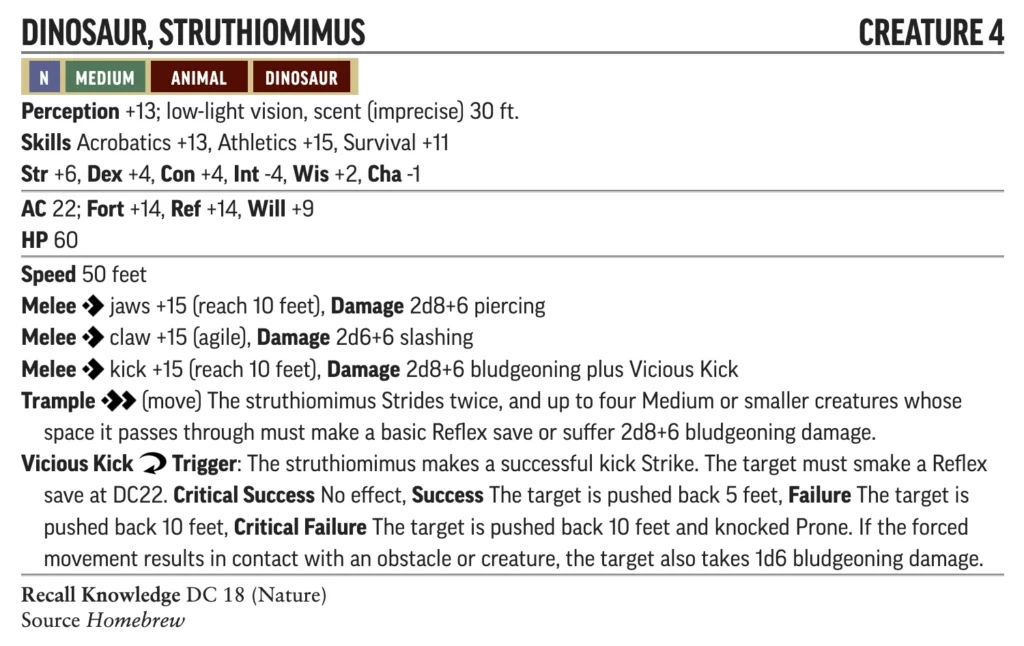
The ostrich-like struthiomimus [strew-theo-MIME-us] is a fourteen-foot-long, three-hundred-pound ostrich from hell—although the baatezu might disagree with that. Their muscular legs can sustain great speeds across flat terrain grassland that leaves most of Pangaea’s bigger predators looking at dust clouds. Struthiomimus are quite jumpy creatures though, prone to flee if anything surprises them, their long necks swaying like scythes as they run. Don’t let the toothless beak fool you into thinking they’re harmless grazers, mind, cutter—that’s an omnivore’s tool for cropping ferns one minute, scooping fish the next, and when hunger tips the scales, delivering a skull-cracking strike. backed by the full mass of a biped whose legs solve most problems by outrunning them. Struthiomimus tend to pick on prey smaller than themselves, which means human adults are safe unless the struthiomimus is particularly hungry or angry, but halflings or gnomes look delicious any time. Struthiomimus fill a mid-tier omnivore niche in Pangaea: the great carnosaurs ignore it, small fry scatter from it, and planewalkers pegs it as skittish herd, at least till a flock of twelve, spooked by something nastier in the grass, veers your way and then clocks the party’s gnome at perfect beak-height.
Stats: [ D&D 2e | 5e ] Monstrous Compendium Annual Volume Two [2e] p39; see also Wikipedia
Velociraptor
Velociraptor mongoliensis, ‘swift-thief’; N Animal | Dinosaur | Swarm; CR1-2 (individual; 5 (pack)
Habitat: Dense scrubland, tall-grass margins, forest undergrowth—anywhere that rewards concealment and explosive short-range acceleration
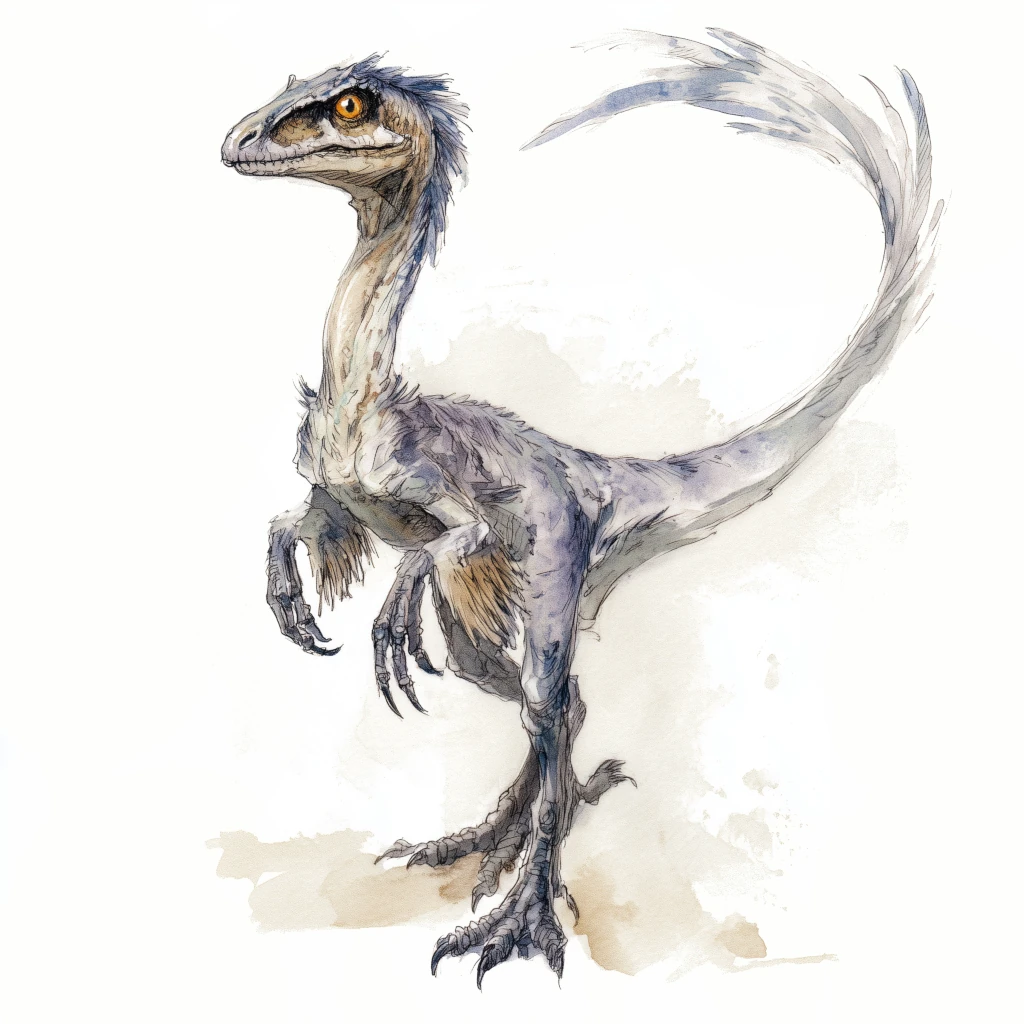
The velociraptor [vell-OSSY-rapt-tor], the smaller cousin of the deinonychus, can be found lurking in dense scrub, tall-grass, and forest undergrowth—terrain that rewards those who can wait patiently and then suddenly explode with speed. They are sleek pack hunters standing just a foot and a half at the shoulder, and seven feet from those vicious snapping jaws to tail-tip. They weigh in at barely thirty-five pounds, like an oversized turkey designed by a power with a grudge. Its secret’s in the feathers: the short plumage that runs down its back, arms, legs, and tail lies flat and blends well into the shadows at rest, making a stationary pack damn near invisible until the moment it flares up. At that point they puff up their frills to flash the bright colours underneath, allowing them to intimidate their prey more effectively. But it’s their leap you’ll want to watch out for, as they jump over obstacles and slice at your face with their wickedly oversized claws. These swift, cunning sods have no fear of prey larger than themselves—a lone velociraptor might snap up lizards and small game, but a pack of six to ten’ll swarm a horse-sized target without a second thought. Smarter than most of their fellow dinosaurs they’re clever enough to isolate, flank, and plan ambushes.
Stats: Individual [ D&D 5e | PF 1e | 2e ], Pack [ PF 2e ] Bestiary 4 [PF1e] p59; Monster Core [PF2e] p96; Monster Core 2 [PF2e] p106; see also Wikipedia
Mimir.net takes no responsibility for fatalities incurred while consulting this entry in the field.
If you are currently being pursued, stop reading and climb something.
Sources: Jon Winter-Holt
Love me some dinosaurs! I remember wanting to adapt some of them into Pathfinder