[ Cordant Planes > Pangaea ]
[ Conditions | Locations | Powers | Animal Lords | Factions | Bestiary ]
[ Aerial | Apex Predators | Aquatic | Herbivores | Megafauna | Pack Hunters | Planetouched ]
Herbivorous Archosaurs of the Plane of Prehistory
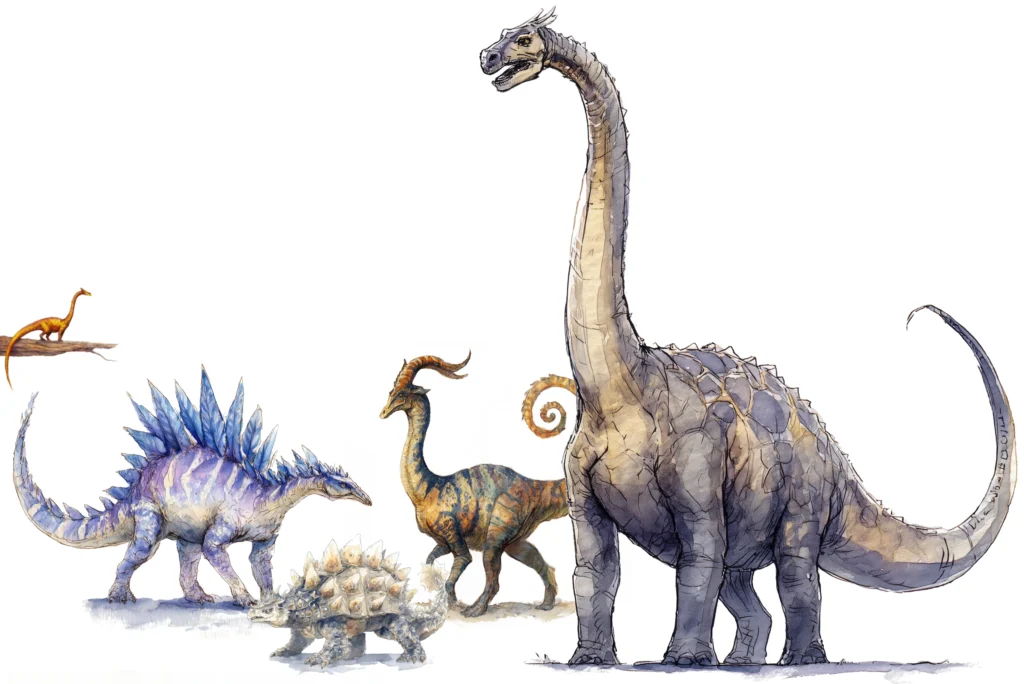
A gigantic category of frequently enormous dinosaurs, the plains of Pangaea throng with herbivores of all shapes and sizes. Guvner graybeards have categorised them into five general groups depending upon their body shape and key features. Most live in herds in order to protect themselves from constant predation by carnivorous archosaurs and pack hunters…
- Marginocephalian—stocky quadruped with a large bony ‘margin’ fringe at the back of their dome-shaped heads
- Ornithopod—bird-footed herbivore, often with duck-like snouts
- Sauropod—long-necked and long-tailed, with a small head relative to the rest of the body and four thick, pillar-like legs
- Theropod—beast-footed biped who is typically (but not always) meat-eating, also including birds
- Thyreophora—large solid quadruped with thick armour-plating or shield-spikes
| Herbivorous Dinosaur | Adult Size (feet) | Notable Abilities | Challenge Rating |
| Kulindadromeus * | Small (H: 2, L: 4) | Muddy wader | -1 |
| Psittacosaurus * | Small (H: 4; L: 6) | Quills, herd mentality | -1 |
| Zalmoxes * | Small (H: 4, L: 8) | Cowardly retreat | -1 |
| Struthiosaurus * | Small (H: 3, L: 8) | Back blades, defensive pose | 0 |
| Scelidosaurus * | Medium (H: 3. L: 12) | Intimidating defences | 1 |
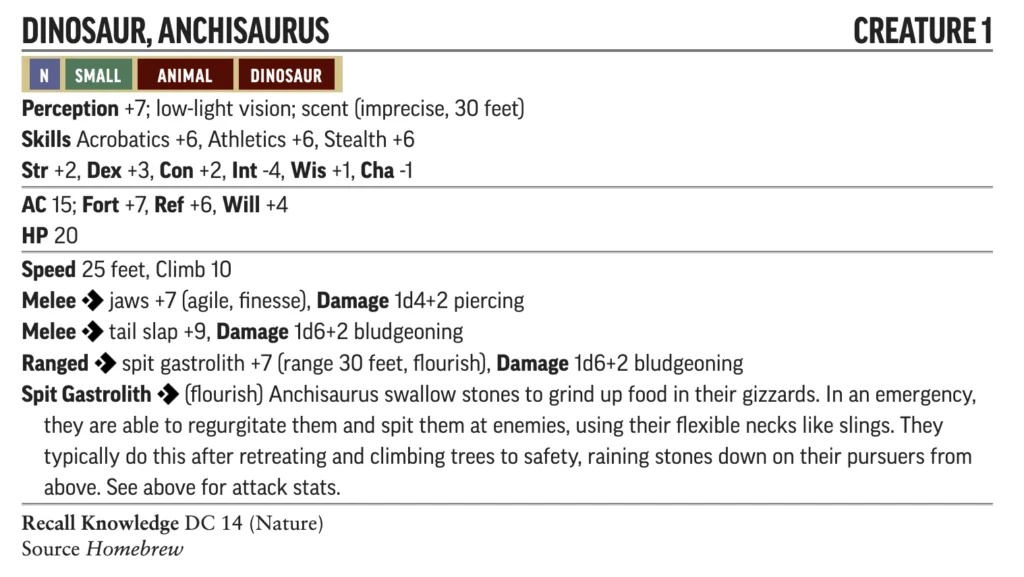
| Anchisaurus | Small (H: 2, L: 6) | Spit gizzard stones | 1 |
| Stegouros ‡ | Small (H: 2, L: 4) | Spiked tail, camouflage | 1 |
| Camptosaurus | Huge (H: 6, L: 20) | Stampede | 2 |
| Protoceratops | Medium (H: 3, L: 8) | Frill block, defensive posture | 2 |
| Trachodon | Huge (H: 10, L: 30) | Generally peaceful powerful tail lash | 2 |
| Centrosaurus * | Large (H: 6, L: 18) | Defensive frill, horn charge | 3 |
| Massospondylus | Large (H:4, L:15) | Quick to anger | 3 |
| Lambeosaurus | Huge (H: 15, L: 25) | Loud warning cry can summon predators | 3 |
| Paleocinthus | Huge (H: 5, L: 20) | Club tail | 3 |
| Bolong * | Medium (H: 5, L:13) | Thundering charge, thumb claws | 4 |
| Hadrosaurid | Huge (H: 8, L: 25) | Fast runners, don’t get caught in a stampede | 4 |
| Magyarosaurus * | Large (H: 5, L: 18) | Neck sweep, mighty stomp | 4 |
| Kentrosaurus | Large (H: 4, L: 15) | Sharp defensive spikes | 5 |
| Mnyamawamtuka * | Huge (H; 20, L: 25) | Intimidating size, disarming teeth | 5 |
| Styracosaurus | Huge (H: 8, L: 20) | Deadly nose-horn and head-frill | 5 |
| Zuul * | Large (H: 5, L: 20) | Shattering blow, knockdown | 5 |
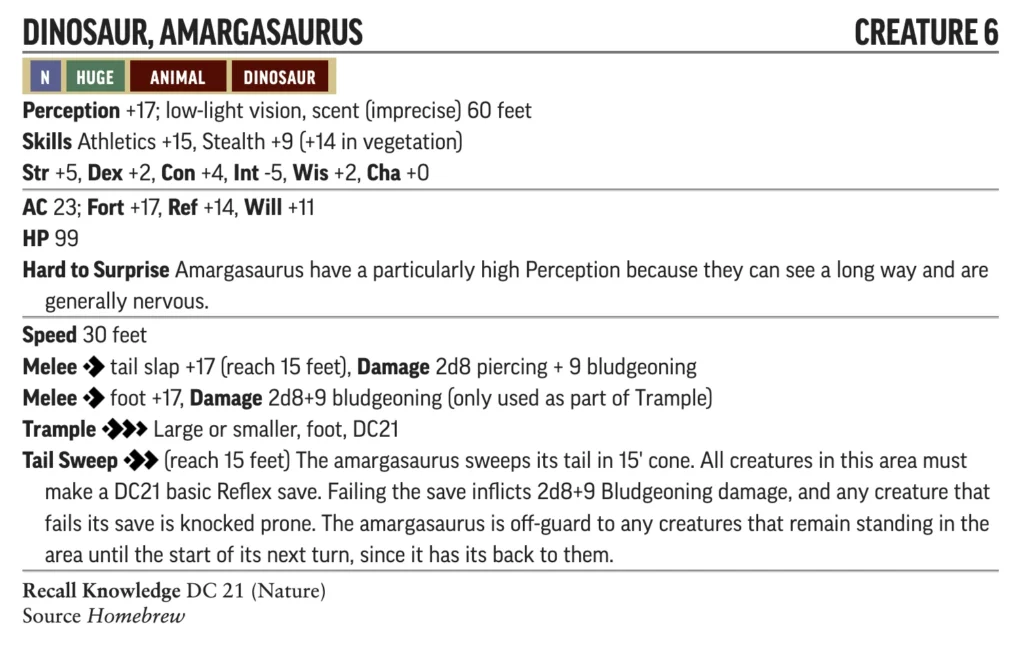
| Amargasaurus † | Huge (H: 9, L: 35) | Trample, tail slap | 6 |
| Ankylosaurus | Huge (H: 7, L: 25) | Dangerous tail | 6 |
| Deinocheirus * | Huge (H: 8, L: 35) | Intimidating display, grasping tongue | 6 |
| Iguanodon | Huge (H: 20, L: 35) | Dangerous thumb spike | 6 |
| Pachycephalosaurus | Large (H: 6, L 15) | Headbutt and shove | 6 |
| Pentaceratops | Huge (H; 10, L: 25) | Head packed with five sharp horns | 6 |
| Camarasaurus | Gargantuan (H: 25, L:50) | Herd beasts, stampede if spooked | 7 |
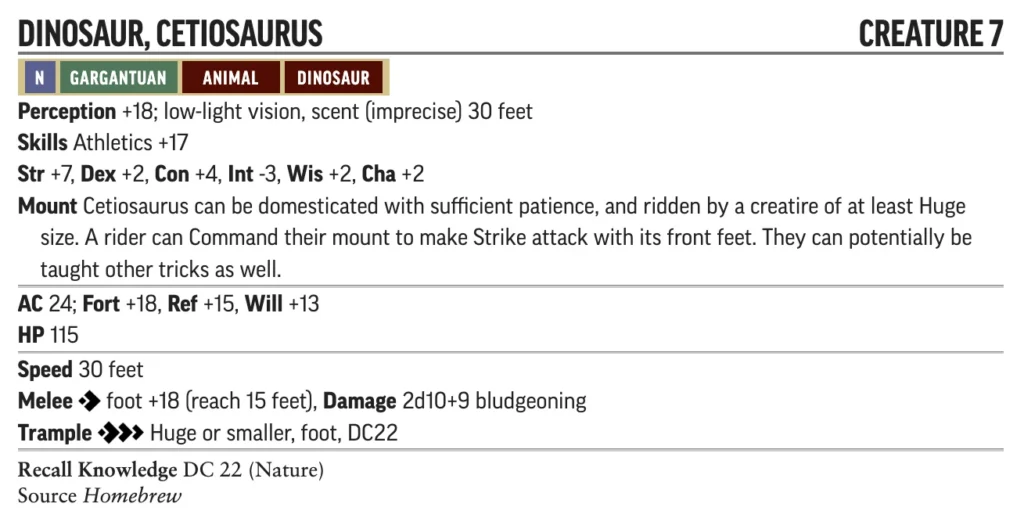
| Cetiosaurus | Gargantuan (H: 15, L: 60) | Can be trained or used as a mount | 7 |
| Dacentrurus | Huge (H: 10, L: 30) | Lashing tail | 7 |
| Mamenchisaurus | Gargantuan (H: 45, L: 90) | Extremely long neck and tail | 7 |
| Stegosaurus | Huge (H: 10, L: 25) | Deflecting armoured plates | 7 |
| Brachiosaurus | Gargantuan (H: 40, L: 70) | Tail sweep, trample | 8 |
| Giraffatitan * | Gargantuan (H: 45, L: 85) | Extremely long neck | 9 |
| Triceratops | Huge (H: 10, L: 25) | Powerful horn attack | 9 |
| Brontosaurus | Gargantuan (H: 25, L: 80) | Tail sweep, trample | 10 |
| Paralititan * | Gargantuan (H: 25, L: 85) | Almighty stomp, bellowing call | 10 |
| Diplodocus | Gargantuan (H: 30, L: 100) | Tail lash, trample | 12 |
| Titanosaur † | Gargantuan (H: 40, L: 120) | Majestic beast provokes awe, seismic foot stamp and tail swipe | 16 |
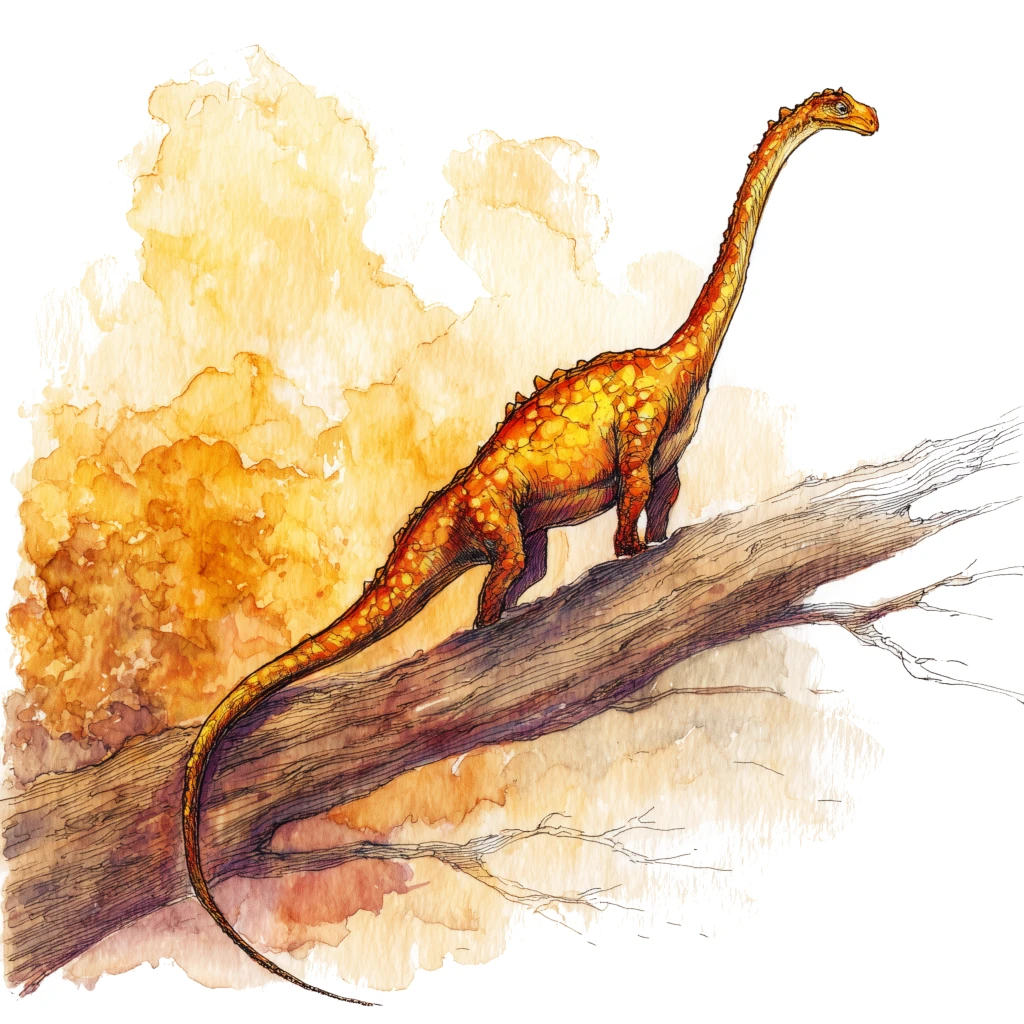
Amargasaurus
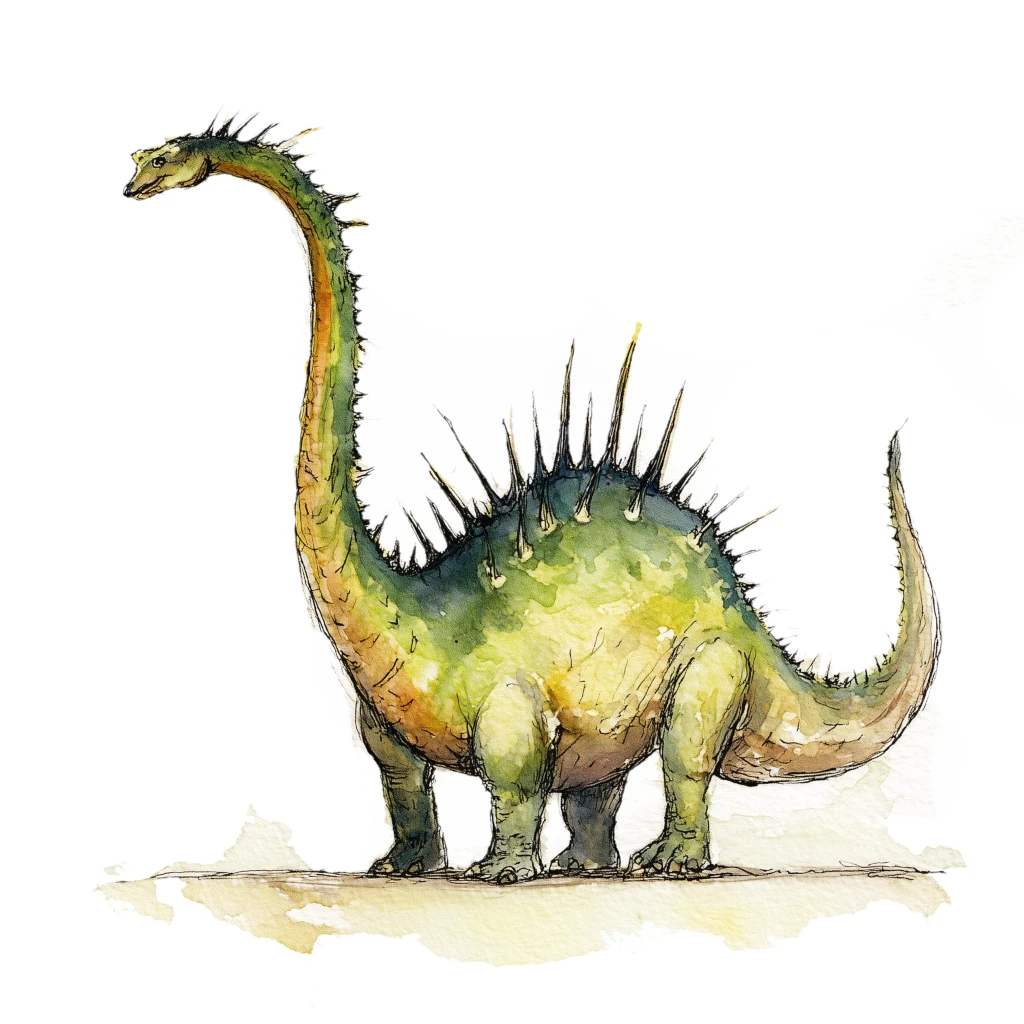
N | Huge | Animal | Dinosaur | Sauropod; CR 6
Huge by mortal standards but—even at up to thirty five feet long—dwarfed by their larger brethren, the amargasaurus [am-ARE-guh-sore-us] are unusual-looking sauropods. They bristle with spikes, with two spiny frills running down their neck, perhaps because they’re easier tasty targets than the behemoths like brontosaurus. Some individuals have spikes on their back and tail as well. All the better for hitting you with, my dear. If you want to imagine them, their bodies are the size of an entire elephant, and then stick on a tail and a neck as large again. The tail swishes from side to side menacingly, especially when the beast is feeling stressed or afraid. Their necks are long and slender, and their heads tiny, like the power who designed them gave them a brain a bit of an afterthought. The amargasaurus can raise its head up to around twenty feet in the air to pluck leaves that smaller herbivores miss, but usually keeps it lowered, not much above its body.
Stats: [ PF 1e | 2e ] Bestiary 6 [PF1e] p94; Homebrew [PF2e]; see also Wikipedia
Anchisaurus
Close-Lizard; N | Small | Animal | Dinosaur | Sauropod; CR 1
Looking like miniature diplodocus, anchisaurus [an-CHEE-sore-us] are six-foot long omnivores with claws for climbing—well, scrambling at least—to higher ground, which they use to escape less agile predators. They are able to walk on their hind legs for a short time, enabling them to reach higher leaves, or peek over barriers. While small, and unlikely to start a fight on their own account, they are not defenceless either. Anchisaurus have sharp teeth, can deliver a sturdy slap with their whip-like tail, but their most surprising ability is their ability to regurgitate gizzard-stones and spit them at targets, using their long necks like slings to achieve a damaging velocity. They tend to use this sparingly, to discourage predators once the anchisaurus has reached the safety of a tree branch. Anchisaurus have somewhat dextrous forelimbs, able to use a thumb-like long toe to oppose their other digits and grip objects. They are occasionally summoned by wizards and primeval witches as familiars.
Stats: [ D&D 2e | 3e | PF 2e ] Monstrous Compendium 3: Forgotten Realms Appendix [2e]; Homebrew [3e; PF2e]; see also Wikipedia
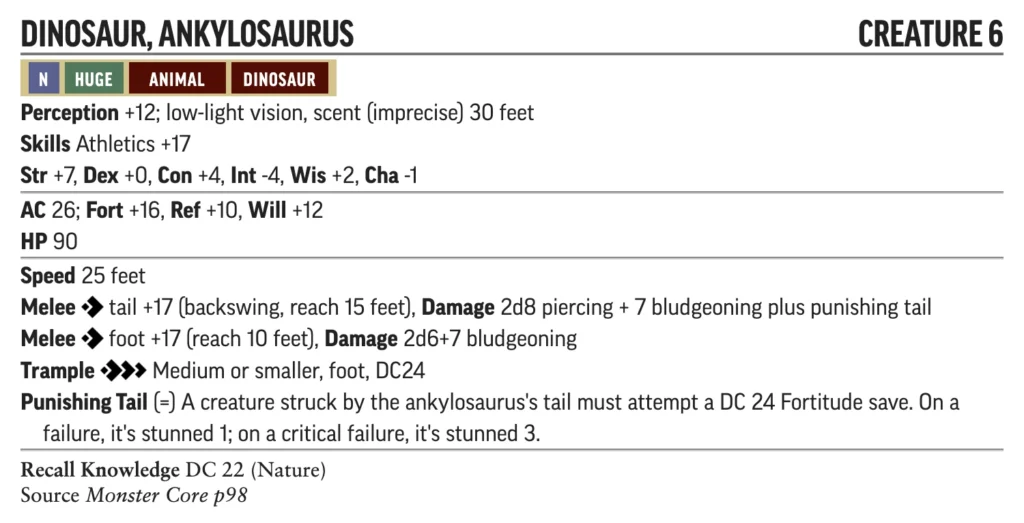
Ankylosaurus
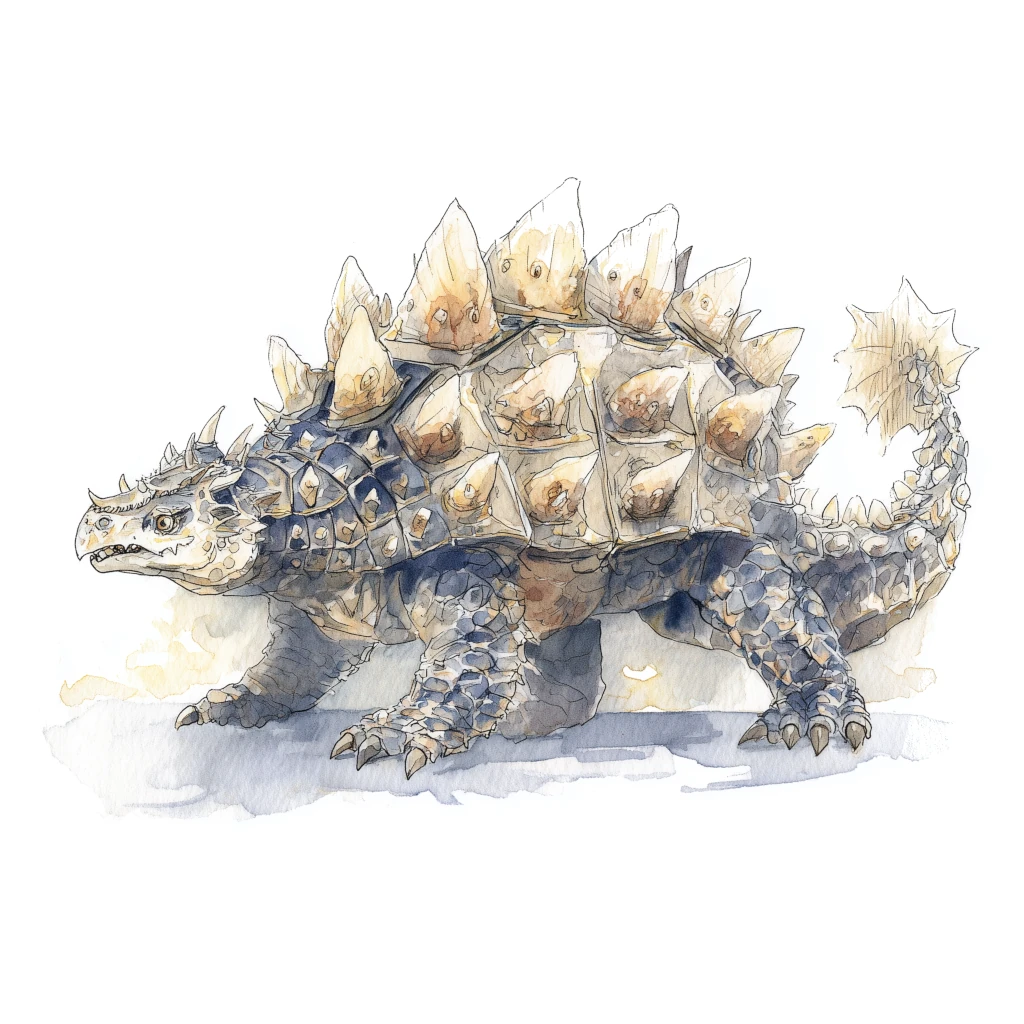
Fused lizard; N | Huge | Animal | Dinosaur | Thyreophoran; CR 3-7
Imagine what you’d get if you crossed a flail with a bad-tempered tortoise, and threw in a bag of caltrop spikes just for a lark. The ankylosaurus [an-KYE-low-sore-us] is an enormous juggernaut of an ornithopod, the side of a horse and cart and considerable heavier. Their heads are small, and their brains even smaller. Not much room in there once all the armour-playing is accounted for, I guess. Despite their aggressive attitude though, they’re herbivores. That doesn’t mean they won’t pummel you into the mud with the enormous spiked tail-club made from bone—but at least they won’t gobble you up afterwards. Unless you’re a leshy, I suppose, in which case watch out for their beaks.
These cutters have developed all that armour and heavy weaponry to defend themselves from the likes of allosaurus and tyrannosaurus. They’re certainly capable of breaking a leg or two with that tail of theirs, but their spiked armour-plating also goes a long way towards making them unappetising. Dinosaur hunters tell me the only good way to take down one of these things, short of a disintegrate spell, is to strike them on their underbellies—a feat that is far easier said than done. If you’re underneath an ankylosaurus, it’s probably already too late for you. Best to wait until they’re feeding, perhaps, as they’re able to rear up on their hind legs to reach the tastiest leaves.
Stats: [ D&D 2e | 3e | 5e | PF 1e | 2e ] Monstrous Manual [2e] p54; Monster Manual II [3e] p70; Monster Manual [5e] p79, 348; Bestiary [PF1e] p83; Monster Core [PF2e] p98; see also Wikipedia
Bolong
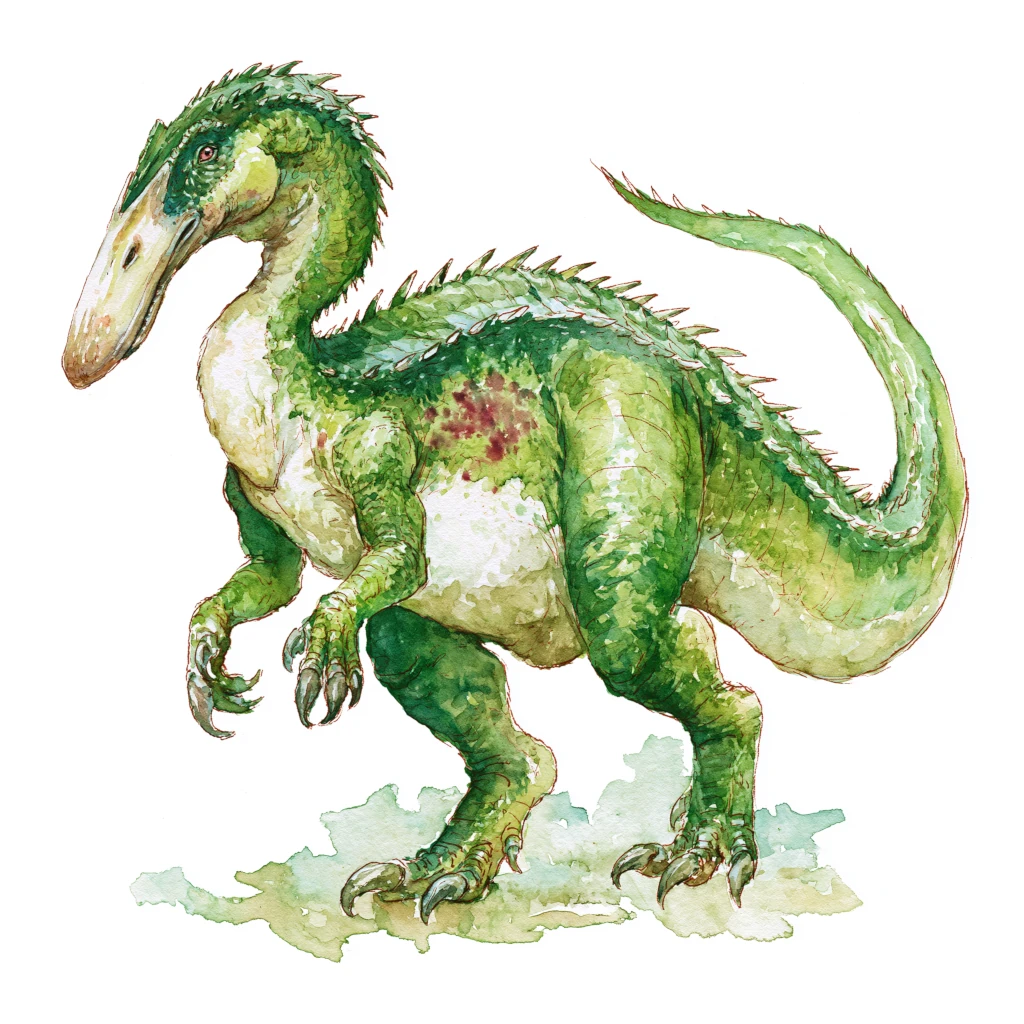
N | Medium | Animal | Dinosaur | Ornithopod; CR 4
A relatively small herbivorous duck-billed hadrosaur with thumb claws.
Stats: [ D&D 5e | PF 2e ] * Dr Dhrolin’s Dictionary of Dinosaurs p48; see also Wikipedia
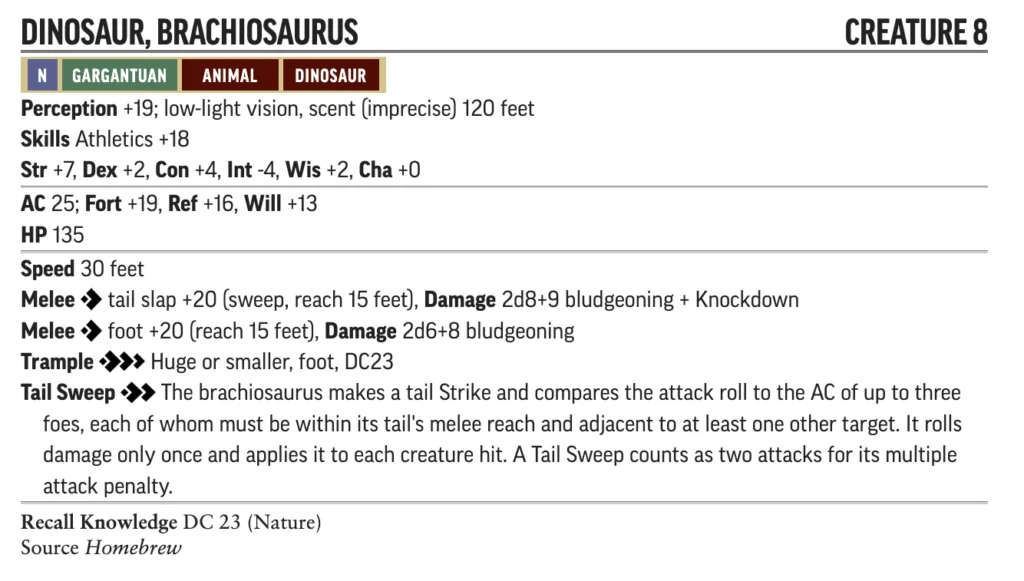
Brachiosaurus
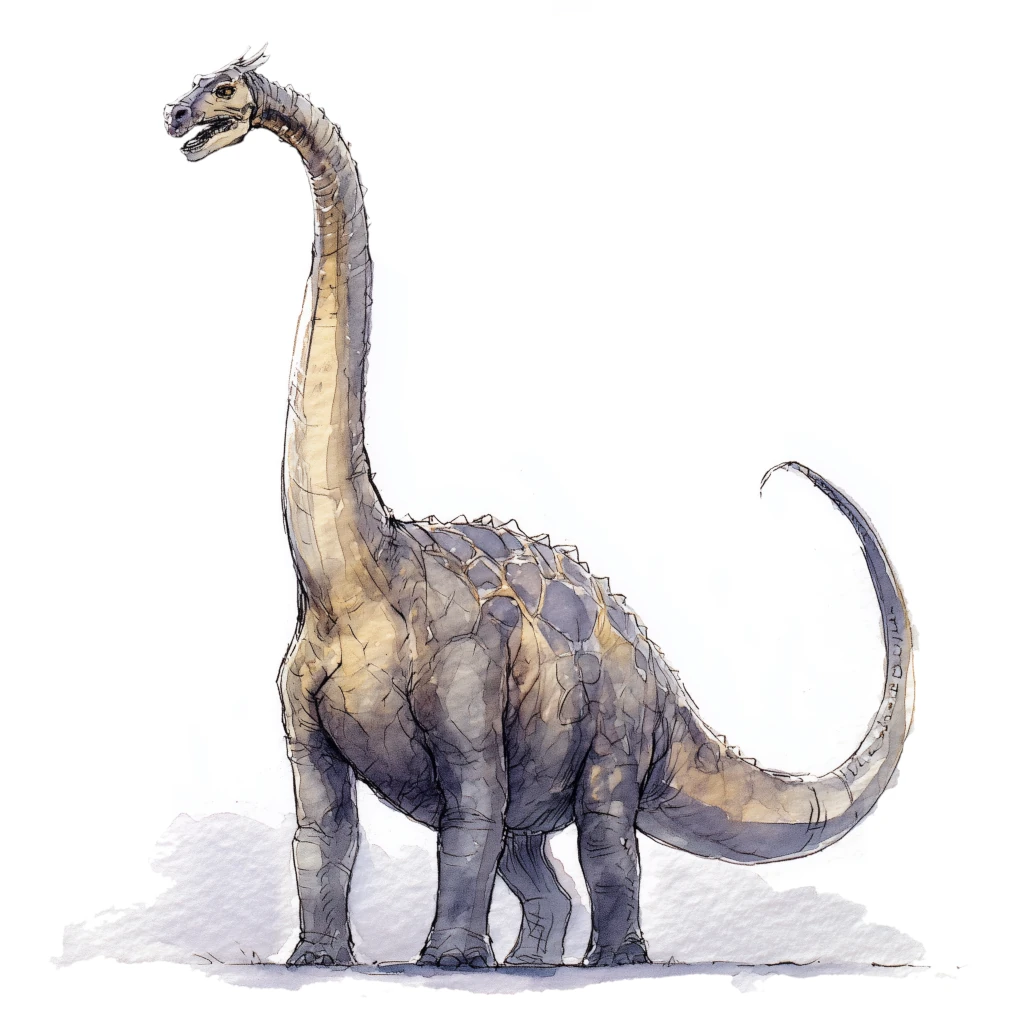
Arm lizard; N | Gargantuan | Animal | Dinosaur | Sauropod; CR 8
Amongst the tallest and heaviest of all of the archosaurs, the brachiosaur [BRACK-ee-oh-sore] dwells in warm lakes and swamps, where the water helps to support its great bulk. On land, their long front legs are deadly to any berk who gets in the way of them. Even more dangerous is the huge tail, which can sweep across a battlefield scattering would-be attackers
Counterbalancing this enormous tail is an equally colossal neck, which make up at least half of their forty-foot height, enabling the brachiosaur to graze on flowers and fruits high into the treetops while keeping their feet firmly on the ground. And graze they must, for in order to support its whale-sized bulk a brachiosaur spends almost all its waking hours eating. A herd is capable of stripping a forest bare in a matter of days, before they move on to another locale like a flock of incredibly large, long-necked locusts.
Stats: [ D&D 2e | PF 1e | 2e ] Monstrous Compendium 3: Forgotten Realms Appendix [2e]; Bestiary [PF1e] p83; Homebrew [PF2e]; see also Wikipedia
Brontosaurus
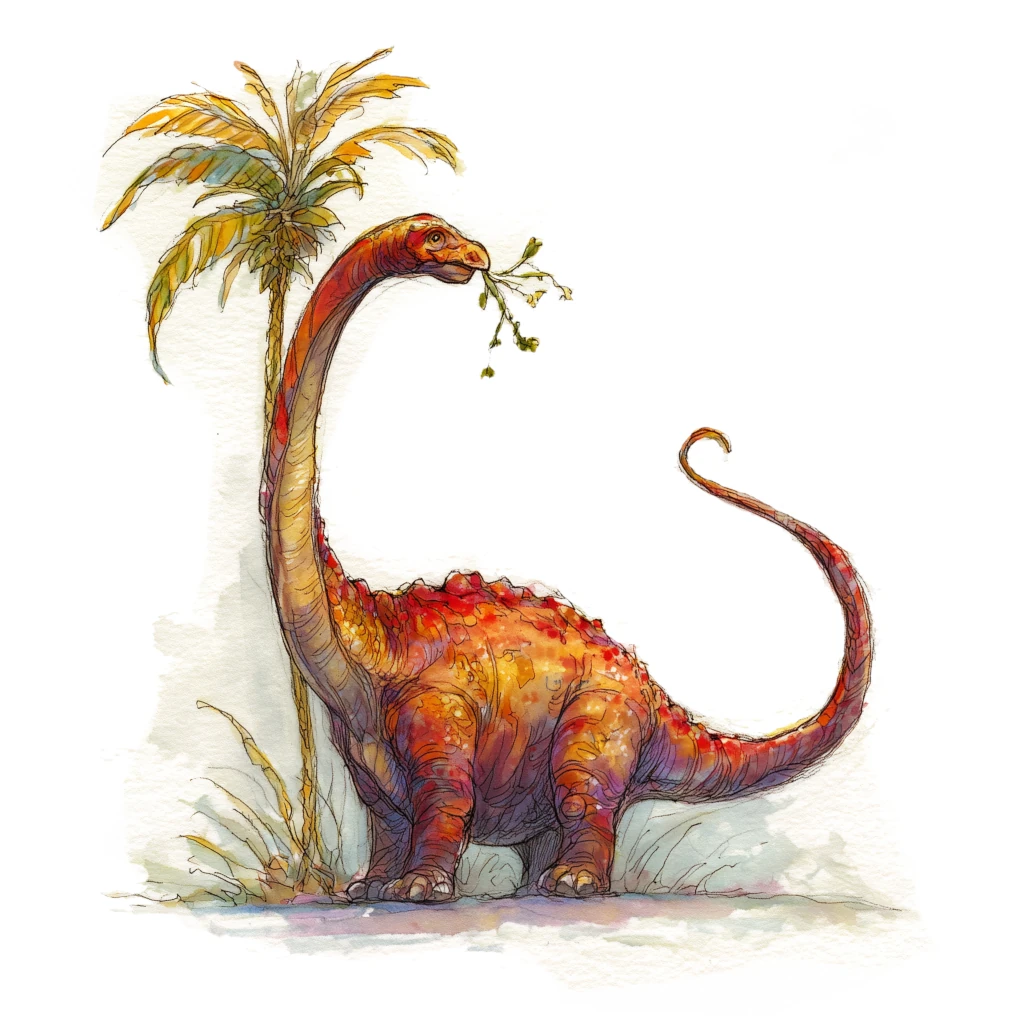
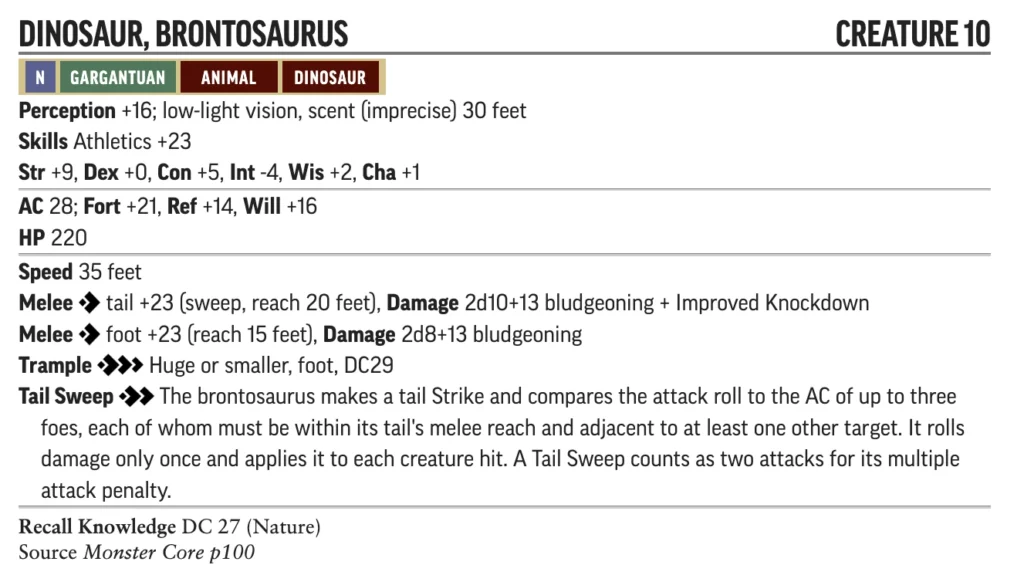
Thunder lizard, apatosaurus; N | Gargantuan | Animal | Dinosaur | Sauropod; CR 11
With shorter legs than a brachiosaurus, the brontosaurus [bron-toe-SORE-us] is considerably less tall, but makes up for this in sheer length. Also a marsh-dweller, the brontosaurus sticks to the shallow water as the pressure of deep water is uncomfortable for it to breathe. Apparently also short-sighted, brontosaurus has a bad habit of trampling on smaller creatures that get under its feet, usually fatally.
While the largest brontosaurus can grow up to eighty feet long, their heads are less than two feet long. As you can imagine, they are not the brightest of dinosaurs, but when you’re this size, you don’t need street-smarts.
Because of their short front legs, brontosaurus are able to rear up onto their back feet to reach the topmost leaves of fern trees. They’re also able to make use of this ability when fighting their main predators, allosaurus, by rearing up suddenly and then coming crashing down upon them. They are also able to attack with their enormous tails, batting away attackers, vegetation and buildings with impunity.
Stats: [ D&D 2e | 3e | 5e | PF 2e ] Monstrous Compendium Annual Volume Two [2e] p35; Volo’s Guide to Monsters [5e] p139; Monster Core [PF2e] p100; see also Wikipedia
Camarasaurus
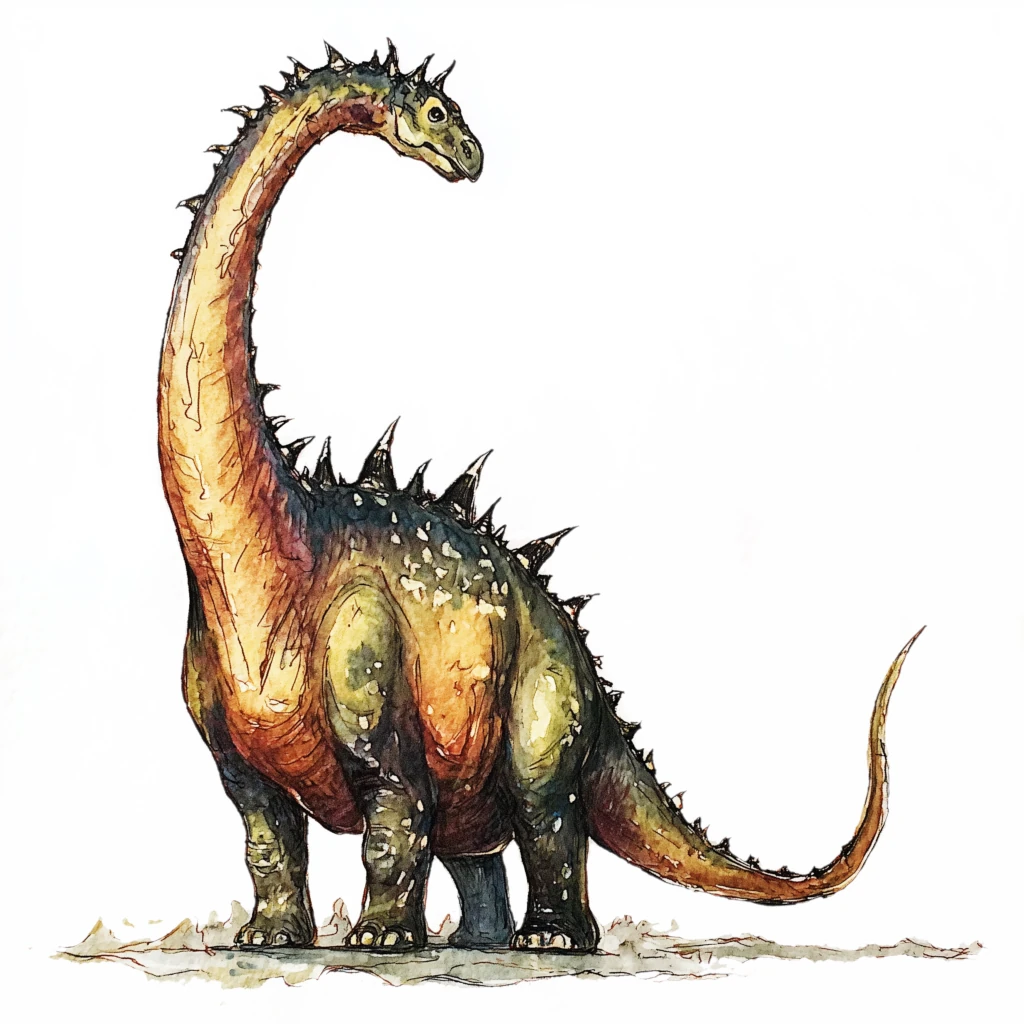
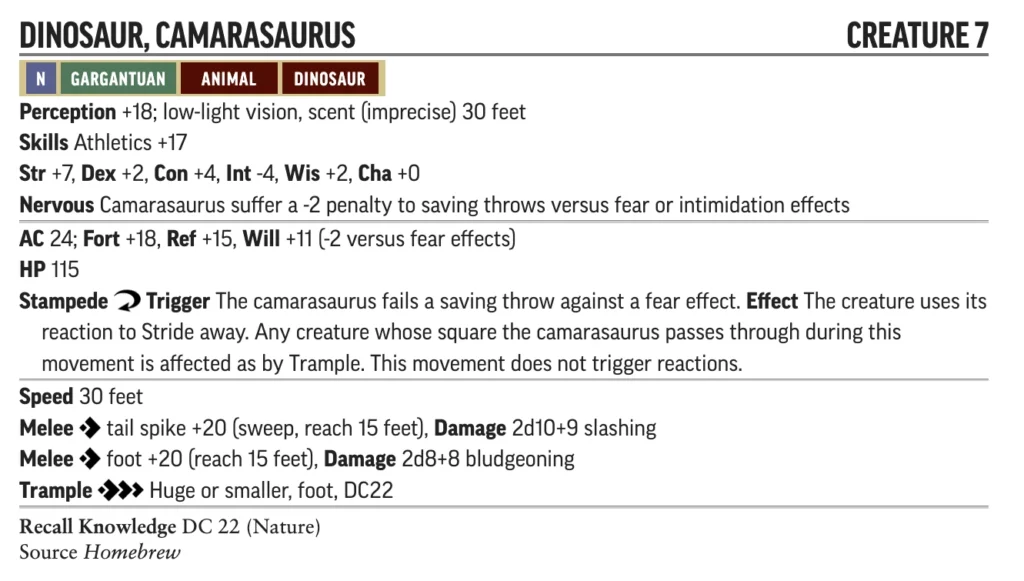
Chambered lizard; N | Gargantuan | Animal | Dinosaur | Sauropod; CR 7
While still enormous in comparison with humanoids, the camarasaurus [kam-ARE-uh-SORE-us] are smaller than many of their marsh-dwelling counterparts. Perhaps because of this, they are also rather timid, and panic rather easily. Living together in groups helps the creatures protect the smaller members of the species—but woe betide any berk who panics a herd of camarasauri. Stampeding sauropods are one of the most dangerous hazards on Pangaea, surpasses, some reckon, only by meteorite strikes and volcanic eruptions.
Camarasauri herds follow the seasons, and migrate constantly across the Old Lands. This means they can be found almost anywhere in Pangaea, in the growing season. Their preferred foods are ground ferns, bushes, and the lower leaves of trees. Like many birds of the Prime, camarasaurus have gizzards filled with rocks to grind up their food. The harder the rocks the better, and this has led to the planewalking hunters’ tales of camarasaurus trophy kills being slit open only to reveal diamonds in their gizzards. Whether this is true or not, perhaps the camarasaurus are right to be jumpy around humanoids.
Stats: [ D&D 2e ] Monstrous Compendium 3: Forgotten Realms Appendix [2e]; Homebrew [PF2e]; see also Wikipedia
Camptosaurus
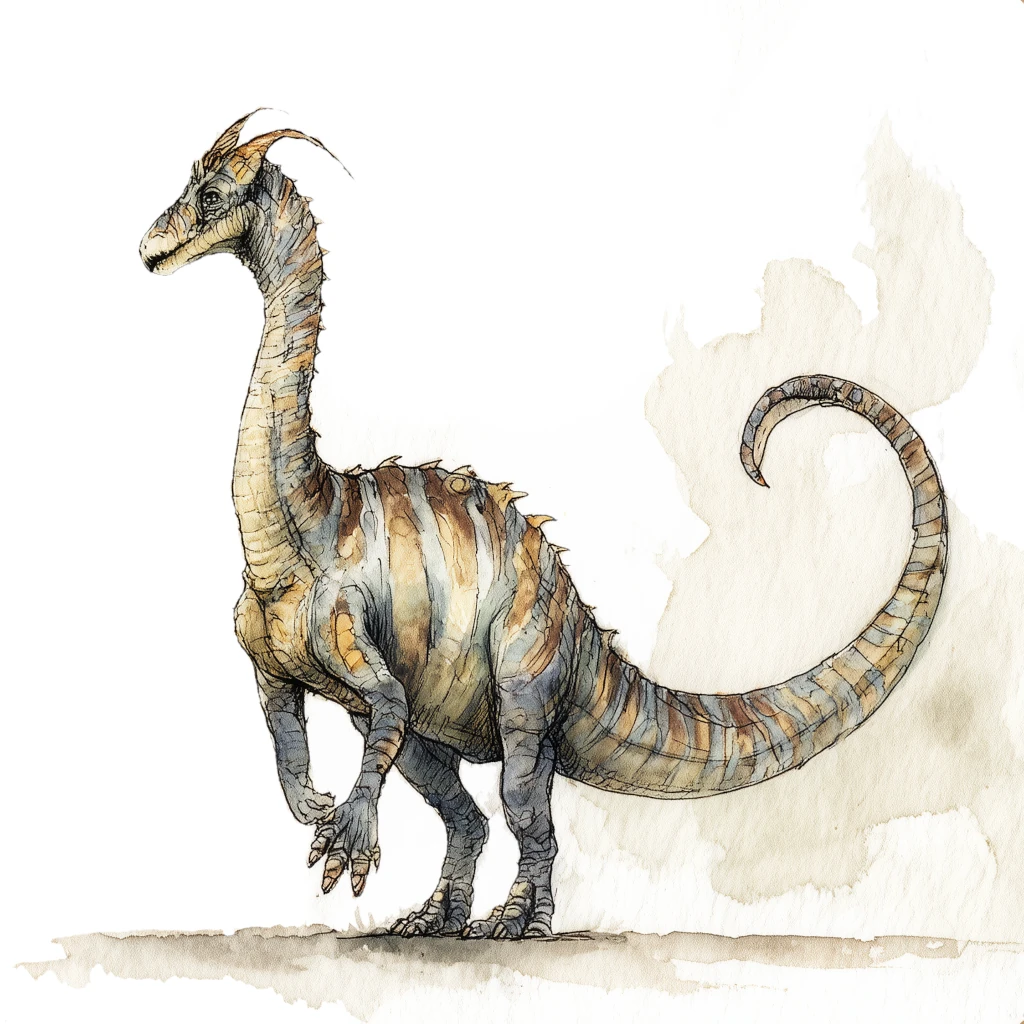
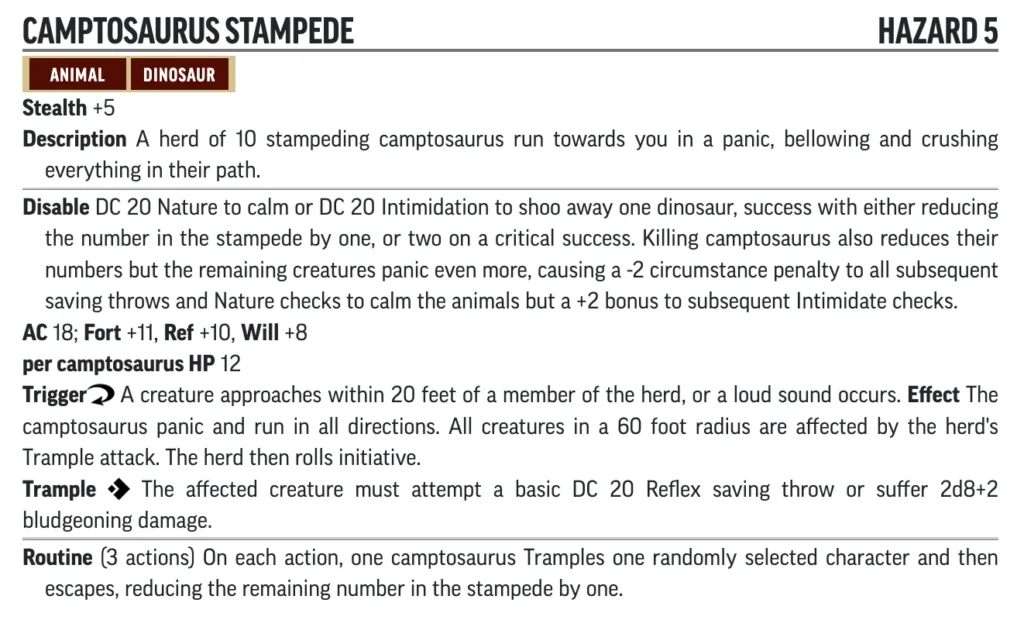
Campie, Bent Lizard; N | Huge | Animal | Dinosaur | Ornithopod; Hazard 5
The dinosaurs of Pangaea aren’t known for their wits, but even for a dinosaur, the camptosaurus [camp-toe-SORE-us] seems particularly unintelligent. Whether it’s because they are unobservant or simply stupid, these sods are easy prey for hunter of the humanoid and carnosaur varieties both. It’s said that the herd generally doesn’t start to run until one of its number gets killed—and then, all nine hells break loose. When campies get spooked, they have a bad habit of stampeding, and you’d better believe that is hazardous to any berk caught up in it. A herd consists of up to a dozen twenty foot long bull males, females and young who are still larger than horses, and small juveniles who are nevertheless larger than adult humans. While stampeding campies are not much of a danger to each other, any non-camptosaurus in the midst of the chaos is in grave danger of being trampled to death as the campies try to escape.
Stats: [ D&D 2e | 3e | PF 2e ] Monstrous Compendium 3: Forgotten Realms Appendix [2e]; Homebrew [PF2e hazard]; see also Wikipedia
Centrosaurus
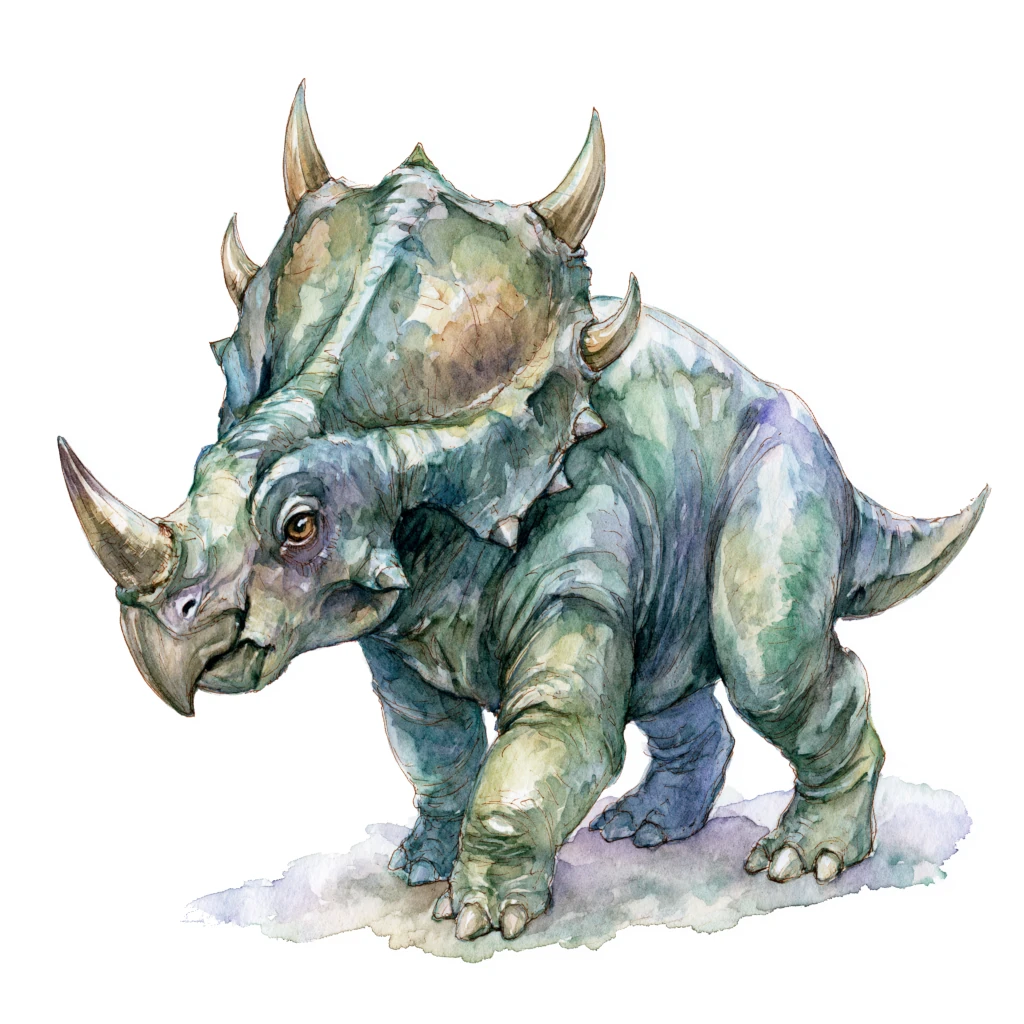
Monoclonius; N | Medium | Animal | Dinosaur | Marginocephalian; CR 3
A small relative of the triceratops, the centrosaurus [sen-tro-SORE-us] has a sharp beak and bony head-frill which guards its head and neck like a built-in shield. But it’s the sturdy nasal horn that gets all the attention. What makes it especially troublesome is the way the beast’s neck works means it can swing its horned head with far more speed and in more directions than a body would expect from something so, well, thick.
Now, a lone centrosaurus is bad enough if you get too close, but the real danger comes when the herd decides to move. They are herbivores, sure, but they defend themselves with those horn thrusts, and they’re somehow able to weaponise the mass panic of the herd. If these beasts decide to charge at you, you’re on your own cutter.
Stats: [ D&D 2e | 5e | PF 2e ] Monstrous Compendium Annual Volume Two [2e] p38; * Dr Dhrolin’s Dictionary of Dinosaurs p118
Cetiosaurus
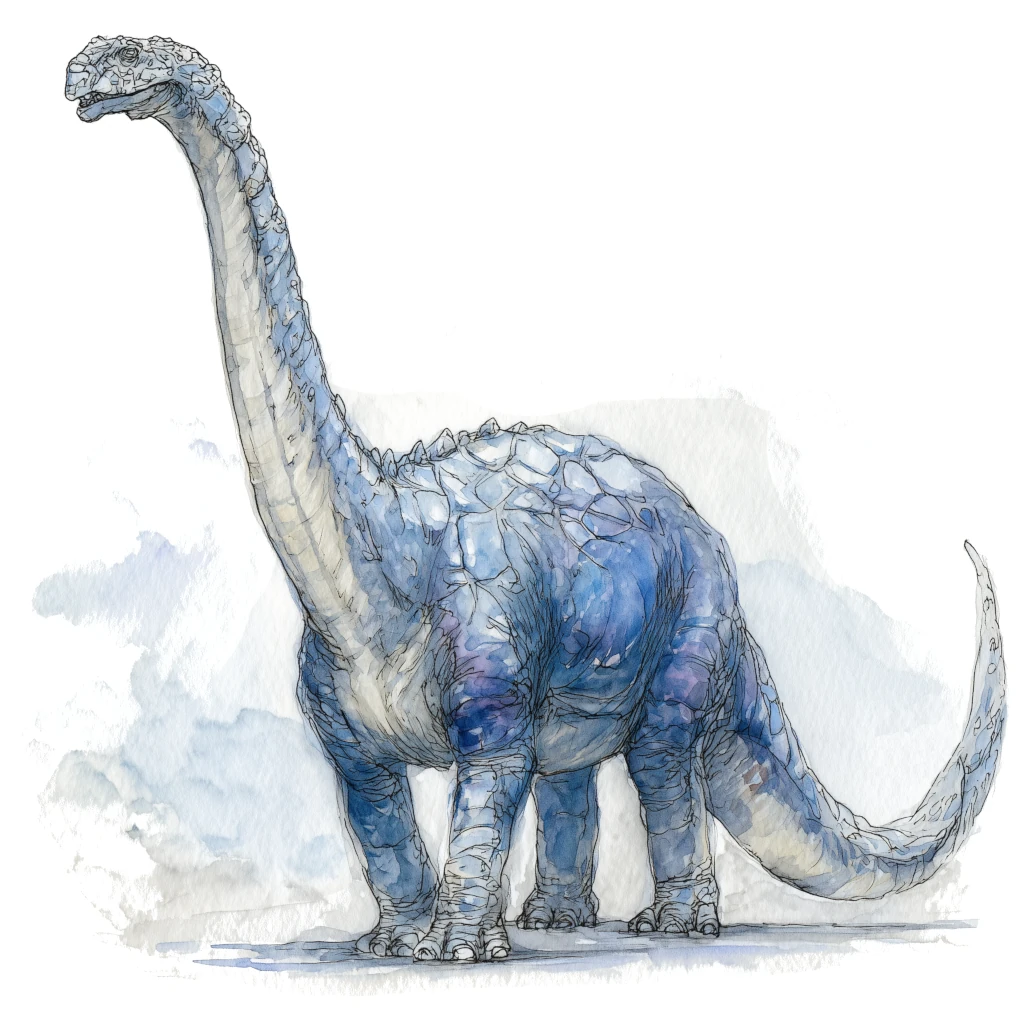
Whale lizard; N | Gargantuan | Animal | Dinosaur | Sauropod; CR 7
The chant goes that these enormous beasts were named by a graybeard who was either incredibly short-sighted, or incredibly bubbed up, because cetiosaurus [setty-oh-SORE-us] means ‘whale lizard’ in some dead Prime language. The charitable explanation is that they’d only seen the bones of one of these sauropods, and then were too proud to rewrite their book. Anyway, as any planewalker who’s encountered one of these magnificent beasts can tell you, while they certainly like to get their bellies wet in marsh water, the cetiosaurus is very much a land animal. They dwell in lakes, bogs and fens, gobbling up huge amounts of vegetation to maintain their bulk.
Larger than the amargasaurus but smaller than a brontosaurus, the sixty-foot long cetiosaurus seems to have found a niche by being slightly smarter than their kin. With heads, and presumably brain-boxes, twice the size, cetiosauri can be trained by a patient beastmaster, and chant goes they’ve even been used as mounts by giants. Marsh giants bully them into submission, turning them into aggressive fighting mounts which they ride in pairs—one to control the beast with whip and stick, the other to wield the weapons. On the other hand, cloud giants tend to treat cetiosauri with more respect, resulting in a less aggressive and much more loyal mount that is easier for them to ride solo, or hook up to pull a cloud caravan. But exactly how a cloud giant is able to get a 10 tonne dinosaur up into their cloud castles, and what they feed them up there, well those are feats of magic beyond my ken.
Stats: [ D&D 2e | PF 2e ] Monstrous Compendium 3: Forgotten Realms Appendix [2e]; Homebrew [PF2e]
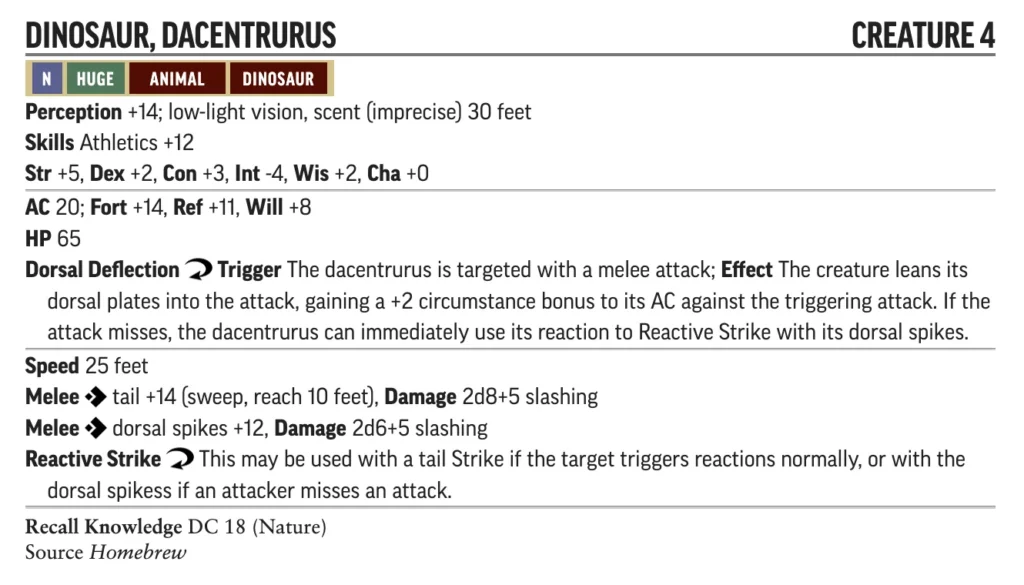
Dacentrurus
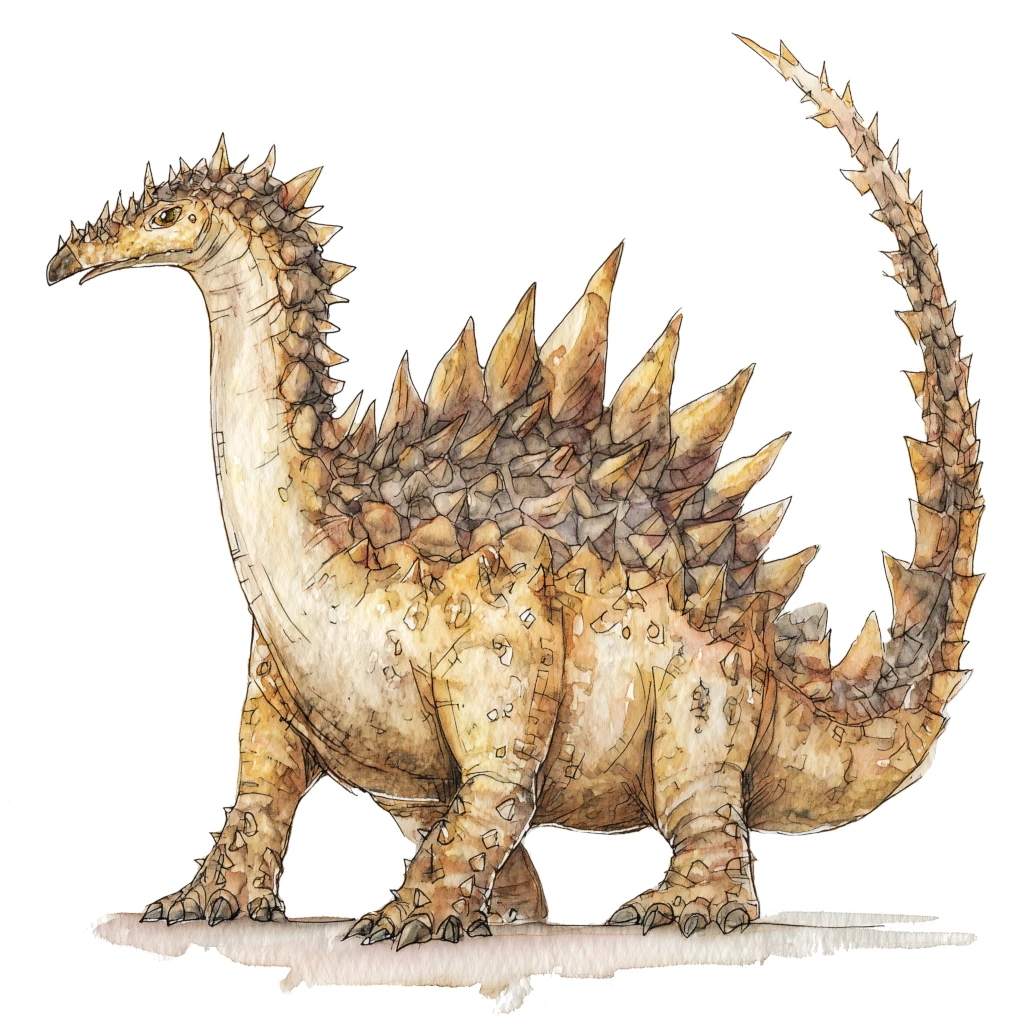
Tail-full-of-points; N | Huge | Animal | Dinosaur | Thyreophoran; CR 4
Looking like a stegosaurus whose flat plates have been filed down into sharp points, the dacentrurus [da-sen-TRUE-rus] is fierce, but herbivorous. About thirty feet long and ten tall, it feeds among dense fern beds, thickets, and other overgrown areas where a predator would have to in close. This is exactly where the trouble starts, because a dacentrurus is an aggressive defender that keeps turning its body to face danger with its tail. The sharp blades makes every attack on its neck, back, or hindquarters a risky proposition as the armour-plating is designed to inflict damage back on any predator who dares try and bite them. The main thing to watch is that tail mind—its build like like one of those bladed slashing whips you see some drow wield. It’s not a clumsy club like an ankylosaurus, but a lashing bank of spikes. The answers here are simple—never crowd one in thick cover because it’ll have the advantage. Never assume that just because it’s a a plant-eater it wants to flee. And above all never stand where it has room to swing that tail.
Stats: [ D&D 2e | PF 2e ] Monstrous Compendium 3: Forgotten Realms Appendix [2e]; Homebrew [PF2e]; see also Wikipedia
Deinocheirus
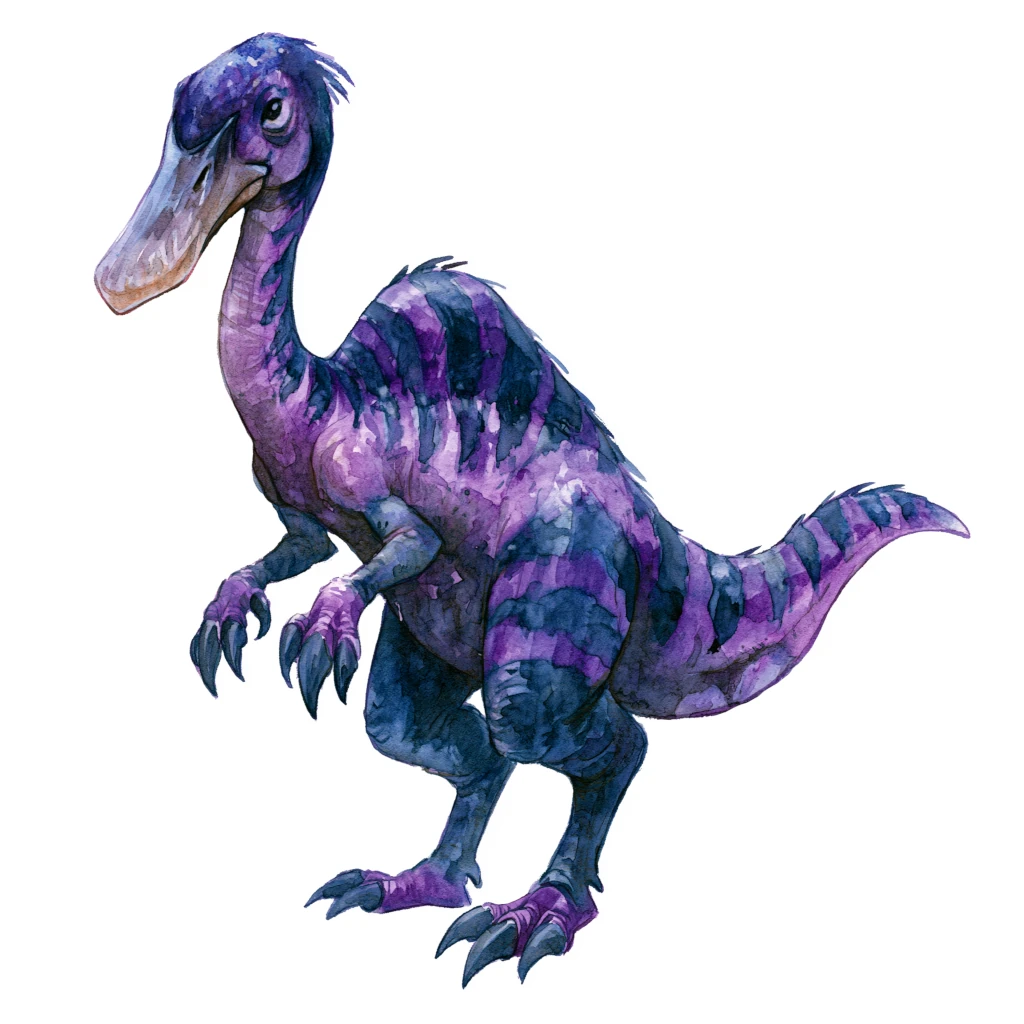
N | Huge | Animal | Dinosaur | Theropod; CR 6
Although it looks like a bizarre bipedal hunchbacked carnivorous hunter, the deinocheirus [die-uh-NYE-keh-rus] is actually a huge herbivore who dwells in marshlands. Unfortunately despite being vegetarian, it has the temper and defences of a predator—so watch out anyway!
Stats: [ D&D 5e | PF 2e ] * Dr Dhrolin’s Dictionary of Dinosaurs p122
Diplodocus
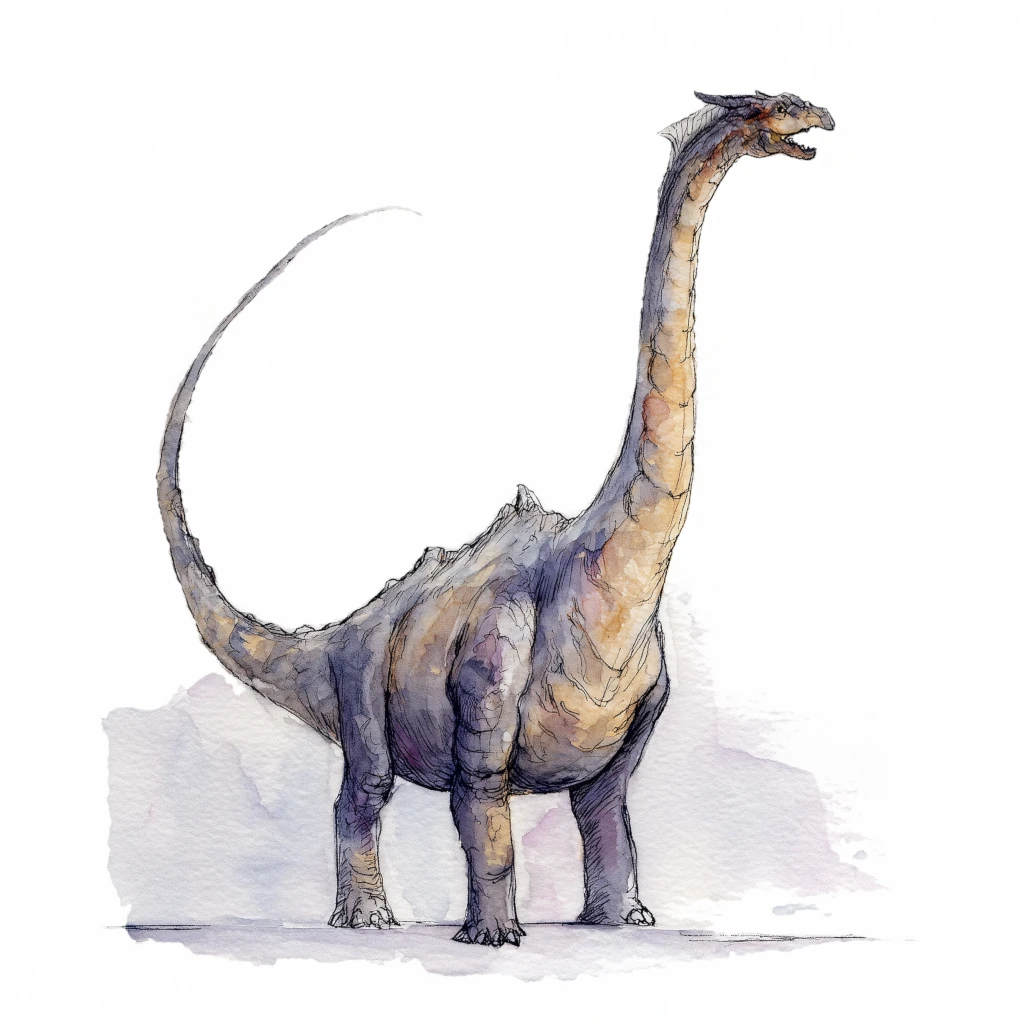
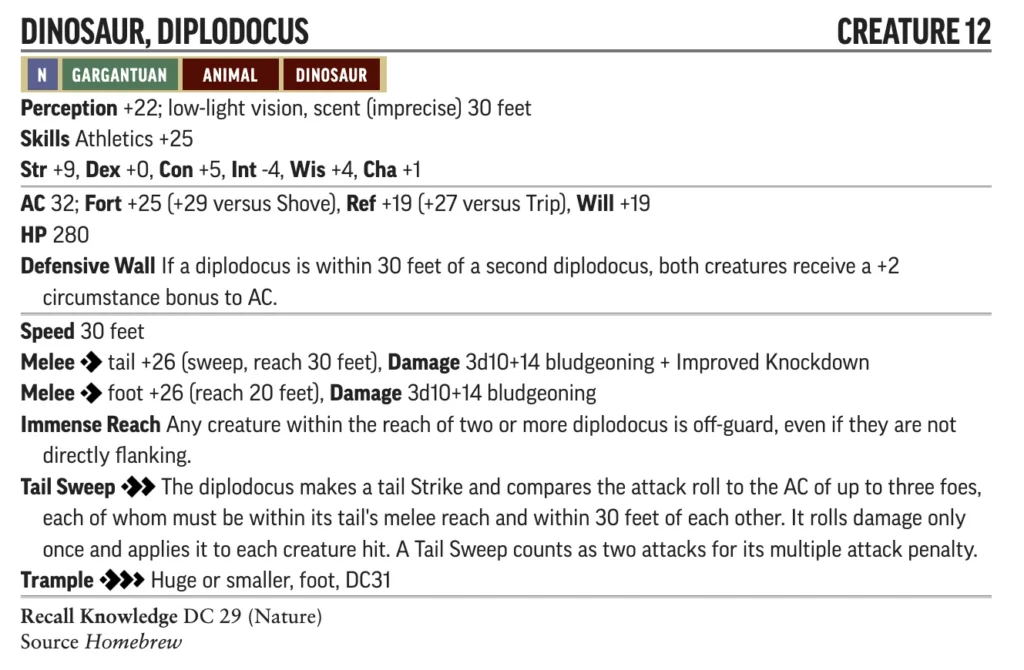
Seismosaurus, Double beam lizard; N | Gargantuan | Animal | Dinosaur | Sauropod; CR 12
The diplodocus [dip-luh-DOE-kuss] is a colossal sauropod so large that a body could mistake it for part of the landscape until that neck lifts up and the tail begins to move. A small, narrow head balances atop that its immense neck, while the creature’s vast bulk trails behind in a broad muscular body with an extraordinarily long, whip-like tail that is held out behind for balance. It gives the whole beast a kind of uncanny grace, despite its ten-ton weight and hundred-foot length. Diplodocus travel in herds and favour warm fern prairies, lake shallows and marshes, and open forests where water and tasty vegetation are plentiful. They spend most of their time browsing low plants and waterside growth with the steady, unhurried rhythm common to large sauropods.
That calm fools plenty of berks. A diplodocus is no dedicated killer, but it’s dangerous in all the ways a creature that size can be deadly. A misplaced foot can squash a careless planewalker to pulp, while a sudden rear up and crashing drop could flatten even an elephant. The tail of an angry diplodocus can lash out over surprising distance to scatter smaller threats as the smaller members of the herd withdraw. Against large predators, diplodocus rely on their bulks, and spacing out in mutual defence. Several adults together can present a wall of trampling feet and snapping tail strikes that make any sane attacker feel they’ve made a grave error. If you’re crossing country claimed by diplodocus, the dark to keep in mind is simple enough—watch the herd’s movement—they’re hard to miss, so no excuses there—and give their tails a much wider berth than you might expect. Finally, never mistake placid for safe, because these giants usually ignore small creatures right up until those small creatures stand where the herd intends to go.
Stats: [ D&D 2e | 3e & 3e | PF 1e | 2e ] Monstrous Manual [2e] p54; Monster Manual II [3e] p72 (seismosaurus); Dragon Magazine #318 [3e] (diplodocus); Bestiary 4 [PF1e] p58; Homebrew [PF2e]
Giraffatitan
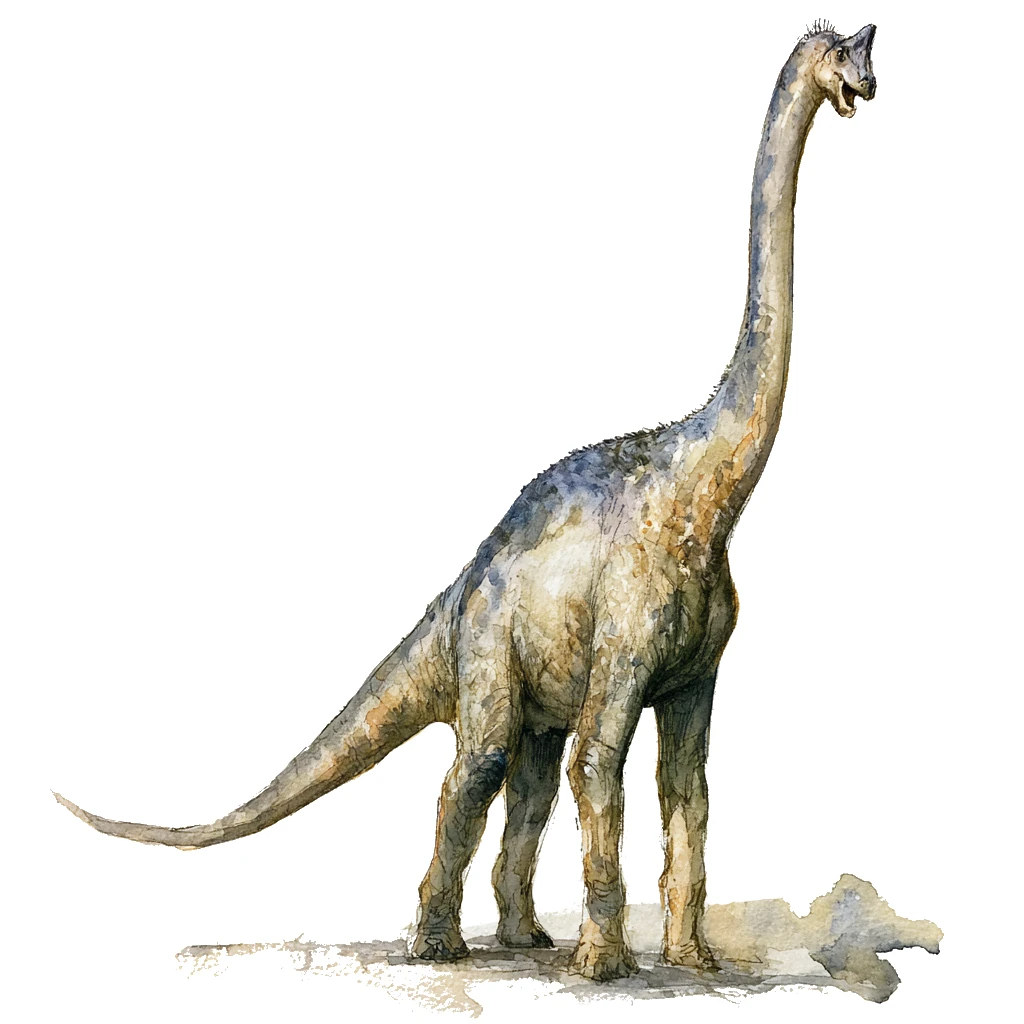
N | Gargantuan | Animal | Dinosaur | Sauropod; CR 9
The giraffatitan [jee-raffa-TIE-tan] is a member of the titanosaur family with exceptionally long legs and neck, and it uses both to attack with a huge reach.
Stats: [ D&D 5e | PF 2e ] * Dr Dhrolin’s Dictionary of Dinosaurs p136
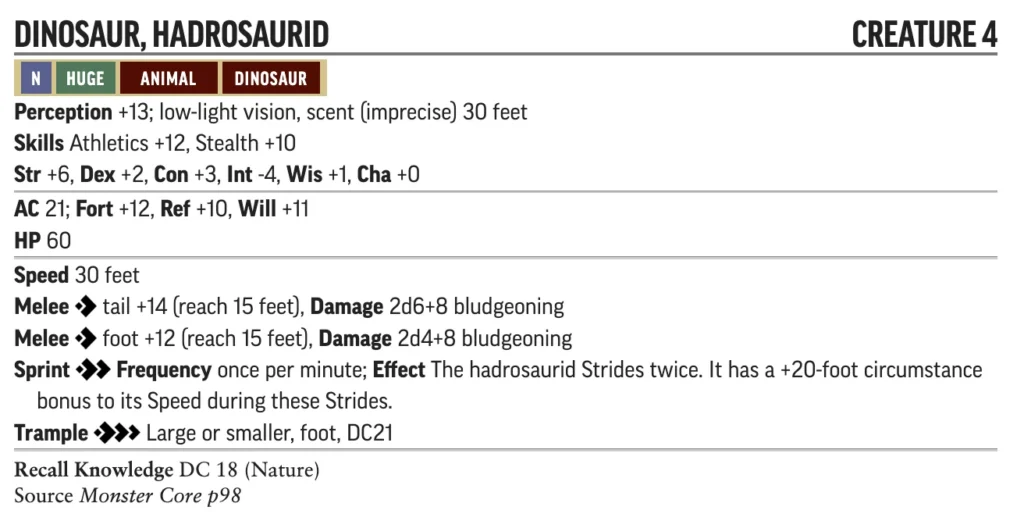
Hadrosaurid
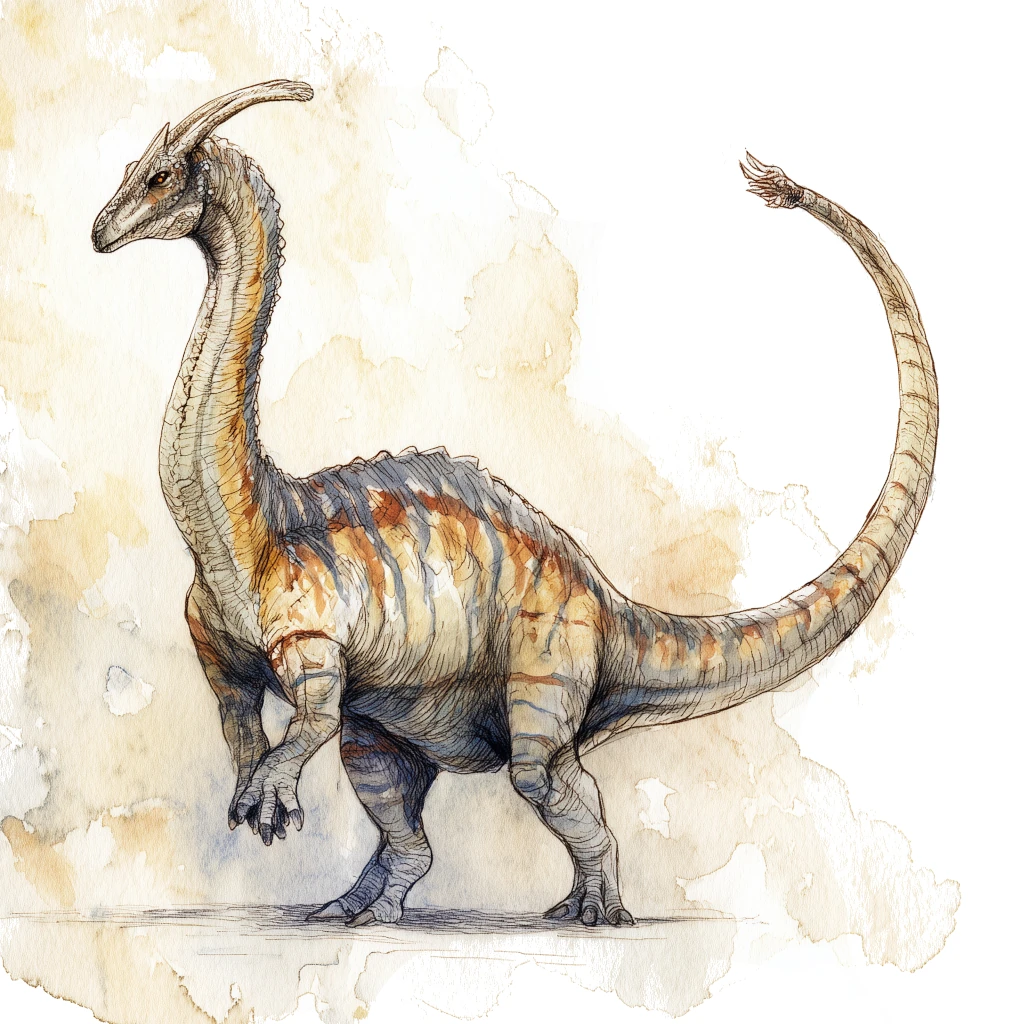
Stout lizard; N | Huge | Animal | Dinosaur | Ornithopod; CR 4
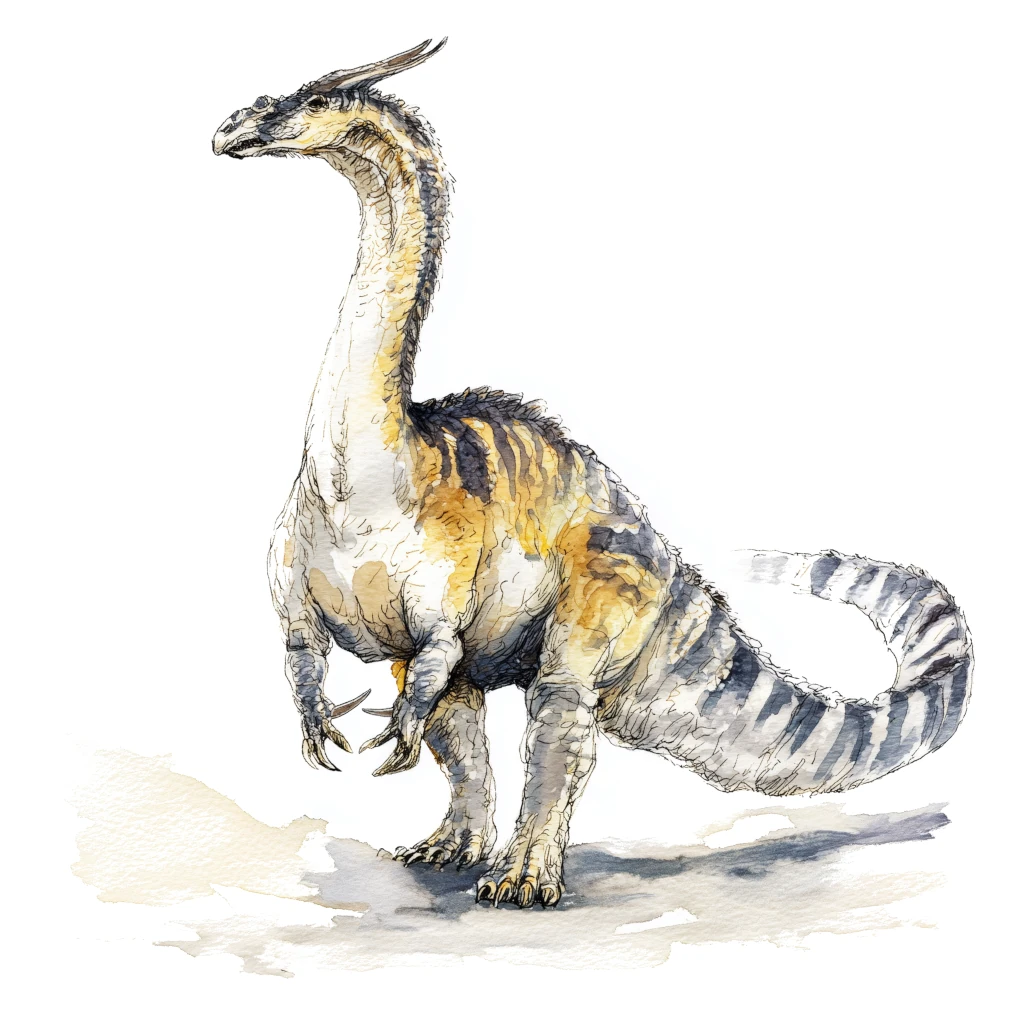
The hadrosaurid [had-roe-SORE-id] is one of Pangaea’s more familiar great grazers, a huge duck-billed ornithopod with a broad flat snout that’s packed with grinding teeth, a stout body about twenty-five feet long and eight feet tall, and, in many species, a distinctive head crest that makes herds easy to pick out even at a distance. These herbivores are usually found in open feeding country where the vegetation is lush and plentiful, traveling in groups and relying more on alertness, numbers, and sudden bursts of speed than on aggression. Giants and other oversized folk sometimes keep them as livestock, even though their timid nature makes them poor mounts. The chief danger they pose is their tendency to panic: a startled hadrosaurid would rather flee than fight, but a sprinting or stampeding herd can trample anything in its path, so the dark is to remember is that the safest place near duck-bills is never directly in front of where they’ve decided to run.
Stats: [ D&D 5e | PF 2e ] Volo’s Guide to Monsters [5e] p139-140; Monster Core [PF2e] p98
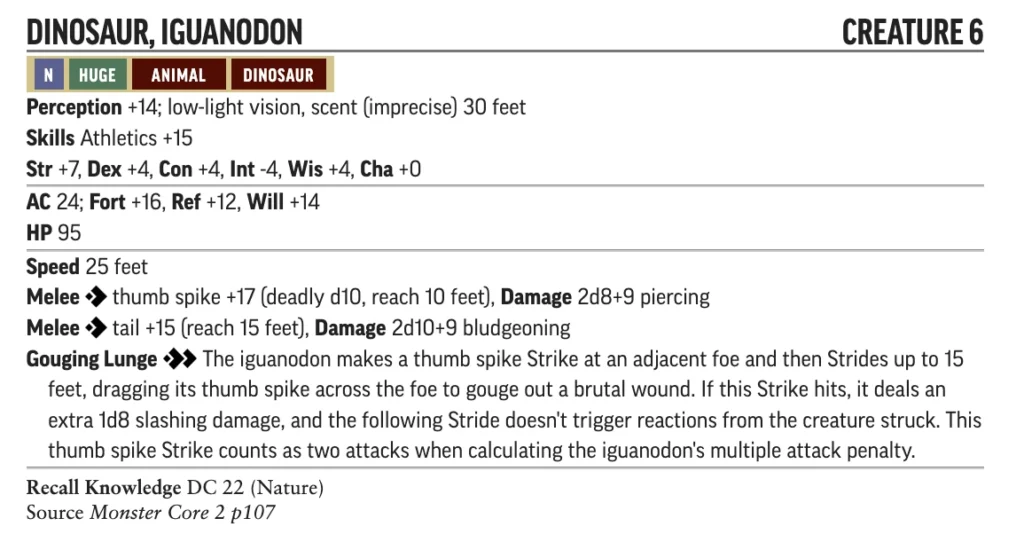
Iguanodon
Iguana tooth; N | Huge | Animal | Dinosaur | Ornithopod; CR 4–6
The iguanodon [ig-WANNA-don] is one of those herbivores that gives a body false confidence right up until it turns sideways and shows its hands. At a glance it might pass for a gentle hadrosaurid. It’s one of those huge browsing beasts with a heavy barrel body, a long tail, and a neck that lifts high when there are better leaves higher up. These beasts are built to move on all fours through swamps and forests but perfectly willing to rear up on two legs for a short time. Look closer, and you’ll spot that its forelimbs end in cruel, spike-thumbs—and that single detail is enough to turn a peaceful grazer into something most predators approach with a lot more caution.
Iguanodons usually travel in herds and would rather put distance between themselves and danger than stand and trade blows, but they’ve got a quick temper for plant-eaters and a surprising mean streak once cornered. When pressed, an iguanodon can lunge forward with those thumb spikes in a gouging thrust, slash about wildly with its forelimbs, or lash with its tail hard enough to make a hungry carnivore reconsider its options.
Stats: [ D&D 2e | PF 1e | 2e ] Monstrous Compendium Annual Volume Two [2e] p38; Bestiary 3 [PF1e] p78; Monster Core 2 [PF2e] p107; * Dr Dhrolin’s Dictionary of Dinosaurs [5e, PF2e] p138 (CR 4 version)
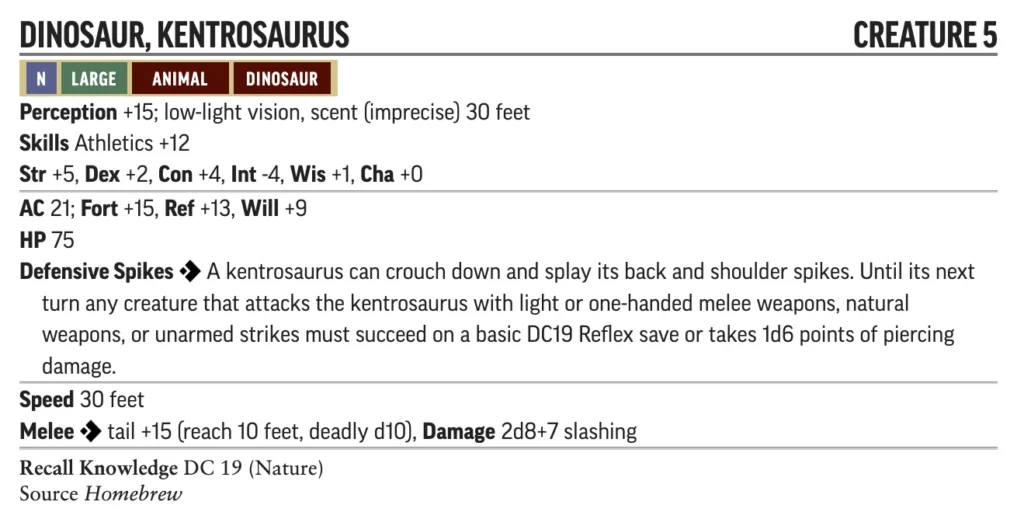
Kentrosaurus
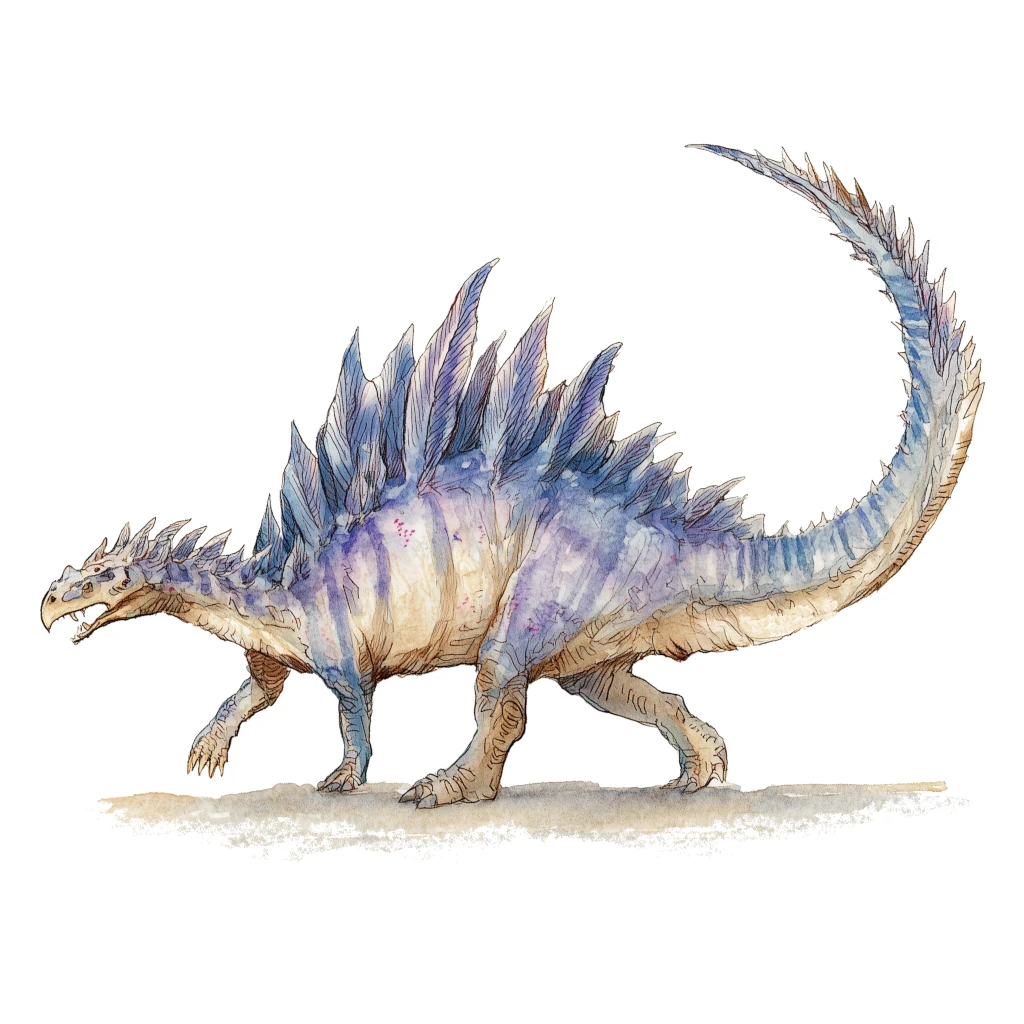
Prickle lizard; N | Large | Animal | Dinosaur | Thyreophoran; CR 5
The kentrosaurus [ken-tro-SORE-us] is a spiteful-looking little cousin of the larger stegosaurs, a low-slung jungle thyreophoran whose body is as much spike as dinosaur. From the neck to the hips, its back is lined with sharp bony plates, but behind that the armour gives way to long rearward-pointing spines that continue down the tail, so that even its silhouette looks hazardous. At only about fifteen feet long and four feet high it is smaller than many of Pangaea’s herbivorous beasts, but that only makes it easier to underestimate when it vanishes into dense green cover and turns itself sideways among the roots and ferns.
That last bit is the dangerous part, because a kentrosaurus specialises in active defence rather than brute force . It keeps its hindquarters angled toward danger, lashes with its spiked tail, and can crouch to splay its back and shoulder spikes so that any predator foolish enough to rush in with tooth, claw, or blade risks tearing itself open on the approach . For planewalkers, the advice is to always approach them from the front.
Stats: [ D&D 2e | 3e | 5e | PF 1e | 2e ] Monstrous Compendium 3: Forgotten Realms Appendix [2e]; Bestiary 6 [PF1e] p95; Homebrew [PF2e]; * Dr Dhrolin’s Dictionary of Dinosaurs [5e, PF2e] p142 (CR 3 variant)
Kulindadromeus
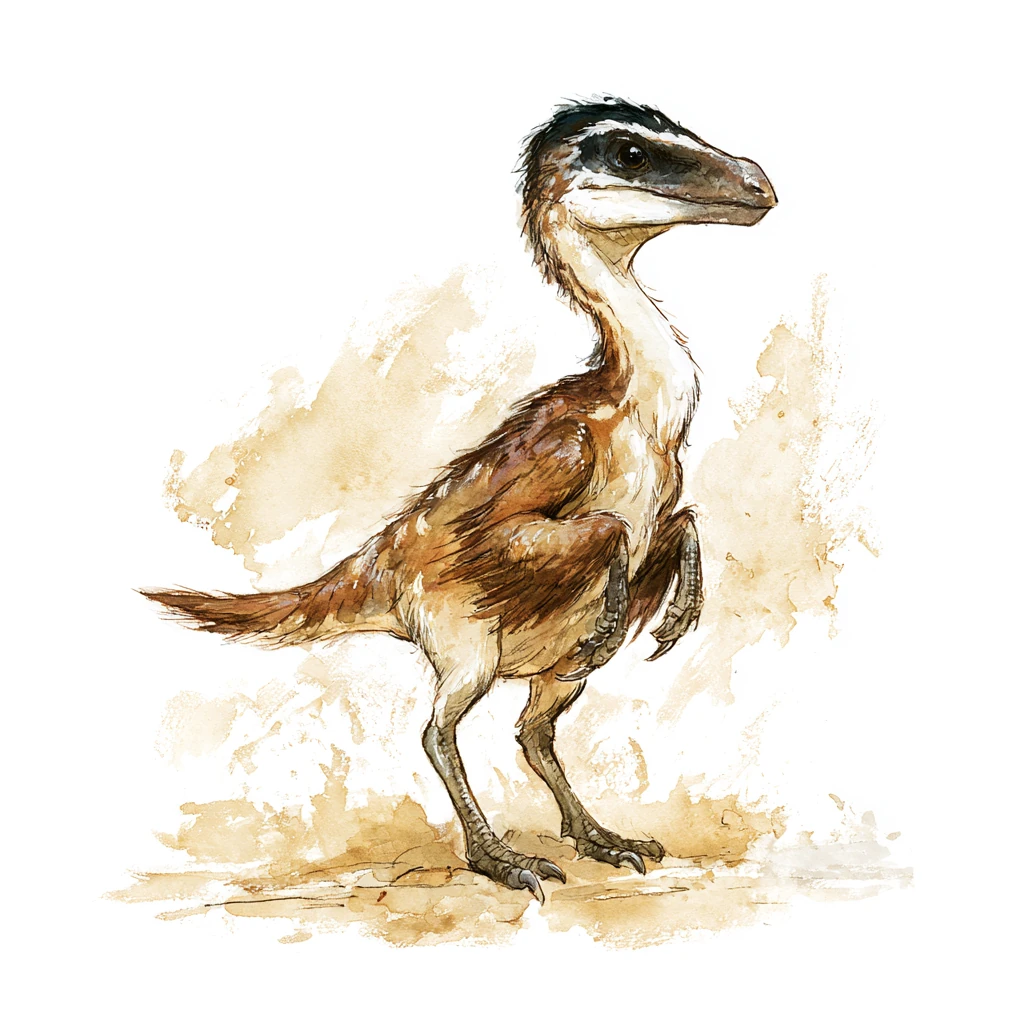
N | Small | Animal | Dinosaur | Ornithopod; CR -1
A small bird-like dinosaur that wades in swamps, foraging for ferns and insects.
Stats: [ D&D 5e | PF 2e ] * Dr Dhrolin’s Dictionary of Dinosaurs p146
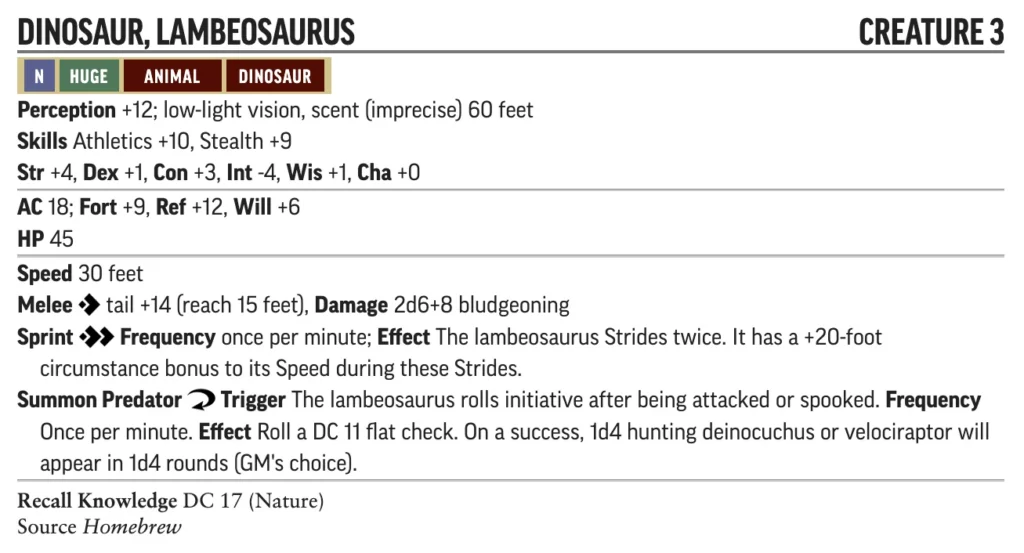
Lambeosaurus
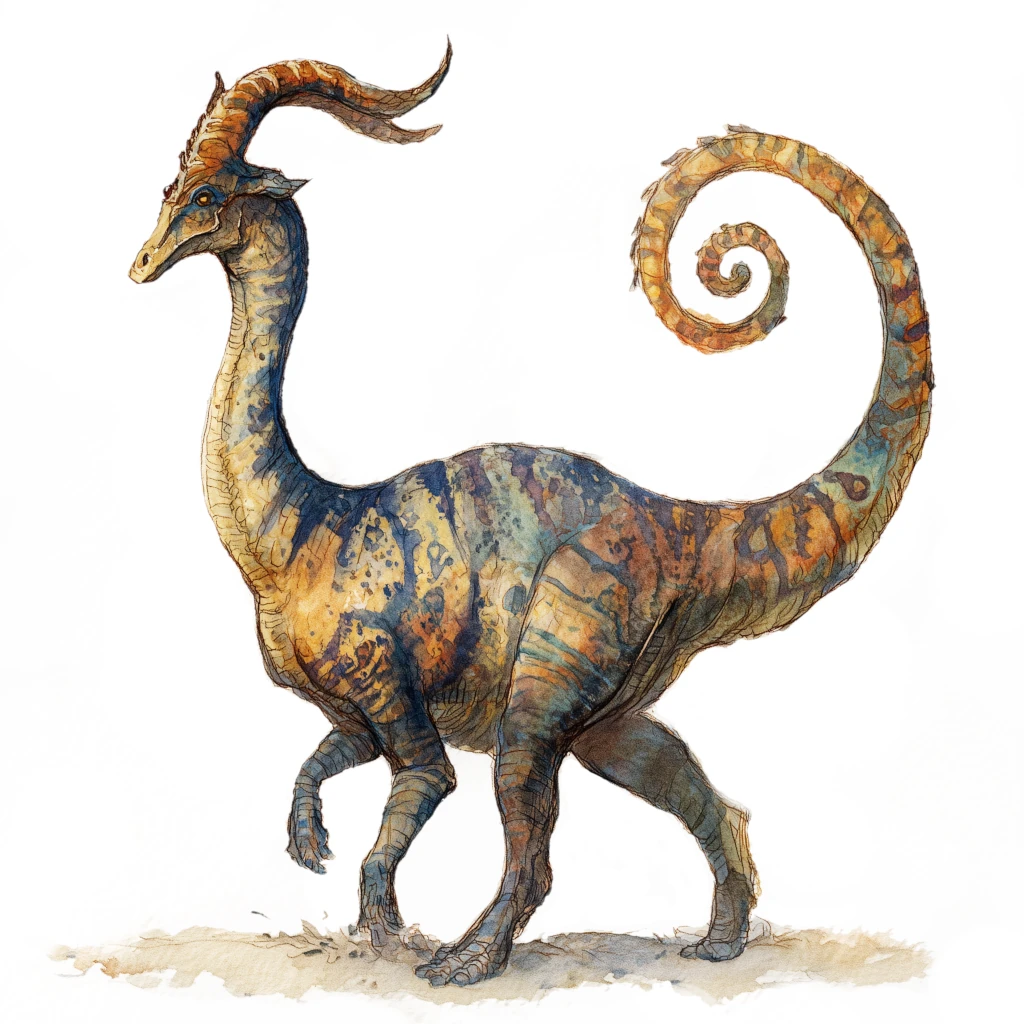
Parasaurolophus; N | Huge | Animal | Dinosaur | Ornithopod; CR 3
The lambeosaurus [lam-BAY-oh-SORE-us] is the most recognisable herbovires—a huge, peaceful hadrosaur with a flat snout, a long flexible tail for balancing, and most notably, a hollow cranial crest. This brightly-coloured set of horns serves for both mating display and resonating chamber, letting the herd call to one another across remarkable distances. Lambeosauri are built more for alertness and attracting attention than for battle, with sharp senses for spotting danger and a strong instinct to run when trouble comes near—although a cornered beast can still lash out with its tail pretty hard.
For planewalkers though, the thing to watch out for is not the lambeosaurus itself but what follows its panic cry. Loud noise, fire, or attacks the herd can trigger a lambeosaurus panic call that rolls across the landscape like a hunting horn, mournful and haunting. On Pangaea this sound has a bad habit of drawing exactly the sort of attention no sensible berk wants—raptors in the brush, great reptiles in the water, and any other sharp-toothed listener within earshot. So while the lambeosaurus is about as unlikely to attack as any creature that size can be, treating it rough is still a fine way to turn a quiet patch of wilderness into one prowling with predators.
Stats: [ D&D 2e | 3e | PF 1e | 2e ] Monstrous Manual [2e] p54; Dragon Magazine #318 [3e]; Bestiary 2 [PF1e] p91; Homebrew [PF2e]
Magyarosaurus
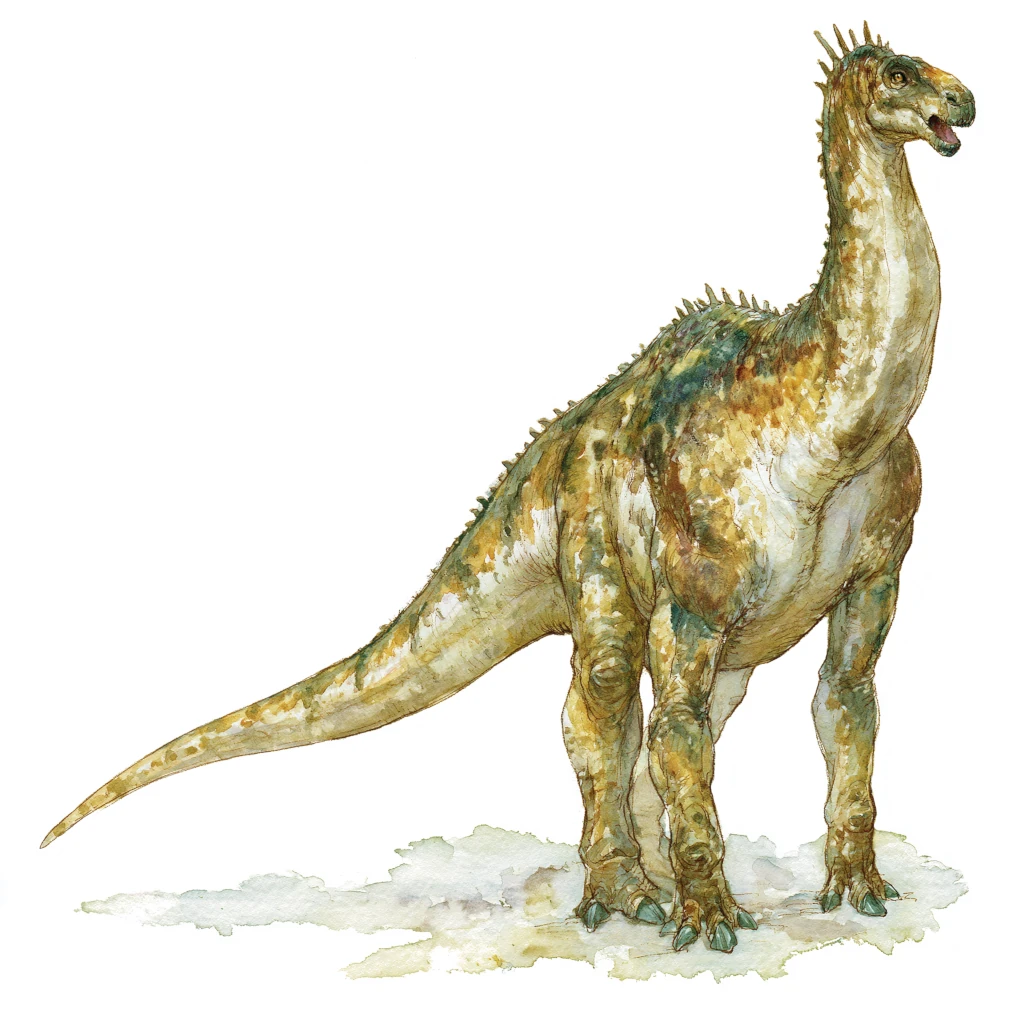
N | Large | Animal | Dinosaur | Sauropod; CR 4
One of the smaller sauropod species, but similar in behaviour to its larger cousins—dwelling in a herd, uses its neck and stomp attacks in defence. Its neck and back are covered in short spikes for protection.
Stats: [ D&D 5e | PF 2e ] * Dr Dhrolin’s Dictionary of Dinosaurs p90
Mamenchisaurus
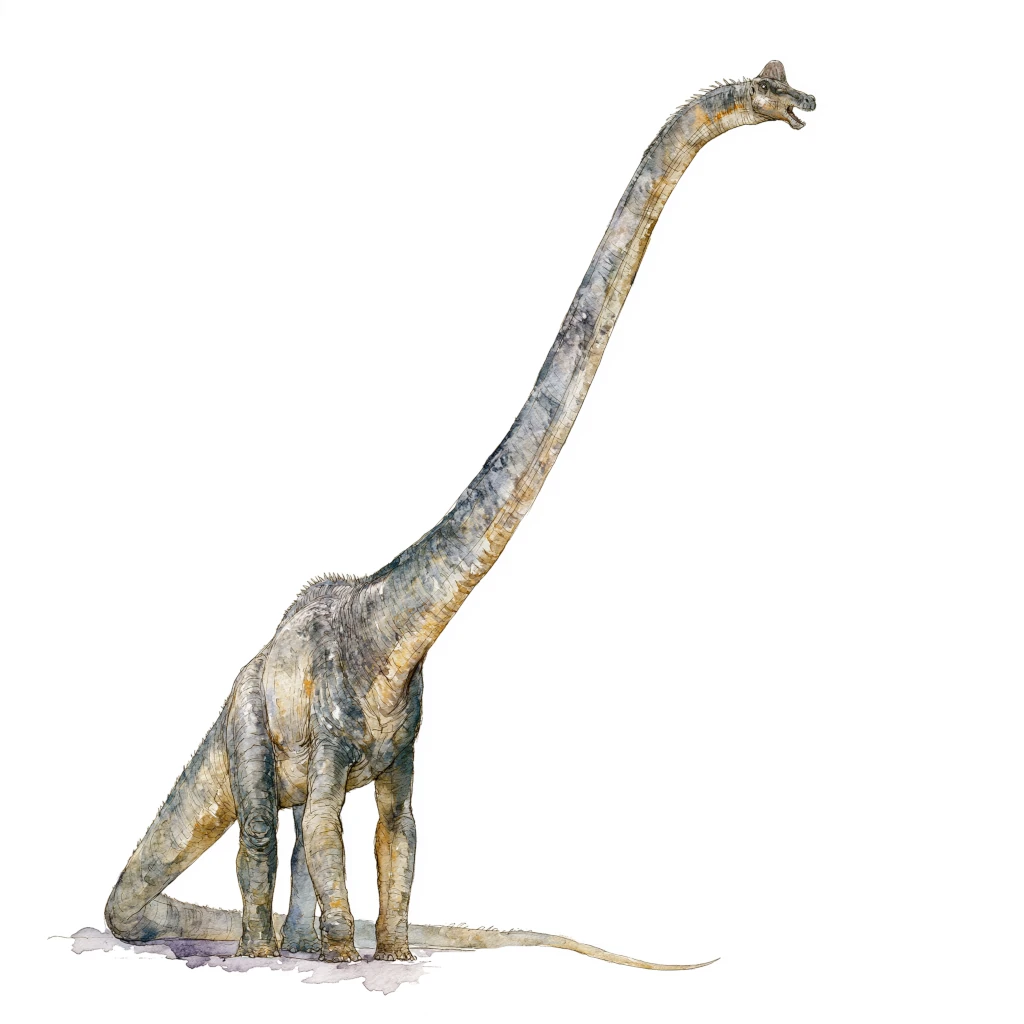
N | Gargantuan | Animal | Dinosaur | Sauropod; CR 7
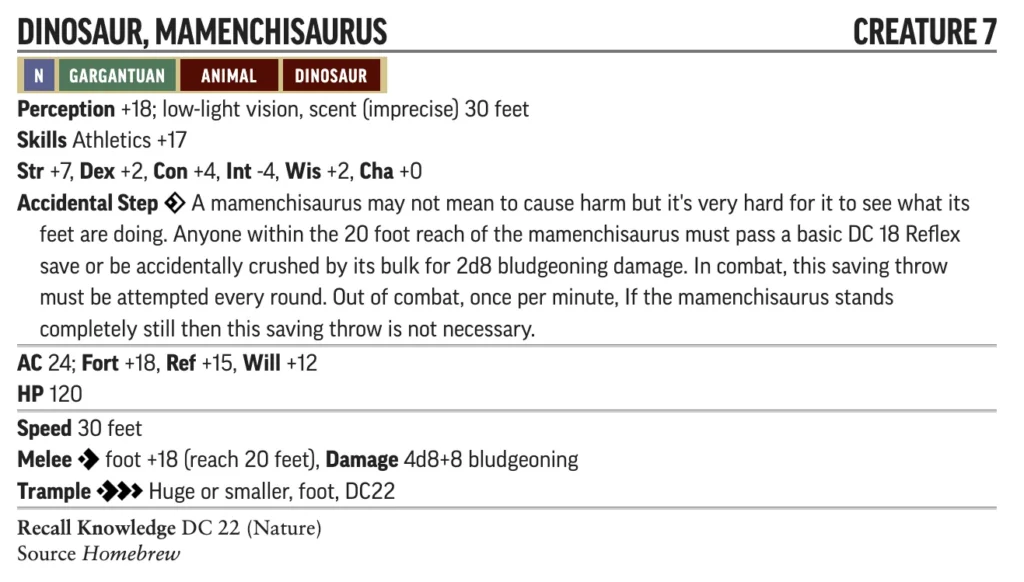
The mamenchisaurus [ma-menky-SORE-us] is perhaps Pangaea’s most unusual-looking sauropod, a gargantuan swamp-dwelling browser built around an absurdly long neck with a body stuck on behind like an afterthought. Nearly half its ninety-foot length is neck alone, and graybeards reckon it may be the longest neck of any non-magical animal. It’s as unwieldy in practise as it looks too, because a mamenchisaurus isn’t really able to bend it, just pivot up and down. Despite its great size the mamenchisaurus is lighter on its feet than some of its relatives, and it is able to reach higher than any of them too, especially when it rears up on its hind legs. Because it can’t bend easily, it walks with a look of haughtiness that’s rate to see outside the Lady’s Ward.
For all its size, the mamenchisaurus is surprisingly timid, and usually strikes only when threatened. Any creature small enough to be beneath its notice—and you;’d better believe that’s even large creatures—can easily be crushed underfoot by accident. When alarmed the sheer mass of the beast, the sweep of its body, and the reach of that neck can turn a patch of swamp into a very bad place to be standing. The advice for planewalkers is simple enough: give it plenty of room, watch where its feet are going.
Stats: [ D&D 2e | PF 2e ] Monstrous Compendium 3: Forgotten Realms Appendix [2e]; Homebrew [PF2e]
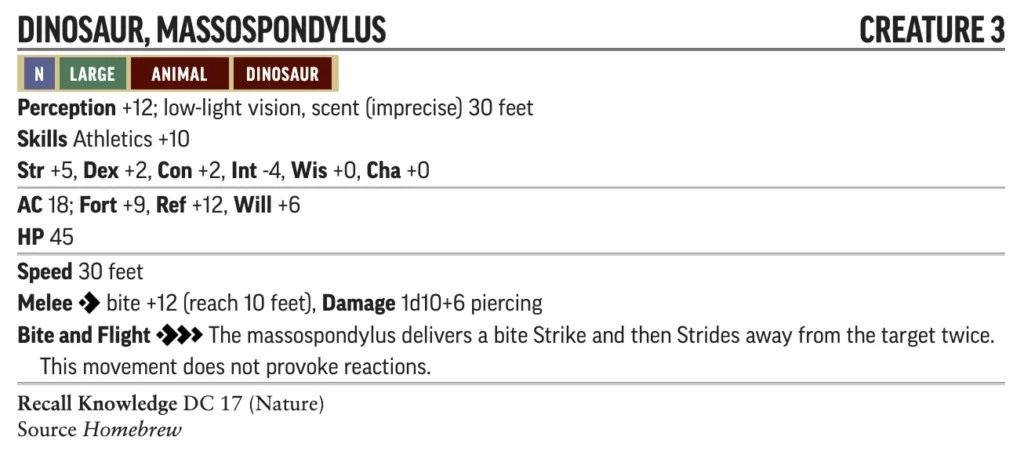
Massospondylus
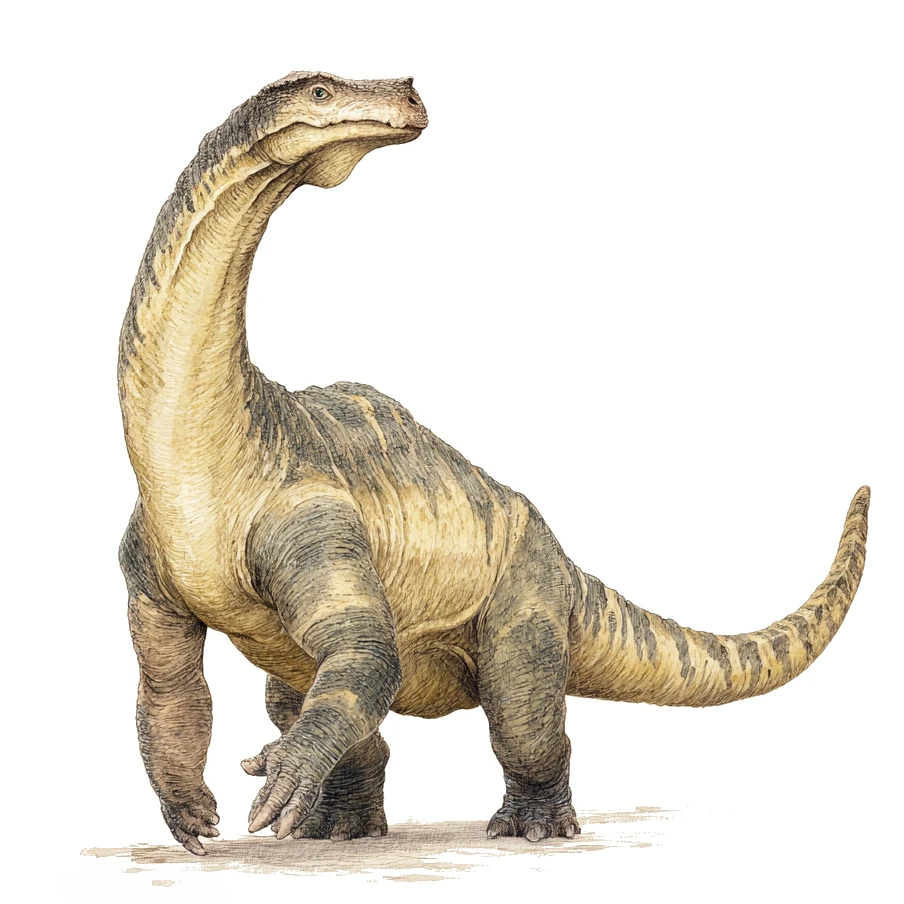
Long back; N | Large | Animal | Dinosaur | Sauropod; CR 3
The massospondylus [mass-oh-SPON-dill-us] is a common sight in Pangaea’s open woods and scrublands. It’s a large, lightly built sauropod about fifteen feet long with a small head, a thick neck, a plump body on relatively slender legs, and five-fingered hands with a sharp thumb spike it uses for pulling up and shredding vegetation rather than for fighting. It has a habit of swallowing stones to help grind down coarse plant matter in its gut. They are gentle grazers, placid and slow on the uptake.
Their sharp teeth tell a different story, though, and so does their reputation as the favourite quarry for virtually every large carnivore on the plane. Constant predation has taught massospondylus to be twitchy. They interpret most unusual approaches as threats, and their standard response is a bite—quick, hard, and backed by teeth better suited for defence than most herbivores carry—followed immediately by fleeing. The lesson here is that a creature this dim and this used to being hunted has no reason to distinguish between a carnosaur and a cutter who wandered too close for a look, so stay back, move slowly, and don’t be surprised if an beast with no quarrel in the world still takes a chunk out of you, just on principle.
Stats: [ D&D 2e | PF 2e ] Monstrous Compendium 3: Forgotten Realms Appendix [2e]; Homebrew [PF2e]
Mnyamawamtuka
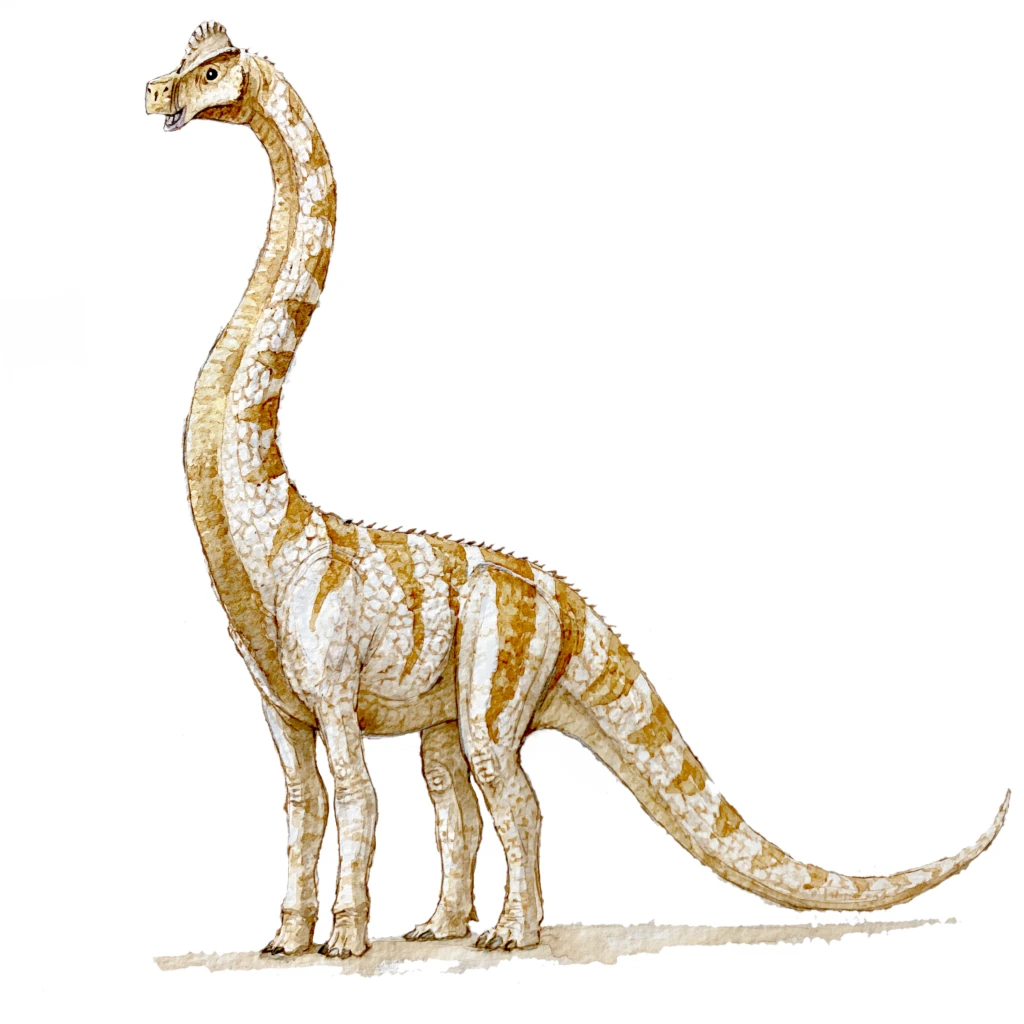
N | Huge | Animal | Dinosaur | Sauropod; CR 5
One of the smaller sauropod species, the mnyamawamtuka [mm-NYA-ma-wah-mm-TOO-ka] are herd-dwelling and relatively peaceful, unless threatened.
Stats: [ D&D 5e | PF 2e ] * Dr Dhrolin’s Dictionary of Dinosaurs p156
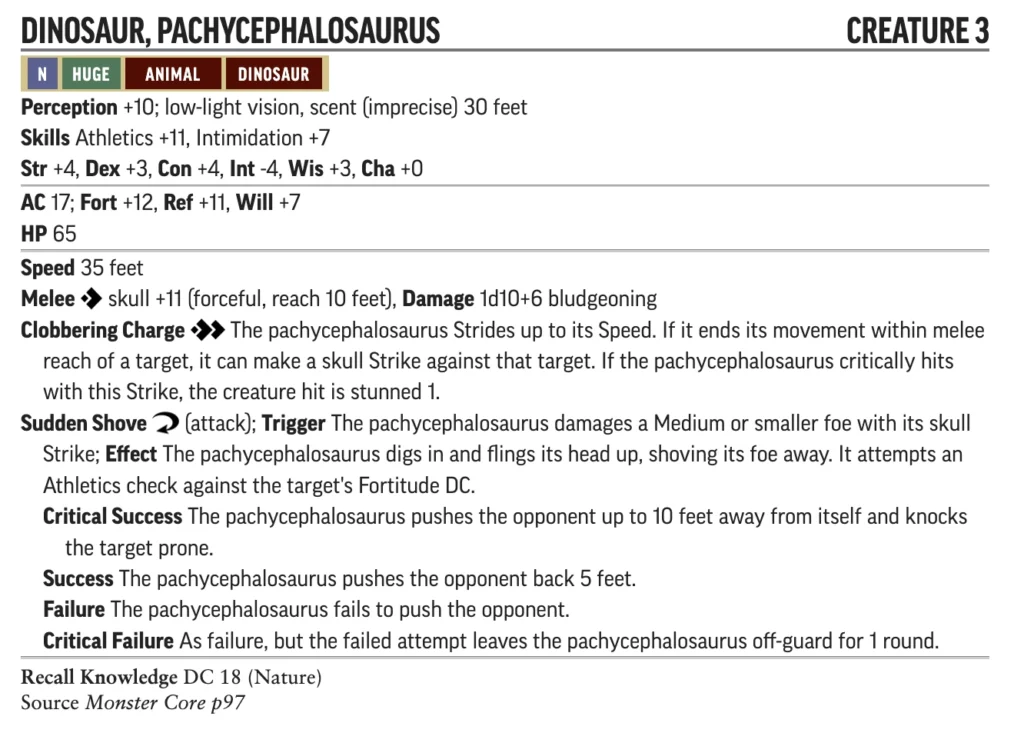
Pachycephalosaurus
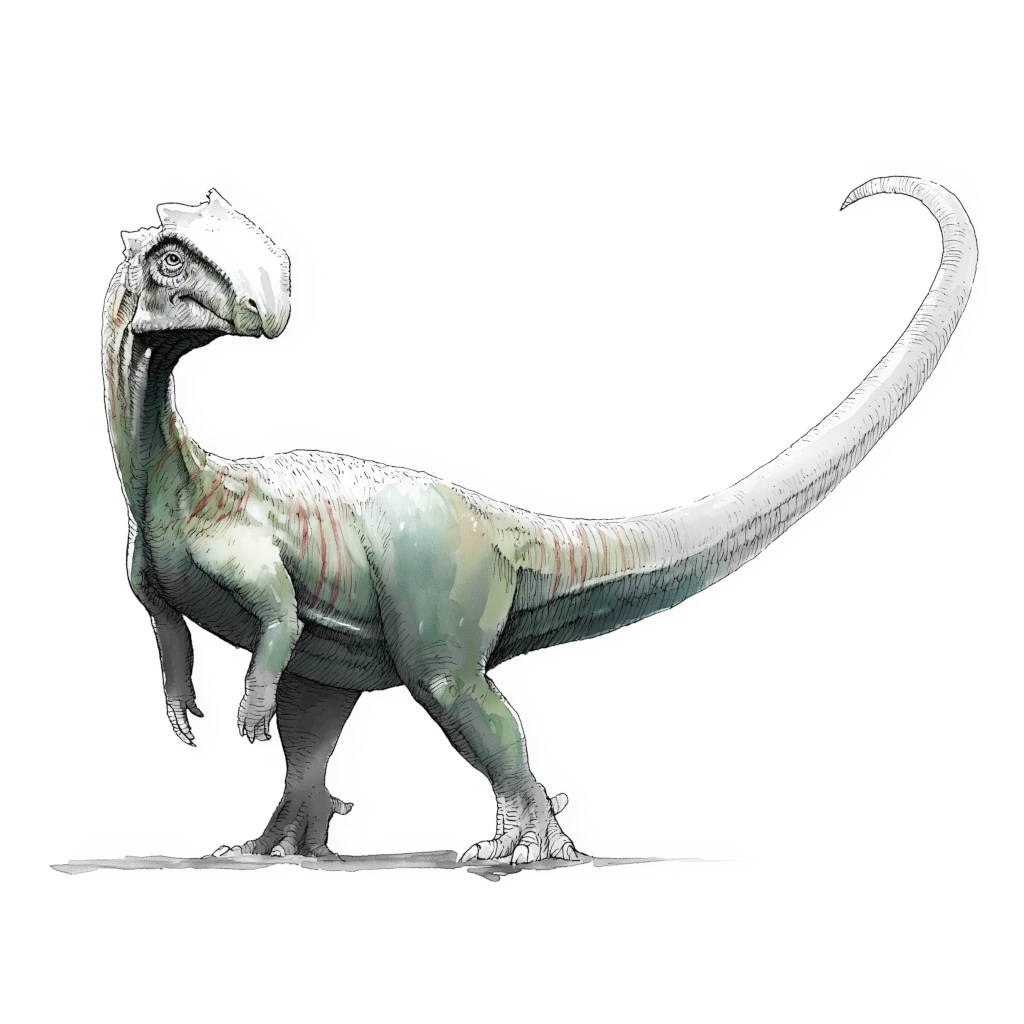
Thick-headed lizard; N | Large | Animal | Dinosaur | Marginocephalian; CR 3-6
The pachycephalosaurus [pack-ee-SEF-a-lus] is one of Pangaea’s more temperamental little bruisers, a bipedal marginocephalian about fifteen feet long with a dense bony dome atop its skull. Its head is fringed by ridges and horns that make its head look like a battering ram. In quieter times it is usually a peaceful enough herbivore, moving with its herd and minding its own business—but its compact neck and heavy crown are built for violent forward lunges. Pachycephalosaurus used their helmet-like skulls in headbutting contests over mates, territory, or status in the pack. And it’ll do the same to humanioids too—if a pachycephalosaurus decides you are too close, it’ll usually try to resolve the matter with a headfirst charge. That makes them more dangerous than their size first suggests. A riled-up pachycephalosaurus does not stand still and trade blows; it rushes in, slams with a dome-headed shove, and then wheels away to line up another pass, sometimes sending smaller foes sprawling with the sheer force of impact. They grow especially irritable during mating season and whenever their herd contains young. Best practice is to keep an eye on any individual starting at you and lowering its head.
Stats: [ D&D 3e | PF 1e | 2e ] Dragon Magazine #318 [3e]; Bestiary 3 [PF1e] p79; Monster Core [PF2e] p97
Paleocinthus
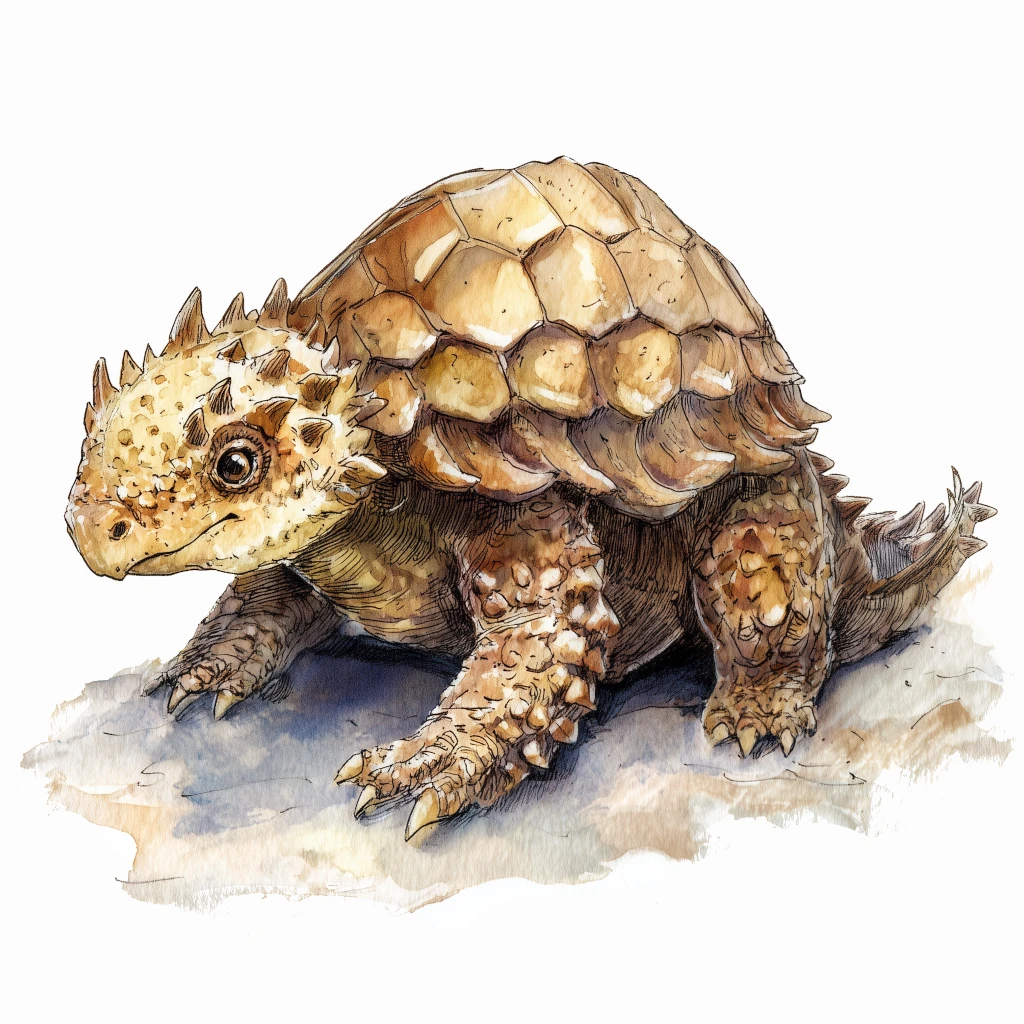
Palaeoscincus, Ancient lizard; N | Huge | Animal | Dinosaur | Thyreophoran; CR 3
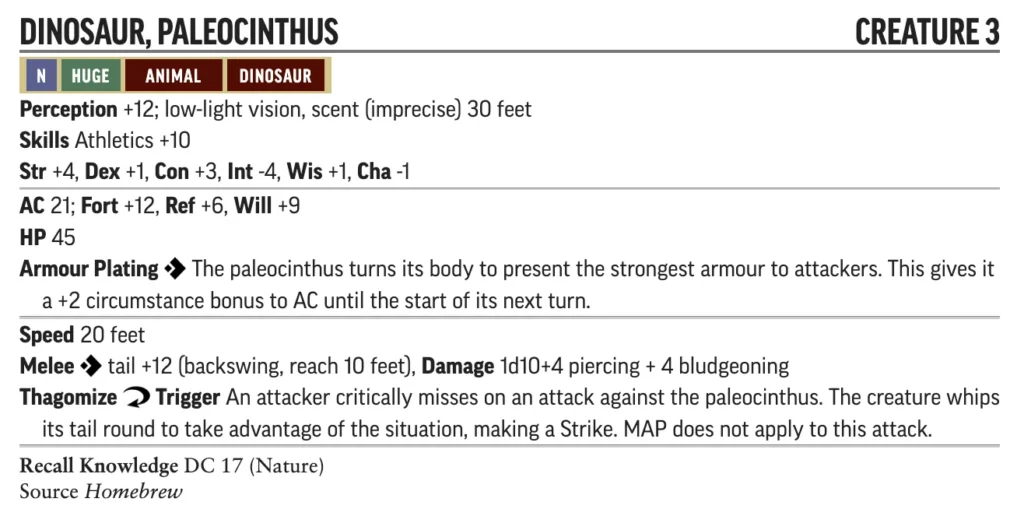
At only twenty feet long and five feet tall the paleocinthus [pale-ee-oh-SIN-thus] is not one of Pangaea’s largest herbivores. It is, however, a walking fortress—a huge low-built thyreophoran with heavy plated skin, sharp side spines, and a thorny tail that makes the beast look less like an animal than a siege engine. It belongs to the same broad armoured family as ankylosaurus, and is a similar story for a hungry predator: they have too much bone in all the wrong places, too many spikes to bite safely, and generally pose far too much risk to hunt.
While a paleocinthus is a plant-eater and usually minds its own affairs, if intruded upon it can turn aggressive in a hurry however. Anything foolish enough to get within thagomising distance of that tail may not live too long to regret it. The paleocinthus can whip its heavy spiked tail at quite the speed, lashing hard enough to drive off most attackers and punish anything trying to work around its flanks. This beast is built like a dreadnought, and should definitely be tackled from the front.
Stats: [ D&D 2e | PF 2e ] Monstrous Compendium 3: Forgotten Realms Appendix [2e]; Homebrew [PF2e]
Paralititan
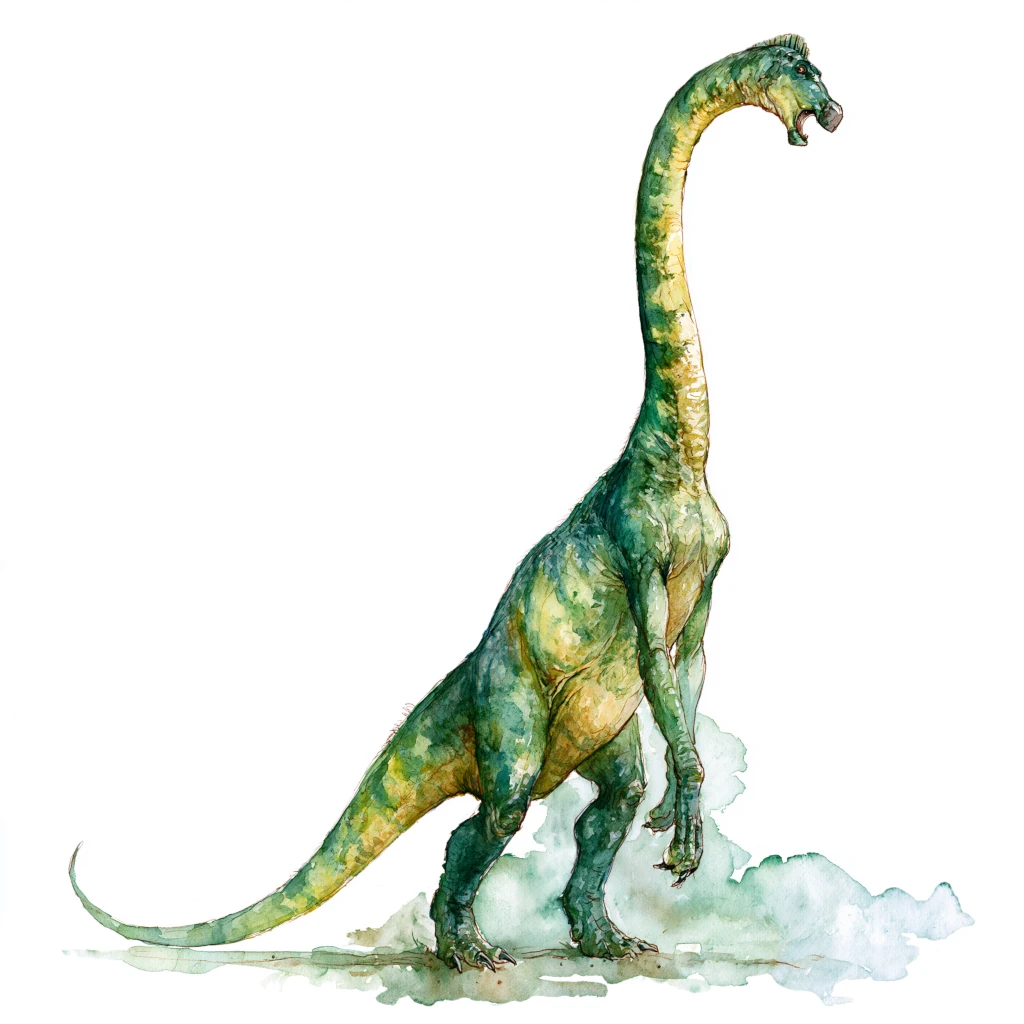
N | Gargantuan | Animal | Dinosaur | Sauropod; CR 10
A titanosaur with an attitude, prone to terrifying bellows, rearing up and stamping on opponents.
Stats: [ D&D 5e | PF 2e ] * Dr Dhrolin’s Dictionary of Dinosaurs p70
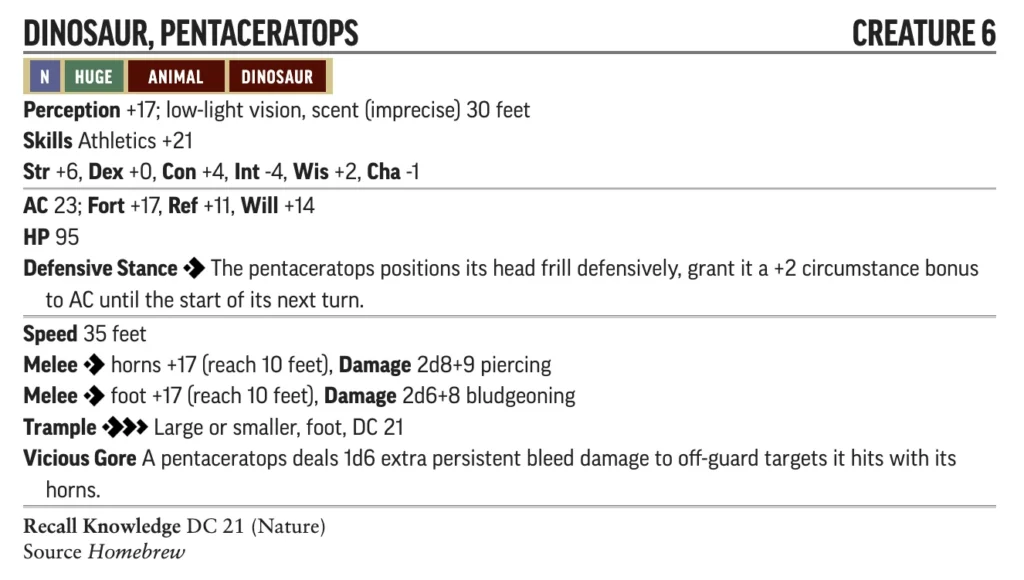
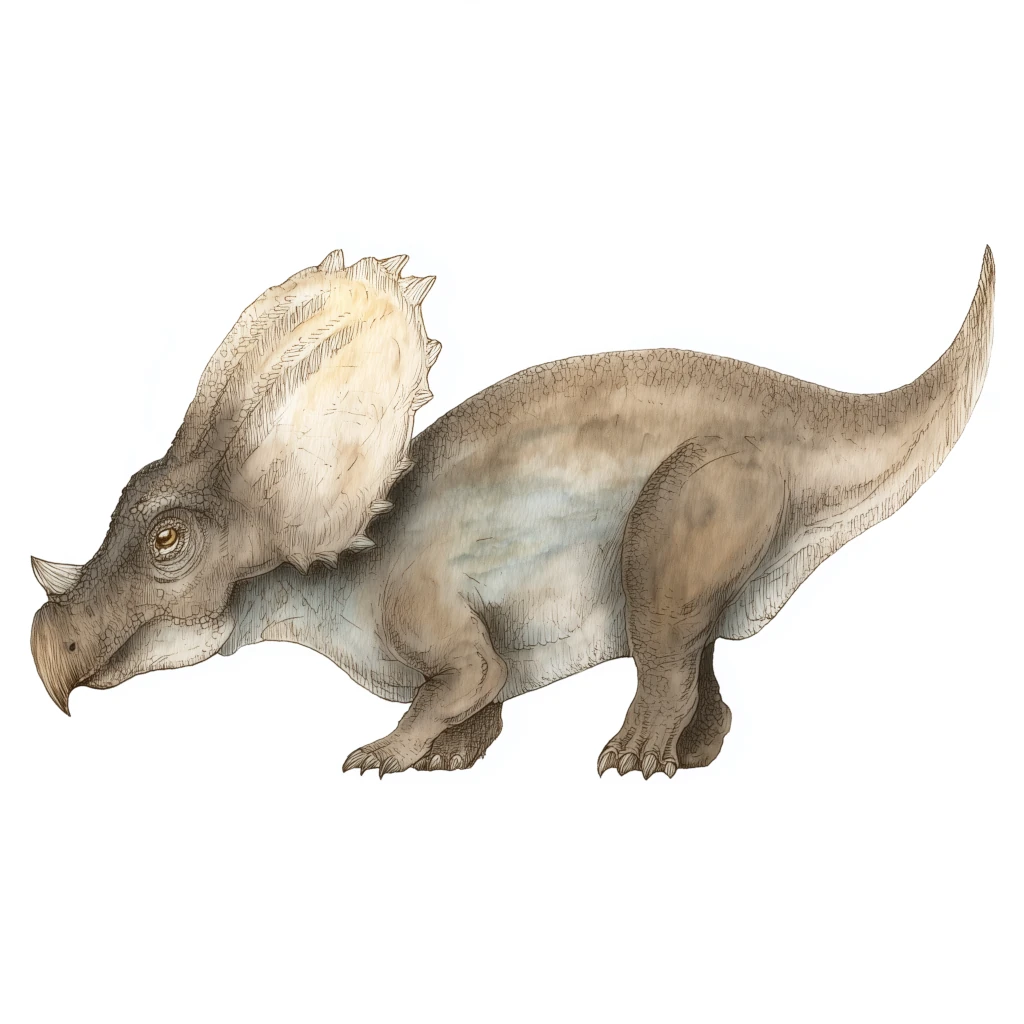
Pentaceratops
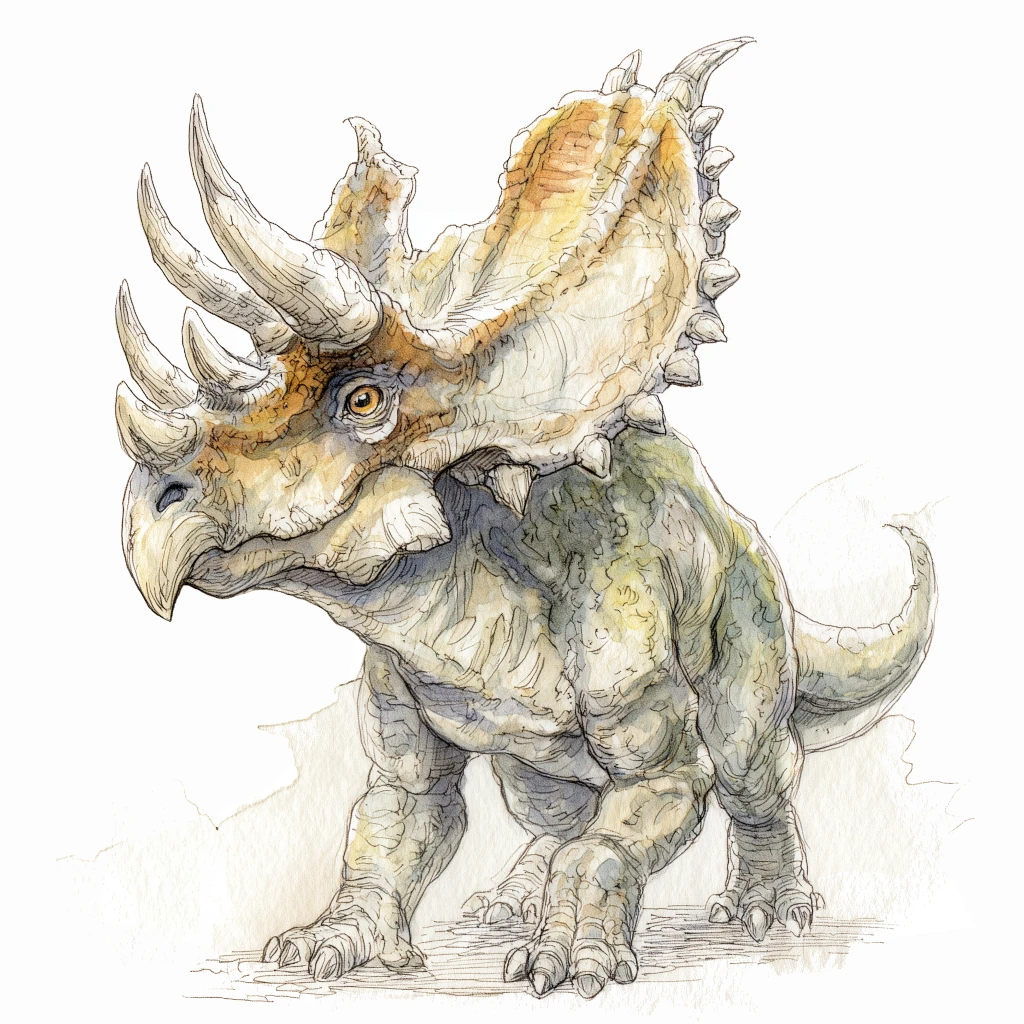
Five-horn-face; N | Huge | Animal | Dinosaur | Marginocephalian; CR 6
The pentaceratops [penta-SERRA-tops] is another of Pangaea’s great quadrupedal horned herbivores, a close relative of monoclonius, styracosaurus, and triceratops. It too has a vast shield-frill and a face built to make predators think twice before approaching. Its name means “five-horned face,” though that’s a bit of a cheat, since only three of those projections are true horns—the other two are sharply pronounced cheek bones that bulk out the head’s already formidable silhouette. Between the horns and that immense protective frill, which is sometimes so large it seems to spill back over much of the animal’s shoulders, the front of a pentaceratops can look less like flesh and bone than a tower shield with eyes. And five horns. Or three. Whatever, cutter.
Like most great ceratopsians, pentaceratops is an herbivore with an aggressive streak when pressed. The dangerous part is how much of its threat is concentrated in that over-engineered head. A body facing one has little use for knowing which parts are shield and which parts are softer, because if the beast lowers its skull and commits to a charge, smaller creatures are going to be bowled down and trampled under the full weight of the rush before they’ve had time to appreciate the distinction. Obviously, don’t stand in front of one, and don’t worry about which horns are real because they all point the same way and frankly, three is more than enough anyway.
Stats: [ D&D 2e | PF 2e ] Monstrous Compendium 3: Forgotten Realms Appendix [2e]; Homebrew [PF2e]
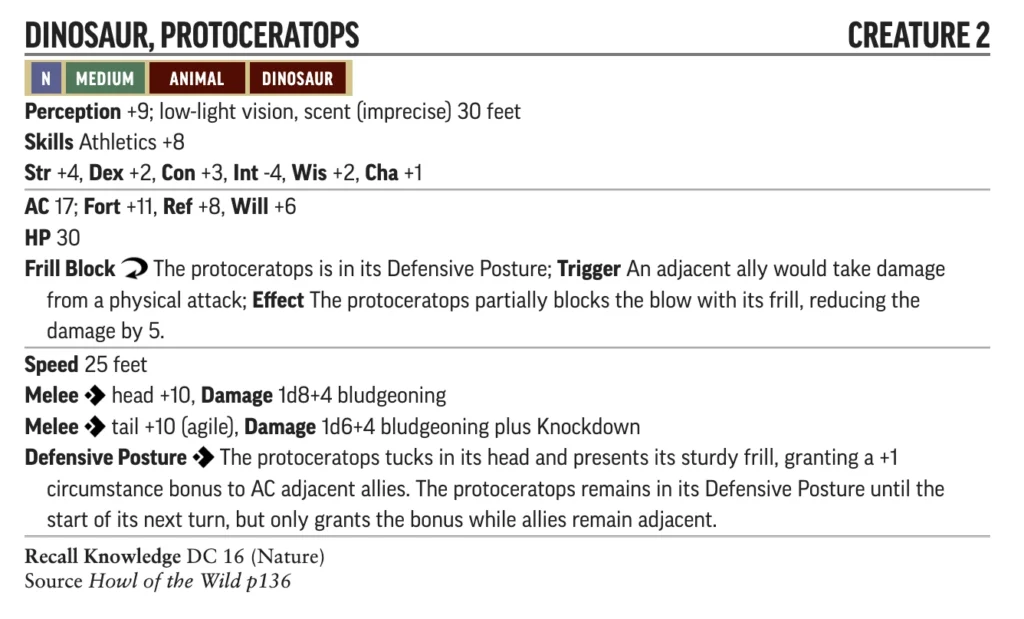
Protoceratops
First horned face; N | Medium | Animal | Dinosaur | Marginocephalian; CR 2
The protoceratops [pro-toe-SERRA-tops] is a small desert herbivore, about the size of a large dog or a sheep. It has a broad bony frill behind the head for defence, and none of the fancy facial horns its larger cousins have made famous. It lives in dry country, rooting for tubers beneath baked earth and cropping tough scrub and desert weeds with it strong beak and sturdy jaws. Meanwhile its thick skull, tough hide, and compact build help it endure both the climate and the steady attention of anything larger with an appetite. The protoceratops isn’t especially aggressive in temperament, but that’s because it has learned a more practical trick than standing and fighting: when threatened, it lowers its head, puts that frill to work like a shield, and charges to bowl a foe aside so it can escape. If escape fails, it repeats the performance as often as needed, and in a tight group it can hunker down into a defensive posture that makes the whole knot of animals harder to break apart, each little frilled head covering the next. Don’t laugh at the size, don’t box one in, and don’t forget that prey animals survive by making the first mistake belongs to someone else.
Stats: [ D&D 3e | PF 2e ] Sandstorm [3e] p147; Howl of the Wild [PF2e] p136; see also Wikipedia
Psittacosaurus
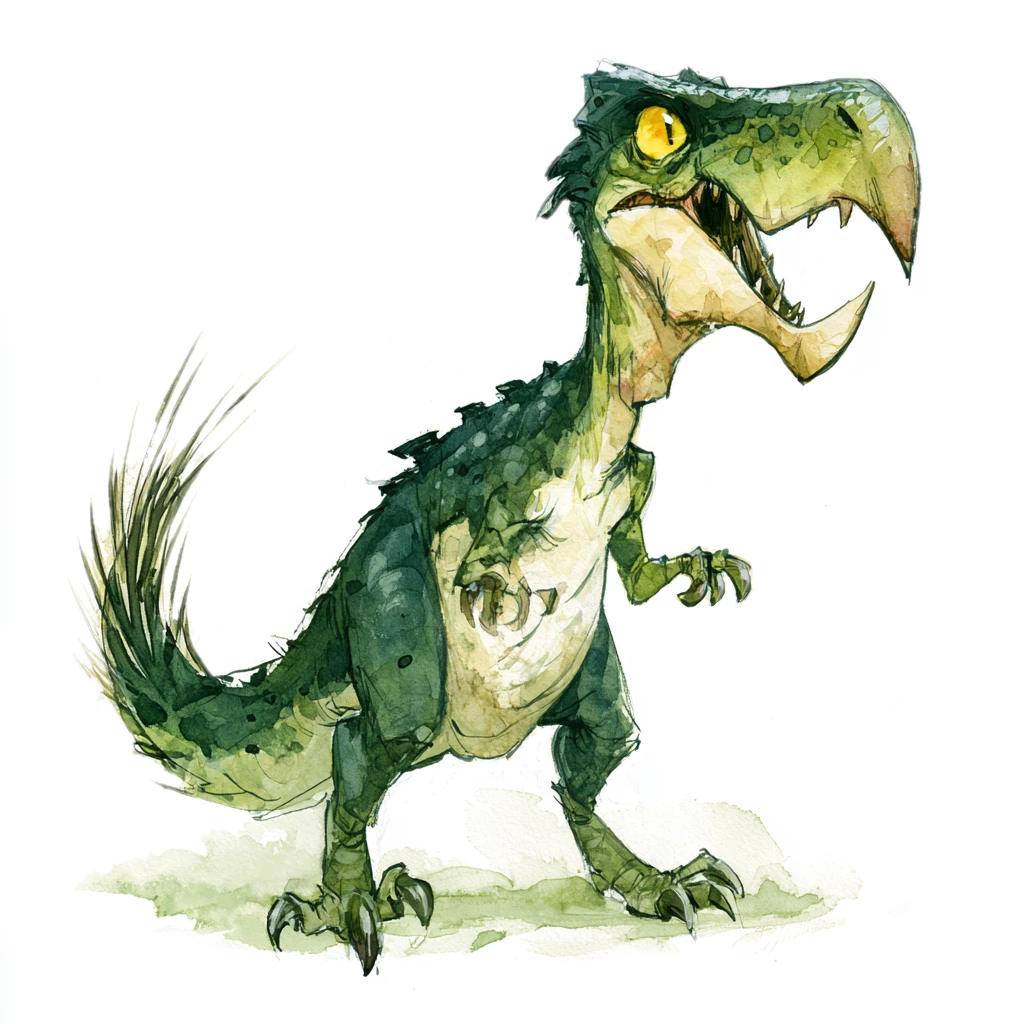
N | Small | Animal | Dinosaur | Marginocephalian | CR -1
A small bipedal herbivore with none of the plates or frills of its larger cousins, but a vicios set of porcupine-like quills to defend itself on its tail.
Stats: [ D&D 5e | PF 2e ] * Dr Dhrolin’s Dictionary of Dinosaurs p53
Scelidosaurus
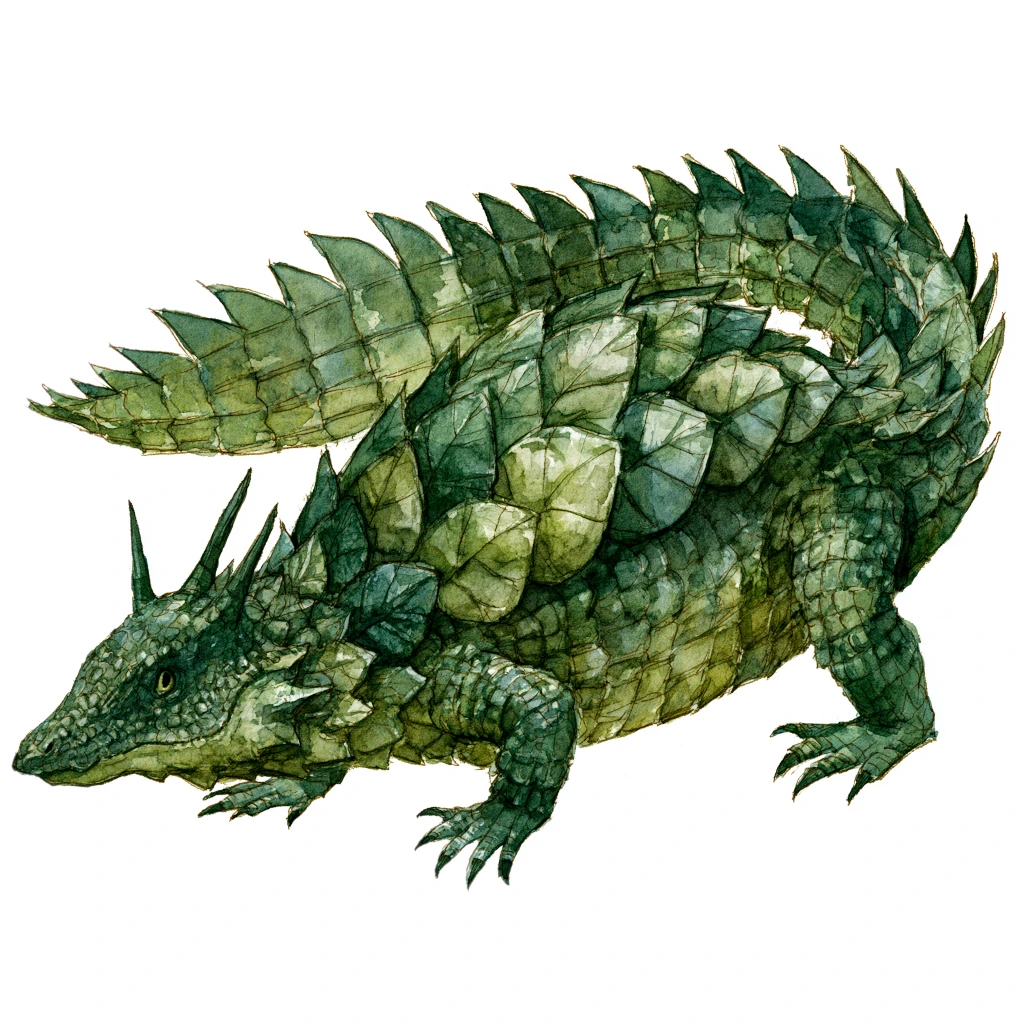
N | Medium | Animal | Dinosaur | Thyreophoran; CR 1
A small armoured dinosaur with sharp defensive blades on the sides of its back.
Stats: [ D&D 5e | PF 2e ] * Dr Dhrolin’s Dictionary of Dinosaurs p176
Stegosaurus
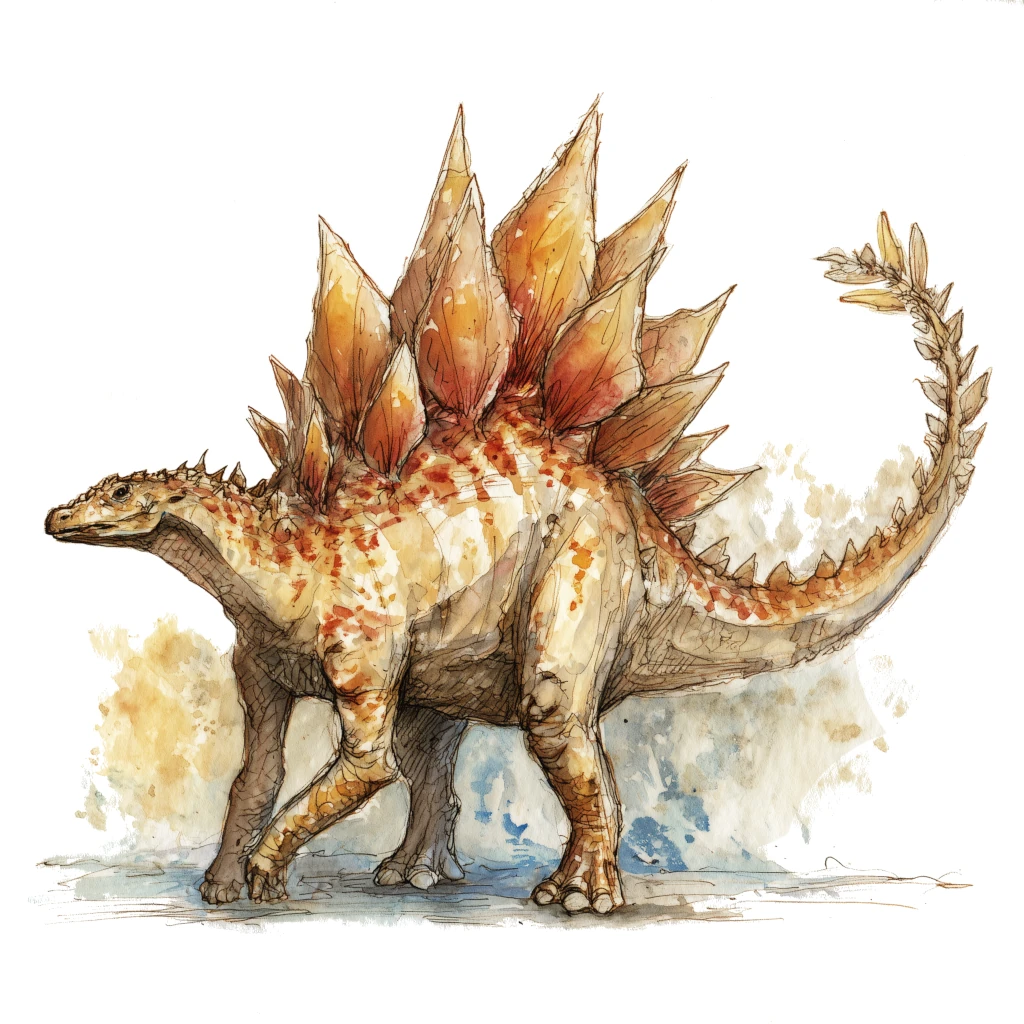
Roof lizard; N | Huge | Animal | Dinosaur | Thyreophoran; CR 7
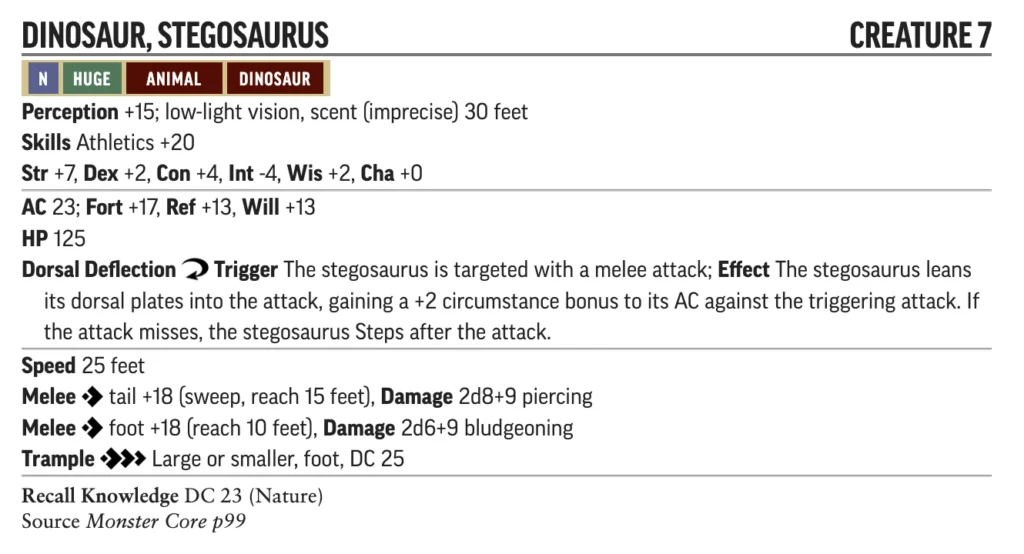
The stegosaurus [steggo-SORE-us] is one of the most unmistakable herbivores of the plane—a huge quadruped with a small head, a humped back lined by twin rows of great leaf- or diamond-shaped plates, and a muscular tail tipped with four long spikes that most sensible predators learn to respect very quickly. It thrives in a wide range of terrain, especially plains and jungles, and though it is often described as stupid, it has an admirably simple answer to danger: turn its rear toward the threat, tuck its vulnerable head low, and let its tail do the talking. This posture defines the stegosaurus almost much as the plates do, giving it the look of a living barricade.
For all that, a stegosaurus is usually even-tempered and gentle, which is why some folk prize them as trained beasts or heavy-armoured giant guard dogs despite the risks. The danger comes when a stegosaurus is startled, crowded, or annoyed, which you can spot when its plates bristle up to shield its back and flanks. Once angered, it can trample anything underfoot, and its sweeping tail lashes out with enough reach and force to gore a predator or send a careless berk flying. Never approach from the rear, never assume ‘calm’ means ‘tame’, and never forget that a stegosaurus will try to solve an argument by pointing its sharp end in your direction.
Stats: [ D&D 2e | 3e | 5e | PF 1e | 2e ] Monstrous Manual [2e] p54; Serpemnt Kingdoms [3e]; Volo’s Guide to Monsters [5e] p139-140; Bestiary [PF1e] p85; Monster Core [PF2e] p99
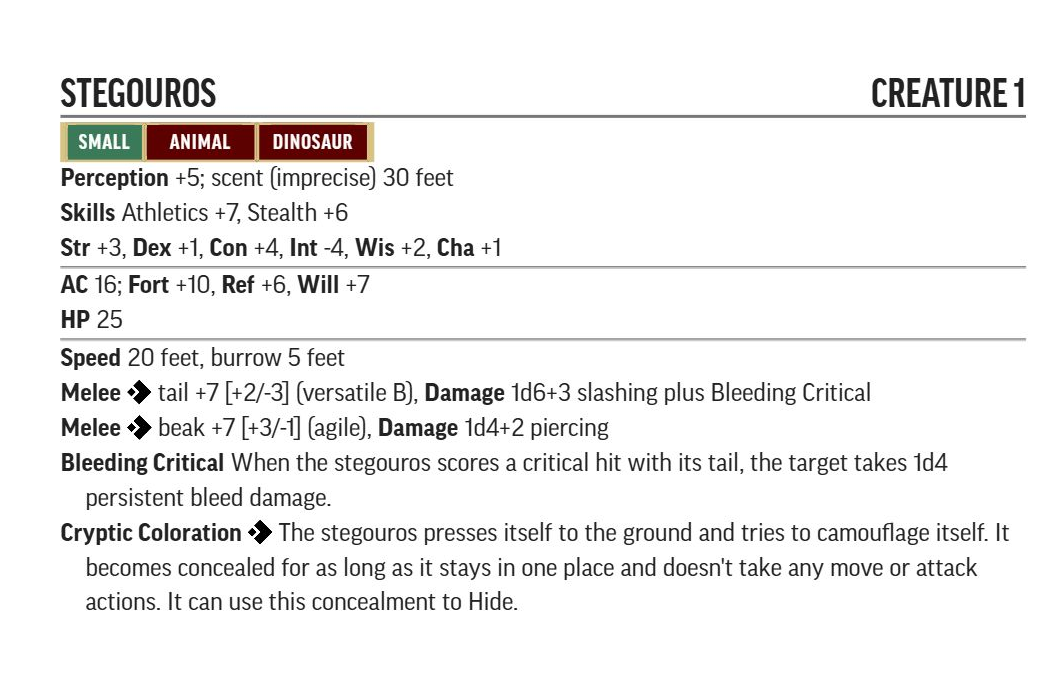
Stegouros
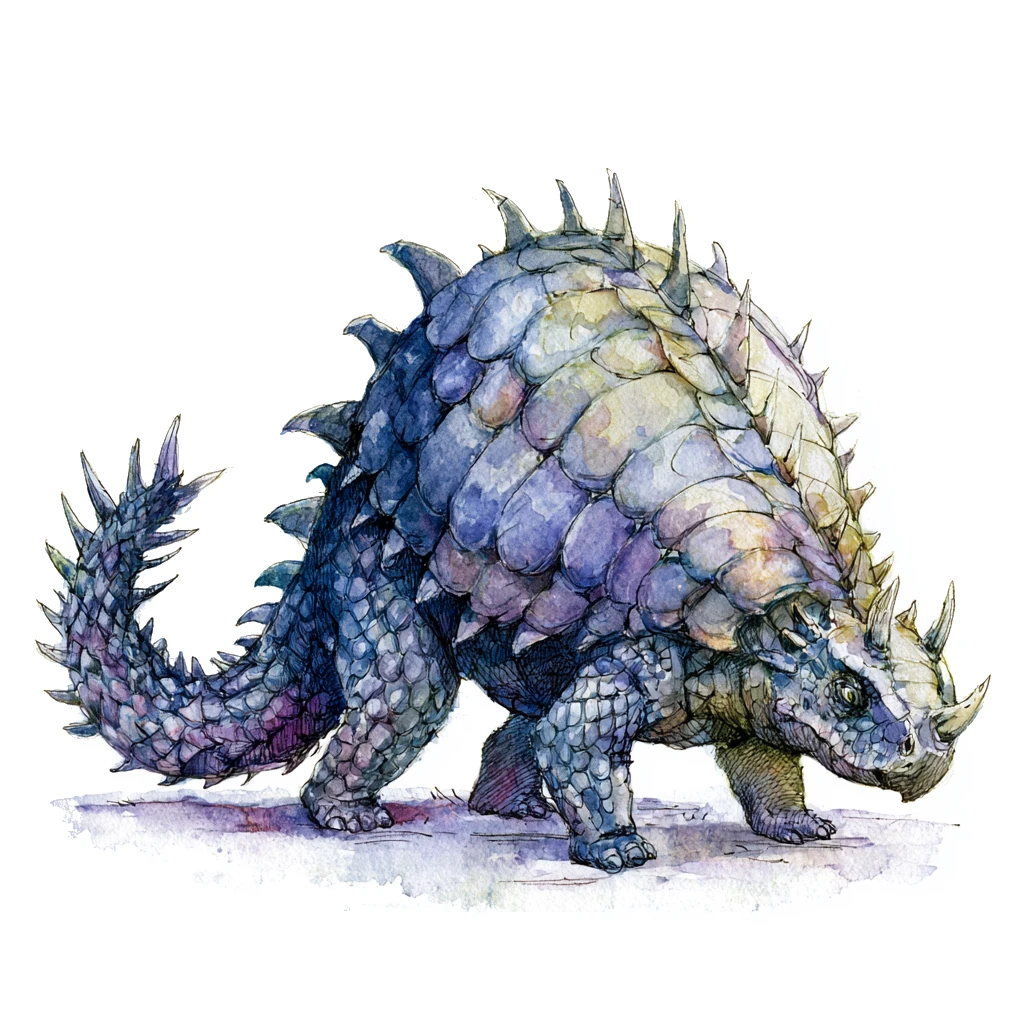
Roof Tail; Small | Animal | Dinosaur | Thyreophoran; CR 1
This primitive ankylosaurian can barely reach the size of a goat, and it occupies almost the same role in its ecosystem. Stegouros is a small and solitary herbivore, who subsists on soft plants and tubers that they dig out of the ground. Stegouroses rely on stealth above all, using their brown-and-grey coloured hide to hide amongst rocks and dirt in the forests. However, when push comes to shove, these dinosaurs can swing their tail, adorned with frightful triangular spikes, to inflict grievous wounds.
Stats: [ PF 2e ] Homebrew
Struthiosaurus
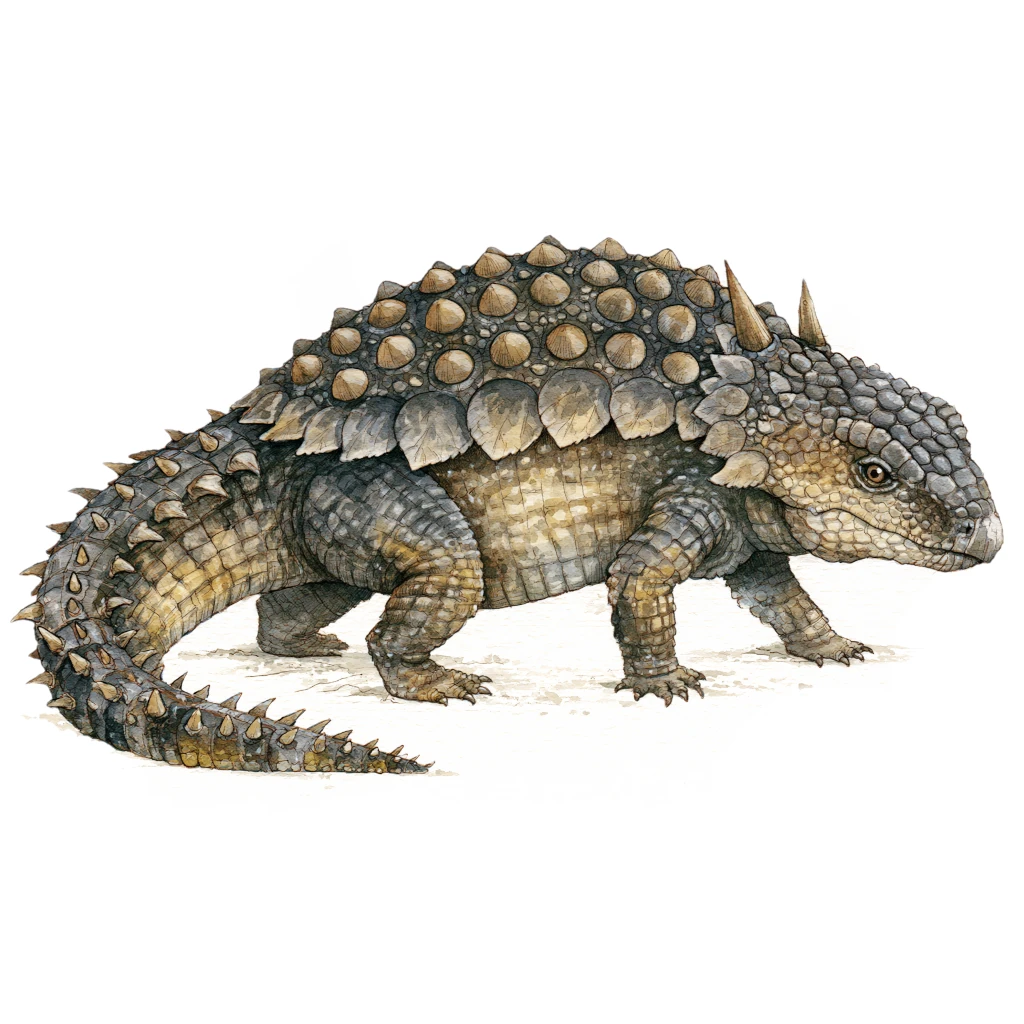
N | Small | Animal | Dinosaur | Thyreophoran; CR 0
A small, heavily protected cousin of ankylosaurus, with blades down its back.
Stats: [ D&D 5e | PF 2e ] * Dr Dhrolin’s Dictionary of Dinosaurs p92
Styracosaurus
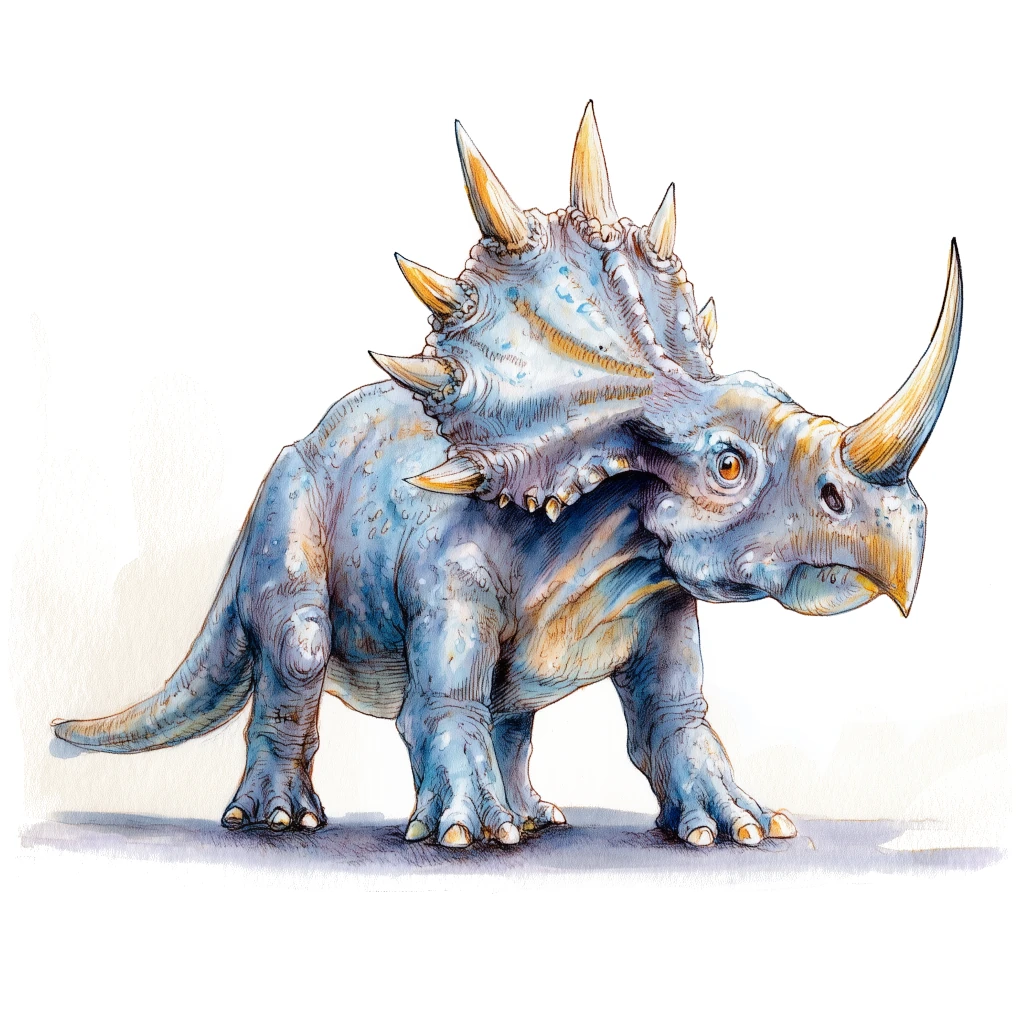
Spike lizard; N | Huge | Animal | Dinosaur | Marginocephalian; CR 5
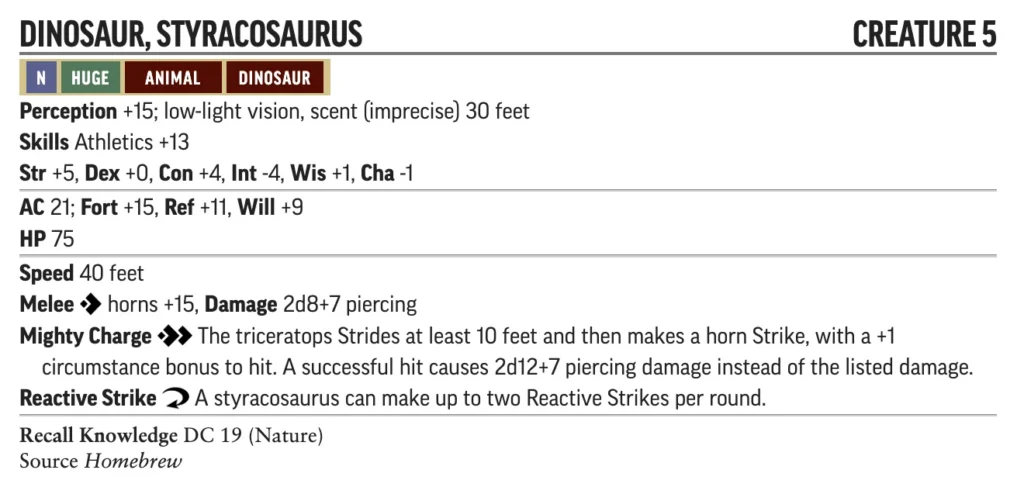
While the styracosaurus styracosaurus [sty-RACK-oh-sore-us] might be smaller than a triceratops, they are exactly as bad-tempered. Something about having half a dozen horns sticking out of your head must do that sort of thing, I suppose. The styracosaurus has one particularly deadly horn at the tip of its nose which it uses for stabbing, its well-armoured head-frill is useful to defend itself from attackers who approach it from behind. These beasts are notorious for swiping at anything that moves carelessly near them, and with so many spikes, this is unsurprisingly easy for them to do. It also makes riding one of these things impractical, even before you consider their temperament. Hunters should be warned that trying to flank a styracosaur rarely ends well, as this seems to drive them into a three ton frenzy of aggression.
Stats: [ D&D 2e | PF 1e | 2e ] Monstrous Compendium 3: Forgotten Realms Appendix [2e]; Bestiary 4 [PF1e] p59; Homebrew [PF2e]
Titanosaur
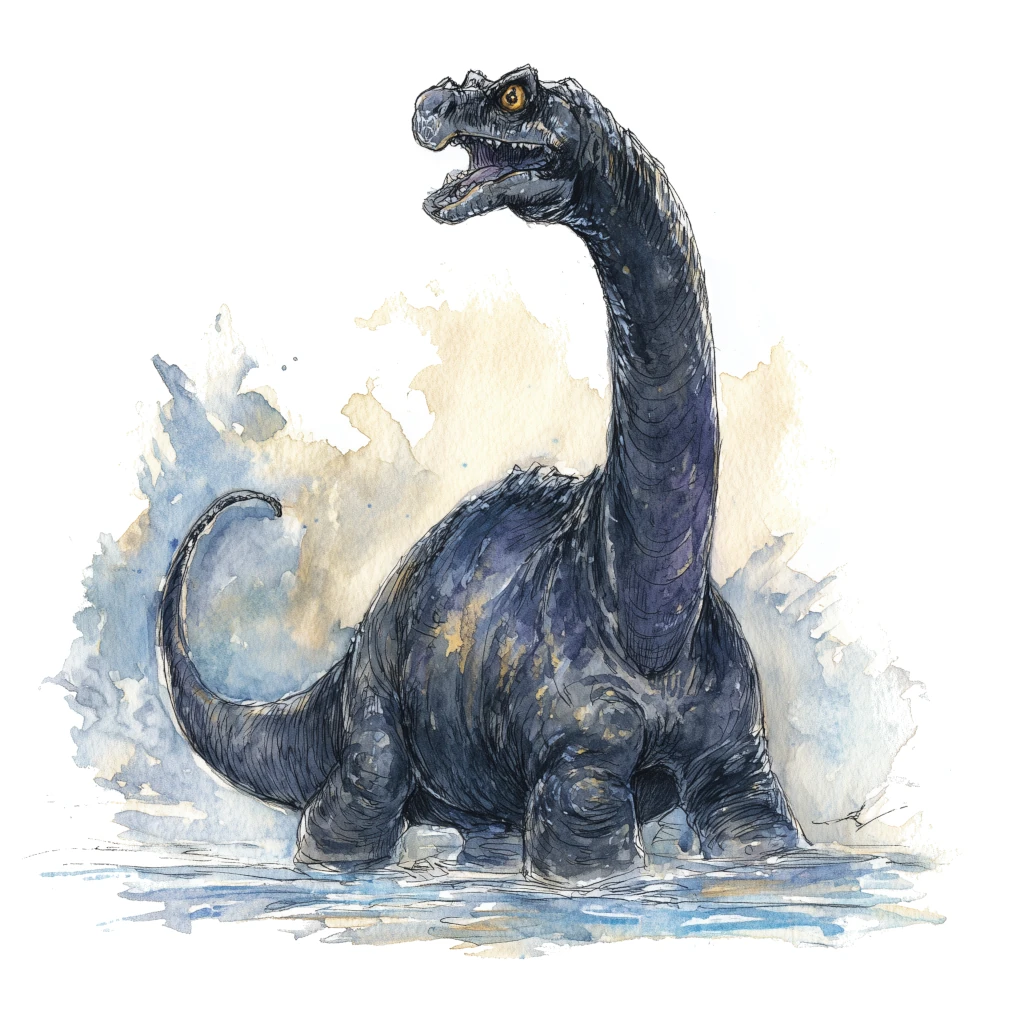
N | Gargantuan | Animal | Dinosaur | Sauropod; CR 16
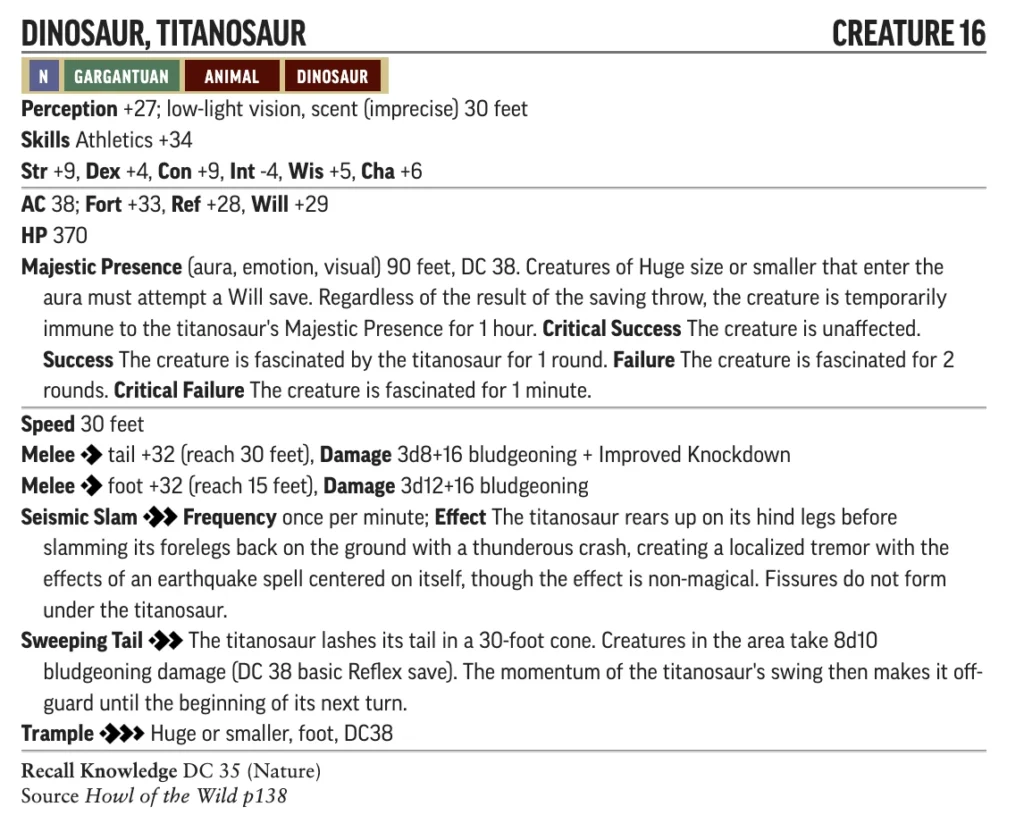
The titanosaur [tie-TAN-oh-sore] is less a beast than a moving mountain, probably the greatest sauropod on Pangaea and among the largest land animals ever to walk any world. Gargantuan herbivores that can stretch well past a hundred feet in length, they stand forty feet high, and weigh upward of eighty tons, while still carrying the colossal neck, pillar-like legs, and enormous sweeping tail common to their sauropod kin. Most days they are content to do what all giants do—consume impossible quantities of vegetation and ignore anything too small to matter. When a titanosaur feels threatened however, the force it can bring to bear is more like an avalanche than an animal.
An angry titanosaur can rear up and slam its forequarters down hard enough to shake the ground, sweep its tail through a arc that can catch a whole group at once. It wields such immense reach that the idea of a “safe distance” becomes largely theoretical. Titanosaurs are so gargantuan that their mere presence can awe smaller creatures into stunned silence before the real violence has even started. Even then, titanosaurs are not cruel, only colossal—ancient, majestic herbivore. If you find one on the move, step aside early, keep well clear of the feet and tail.
Stats: [ PF 2e ] Howl of the Wild [PF2e] p138
Trachodon
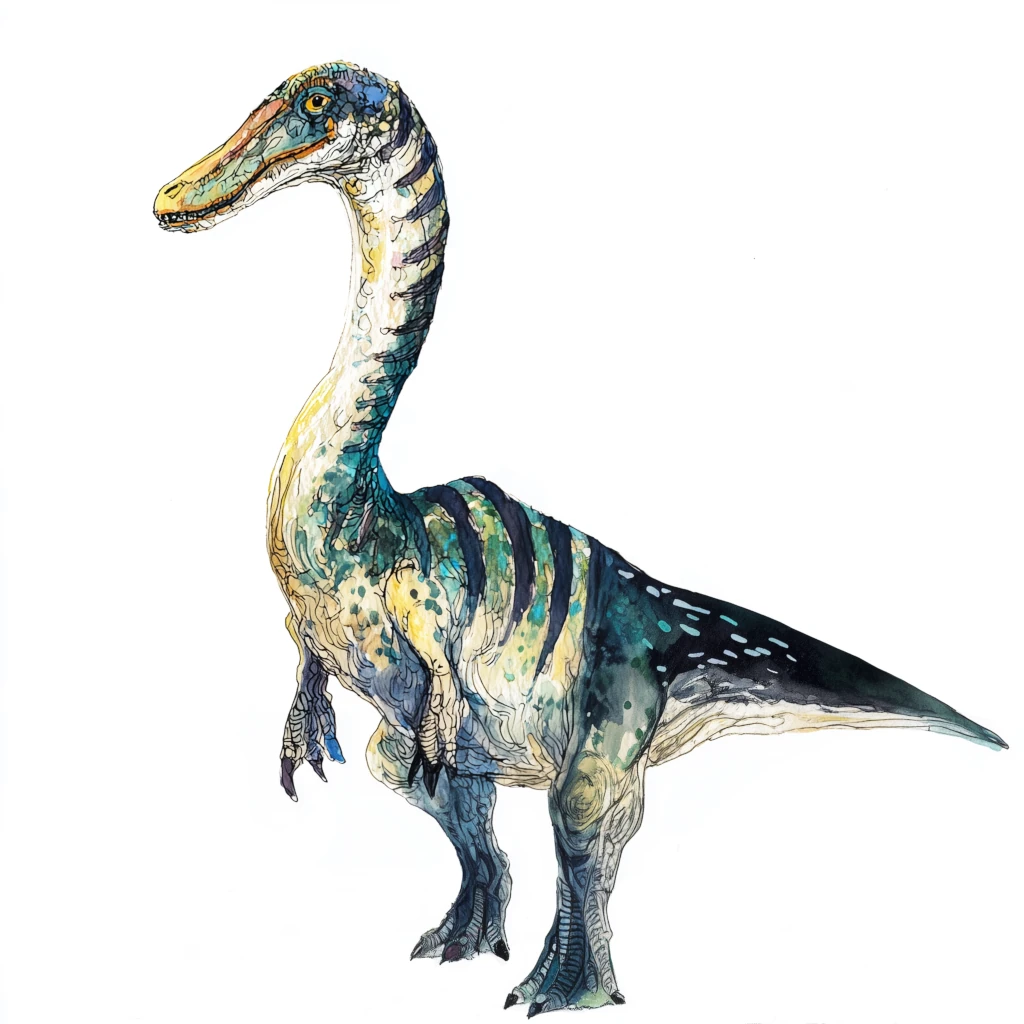
Anatosaurus, Duck Lizard, Rough Tooth; N | Huge | Animal | Dinosaur | Ornithopod; CR 2
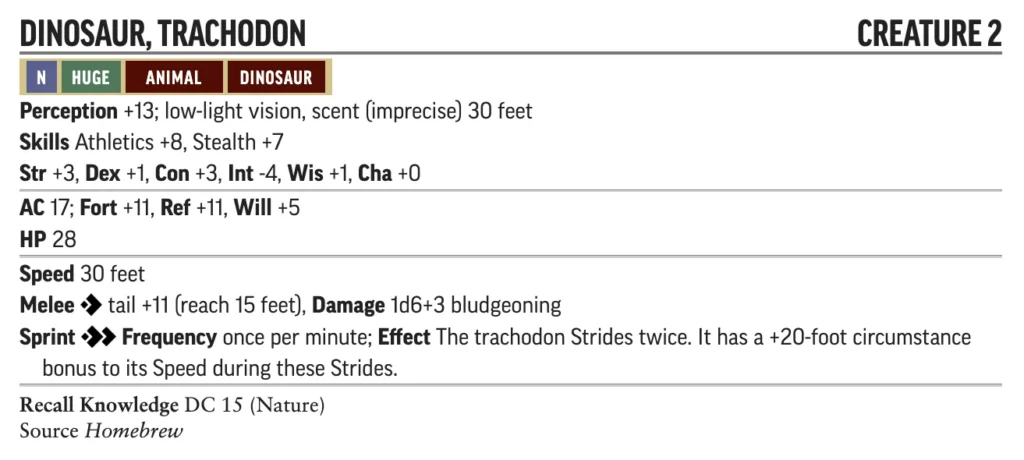
The trachodon [TRAK-oh-don] is a huge, peaceful hadrosaur plant-eater with the broad duck-bill, long pointed tail for balance, and a heavy four-ton body. It dwells in wetlands and the edges of forest. It is as comfortable wading through shallow water to crop water plants as it is browsing leaves, pine needles, and other vegetation on dry land, which means it one of those common herbivores a planewalker might meet in marsh, lakeshore, or wooded country with equal odds. That flexibility keeps it well-fed, but it also keeps it in the notice of every large predator around—especially the bigger carnosaurs that see a thirty-foot hadrosaur as dinner on legs.
For all its size, the trachodon is not a fighter by inclination and almost always chooses flight over fight. Its main defence is its lashing tail and the hope of getting itself out of the way before teeth can catch it. This tells you plenty about the sort of life it leads: constant movement, constant vigilance, and just enough toughness to increase its chances of surviving the chase, if its luck holds. The thing for planewalkers to note is that the beast itself probably means no harm, the carnosaur chasing it may be close behind, and certainly does mean it. When you see duck-bills bolting into water or the tree line, take the hint and start looking for what made them run. Preferably as you start running yourself.
Stats: [ D&D 2e | PF 2e ] Monstrous Compendium Annual Volume Two [2e] p39; Homebrew [PF2e]
Triceratops
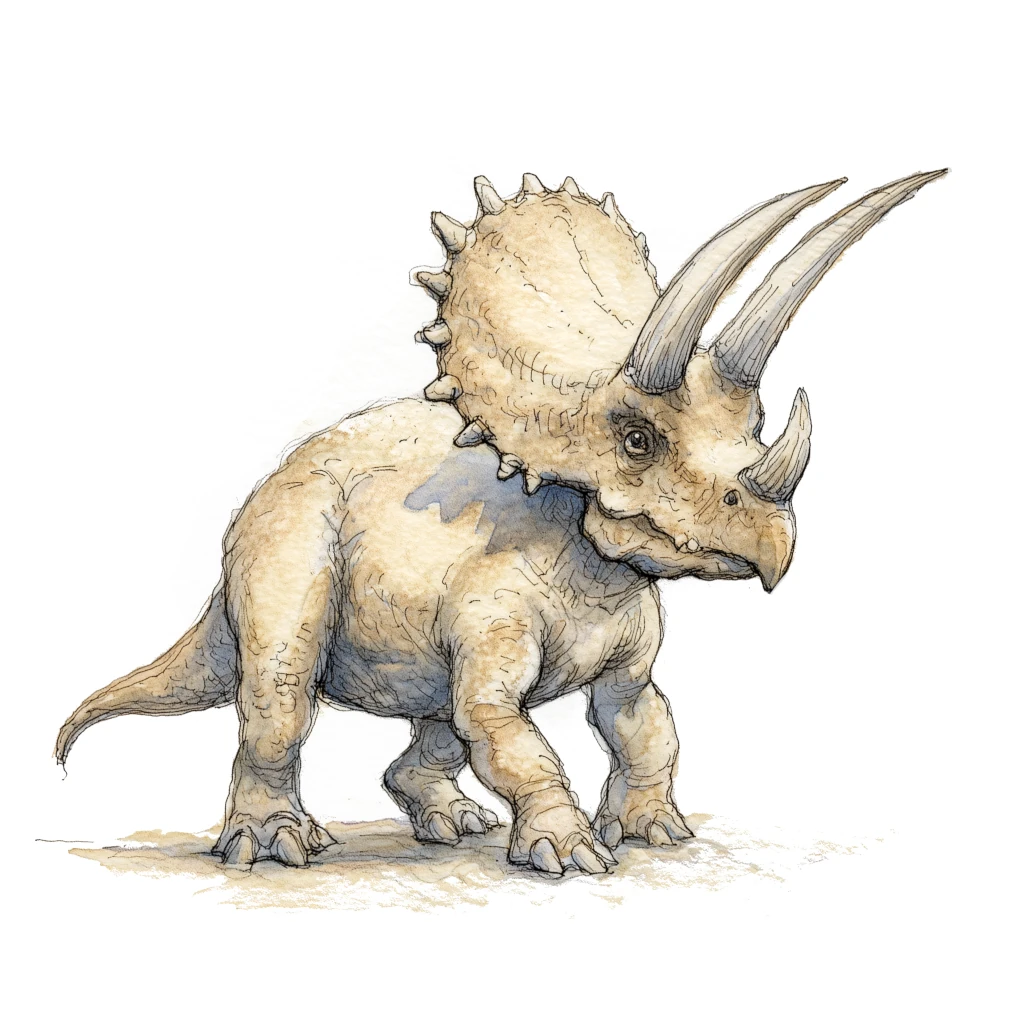
Three-horn face; N | Huge | Animal | Dinosaur | Marginocephalian; CR 5-9
One of the most iconic of the giant beasts of Pangaea, the triceratops [try-SERRA-tops] is well-armoured, short-tempered, and frankly rather dangerous. Its head looks enormous but that’s mostly because of the large defensive frill that protrudes from the top of its skull. This protects the herbivore from attackers, sure—but it has also been taken advantage of by hill giants who’ve managed to tame themselves triceratops to use as mounts. With three wickedly sharp horns on the front of their face, and built-in shielding, a triceratops makes an impressive war machine, capable of scattering army formations with an terrifying charge, and trampling all over them. For herbivores, these sods are aggressive, and given their natural predators are some of the largest and meanest therapods, they have every right to be. Intruders on their territory—triceratops tend to dwell on plains and open spaces where they can keep an eye on potential predators—will find a ten tonne beast barrelling towards them, point-first. Anyone barmy enough to domesticate one of these things has my unending respect.
Stats: [ D&D 2e | 3e | 5e | PF 1e | 2e ] Monstrous Manual [2e] p54; Monster Manual I [3e] p55-56; Monster Manual [5e] p79-80, 372; Bestiary [PF1e] p86; Monster Core [PF2e] p99
Zalmoxes
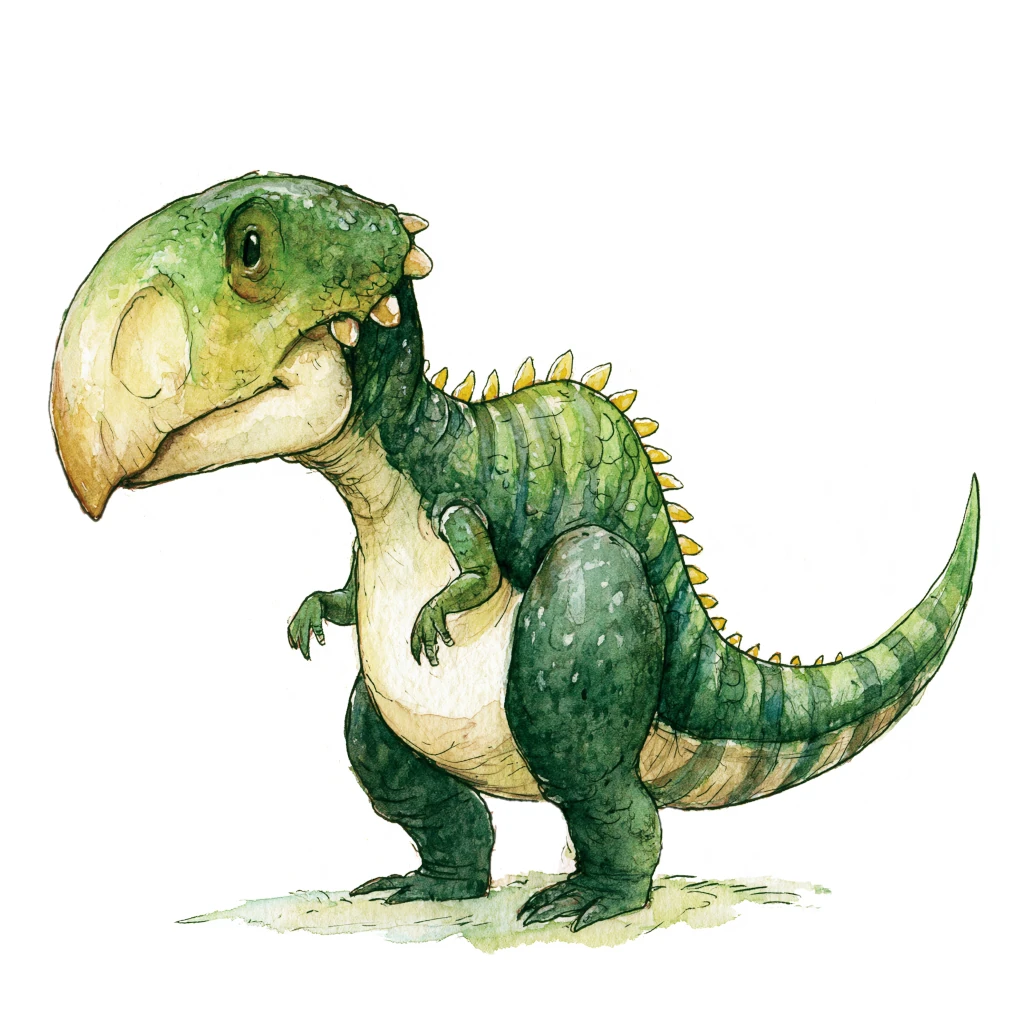
N | Small | Animal | Dinosaur | Ornithopod; CR -1
A small herbivore who form highly-vigilant herds, primed to run away at the slightest threat.
Stats: [ D&D 5e | PF 2e ] * Dr Dhrolin’s Dictionary of Dinosaurs p94
Zuul
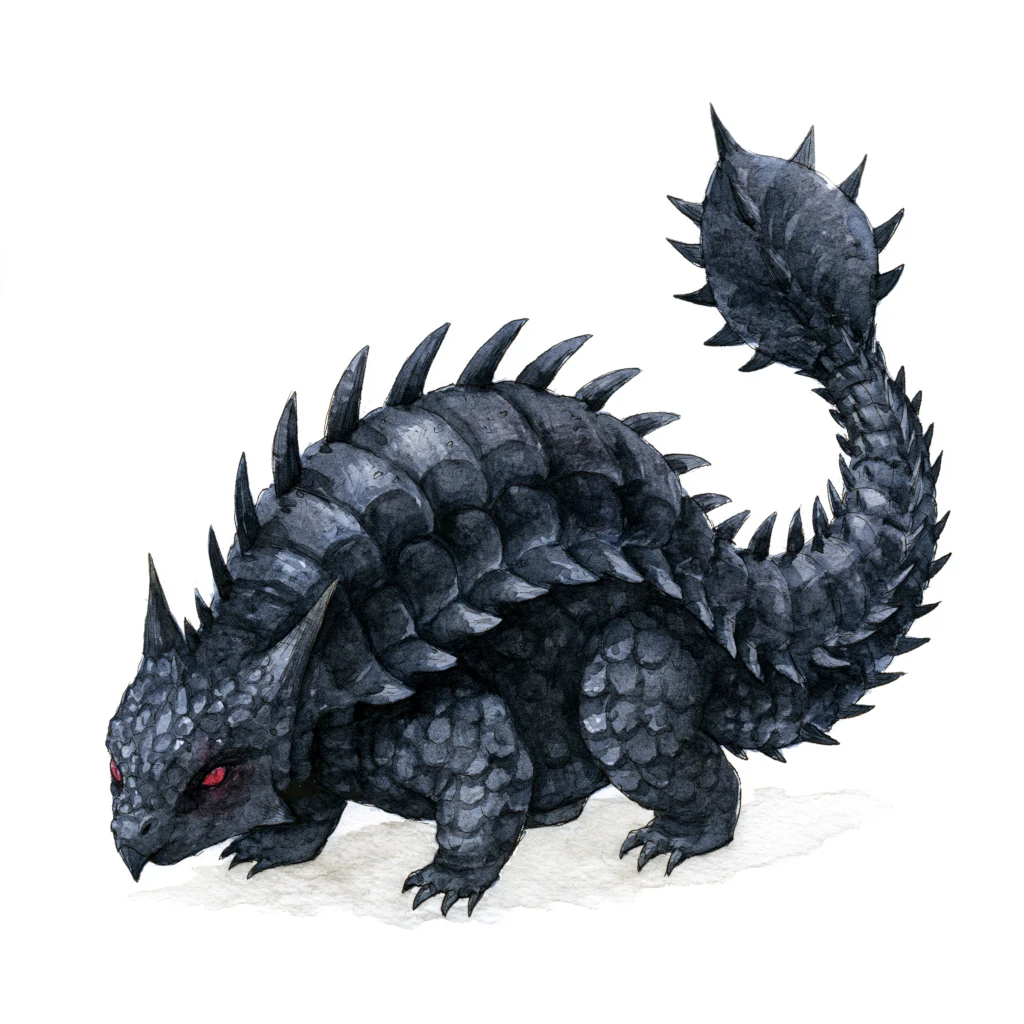
N | Large | Animal | Dinosaur | Thyreophoran; CR 5
A herbivorous ankylosaur with intimidating defences and a crushing club tail.
Stats: [ D&D 5e | PF 2e ] * Dr Dhrolin’s Dictionary of Dinosaurs p192
Sources: Jon Winter-Holt and Margarita. Canonwatch: As well as the RPG sources mentioned above, I’ve used Wikipedia a lot to look up what’s known about some of these beasties. AD&D 2e might have included a lot of dinos but they were mainly just different sized bags of hit points, so to make them more distinctive I’ve also invented a bunch of abilities and lore for the creatures. So don’t @ me if you think dinosaurs spitting gizzard stones as projectiles is far-fetched. I’m pretty sure cloud giants never rode dinosaurs either… * Copyrightwatch: The excellent Dr Dhrolin’s Dictionary of Dinosaurs is available in multiple RPG rulesets—creatures and stats are not available online unfortunately, and not reproduced here for copyright purposes. I only have the PF2e version, please let me know if the page numbers are different in the D&D version!