[ Persian Pantheon ] [ Baxt | Daevas | Yazad ]
The Persian Pantheon of Druj
In Persian mythology there are demons who cause plagues, droughts, storms and poisons. There are beings who battle against every form of religion. There are demons of soul-stealing, of fiend-summoning, and of Druj: the Lie. According to some myths, they are all the servants—or followers—or even fragments of a being of ultimate wickedness called Angra Mainyu. They fight Ahuru Mazda, his amesha spentas, and the powers of the Yazad. I would have written ‘together they fight’, but that would have been a lie, because there’s nothing together about the Daevas. They are a bunch of warring, spite-filled creatures who could probably take over the multiverse if they could only stop fighting amongst themselves. The ironic thing is they seem to be playing the role they have been designed for perfectly. Who then, is their barmy creator?
Angra Mainyu
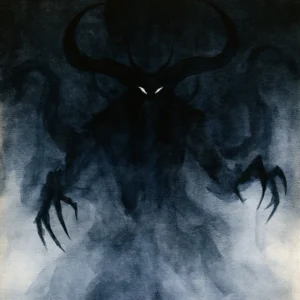
The Eternal Lie, Lord of Darkness and Ruin; NE Overpower of druj, supreme evil and lies [He/Him]
Realm: The Darkness Beyond Planes (?)
Discord, disease, and destruction. Nihilism, corruption, and oblivion. Crippling cold, blistering heat, and death. There’s nothing bad that can’t be traced back to Angra Mainyu it seems, if the chant is to be believed. But there are all these stories about him, and precious evidence that he even exists. See, like Ahura Mazda, the power of light, Angra Mainyu isn’t anywhere to be found on the planes, but his spawn are. He emanated a whole pantheon of daevas, set them squabbling, and then stepped back.
Whether or not you believe in Angra Mainyu though, you can’t deny the existence of the Daevas. The following is a list of the major players in the group. I hesitate to call it a pantheon because that suggests some measure of shared philsophy and perhaps even cooperation. The daevas show none of that—they hate each other almost as much as they hate their eternal adversaries, the Yazad.
More chant on Angra Mainyu here…
The Daevas
| NAME | PORTFOLIO | ALIGNMENT, POWER LEVEL, PRONOUNS |
| Aeshma | Wrath, rage, violence, blood-lust, war-madness | CE, Intermediate (He/Him) |
| Ahriman | Oblivion, nihilism, divs | NE, Greater (He/Him) |
| Aka Manah | Sensual desire | CE, Intermediate (He/Him) |
| Apaosha | Drought, aridity, withering of crops and herds | CE, Demipower, now a vestige (He/Him) |
| Asmodeus | The Ruler of Hell | LE, Lord of the Nine; Avatar? Power? (He/Him) |
| Asto Vidatu | The moment of death, soul-chasing | LE, Lesser (He/Him) |
| Azhi Dahaka | World-devouring dragon, oppression, doom, barmy, imprisoned | CE, Intermediate (He/Him) |
| Chinnaphapast | Pulls sinful souls from the Chinvat Bridge and into Duzakh | LE, Demipower (It/Its) |
| Druaga | Baatezu summoning and binding | LE, Intermediate (She/Him) |
| Gandarewa | Corruption, predation, insatiable hunger | CE, Abyssal Lord (He/Him) |
| Indar | Apostasy | NE, Intermediate (He/Him) |
| Nanghaithya | Discontentment, ingratitude | LE, Intermediate (She/Her) |
| Zarich | Aging, poison | NE, Demipower (She/Her) |
Aeshma
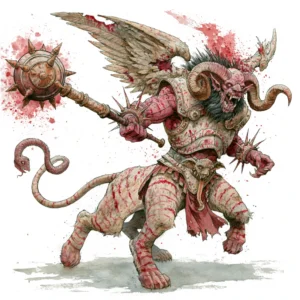
Of the Bloody Mace, the Lord of Rage and Ruin; CE Intermediate power (daeva) of wrath, rage, blood-lust [He/Him]
Realm: Abyss / Layer 304 / The Battlefield / Field of Maces ‡
Aeshma [AY-esh-ma], whose very name means wrath, is one of the oldest and most dangerous daevas in the pantheon. His usual epithet is Aeshma of the Bloody Mace, and that really says everything a cutter needs to know about him:—a power of subtle deception he is not. Aeshma is more like a mace to the face when it comes to diplomacy, a force of raw, blood-soaked violence that exists to turn mortals against one another, and untimately, to break the world through slaughter and discord. But fiends shouldn’t feel left out, because Aeshma aims to sow discord among demons themselves as well.
His body is marked with brutal engravings scarring his face and body. His two wings are ripped and jagged bone-spikes erupt from his wrists. He is quite the first sight for petitioners who’ve just arrived at the Chinvat Bridge, and that’s by design. You see, Aeshma waits below the razor-edge crossing, clamouring to claim the souls of the wicked as they fall off. And if he can scare some righteous souls into slipping and falling too then that’s an even sweeter victory. He tests the resolve of would-be petitioners as they cross the bridge. Any berks who know deep down that they are not worthy of an afterlife in paradise are susceptible to his attacks, as are those who are are fearful of falling because of guilty secrets they harbour.
His realm, the Field of Maces, is on a layer of the Abyss strewn with broken weapons, bone-dust, and the echoes of every senseless war ever fought on the Prime. Chant goes that when the unburied bodies of those killed on pointless battlefields rot away, it’s here that they appear. It’s also said that there’s a gate hidden away somewhere here that leas to Nessus. Now you might think that a backdoor between Baator and the Abyss would be rife for abuse by Blood War generals, but it’s a dark that has so far eluded them. Quite why Aeshma might need to visit Asmodeus secretly, well that’s a tale best left to your dark imagination.
Get the chant on the differences between Aeshmar, Ahriman, Angra Mainyu and Asmodeus here…
Ahriman
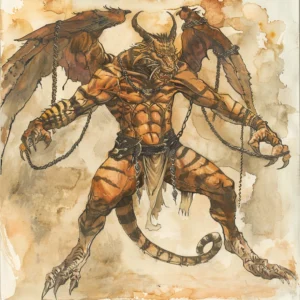
Lord of All Divs. NE Greater power (daeva) of oblivion, destruction, divs, nihilism [He/Him]
Realm: Gehenna / Krangath / Duzakh
Ahriman [ah-REE-man] embodies the nihilistic aspect of Angra Mainyu, and with the twisted children he calls the divs, he is slowly spreading despair and oblivion across the Multiverse. His preferred form is that of a bestial fiend, a terrifying amalgamation of predator and darkness. His hands are clawed like those of a tiger, capable of rending giants, while his feet bear the talons of a vulture. His scarred black flesh writhes with oily snakes, which inject deadly venom into those near him. His tiger’s face is crowned with horns etched with ancient curses. Chant goes that his maw, which is filled with soul-rending fangs, is a gate to a realm of absolute oblivion.
More chant on Ahriman here…
Aka Manah
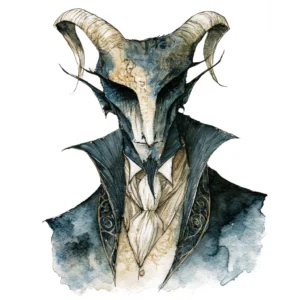
The Evil Mind, the Seducer of Thought, the Lord of Sensual Corruption; CE Intermediate power (daeva) of sensual desire, corrupt thoughts, evil minds [He/Him] ‡
Realm: Abyss / Layer 550 / Forest of the Living Tongues
Aka Manah [AH-kah MAH-nah], whose name literally means ‘bad purpose’, is the eternal opponent of Vohu Manah, the yazata of wisdom, purity and right thought. Aka Manah embodies the corruption of those qualities through lust, spiritual distraction, and grotesque appetite. While he cavorts in the Abyss, Aka Manah is no mere tanar’ri lord. He is the power of unhealthy fixation, vanity and obsession—with food, drugs, or bodies. When some upstanding basher falters and falls into addiction or temptation, when good judgement becomes impossible through a fog of craving, or when a berk’s own mind starts to work against their own ambitions, that’s the influence of Aka Manah at work. He dances a subtle ballet, slipping inside a sod’s soul, replacing mental clarity with a yearning desire, purpose with distraction, and devotion with insatiable appetite. He’s a beautiful cutter, don’t get me wrong, elegant and well-dressed, yet also subtly wrong in a way it’s hard to pin down. His eyes are like still dark water that reflect what the viewer craves most. Never violent, Aka Manah is still terrifying in his own way, for he knows exactly how to get what he wants through mental manipulation alone. It’s said that he can appear in any forms he wants, any gender or ancestry, and will stop at nothing to achieve his dark goals. What are these goals? Well, for starters there’s his realm, the deep Abyssal layer called the Forest of Living Tongues. This plant life of this gruesome forest is particularly disturbing, because rather than having leaves, the branches of trees here are festooned with the tongues of countless mortals. Chant goes that these organs belonged to berks who were caught cheating on their partners after being temped by Aka Manah or his minions.
Apaosha
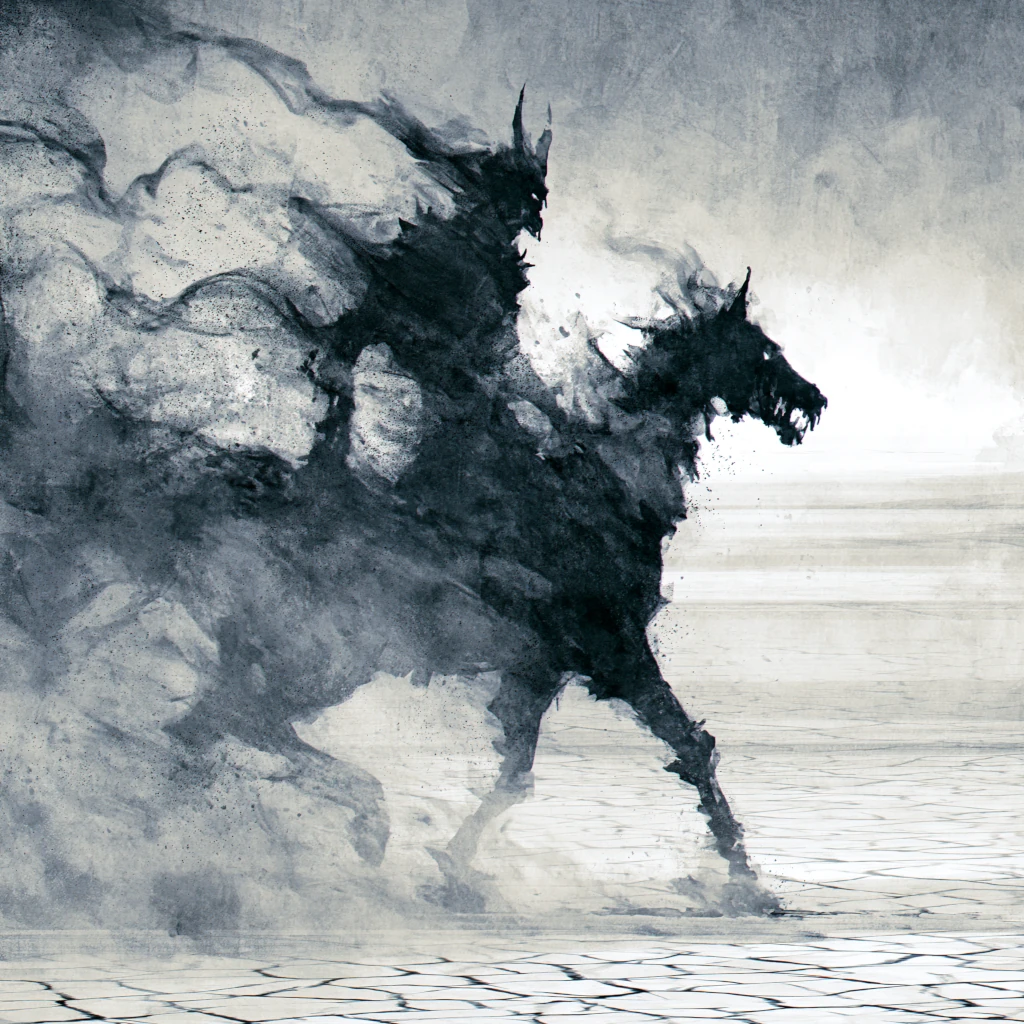
Apaoša, Apaush, Aposh, Black Horse of Withering. CE Demipower (daeva) of drought and blight [He/Him; dead. now a vestige] ‡
Realm: Abyss / Layer 403 / Rainless Waste / Salt the Earth
Apaosha [ah-pah-OH-shah] was the demonic daeva of drought, and the eternal adversary of Tishtrya. He was the embodiment of the destructive malice of drought and crop failure, and an enemy of all life that depends on the wet season. A visitation from Apaosha was enough to prevent any rains from falling, to parch fields and pasture, and to ruin crops and kill off herds through dryness and sterility. Chant goes he rode a deformed black horse which trailed thick clouds of dust behind it, and he finished off countless civilisations like some kind of Fifth Horseman. After wreaking havoc for years, he was finally challenged by Tishtrya, the god of the rains—but the demon defeated him and drove the yazata away. It was only when Tishtrya beseeched Ahura Mazda for a rare intervention that the overpower granted the yazata an unprecedented boon—and he was finally able to defeat Apaosha. The daeva was driven back and banished to the depths of the Abyss and still exists there as a vestige, slowly regaining his strength. Whether he will re-emerge as a demipower once more before te end of time and Frashokereti, that remains to be seen.
Salt the Earth, the prison-grave-realm of Apaosha, is on the 403rd layer of the Abyss—a dust-choked wasteland of cracked riverbeds, salt flats, and scoring gritty wind where no plant could possibly live. The few creatures that dwell here are salt quasi-elementals drawn from the Inner Plane and trapped, and the petitioner shades of slain kudimmu. Apaosha exists there as an incorporeal dust storm, the angriest tornado you ever saw. He’s still exceptionally dangerous, and gains strengths with each berk he kills. Unfortunately for him though, there’s no reason for any berk to visit his layer, so he faces a long wait to claw back enough strength to burst free.
Asmodeus
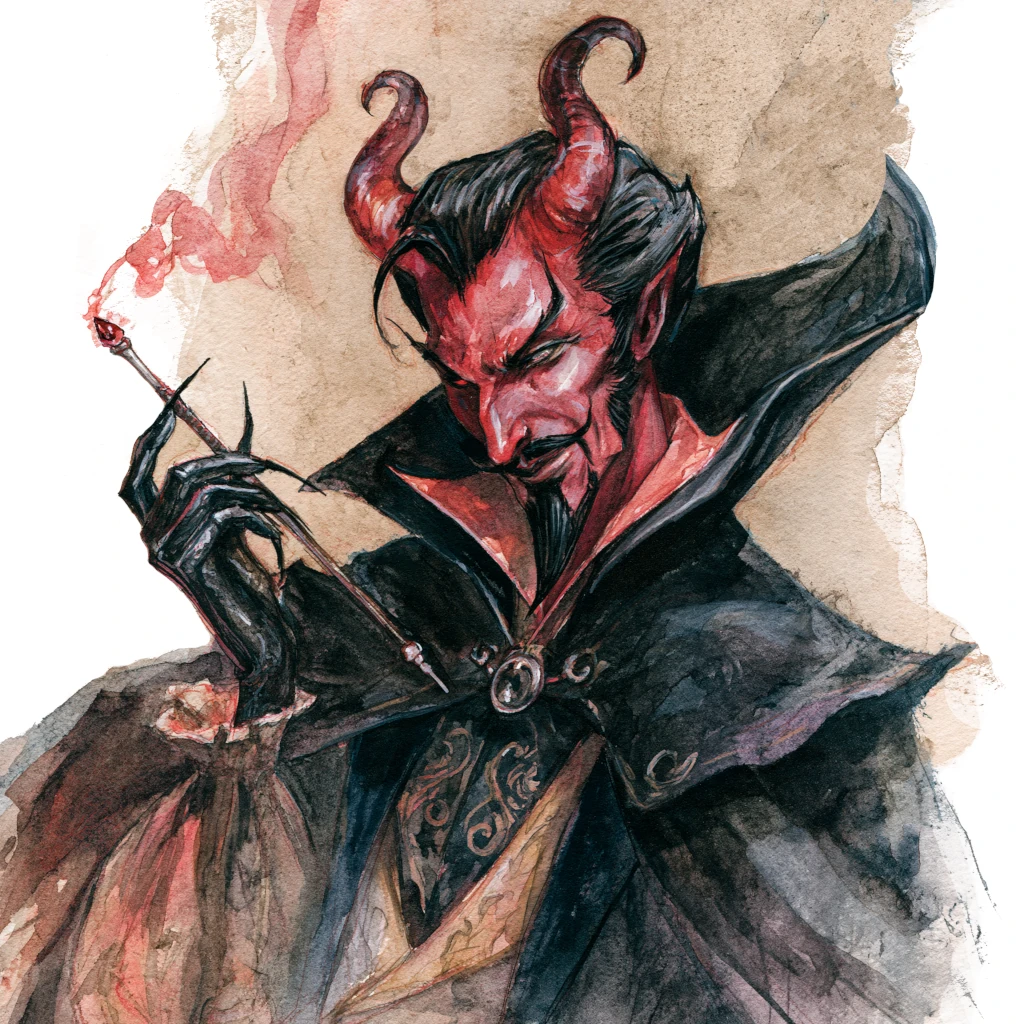
The Dark Lord, the Prince of Hell; LE Lord of the Nine [He/Him]
Realm: Baator / Nessus / Citadel Malsheem
Asmodeus is the Lord of the Ninth, the dark ruler of Nessus and master of Malsheem. He’s outwardly the greatest of the archdevils, and inwardly possibly something older, deeper, and more blasphemous. Persian graybeards reckon he might be the infernal mask worn by Angra Mainyu, shaped from the same current of malice that produced Aeshma and the druj, but refined by intricate calculation, carefully crafted laws, and industrial levels of deceit. Where his rival Ahriman stands for cosmic negation and ruin, Asmodeus is that ruin made patient, elegant, and administrative. He is a power that has learned to conquer by binding contracts, strictly enforced hierarchies, and systems that persuade—or trick—their victims into forging their own chains. Physically, he is best imagined in two overlapping forms: a tall and beautiful red-skinned devil in immaculate black and crimson robes, jewels, gloved hands, and a voice like warm velvet. However beneath that polished body there is an older, more terrible truth—a vast serpentine presence coiled in the dark below Nessus. It is ancient, wounded, and too immense to behold at once. Perhaps that is Asmodeus too, or even Angra Mainyu—in which case the so-called ‘ruler of the multiverse’ is in bad shape.
Asmodeus’ philosophy is that order is better than chaos since it can be weaponised, and wielded to bend the entire multiverse to one’s liking. Asmodeus believes in structure, but only as a means of extracting obedience, guilt, debt, and self-betrayal. He is what happens when the druj learns patience, a being who makes tyranny seem rational, and damnation feel like the natural consequence of one’s own choices. He does not usually rage, because rage is for lesser fiends. When angred, instead he smiles, subtle amends his terms, and lets the victim participate in their own undoing. And that is why he is far more dangerous than any beast or berserker god could ever be.
Get the chant on the differences between Aeshmar, Ahriman, Angra Mainyu and Asmodeus here…
Sources: Book of Vile Darkness [3e] p57-58,143,149,155,157-158,163,165-168; Dragon Magazines #348 p32; #357 p68; #359 p28-29; Fiendish Codex II [3e] p4-5,8,12,26,33,35,38,45-46,55-56,59-62,65,73-75,81,126,146,149,151,153-157; Faces of Evil [2e] p32; Manual of the Planes [3e] p115-116,119,122-123
Asto Vidatu
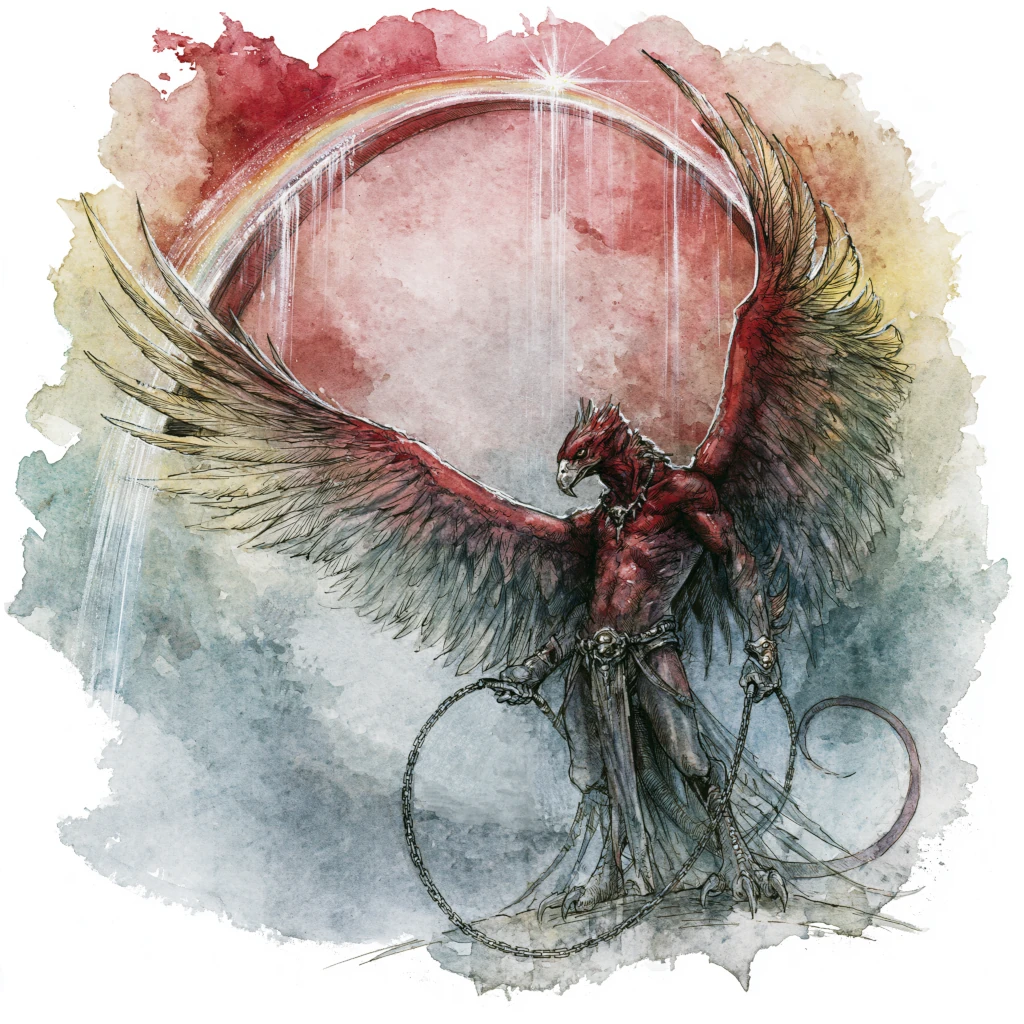
The Bone-Dissolver, the Dark Psychopomp, the Noose at the Threshold; NE Lesser power (daeva) of mortal inevitability, death [He/Him] ‡
Realm: Chinvat Bridge / the Pit of Bones
Asto Vidatu [AS-toh vih-DAH-too] is the daeva of death, feared by all those who must cross the Chinvat Bridge as the power with the chain noose from which no mortal escapes. It is Asto Vidatu who is responsible for the soul and the body separating at the point of death. As a follower of the Persian pantheons dies, Asto Vidatu is already ready and waiting. Some call him the Dark Psychopomp, but his role is not to ferry the spirits of the dead safely to their afterlives, but to use his chains like a lasso to ensnare the soul and literally drag it out of the dying berk’s body. Once freed, the soul makes its way through the Astral Plane to the Underlands—protected by psychopomps—and eventually the Chinvat Bridge, which it must pass over in order to reach its final destination. However, a berk who tries to resist Asto Vidatu is in for a whole multiverse of trouble. Malevolent though he is, Asto Vidatu does not target anyone whose allotted time is not up. This means that if a cutter fights back, Asto Vidatu is permitted to turn to more persuasive methods to separate soul from mortal remains. He’s been known to drag a dying berk all the way down to the his macabre lair beneath the Chinvat Bridge. It’s best not to think too long about what happens to them there. Suffice to say, Asto Vidatu is also called the ‘bone-dissolver’.
Azhi Dahaka
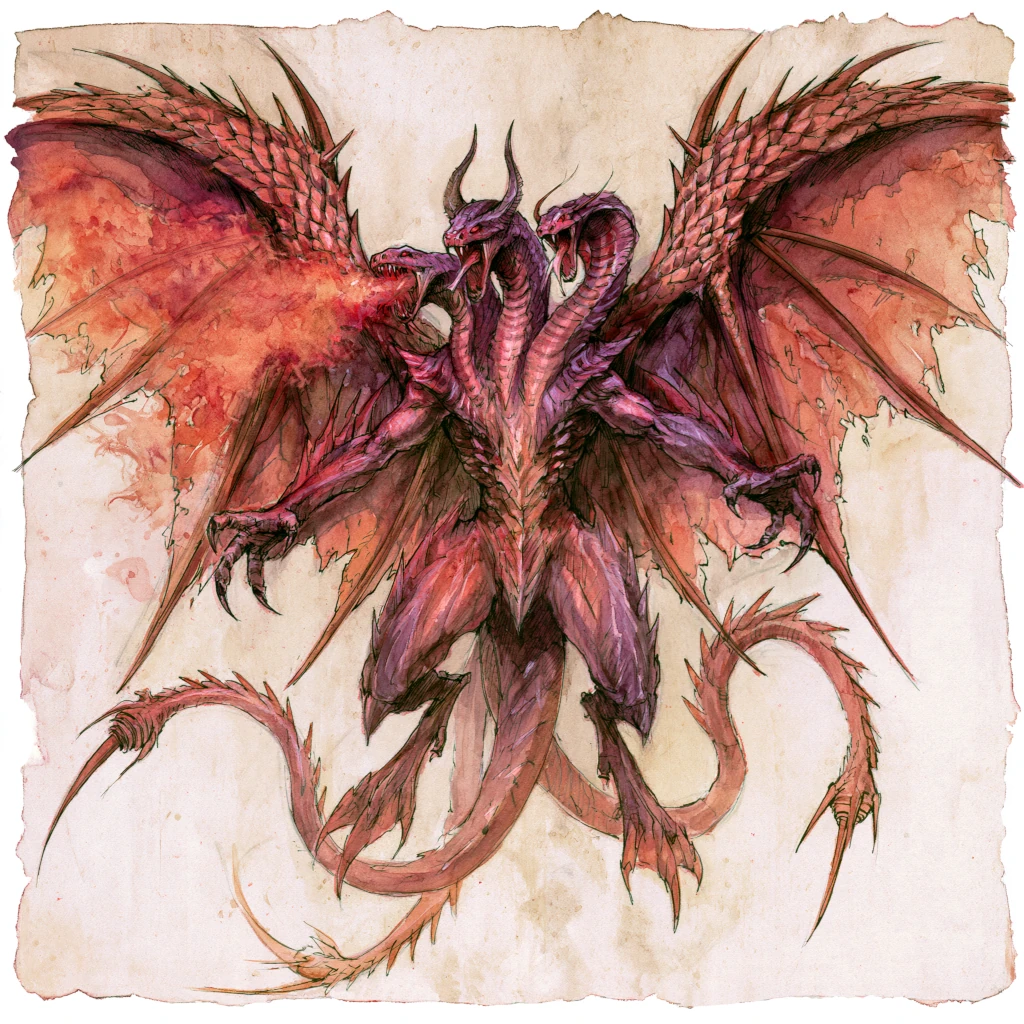
Aži Dahāka, Dahāg, Zahhak; the World-Devouring Dragon, Tyrant of Doom; CE Intermediate power (daeva) of world-devouring, doom [He/Him] ‡
Realm: Carceri / Colothys / the Shackled Peak / the Serpent-Pit of Damavand
Azhi Dahaka [AH-zhee dah-HAH-kah] is one of the great monsters of Persian mythology, a dragon-demon of world-devouring evil. He is a three-headed, six-eyed, snake-like horror associated, and either a servant or offspring of Ahriman, created to devastate the creations of Ahura Mazda. He embodies more than brute monstrosity though—Azhi Dahaka is also a power of oppression, a tyrannical ruler whose reign became too cruel, and the devouring of mortal’s ability to flourish too great, that the Yazad decided to do something about him. They caused a hero to be born, a mortal named Thraetaona, who was prophesied to defeat Azhi Dahaka. The daeva started dreaming of this hero the day that he was born, and spent an entire mortal lifetime trying, and failing, to track down his would-be killer. Inevitably, Thraertaona did outmanoeuvre the demon, but was advised by a solar aasimon to bind the fiend rather than slay him. Thraetaona imprisoned Azhi Dahaka beneath Mount Damavand in Colothys, where he will remain until Frashokereti at the end of time, when he will break free and devour one third of all mortals before being finally defeated. After thousands of years on imprisonment, Azhi Dahaka is even more barmy than when he was first chained up in his Serpent Pit.
Chinnaphapast
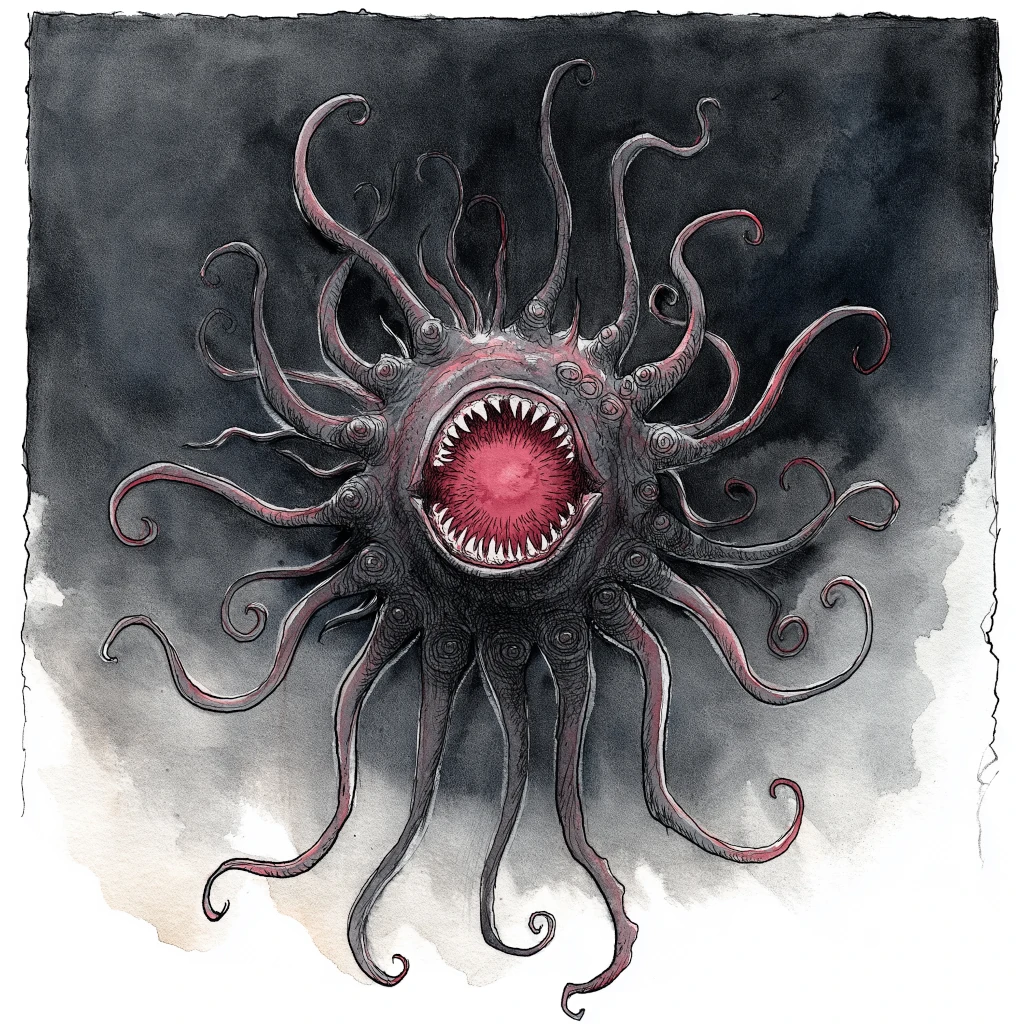
Vizaresh, Vizar; Seizer of the Sinful; LE Demipower (daeva) of punishment for the wicked [He/Him] ‡
Realm: Chinvat Bridge / Druj-Demāna, the House of Lies
Chinnaphapast [chin-NAH-fa-past] is one of the liminal powers that wait below the narrowest point of the Chinvat Bridge, the precarious arch that all petitioners of powers from the Persian pantheons must cross. Unlike Aeshma, who target whoever the hells he wants, Chinnaphapast does not choose its victims. While a righteous soul sees a broad and beautiful shining bridge and is guided by Daena towards paradise, wicked souls see the bridge narrow to a razor’s edge. Below this point, the thrashing tentacles of Chinnaphapast emerge from the darkness below. Unlucky (and frankly most) of these berks are grabbed, lose their footing, and are dragged down by force into Druj-Demāna, the House of Lies.
Contrary to its name, the House of Lies is not a building at all, but a dark branch of the Chinvat Bridge. It’s a dark, stinking, narrow passageway that leads straight down, like a well. Petitioners are forced by Chinnaphapast to climb down this terrifying passage, packed together in terrible closeness. Sometimes they make it, and sometimes they don’t; it’s really not Chinnaphapast’s problem. If the poor sods are not careful they will fall, often pulling others down with them in their desperation and selfishness. If they do not climb quickly enough, Chinnaphapast pulls them off the walls and drops them anyway. After many days of limb-shredding climbing (or maybe an hour of falling), the unlucky sods emerge into Duzakh, the awful realm of Ahriman. The Lord of the Div likes to greet each of his new petitioners personally—powers only know how he finds the time—with a welcome of scorn and mockery.
Druug
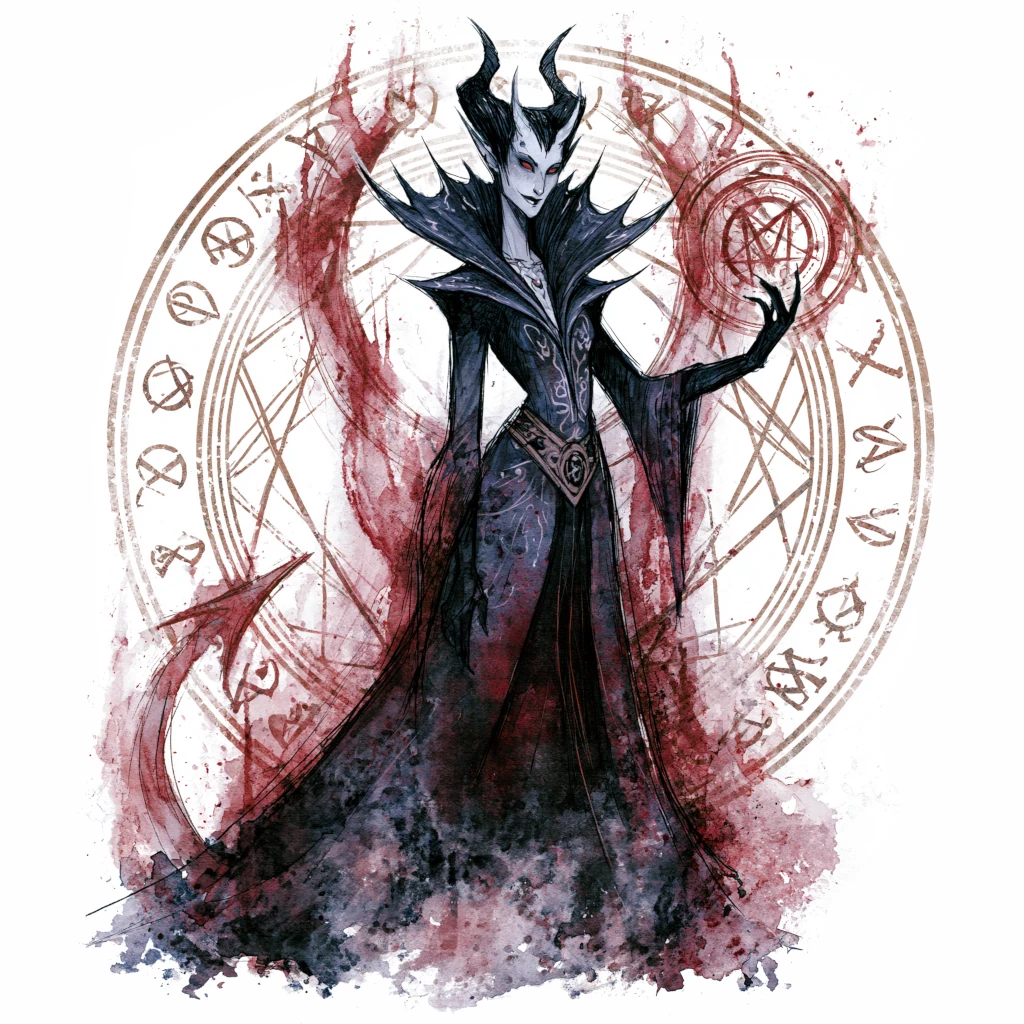
Drauga, Druaga, the Lie Incarnate, Hand of Asmodeus, Mother of Baatezu; LE Intermediate power of summoning, binding and loopholes [She/He]
Realm: Baator / Maladomini / Zisurrû and/or Baator / Dis / Retreat of the Fallen
Druug [DROOG] is the personification of druj, the great cosmic Lie that stands opposite asha, the Truth. She’s one of the most ancient, and powerful, of the daevas. Or should that be he?Thing is this power is one of the most deceptive beings in Baator, and that’s saying something. The number of names, appearances and even pantheons they have claimed to be in is bewildering. According to some graybeards, they are a male power called Druaga of the Babylonian pantheon, with a realm in Dis. Ask a Babylonian power though, and they deny any knowledge of the berk. There’s more evidence that this power is really called Druug, or perhaps Drauga, is female, and has her realm in Maladomini. What can you expect, I suppose, from a power who literally embodies lies. Ask a baatezu though, and they will huff and bluster and not tell you anything very useful, but it’s clear some of them want to, yet they are somehow unable to. Almost as if they are bound to silence.
The dark though is that Druug is essential to Asmodeus and his control of the baatezu. See, Asmodeus himself is not actually a baatezu at all. Truth be told, nobody really knows what he is, but that’s another story. So Druug is the mechanism by which Asmodeus has exerted his power over the fiends. She invented, and taught him the art of the infernal compact—the binding lie dressed up as strength. Through her mastery of baatezu summoning she’s enabled the Dark Lord to enslave an entire race, without them even realising it. Every devil’s contract is, at its root, an expression of the Lie presented as the Law.
Druug is a tall, pale woman of extraordinary beauty and stillness, whose shadow falls in the wrong direction. When she speaks, the words arrive slightly before she speaks them, as though truth itself runs a moment behind her. Her realm in Maladomini, Zisurrû, is an entire city—largely abandoned—that has been carefully designed with streets spiralling out in intricate patterns. Touts be warned, it is an offence punishable by an eternity in a boiling pit of hellfire to make or possess a map of the burg. But from high up enough in the air, a cutter can see it for what it is: the largest summoning circle of all.
Sources: Hellbound [2e] Dark of the War p50 (Druaga as patron of fiends); On Hallowed Ground [2e] p64-65,75,172 (Druaga as a Babylonian power)
Gandarewa
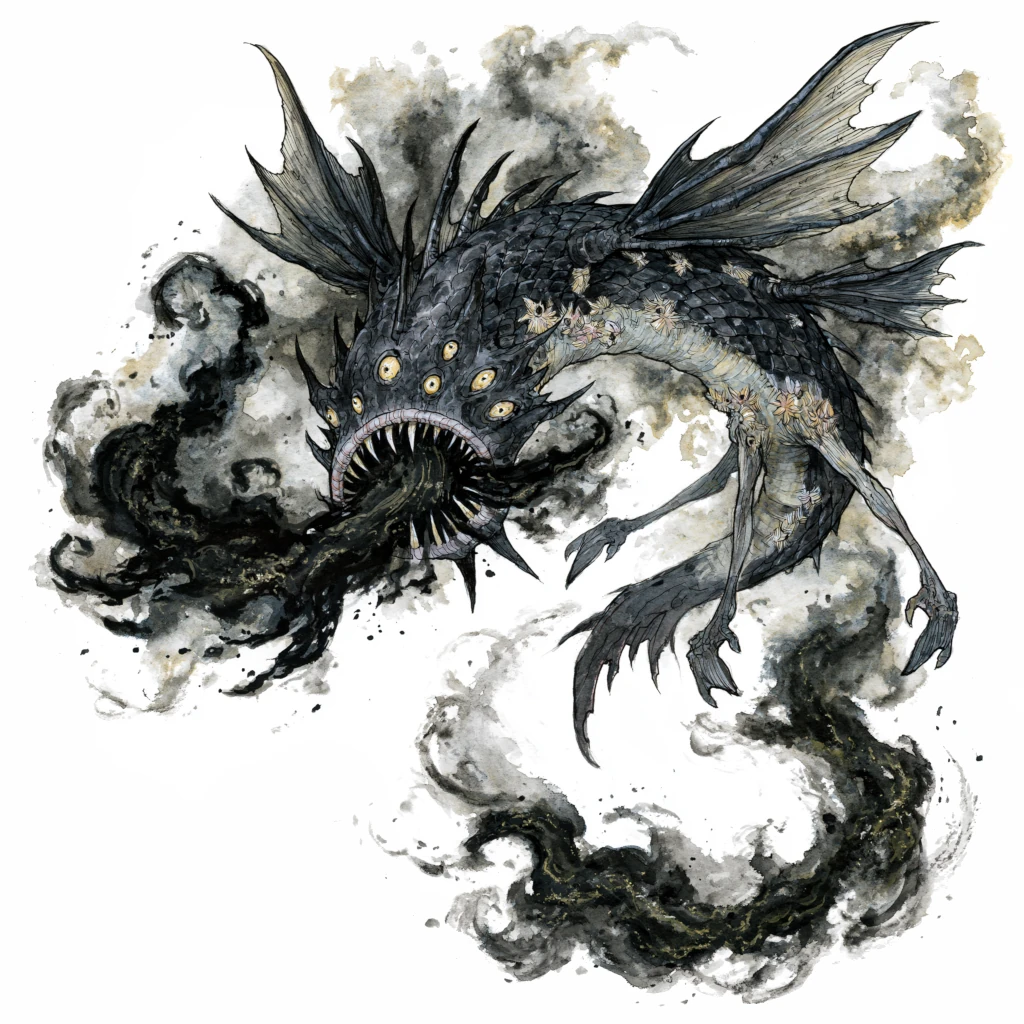
The Devourer; CE Abyssal lord (daeva) of corruption, predation, insatiable hunger [He/Him] ‡
Realm: Abyss / Layer 174 — the Rancid Ocean / the Drowning Maw
Ganderawa [gan-deh-RAH-wah] is a sea monster from Persian mythology who lurks in the cosmic waters, and continually tries to swallow the good things of creation. Fresh water is the most precious of elements to cutters from arid lands, making Ganderawa one of the most feared daevas. While he lairs in the Abyss in a truly miserable layer called the Rancid Ocean, Ganderawa roams across many of the interplanar oceans; the Seventh Sea, Vourukaša, and Ishiar, the Ocean of Despair. Truly vast in size, he manifests as a colossal eel-dragon with lamprey jaws, barnacle armour, and a body that oozes oily black water. His realm is a pitch-dark tarpit at the bottom of an ocean already thick with slime and corruption. The opposite of Apaosha the drought demon, Ganderawa instead spreads sickness and misery through flooding with polluted waters. To achieve this, Ganderawa has a small cult of ghawwas divs—or diving demons—as his horrid agents. They travel the planes fouling springs, seas, and oases, tainting life-giving waters, and spreading Gandarewa’s primal hunger into every drop of water they can reach.
Indar
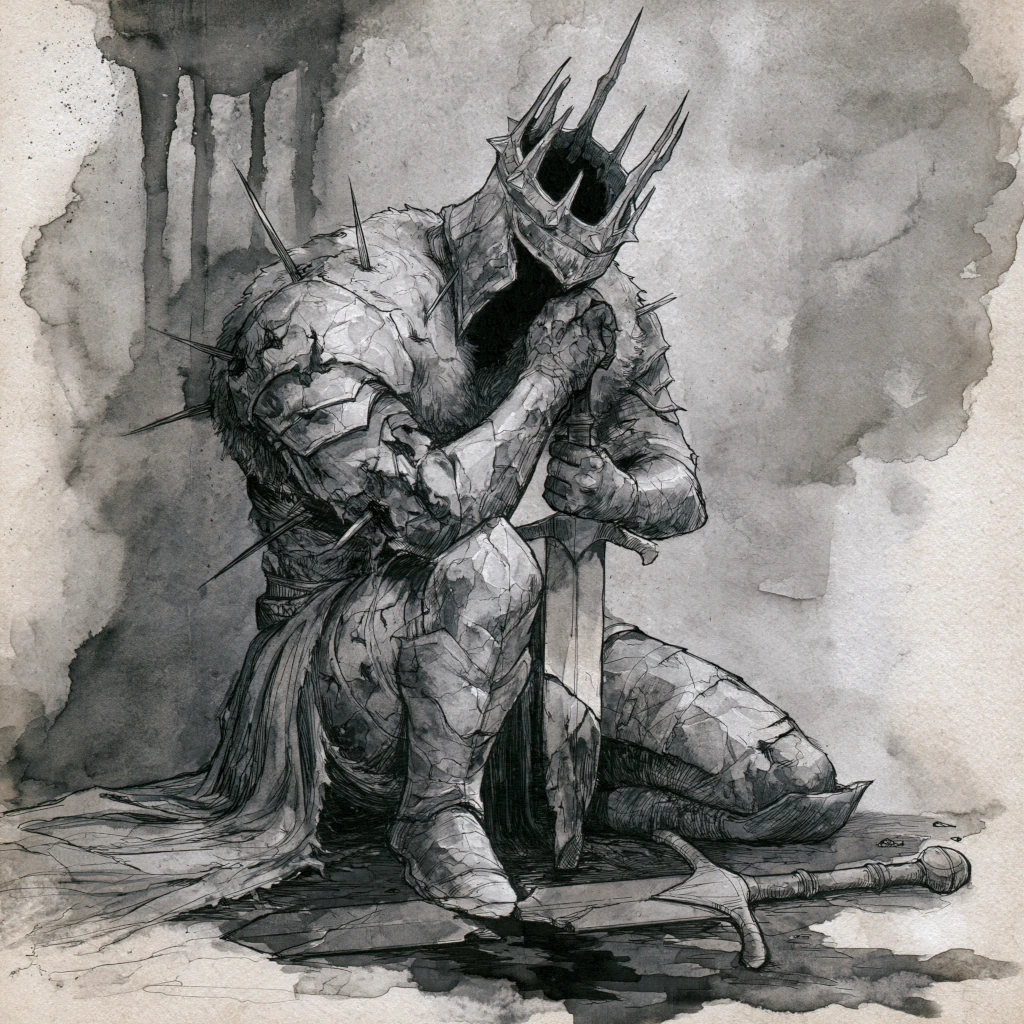
Andra, the Apostatic, Renegade of the Old War; NE Intermediate power (daeva) of apostasy, false worship, rebellion against religion [He/Him] ‡
Realm: Gehenna / Mungoth / the Temple of Hypocrisy
If the Athar were ever to swallow their pride and follow a power, it would be Indar [inn-DARR]. This blood is a most paradoxical power, a deity who rails against religion itself. He seeks to lead mortals away from worshipping gods in general, especially the Yazad, but even including himself. His eternal opponent is Asha Vahishta, the amesha spenta of truth. Chant goes that Indar was originally a noble power of storms and war, a divine champion of heroic violence, but after he lost an epic battle against Aeshma, the faith of his worshippers was shaken to the core. As priests abandoned their defeated war god in droves, Indar grew embittered. It was at his lowest ebb that Ahriman made his approach, offering to restore Indar’s power if he turned his back on the Yazad. And so Indra fell from the ranks of the yazata into the company of daevas. This was one of Ahriman’s great corruptions, and of course based on the Lie. While he gave Indar back the power he craved, Ahriman also hollowed out everything noble left in him, twisting him into the daeve of apostasy. These days, Indra is an empty spirit who now turns strength against righteousness, and tempts mortals to abandon the holy order for pride, rebellion, and false worship.
His realm, the Temple of Hypocrisy, is a vast ever-collapsing cathedral that dwarfs the Athar’s base in Sigil. Huge blocks of masonry fall constantly from its teetering towers as lightning hits the spires, yet the structure never seems to get any smaller. The frigid mountainside here is littered with broken and useless holy symbols from a thousand abandoned gods. Prayer Unanswered (planar deimavigga baatezu [they/them] / LE) would probably be a proxy of Indar, were he a power who wanted one. Instead, Prayer Unanswered tends the Temple of Hypocrisy by trying to speed up its destruction, and offering Indar the opposite of worship.
Nanghaithya
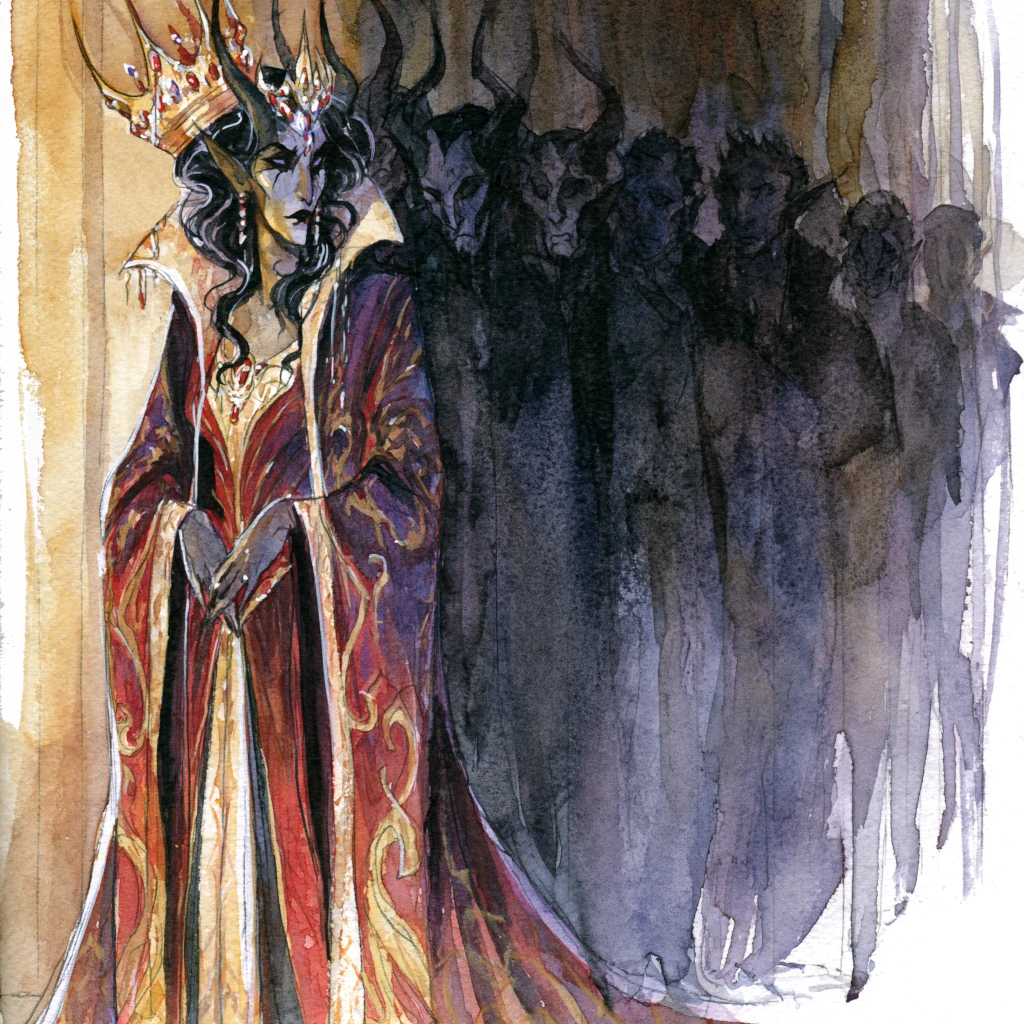
Naonhaithya, Nanghait, the Ingrate, the Restless Want; LE Intermediate power (daeva) of discontent, dissatisfaction and ingratitude [She/Her] ‡
Realm: Baator / Cania / the Court of Want
Nanghaithya [nan-GYE-thee-ah] is one of the great daevas, a being who, even though she is literally a goddess, feels hard-done-by. She is the embodiment of discontentment and ingratitude—one word from her makes any gift feel insufficient, every home too small, every duty too much to ask, and every favour unworthy of gratitude. She is directly opposed to Armaiti the bountiful, making her the enemy of humility, patience, and acceptance of one’s proper place in the world. Nanghaithya exercises her power by implanting doubts, whispering to mortals that what they have is never enough and that what others possess ought rightfully to be theirs instead.
Her aim is to make every soul incapable of contentment. She wants households to be full of resentment, kingdoms full of grievances between peasant and noble, priests full of doubt, and lovers hung up on comparison. A cutter under Nanghaithya’s influence becomes unable to appreciate their blessings, and so drift naturally toward greed, betrayal, envy, and revolt. Nanghaithya teaches that all friends are rivals, all limits are intolerable, and all contentment is just laziness.
Nanghaithya manifests as a regal but hollow figure: a tall fiend in rich garments that never sit comfortably, with a crown always tilted, jewels worn like she resents them, and a face beautiful enough to inspire longing but never satisfaction. When she wishes, her form can changes to reflect what the viewer most covets, ensuring that even beholding her becomes an act of envy.
Her realm in frigid Cania is called the Court of Want. It’s a palace of crowded courtyards clinging to the side of a vertical mountain. Its towers are beautiful but unfinished, and its terraces breathtaking but unsafe. Petitioners are forced to line up in queues in front of doors that never open, In this place every room is furnished with something that makes the viewer envious. Petitioners and lesser fiends are not tortured with physical pain—unless they steal something of course—instead they are immersed in a society of ceaseless comparison, frustrated ambition, and the knowledge that their desires could be fulfilled easily, if only they were not being withheld. In the Court of Want, complaining is an art form, but the difficult part if finding someone to listen to it who actually cares.
Zarich
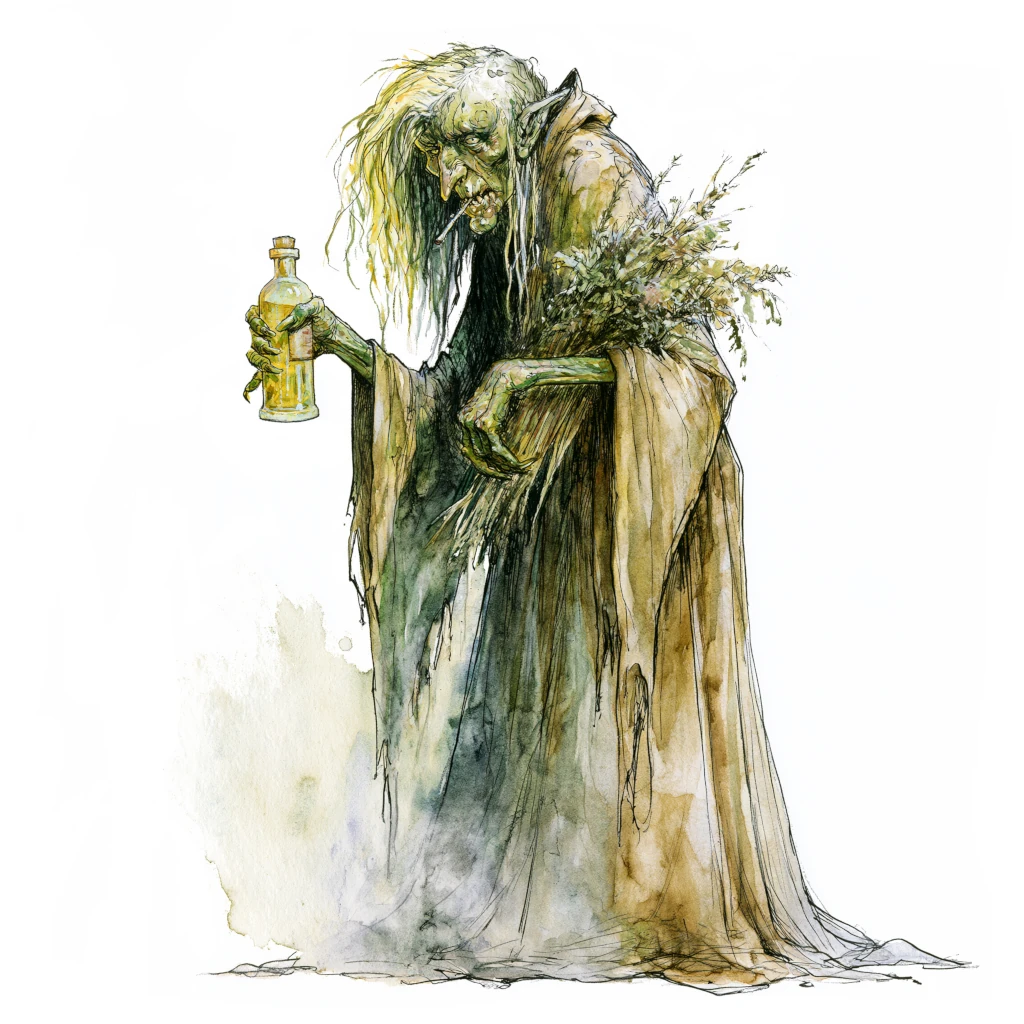
Zarik, Zairicha, the Yellow-Green Hag; LE Intermediate power (daeva) or aging, poison and slow degeneration [She/Her] ‡
Realm: Gray Waste / Pluton / the Withering Mire
Zarich [ZAH-rich] is the personification of the aging process, who nudges the living ever closer toward decline, and makes the ravages of time feel poisonous. She’s also a patron of toxic herbs, thirst—since Apaosha was killed at least, and poor health. All of these make her the infernal opposite to Ameretat, the amesha spenta of immortality and plant life. Zarich presides over yellowing leaves, shrivelling flesh, tainted sap, and the certainty that all bodies will fail in time.
She manifests as a wizened hag the green-yellow colour of mildew, dark veins visible through her parchment-like skin, her white hair turning green at the roots. She carries a bouquet of henbane and nightshade, a bottle of poison, and is usually smoking a noxious roll-up that smells of stagnant medicine. What she’s most notorious for though is her hatred for haoma, the holiest herb of the Yazad. The crone will stop at nothing to bring a blight on haoma plants, or poison the life-giving drink. In some stories she may appear as an almost beautiful apothecary at first, like some kind of a healer or herb-wife. However, she can’t keep up the deception for long and the image rots away once she is up close.
Zarich’s philosophy is that everything erodes, and it’s her job to help things along. You could say she’s the original Doomguard perhaps, and indeed there are many of the faction in her sinister cults. Her aim is to make all life feel temporary, frail, and easily contaminated, so that a berk’s hope gives way to fear of decline. She inverts Ameretat’s promise: nothing should remain green, nothing should stay wholesome, and too much of any elixir should be harmful.
Her realm in Pluton is called the Withering Mire. Formerly some kind of hospice-city, the burg is now all crumbling bathhouses, abandoned herb gardens, apothecaries full of noxious medicines, and orchards whose fruit ripens straight into rot. It’s not clear she corrupted the place and dragged it into Pluton, or she discovered it here and made her lair, nor who lived here previously but is now missing.
| NAME | PORTFOLIO | REALM |
| Aeshma | Wrath, rage, violence, blood-lust, war-madness | Abyss / Layer 304 / Field of Maces |
| Ahriman | Oblivion, nihilism, divs | Gehenna / Krangath / Duzakh |
| Aka Manah | Sensual desire | Abyss / Layer 550 / Forest of Living Tongues |
| Apaosha | Drought, aridity, withering of crops and herds | Abyss / Layer 403 / Rainless Waste / Salt the Earth |
| Asmodeus (?) | The Ruler of Hell | Baator / Nessus / Fortress Malsheem |
| Asto Vidatu | The moment of death, soul-chasing | Chinvat Bridge / the Pit of Bones |
| Azhi Dahaka | World-devouring dragon, oppression, doom, barmy, imprisoned | Carceri / Colothys / the Shackled Peak / the Serpent-Pit of Damavand |
| Chinnaphapast | Pulls sinful souls from the Chinvat Bridge and into Duzakh | Chinvat Bridge / Druj-Demana, the House of Lies |
| Druaga | Baatezu summoning and binding | Baator / Maladomini / Zisurrû |
| Gandarewa | Corruption, predation, insatiable hunger | Abyss / Layer 174 — the Ocean of Despair / the Drowning Maw |
| Indar | Apostasy | Gehenna / Mungoth / the Temple of Hypocrisy |
| Nanghaithya | Discontentment, ingratitude | Baator / Cania / the Court of Want |
| Zarich | Aging, poison | Gray Waste / Pluton / the Withering Mire |
A Who’s Who of the Pantheon
Realms of the Persian Powers

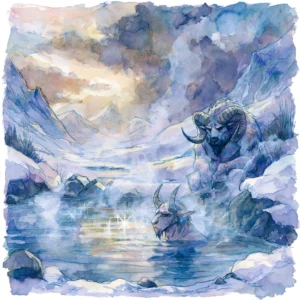
Source:Jon Winter-Holt. The sourcebook Scion 1e: Yazata was also helpful in getting my head around the Persian powers. ‘Yazata’ is I suspect also where the Pathfinder term for eladrin-like creatures, ‘azata’ comes from. The pantheon and philosophy described here are based on Zoroastrianism, at 3500 years old or more, it is one of the most ancient religions, and even more impressively, it’s still around to this day. While the religion originated in what is now called Iran, most of the 100,000+ faithful are Parsis who live in India and Iran.
Indar has his name written as Indra twice in his section
Well spotted, thanks!