
[ Outsiders > Fiends > Parochial > Likhoradka ]
[ Cattle’s Death | Gneteya | Korcheya | Kostolomka | Ogneya | Ospa | Oznoba ]
Likhoradka, Cattle’s Death
The Ragpicker’s Disease; the Charbon Beast
| TRAITS: | Fiend | Unholy |
| PLANE / LAYER: | Gray Waste |
| ACTIVITY CYCLE: | Any |
| DIET: | Breath |
| INTELLIGENCE: | 15 (+2) |
| ALIGNMENT: | Neutral Evil |
| SIZE: | Large |
| CHALLENGE RATING: | CR 16 |
The cattle’s death belongs to a more ancient stratum of dread than the other likhoradkas. Unlike their kin, they’re not an embodiment of humanoid illness, but one primarily of animals. Since animals were first domesticated, cutters have depended on them, and the collapse of a herd will lead to the ruination of a village sure as the Spire. The cattle’s death is a pestilent force that moves from bower to bower, leaving famine in its wake. This likhoradka embodies charbon, the old name used for anthrax. It’s a terrible disease of blackened lesions, sudden death, and uncanny persistence in the soil through dormant spores in poisoned soil. Its tenacity is what makes cattle’s death especially hateful. A charbon infection can linger in contaminated earth for years, just waiting for a hoof, a plough, or a grave-digger to disturb it at the right time. Sure, charbon can affect an unlucky mortal through a cut or consumption of an infected animal, but it’s first and foremost a plague of cattle, sheep and goats. Oh, and bariaur. Yes, many a herd of bariaur has been wiped out by a single likhoradka—that’s probably why their folklore is obsessed with the creatures.
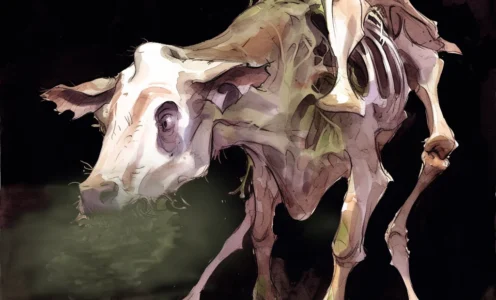
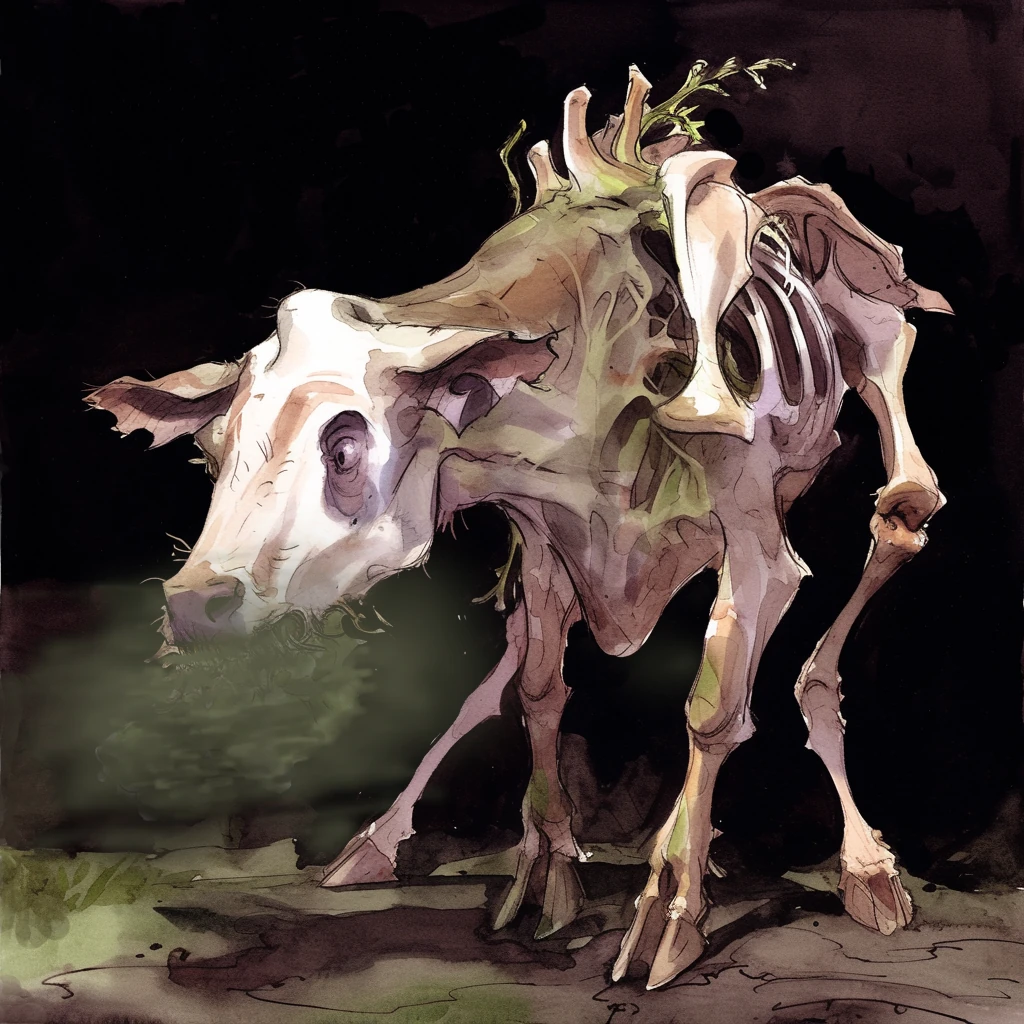
Though it can wear many forms, even that of a humanoid, centaur or bariaur, a cattle’s death usually chooses the shape of a skeletally emaciated cow. Its body is gaunt to the point of obscenity, hide barely stretched over its frame. Sometimes rib bones even protrude through the skin. Its eyes look hollow and dim, its muzzle is crusted with ash or dried blood, and its breath comes out in ragged gusts of rotten green miasmic fog.
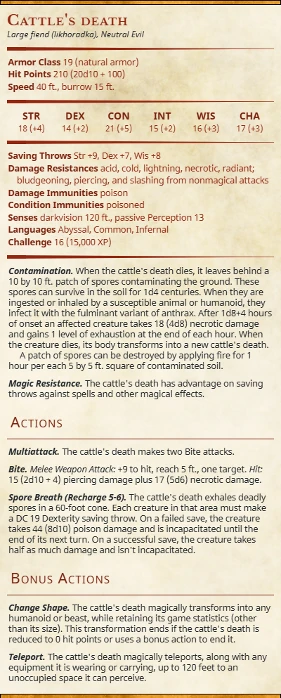
This form seems to have been chosen to provoke fear and revulsion in shepherds and pastoral folk. From a distance, the likhoradka cloaks itself as just a gaunt-looking cow, in need of a good feed. It’s only when the beast starts to mingle with the herd, to get close to the farmer, that it drops the illusion and the full horror of its true appearance is revealed. Its bite leaves blistering, filthy wounds that cause flesh to necrotise, but its breath carries a more terrible corruption, a toxic sickness that incapacitates victims and burns away at the lungs. Perhaps just as terrifying, a cattle’s death is able to teleport itself instantaneously to a nearby location. They do this to launch surprise attacks and maximise the impact of their breath weapon.
Their most awful feature though is their refusal to stay dead. When one of these fiends is ‘killed’, its corpse quickly rots away, seeding the earth beneath it with countless invisible spores like a poisonous memory. Now, you need to understand that cattle’s death are nothing if not patient—for those spores can lie dormant for centuries, waiting for the perfect victim to reinfect with a virulent form of choking charbon sickness that invariably leads to the death of the unlucky creature. At this point the cattle’s death takes over, wearing the stolen corpse as a shell. The ‘new’ cattle’s death retains all of its former memories and vile personality, although with so much time potentially passing, it might take a while to reorientate itself in its new surroundings.
The true enemy of the cattle’s death is fire. Unfortunately not for the fiend itself, fire harms them no more than any other fiend. But the spores are destroyed by prolonged contact with flame, scoring the land with fire is the only way to prevent the fiend from finding a new host and coming back.
These likhoradka are not hunters like some of their kin. While they enjoy infecting livestock and watching them panic and die, their true goal is to inflict generational harm. One dead cow might mean hunger for a single family. Several dead cows mean debt, slaughter of a herd just to be sure, and migration. But a poisoned pasture means a village must slowly cut pieces off itself to survive. That is the scale the cattle’s death prefers—bringing starvation and ruin to a whole burg. Not just for this year, but for centuries to come…
Burn the carcass. Burn the straw,
—Old folk rhyme concerning the cattle’s death
Burn the fence and the ground and the boots that you wore,
Burn your tools and your clothes, and the barn—just to be sure,
Anything less and you’ll meet it once more.

Cattle’s Death
| CLIMATE/TERRAIN: | Gray Waste |
| FREQUENCY: | Very Rare |
| ORGANISATION: | Solitary |
| ACTIVITY CYCLE: | Any |
| DIET: | Breath |
| INTELLIGENCE: | Exceptional (15) |
| TREASURE: | Q, V |
| ALIGNMENT: | Neutral Evil |
| NO. APPEARING: | 1 |
| ARMOUR CLASS: | 0 |
| MOVEMENT: | 20, (Br 5) |
| HIT DICE: | 16 |
| THAC0: | 5 |
| NO. OF ATTACKS: | 1 (bite) |
| DAMAGE/ATTACK: | 1d10 + 4 |
| SPECIAL ATTACKS: | Spore breath weapon (6d8 and paralysis for 1 round), |
| SPECIAL DEFENCES: | Teleport 120 feet (1/turn); polymorph self; contaminated ground |
| MAGIC RESISTANCE: | 25% |
| SIZE: | Large (10 feet long) |
| MORALE: | Fanatic (18) |
| XP VALUE: | 16,000 |
Sources: Margarita and Jon Winter-Holt. Margarita notes: The likhoradkas are a homebrew fiend race, inspired by the eponymous disease-riddled spirits of Slavic mythology. While based on Slavic folklore and beliefs, the amount of actual information we have on pre-Christian Slavic deities is so minuscule that building any kind of lore out of it is impossible. However, there are a lot of folk beliefs about things these deities are thought to represent, which I have worked into the piece.
I’d honestly love to see some HD ratings for a lot of these new monsters for me to use in AD&D or OSRIC in the future.
Hi there! I just had a go at this one, using the conversion guide I found here (in the reverse direction):
https://docs.google.com/document/d/18JxZubIphrP4lpIDnerVztjHgp-qAVLHURmOCJk06BM/edit?tab=t.0
and the standard rules here:
https://www.completecompendium.com/about/the-monsters/
See what you think! It’s been 30 years since I DM’d AD&D 2e so I am verrrry rusty. Any feedback much appreciated! And also, if you convert any of these monsters yourself, please do let me know!