
[ Outsiders > Fiends > Parochial > Likhoradka ]
[ Cattle’s Death | Gneteya | Korcheya | Kostolomka | Ogneya | Ospa | Oznoba ]
Likhoradka, Ogneya
The Fever Fire
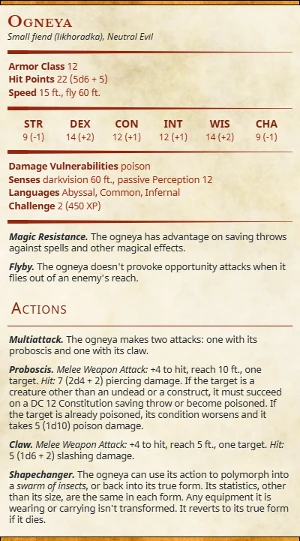
| TRAITS: | Fiend | Unholy |
| PLANE / LAYER: | Gray Waste |
| ACTIVITY CYCLE: | Any |
| DIET: | Blood |
| INTELLIGENCE: | 12 (+1) |
| ALIGNMENT: | Neutral Evil |
| SIZE: | Small |
| CHALLENGE RATING: | CR 2 |
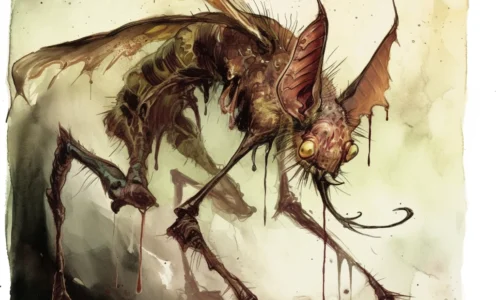
The ogneya are known as the fever fire, and in many ways they’re the opposite of the oznoba. Where their mucus-covered brethren thrive in the cold, the ogneya are fiends of the tropics. Not for them the shivering misery of influenza—these fiends embody the blazing, bone-grinding heat of fever, or dengue. They are the sick wind of Stribog rendered warm and nauseating, blowing around the mosquito-infested humid lands, rain forests, and moist coastal burgs. They carry sickness across the Prime on the backs and in the bellies of insects. Cutters of the Chinese pantheon call these fiends water poison, and the Swahili call them ki-dinga pepo, the seizure demon. However, the mosquito is merely the instrument of the ogneya, their outer skin, and the shape they wear when they wish to spread themselves across the planes.
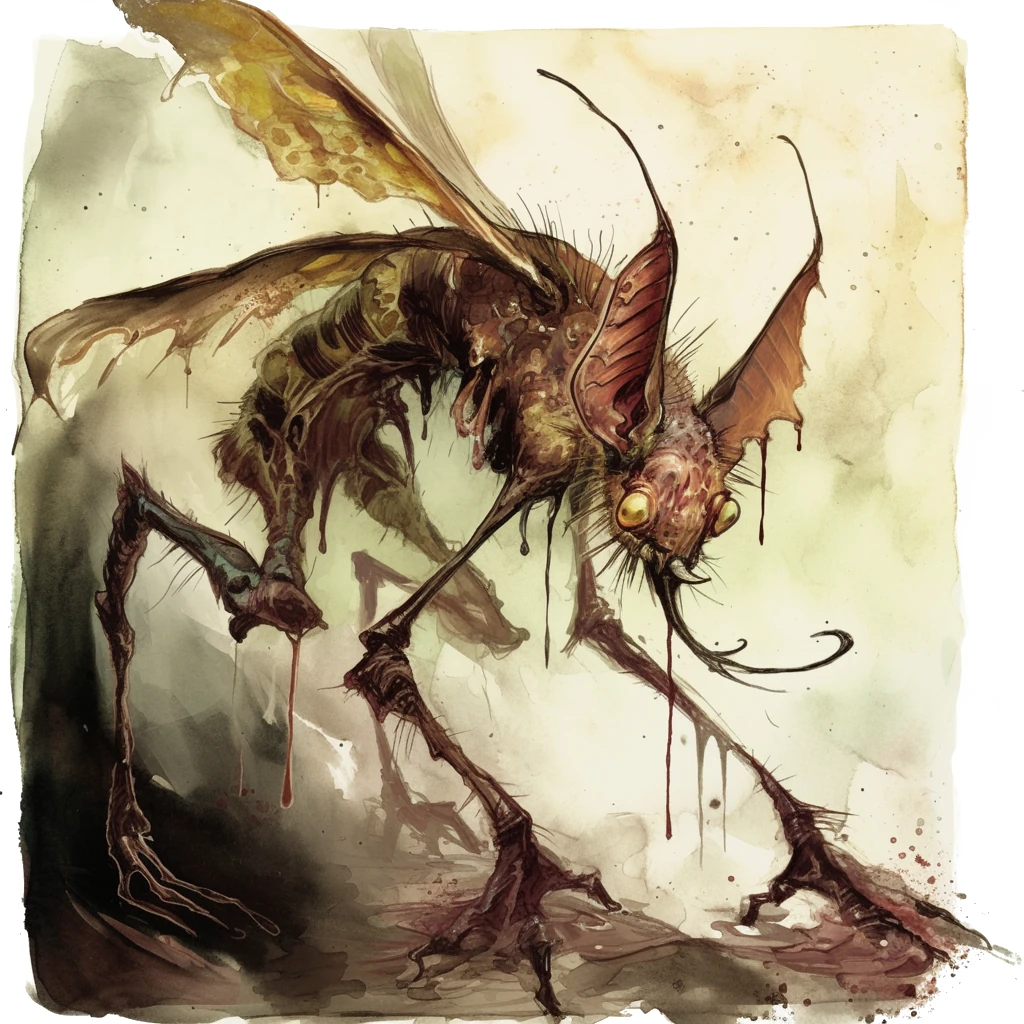
Their true form is something worse—a small humanoid fly-like fiend of unsettling proportions. They have large bat-like ears, four spindly limbs rather than six, claw-fingered hands, bulging yellow eyes. Their skin is a deep, iridescent grey-black that catches light like a beetle’s carapace. Their gauze wings are mottled with dark spots and beat with a high, continuous whine that sits just at the edge of hearing. It’s a horrid sound that sets a berk’s teeth on edge and raises the hairs on the back of the neck. The ogneya’s face is dominated by their long, needle-like proboscis, capable of piercing through leather and cloth alike. They feed on blood, not because they must—these fiends need no sustenance really—but because they enjoy it, and because their saliva carries their gifts.
Their most unsettling ability, however, is not their bite, it is their dissolving. When threatened, an ogneya comes apart at the seams and erupts into a roiling swarm of bloodsucking insects, thousands strong, each carrying the same virulent payload. The swarm can slip through bars and shuttered windows, to seek out tasty necks, wrists and ankles, only to reassemble later somewhere dark and damp.
The one genuine vulnerability of the ogneya is poison gas. Smoke, toxic vapours, and noxious fumes all disrupt the swarm. It is the oldest protection against mosquitoes: light a smudge-fire, burn the right herbs, and the ogneya are repelled.
Ogneya are not subtle or patient—they are immediate, ravenous, and their enthusiasm perhaps makes them more unnerving than a brooding predator. They spread fever the way a fire spreads: opportunistically, hungrily, following the warmth. They gravitate toward ports, river settlements, crowded and humid places where bodies press close and standing water collects. The diseases they spread are rarely immediately fatal—dengue kills slowly, through complications, through the haemorrhagic fever that can follow. You see, a victim burning up with water poison fever, aching so severely they cannot move, trembling on the edge of consciousness, is a victim they can visit again and again.
Sources: Margarita and Jon Winter-Holt. Margarita notes: The likhoradkas are a homebrew fiend race, inspired by the eponymous disease-riddled spirits of Slavic mythology. While based on Slavic folklore and beliefs, the amount of actual information we have on pre-Christian Slavic deities is so minuscule building any kind of lore out of it is impossible. However, there are a lot of folk beliefs about things these deities are thought to represent, which I have worked into the piece.
The Ogneya has been converted to PF1e: https://www.tumblr.com/justicegundam82/823513813600157696/new-pf1e-creature-likhoradka-ogneya
Hope you enjoy! ^^
Awesome, thank you for this one, and the gufna!