Druj-Demana, the House of Lies
Planar pathway
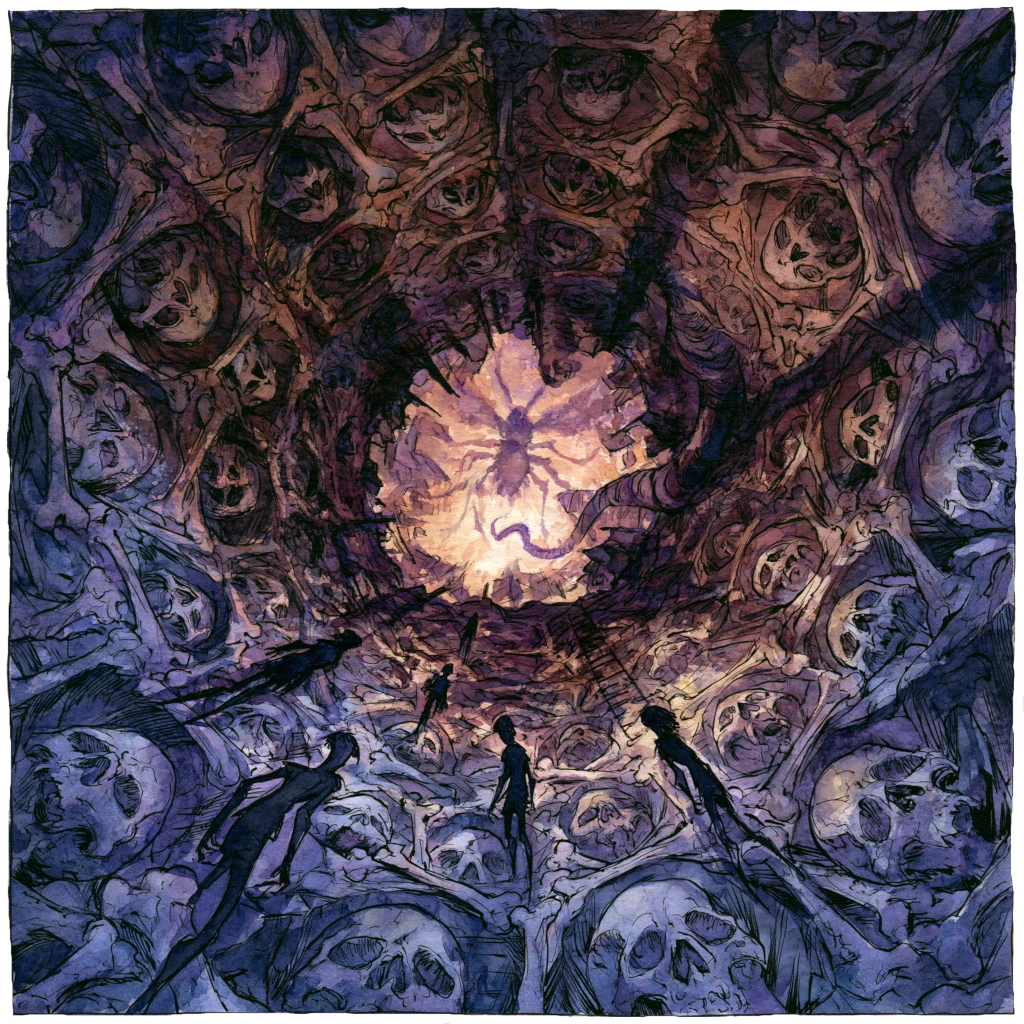
The first lie is that it’s not a house at all, just a sinister-looking tunnel straight down. And for the ill-fated petitioners who fall from the Chinvat Bridge who are also unlucky enough to survive the fall, it’s the only way out of the Pit of Bones. It’s essentially a continuation of the planar pathway that Persian petitioners must walk to get from life to afterlife. This dark part though, is only whispered about in legends, for it is the way that the wicked petitioners must take to reach their final destinations in the Lower Planes. Many of the sods who end up here never make it at all; the predatory xrafstar see to that by picking off the slow or the injured or the exhausted. Only the strongest—or most treacherous—petitioner shades make the journey to the city of Ahermanabad, the realm town of Ahriman’s realm Duzakh.
Story continues from the Pit of Bones …
The tunnel did not get easier; it only got steeper, darker, and more contemptuous of the dead man’s endurance. By the second day—or the third, though time was largely theorotical down there in the dark—he had tumbled to the dark that the tunnel of the Druj-demāna was designed for attrition. The walls wept a mineral slime that made every handhold slick, and the rock was really a loose shale of bone fragments, fingernails, teeth, and old ash. His ghostly limbs should not have obeyed him for so long, but they did, and he continued only because the only choices were continue downwards, or be eaten. Far above, mostly invisible in the gloom, gargantuan xrafstars moved around the shaft, their bulk scraping the rock and causing the tunnel to tremble. Whenever one growled or hissed the panicking climbers below redoubled their efforts.
The dead man passed other deaders on the way down, though down and up had ceased to mean much. There were the newly dead in their burial rags, still trying to work out their own names. There were older souls, gray as soot, who had been climbing for weeks or years and no longer knew whether they had once lived or had merely imagined it. Some sobbed. Some prayed. Some cursed the Chinvat Bridge, the powers, the living world above, and themselves for their own sinful choices.
The dead man learned to keep his eyes fixed on the next handhold and to test every ledge before putting his weight on it. Once, a woman ahead of him vanished in a flash of greenish light when a giant wasp-snake swooped down and struck. The creature’s sting pierced her shoulder, and she blew apart in a spray of pale motes, as if her body had been made of ash held together by a thread. No one screamed. There was no spare energy for screaming. The climbers simply held their breath as they moved through the glittering remains and kept climbing.
At last the tunnel began to smell of sulfur rather than rot. A breeze caressed the dead man’s face, pungent and cold, and the rock beneath his hands changed from wet black stone to cold blue basalt. Finally, the shaft widened out. The dead man climbed through a cavern of cracked basalt and sputtering steam, then hauled himself over the lip of the tunnel. He stood on a steep mountain slope under a sky the colour of bruised copper. Below him spread the dead volcano of Krangath, its flanks crusted with long-frozen lava flows and black slag. The air tasted bitter. Scattered along the mountainside were ledges, fumaroles, and the silhouettes of things that might have been devils but were probably something even worse.
The dead man stood there for a moment, his hands trembling from the exertion, looking out over the mountainside as the frigid wind moved the ash around his feet. Somewhere up the slope, a bell rang once, deep and metallic, and the sound reverberated and tugged at his soul irresistibly. The dead man wiped dust from his face, though no dust could truly cling to him now, and squinted toward a path of broken stones ascending between two smoking ridges. Whatever the tunnel had saved him from, Krangath did not promise safety. He took one breath of the thin, volcanic air, and started up the slope toward whatever waited for him on the dead mountain.
Source: Jon Winter-Holt, idea based on real world mythology