[ Planes of Cordance > Sheol ]
Typhos
The Tyrannical, the Unceasing March, He Who Was Not Asked; demipower of tyranny and ambition [He/Him] / LE
CHARACTER: A vassal who’s never once actually behaved like one, Typhos embodies the boot on the neck of every berk below him and the knife at the throat of everyone above.
The chant about Typhos, and there is plenty of chant—because a demipower marching around the inside of a mountain with a war-caravan in tow finds is difficult to be subtle—is that he should not exist. Not in the sense that he is an abomination, though some would argue that too. More in the sense that a power whose core philosophy is dominate or be dominated has somehow ended up as a vassal of Mot, which means he is, by his own theology, subordinate. And yet he is still here, marching, recruiting. This tells a berk one of two things: either he’s made his peace with this arrangement as a temporary tactical position, or he has not made his peace with it at all and is doing a remarkable job of staying out of the dead-book anyway. The smart jink is on the latter.
Typhos is not an ancient power in the way Mot is ancient. He is old, certainly, old enough that the pantheon he originally served is long gone, but there is nothing primordial about Typhos. Chant goes he’s the only thing to ever have crawled out of the Maw at the nadir of the plane, and he has been climbing ever since.
Perhaps Mot engineered this, deliberately installing a power of tyranny at the base of his plane, aimed upward like a weapon at himself, because the irony of dominating a tyrant was simply too amusing to resist. Or perhaps it was Mot who devoured the pantheon of Typhos but somehow this single power managed to escape. It seems though that Mot has had opportunities to destroy Typhos and has chosen not to, which means either that Typhos is useful in some way, that Mot finds him entertaining, or perhaps that Mot is genuinely unable to.
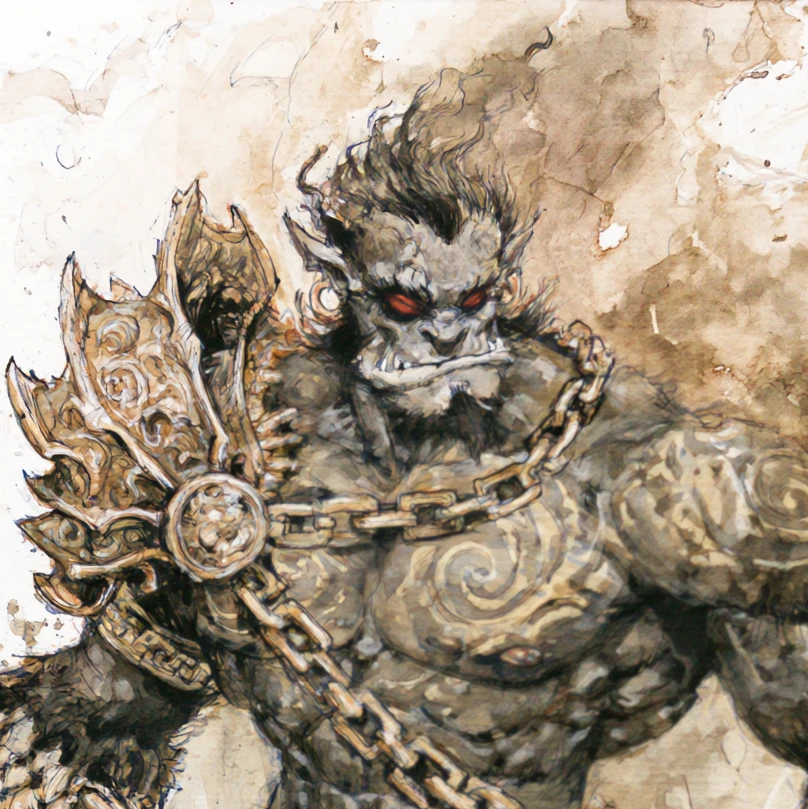
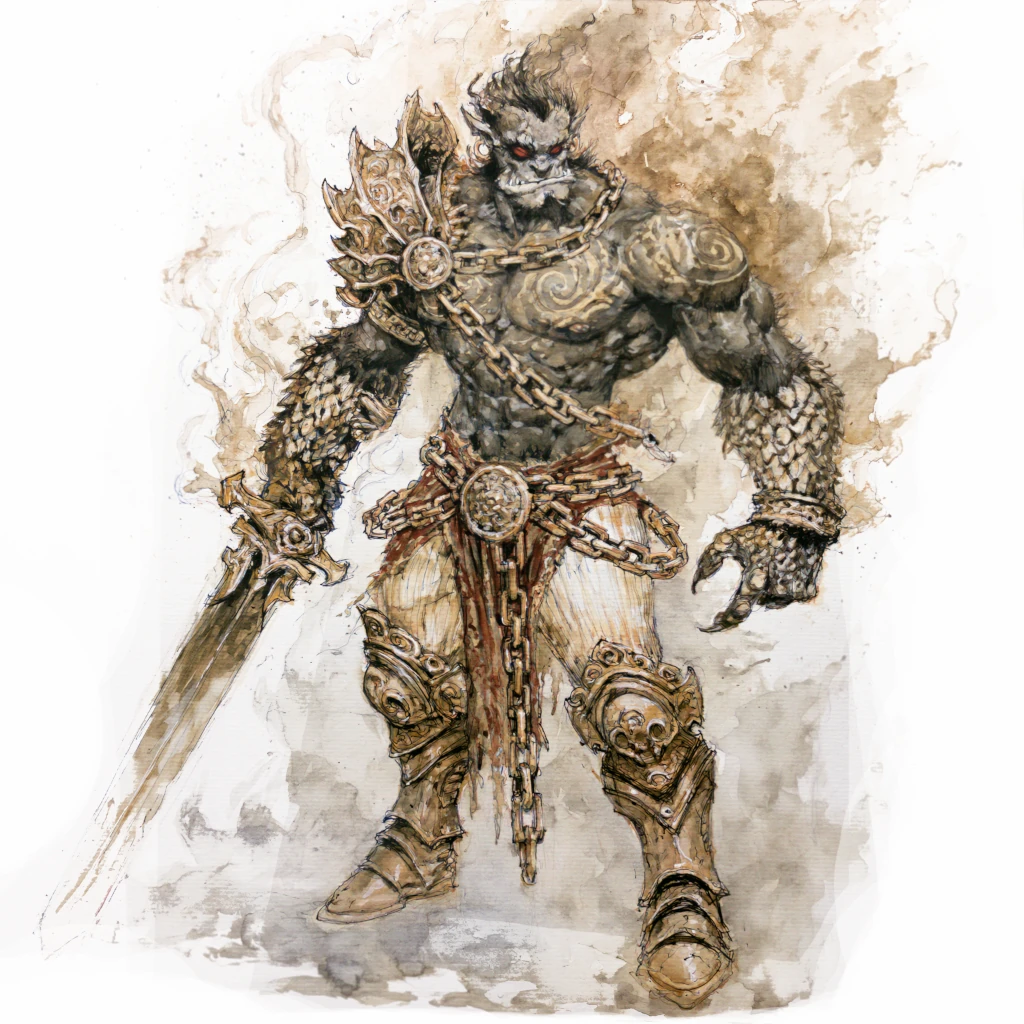
APPEARANCE: Typhos manifests as a tall, powerfully built warrior, wearing no armour above the waist. He has the kind of sneer that says ‘why would I need armour?’ His skin is the colour of tarnished bronze, his eyes are like flames seen through smoke, and his arms and hands are covered in serpentine scales. He carries a greatsword of black iron so large it should be unwieldy, but Typhos holds it like a rapier. Around his neck, at all times, is a single length of heavy iron chain that he wears like a medal. Humans claim him as one of their kind, and dromaar do the same.
REALM: Typhos has left his mark on the plane of Sheol, although it’s not with a realm, at least not in the formal sense. Wherever this blood goes, he’s surrounded by a ten mile aura of divine presence that affects the plane around him. Within this radius, the atmosphere thickens with the smell of camp fires and smithys. You can hear the clang of metal on stone, the noise of hundreds of workers chipping away at the sloping rock, their chains clanking as they swing picks, and whips cracking when they do not. See, Typhos is building a road as he and his army marches upwards, albeit glacially slowly. While his enslaved petitioners might not last long on the job, Typhos is in no hurry. He just wants to ensure his army, also called the March, get where he needs them even if it takes a thousand years. It certainly seems like the plane itself is holding him back, because planewalkers can achieve in a few days climb what has taken Typhos and his army years.
The physical infrastructure of the March is a huge war-caravan with a column of soldiers, followers, enslaved labourers, conscripts, and true believers. This army stretches across the steep paths, rope bridges, and switchback trails of whichever tier Typhos is currently passing through. At the column’s heart are a dozen great wooden houses mounted on massive wheeled frames, hauled by vast beasts of burden that are large, dark, and indifferent to what they are pulling. These rolling houses serve as quarters, command posts, and strategy rooms for the March’s senior figures. Typhos himself occupies the largest, a structure with no windows on its lower story and an open platform at the top from which he can observe the column’s progress.
The road the March leaves behind it is a levelled, excavated path scoured, gouged and blasted into Sheol’s rock by the slave gang of Typhos, and is one of the few reliable pathways available to anyone trying to move between tiers quickly. Planewalkers use it freely, which seems to suit the agenda of Typhos. In this inaccessible plane it is infrastructure, which is a form of influence. While the road is undeniably useful, cutters who live in the burgs of Sheol pray it never reaches their settlement—because burgs who the March reaches rarely survive long enough to enjoy easier travel.
Special Condition: Those who travel with the March, even uninvited travellers moving along the road it has left behind, find the demands of the climb halved. Sleep, food, water, rest: all required at half the normal rate.
It seems the Tyrant has his eyes set on one place: the burg of Tarnation. Whether that’s because he just hates the idea that there’s a burg full of cutters who aren’t bowing and scraping to his rule, or whether he sees taking control of the largest burg on Sheol as a stepping stone for the real prize—the Palace of Mawt, is anyone’s guess.
PRINCIPAL CUTTERS: Adrastos (petitioner minotaur barbarian [he/him] / LE) is Typhos’s most decorated warrior and the closest thing the March has to a general, though the title has not been formally granted because Typhos does not formally grant titles—it gives berks Notions. Adrastos is a petitioner, a minotaur of exceptional size even by minotaur standards. He does not speak much, because he does not need to. Those who’ve been on the wrong side of Adrastos and survived report that the experience was clarifying in the same was as ice cold water: an unpleasant shock that was remarkably effective at focusing the mind on what matters. Typhos is considering elevating him to proxy. Adrastos has not been informed of this, which in itself is a kind of test.
SERVICES: The March serves one meal: vinegrip stew, which is a sheep-based perpetual broth that has been cooking in the rear wagons for many years, with fresh ingredients added each day. It is heavily salted, with crushed vinegrip seeds for bitterness, and finished with blood from whatever creatures the column has encountered that day to enrich the taste. It is, by most accounts, exactly as good as it needs to be and not one degree better. The March does not provide armour, weapons, equipment, or any other material support. A body joining the column is expected to arrive with everything they need to survive it. If they cannot survive it, they were not suitable for the column, and the stew continues on without them. Or perhaps with them in it, if they look tasty enough.
PHILOSOPHY OF THE FAITH: Typhos has no patience for theology and even less for organised religion, which puts his followers in the uncomfortable position of worshipping a god who would prefer they simply find ways themselves to become stronger. His philosophy, insofar as he’s articulated it—mostly in the form of pre-battle rallies, with which he is incredibly motivational—can be reduced to four principles:
Firstly. Nobody is born equal. Every creature born is born at a specific point into a natural hierarchy of strength, intelligence, will, and capacity, with a pre-determined set of skills. The addle-cove’s error is pretending otherwise, arranging the world as though the strong and the weak have the same stake in it. They do not, and they never have.
Second: Freedom must be taken, not given. A body can only be free if they are strong enough to remain free. Freedom given by another is an illusion, because it can be revoked on the whim the other. Freedom carved out by one’s own effort and defended by one’s own force is the only kind of freedom worth anything. Typhos does not hate free people. He respects them, in the same way a predator respects prey that runs fast. He simply believes that if he can take their freedom, it was never really theirs to begin with.
Third: Those who cannot rule must serve. A body who cannot or will not seize their place in the hierarchy is a resource: a stepping stone, a labourer, a shield. Hatred of this role is natural, and acceptable. Resistance to it must be met with force sufficient to end the resistance. Resentment that turns into ambition, and eventually the capacity to fight back is the one form of response Typhos genuinely admires. This surprises many cutters. If you’re a vassal of Typhos and rebel, make no mistake he will put you down, but he will be proud that you put up a fight doing it.
Fourth: Upward, always. There is no point at which a cutter’s climb is complete. Every goal achieved is a base from which to strike out for the next one. Berks who’ve stop climbing have already begun to fall.
Key Typhoan Myths
The Devoured Pantheon. The pantheon to which Typhos belonged, whose name seems absent from all historical records, is said to have been a small but fierce collection of deities from a Prime whose civilisation rose and fell in the time between two of Mot’s deeper sleeps. When Mot consumed the last of the worshippers and the pantheon’s divine fire began to gutter, the other powers either retreated into the ether, or or too were devoured. Somehow though Typhos escaped this fate. Whether this represents his extraordinary willpower, stubbornness, or an inability to recognise that the correct response to a situation is surrender, depends on who is telling the story.
The Offer. Mot’s offer, service or destruction, is the central myth of Typhos’s current existence. In the version told by Typhos’s own followers, Mot offered the choice because he could not simply destroy Typhos and needed a face-saving mechanism. In the version told by Mot’s theologians, the offer was made purely for the philosophical pleasure of watching a tyrant submit to authority. In the version told by Tsharvirel, who claims to have seen the original contract, the terms contain a sub-clause that neither party has yet triggered and that he will not describe further. What all versions agree on is that Typhos accepted, that he said very little during the acceptance, and that the expression on his face was not the expression of someone who intends to uphold his end.
The Birth at the Nadir. The strangest piece of chant about Typhos—circulated primarily by the Witch of Endor is that Typhos was born out of the Maw of Be’Er Shahat. That the Maw and Typhos share an origin, which would make him not a foreign power installed in Sheol but something that Sheol itself produced: a tyrant grown from the plane’s own consuming void, aimed upward at Tarnation, or Mot, or the Institution. The Institution has reviewed this theory. It has been filed under Unsubstantiated, Potentially Inflammatory, Refer to the Department for Archival Suppression.
A Note on Typhos and the Institution
The question of how a power whose explicit goal is the violent overthrow of everything above him can continue to exist within Sheol’s hierarchy without triggering Mot’s response is one that the Institution’s Department of Pending Outcomes has had on its docket for a very long time. The leading explanations are three: that Mot is aware of the threat and considers it beneath current concern; that Mot is aware of the threat and considers it useful as a pressure valve that keeps minds of the upper tiers sharp; or finally that the relationship between Typhos and Be’er Shahat is such that destroying him would have consequences Mot is not yet prepared to manage. The Department has declined to develop this line of inquiry further. Their preliminary report is pending. And it has been pending for a long time. Meanwhile, Typhos continues to march.
Pathfinder 2e Devotee Rules
Divine Attribute: Strength or Constitution
Divine Font: Harm
Divine Sanctification: Can choose unholy
Divine Skill: Athletics
Symbol: A hand holding a whip
Favored Weapon: Greatsword
Domains: Ambition, Might, Tyranny, Zeal
Alternate Domains: Destruction, Duty, Pain, Punishment
Cleric Spells 1st: Breathe Fire; 4th: Suggestion; 6th: Dominate
Worshippers: Warlords, conquerors, slavers, cutters who believe hierarchy is natural and mercy is weakness, anyone who has clawed their way up to the top and intends to stay there
Allies: None formally declared.
Enemies: Every free body in the multiverse, in principle. In practice: whoever is immediately above him.
Edicts
- Seize power wherever it can be seized; hold it by whatever means are necessary
- Treat strength as the only currency that matters by demonstrating yours regularly
- Advance in position, power, and influence without ceasing; to stop is to begin falling
Anathema
- Submit to an authority you have the power to overthrow
- Treat the weak and the strong as equals in any meaningful sense
- Retreat when advance is possible, however costly
Canonical Source: Complete Warrior [3e] p147-148.
Source: SGreen. Canonwatch: ‡ Homebrew expansion of the limited lore around Typhos. All of the Planes of Cordance and the concept of the Splinterlands are homebrew and non-canonical. Expanded from Greg Jensen’s original conception, more information on his Planes of Cordance can be found here.