


[ Fire ] [ Mapping Infinity | Pockets | Bestiary | Flora ]
[ Borders of Fire ] [ Ash | Magma | Metal | Radiance | Smoke ]
Border Bonfires

The Heart of the Flames
Natives of the Plane of Fire divide it into countless provinces and lands, but they’re the only ones who are able to distinguish one sea or island of fire from another. For planewalkers it’s much more convenient to break the plane down into three parts.
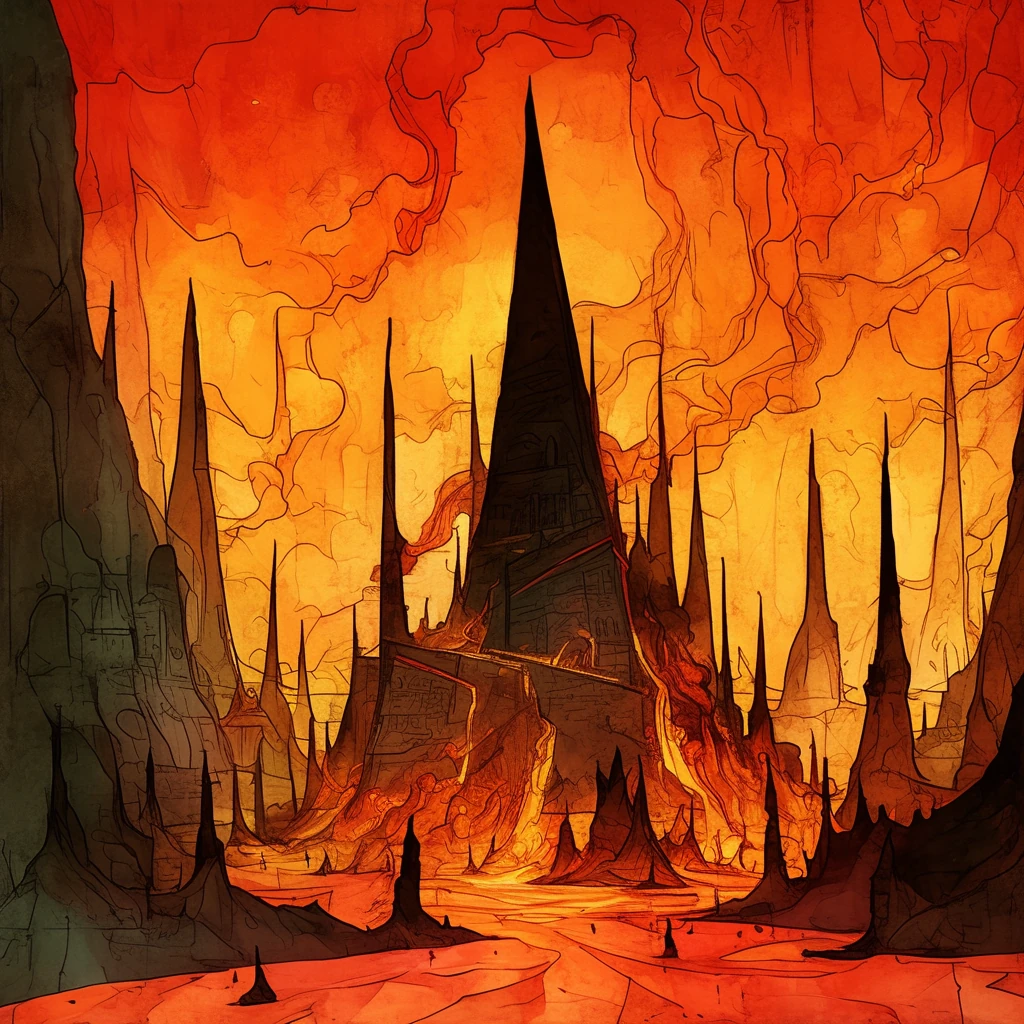
CORE FIRE: Is everything I’ve described so far, the always-burning, ever-hungry heart of the inferno. Air made of fire over water made of fire over earth made of fire. Dozens of races and tribes—efreet, salamanders, firenewts, azers, fire giants, harginn and so on—wage constant wars here to gain access to land and resources. Most of the well-known sites of the Plane of Fire can be found here; the City of Brass, the Sea of Scorching Waves, the Lands of Fire floating in them, the Scalding Skies above.
DEEP FIRE: Delving deeper into Fire, overly curious sods notice that after some time fiery seas stop having islands. In the Deep Fire there are no impurities (knowing the nature of fire, it is wise to say yet), and temperatures keep rising. The Realm of Kossuth stands here as a wall of white flame. It is so hot that no mortal magic can protect a sod approaching it, and even most elementals cannot go near it. What is beyond the wall is unknown—perhaps lands where the biggest (and hottest) primal elementals roam. After all, Inner Planes in theory go on forever.
More information on the Tracts of Core Fire here.

Where the Flames Go to Die
Planewalkers travelling emberwards from Elemental Fire towards the Negative Quasi-Elemental Plane of Ash will have to slog through several dramatic changes in environment, and especially temperature. As the fires are slowed, quelled and poisoned by negative energy, the searing flames die down and the detritus and pollution from all that merry burning builds up.
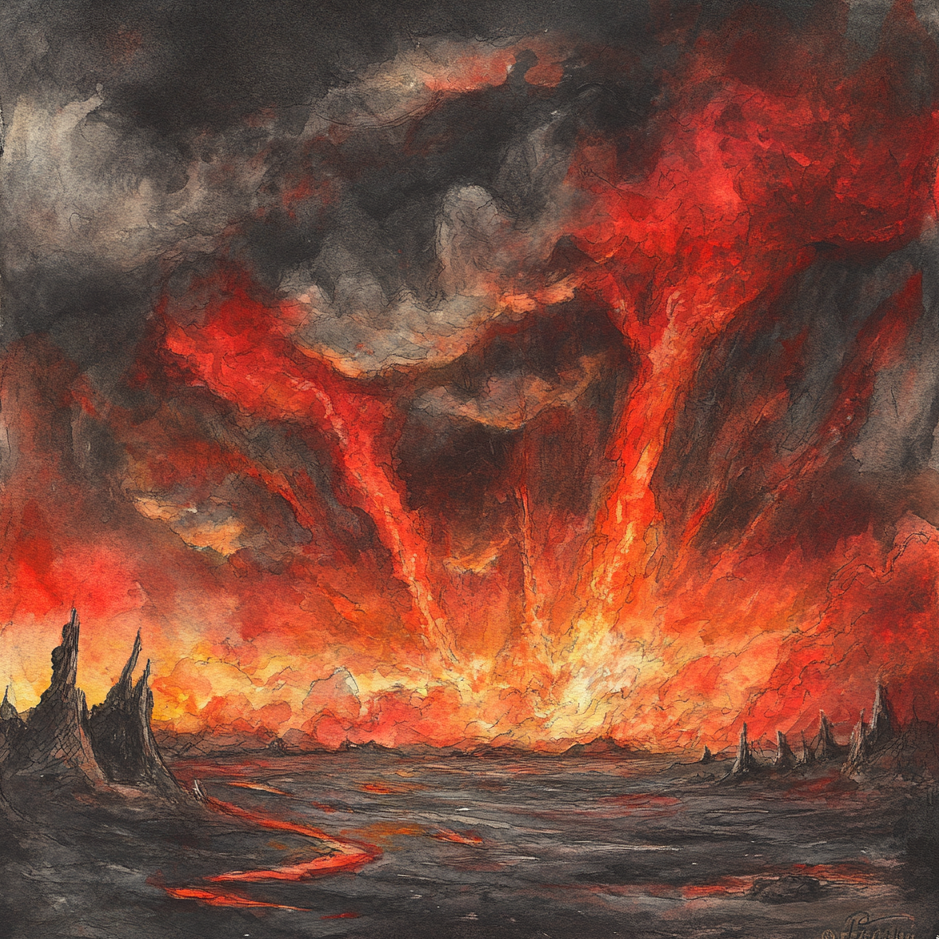
CINDER WASTES: While the graybeards and efreet can argue over whether the Cinder Wastes are technically a region of Fire or whether you’ve already crossed over into Ash (the efreet are all for keeping Fire pure, see), for the poor planewalker stranded here, it matters less. Here the incessant flames have started to flicker and die, leaving behind cooling embers that give rise to swirling desert of glowing soot and clinker.
Here temperatures rapidly drop to around 200-300 degrees—still enough to burn a sod, but not enough to melt precious metals, let alone steel. The burning gases in this place are constantly smothered by the presence of ashes—the place smoulders more than burns, with constant gray-black ‘snow’ falling down and settling as fine twinkling particles. These sparking cinders lay over the surface of the blazing sea as dark dunes, that become cooler still if you continue towards Ash. The cinder dunes can be treacherously thin, leading to many a careless planewalker fall through the quicksand-like cinders and plunge into the liquid fire that lies just beneath the crust.
This image has made many clueless wrongfully assume that the entire Plane of Fire is somehow a desert. Many fire-born creatures find the Cinder Wastes uncomfortably cold, but this place still has its share of inhabitants. For example, cinderbrutes, hulking creatures of fire and compressed ash, seem to be native to the Cinder Wastes and well adapted to life here.
Instead of Fire’s atmosphere of flammable and toxic gases, the ‘air’ here is thick with soot and ash, meaning breathing is impossible without magical assistance. Vision is limited depending on the weather—at best a couple of hundred feet, but in an cinder storm you might be able to see only ten feet around you.

SEA OF FROZEN FLAMES: Travel further emberwards and you’ll eventually reach a point where the ashes overpower the flames, and there is no liquid fire left. Welcome to the Sea of Frozen Flames. Here the fire itself is solid, forming crystalline structures that protrude from the desert and glister with internal light. The Fraternity of Order categorise this place as the start of the plane of Ash in their Codex of the Planes, on account of the surreal lack of heat. While the frozen flames don’t produce any warmth, they will somehow still burn a careless berk who touches them—and the usual protections from fire won’t help you here.
Better then to stick to the passageways and tunnels that wind their way through the place, where the frozen flames are smaller, further apart, or have been crushed down to sparkling soot by centuries of occasional travellers. Initially these are pathways that wind between huge clusters of flame crystal, but as the soot thickens, you’ll find gently glowing tunnels that descend into the ash. If you can survive the harsh, arid environs here, you’ll find this place as beautiful as anywhere. My Sensate friends, it’s well worth a visit.

THE GRAY WALL: Venture ever more nothingwards and you’ll eventually end up against the Gray Wall. It’s a sheer crumbling mass of powdery ash, like a cliff that forgot how to be solid. This is unarguably the Quasi-Elemental Plane of Ash proper—so-called Core Ash—so where a cutter calls the boundary of Fire and Ash is somewhere between here and Core Fire, depending on their biases.
You’ll know it from its all-consuming chill. Natural flames simply cannot ignite here, as the environment actively absorbs heat. The graybeards call it ‘cold dominant’, and while it’s no plane of Ice, it will still finish off planewalkers who come here without protection from the cold. But don’t feel too hard-done-by, because its even more dangerous for fire-based creatures. Breathing here is impossible without magical aid, spells like airy ash will help. Your vision will be limited to whatever pocket you’re standing in, because the rest of the plane is barely-solid soot. Infravision is also foiled here, as any residual heat from creatures is snuffed out by the unearthly chill of the plane.
Unless you can find a tunnel, cavern or elemental pocket, you’ll need to burrow through the ashes yourself if you want to move around here. At its most dense, the ash is the consistency of soil—easy enough to dig through slowly but difficult to shore up to prevent a tunnel collapsing. In its thinner pockets, the ash is more like a thick cloud which limits vision to ten feet but can be navigated like a thick smog in the Lower Ward. The closer you get to the Negative Material Plane, the darker and more sparse the ash becomes…
- Cinder Wastes (area)
- Dungeon Master’s Guide [5e] p55
- Rift River (area)
- Planar Handbook [3e] p155
- Shadow Fire (hazard)
- Inner Planes [2e] p44
- Slag Plinths (area)
- Planescape Campaign Setting [2e] DM’s Guide p31, Manual of the Planes [5e] p159
- Smoldering Gate (gate to the Abyss)
- The Plane Below [4e] p54

From Fire to Magma

Planewalkers travelling lavawards from Elemental Fire towards the Para-Elemental Plane of Magma will have to wade through ever-thickening terrain as fire gives way to molten rock. As the fires solidify, the searing flames die down and the bubbling ground becomes almost solid.
BURNING RIDGES: The Plane of Earth (and, by extension, the Para-Plane of Magma) are important for many civilisations of the Crematorium, since only they can provide such commodities as obsidian and tungsten. As you travel lavawards, the liquid fire becomes darker, and islands much more abundant, resembling mountain ranges. This land is called the Burning Ridges, and a lot of communities (especially azers) from both planes choose it to make their kip. Watch out too for Ymeri and her rapacious followers the pyrophor. As you might expect, competition for land is fierce.

SEARING MISTS: When the gaseous fire becomes thicker, but the solid land is weaker, you’ve entered the Searing Mists, the border region with Magma. Watch your footing, because getting stuck in cooling molten rock is nobody’s idea of fun. Eventually the conflagration becomes thicker and more sticky, unable to support burning at all, and condenses. When you spot the bubbling pools of thick liquid rock you’ll know you are finally in the Para-Elemental Plane of Magma.
- Auroric Palace (realm of Ymeri) †
- Planar Adventures [PF1e] p138; Planes of Power [PF1e] p34
- Basalt Fortress (site)
- Dragon Magazine #347 p34; Inner Planes [2e] p49; Planescape Monstrous Compendium Appendix III [2e] p16
- Crucible (azer tower)
- Manual of the Planes [5e] p158
- Emberean Recess (magma dragons)
- Planar Adventures [PF1e] p140
- Fountains of Creation (volcano range)
- Dungeon Master’s Guide [5e] p55
- Obsidian Fields (area)
- Inner Planes [2e] p47; Planescape Campaign Setting [2e] DM’s Guide p31
- Temple of Ultimate Consumption (realm of Imix)
From Fire to Metal
THE SMELTER: On the edge of the Plane of Fire, the massive solid plane of Metal becomes red-hot, before abruptly cutting off as a giant wall of searing iron (not unlike the border between Magma and Earth). Less heat-resistant metals like lead or copper flow in streams that crash down into the Forge Unsleeping, a region of Metal theorised by many to be on its way to become a para-elemental plane of Melt or Slag. This place has objective gravity (like Fire and Magma) and looks like a sea of flowing molten metal with fragile islands of slag floating between them. Very few elementals are found here, as such heat is harmful not just to their forms, but to magnetic forces they feed upon.

From Fire to Radiance
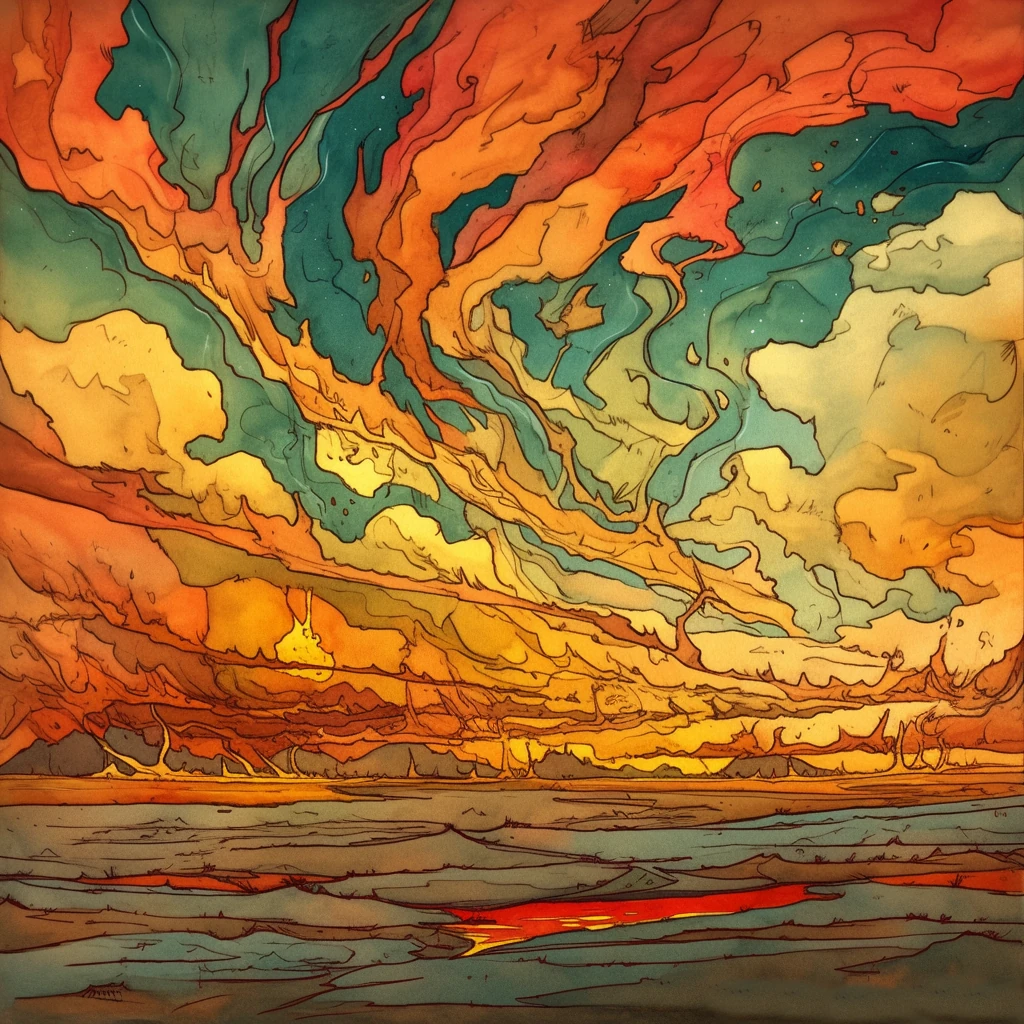
Planewalkers travelling lightwards from Elemental Fire towards the Positive Quasi-Elemental Plane of Radiance will pass through several dramatic changes in environment, and especially colour. As the fires are painted with a kaleidoscope of hues, out-shone and finally smothered by the light, the searing flames die down and the hypnotic aurora colours take over.
PRISMATIC FRONTIER: As you move lightwards towards the Quasi-Elemental Plane of Radiance, the flames change colour. As a premonition of what’s to come, you’ll see red, blue and even green flames. This place is more erratic than other areas, with fountains of toxic gases and areas of strange magic appearing here more often. Emberlings, small psionic creatures with a penchant for contemplation, like to observe these deadly, but beautiful sights.
BRIGHT FLAME: The flares become more brilliant, brighter and ever more colourful. At the point where incandescent rainbow-like arches of light scintillate continuously, this is the sign you’ve crossed over into Bright Flame, the border region of the dazzling Quasi-Elemental Plane of Radiance.
- Throne of the Seven Radiances (shared realm of the One Thousand Gods) ‡
- Tower of Djamela (site)
- The Plane Below [4e] p55

From Fire to Smoke

Planewalkers travelling smogwards from Elemental Fire towards the Para-Elemental Plane of Smoke will have to slog through several dramatic changes in environment, and especially temperature. As the fires are riled up, diffused and finally extinguished by the winds, the searing flames die down and the soot and smog from all that merry burning builds up.
EVERLASTING FIRESTORM: Travelling smogwards, Fire borders Smoke. When fiery environments meet fumes flowing in from the para-plane, the Everlasting Firestorm is found. Here powerful storms of flame ravage the landscape as the soot ignites and burns away. Few creatures of Fire can withstand such storms (even though they aren’t harmed by heat, they still can be flung far away by these “winds” of fire). Only gigantic elder, monolith and primal fire elementals enjoy this place.
SCALDING SKIES: Further still smogwards, in the border region of Scalding Skies where the Smoke chokes out the flames, cyclonic sparkstorms sweep the landscape. Then finally, the fire becomes cooler and filled with fumes. Gaseous, liquid and solid fire layers slowly dissolve into each other, until they meet banks of thick pungent rolling smog—this is the true Para-Elemental Plane of Smoke.
- Burning Rift (site)
- Planar Handbook [3e] p155-156
- Scalding Skies (border region with Smoke)
- Inner Planes [2e] p40, Manual of the Planes [5e] p159
Canonical Sources: Start with the excellent Planescape Inner Planes [2e] book. Other references from D&D and Pathfinder lore are mentioned on the relevant entries. This index will continue to be fleshed out as more locations are added. † denotes something from Pathfinder lore; ‡ denotes homebrew.
Other Sources: Margarita (border regions, conditions), Jon Winter-Holt.
Awesome! Love the inner planes. Some of my favorite stuff from planescape is the border regions from the Quasi Planes and these are great Inventive ones for the core elemental planes! Any plan to do the other Inner Planes at some point?
Absolutely, just need to work through ’em all! Earth is currently in the pipeline next…
Nice! Love your work and excited to see what you do! Your homebrew content is a lot of fun and fleshes out the gaps the official books leave