
[ Layer the Ninth ] [ Bestiary | Addanc | Locations | Stinking Pearl ]
Locations in Burningwater
The Altar of the Unbowed Sun
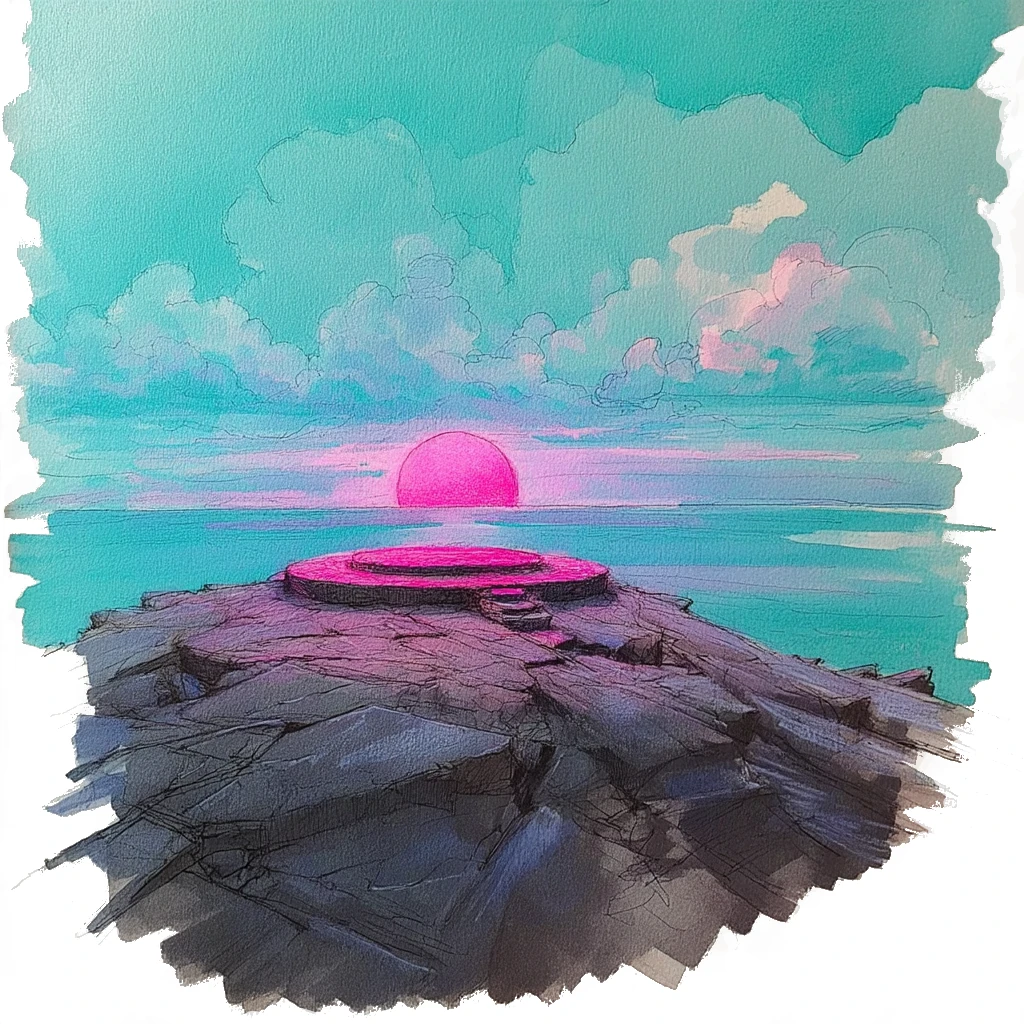
The Altar of the Unbowed Sun is a solitary, unnaturally flat island of black granite that rises from the Sea of Eosvotti like a great, scorched platter. Its surface is cracked and heat‑warped, while its edges have been worn smooth by the constant lapping of the corrosive sea. At its centre stands a low, circular dais of pink polished coral that glows as if it has absorbed too much of the sun’s light and now leaks it back in a dull, sickly radiance. The air above the island is always still and hot, bending the light so that the sun’s disk seems to hang crooked just above the dais, like the sky has been knotted around this single point. The island is sacred to a cult of babau tanar’ri who believe that the Altar of the Unbowed Sun represents a wound in the layer, a point where the Abyss has pressed itself against the veil of the Ethereal too hard, and the source of the strange convergence of planes. The sea around the island is unnaturally calm, with any waves slowing as they approach and then curling back upon themselves, as if the acidic water itself is wary of the spot where the sky is bent so badly. If you can avoid the cultists—who would gladly sacrifice you to the sun—the chant goes this is one of the best places to escape Burningwater. By using any kind of planar magic at the altar you’ll end up flung into a random location in the Ethereal, but the important thing is you’re no longer in the Abyss, right?
Bleached Archipelago
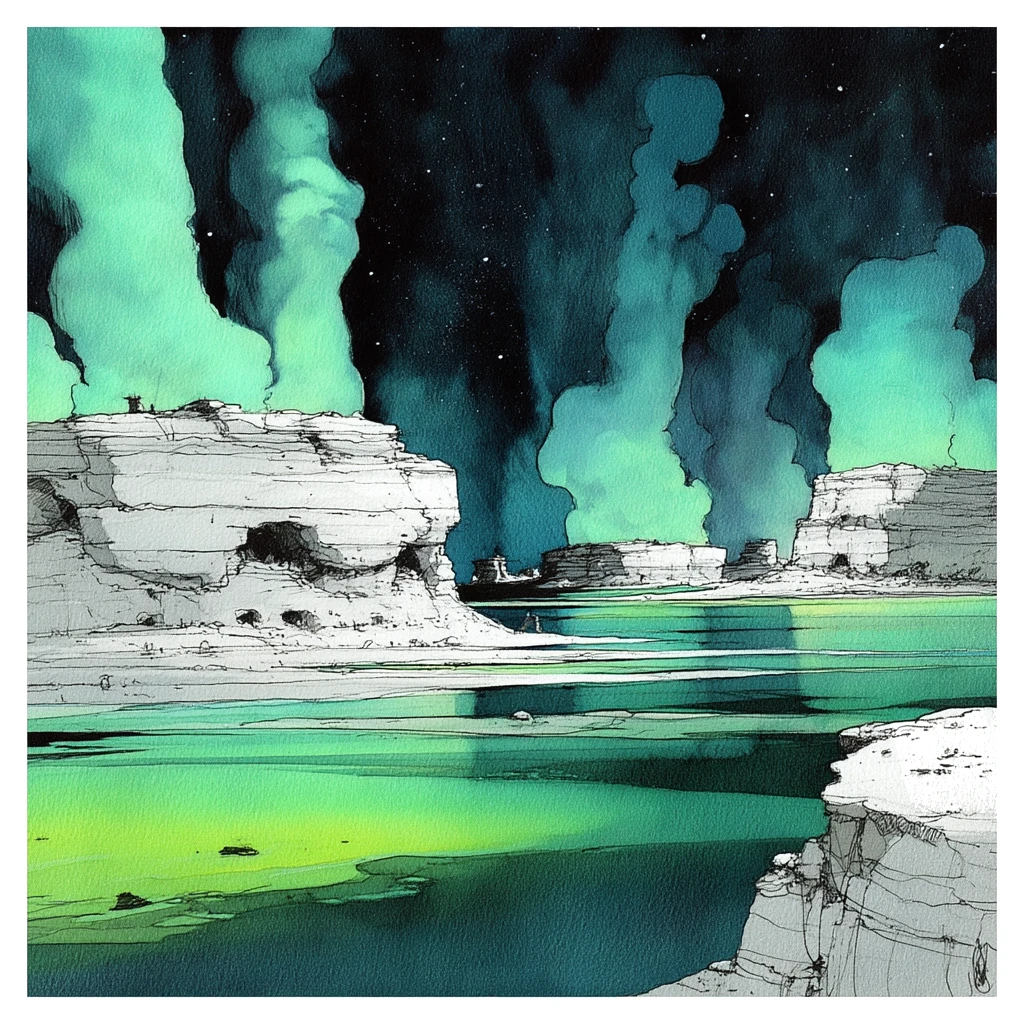
The Bleached Archipelago is scattered like a mouthful of broken teeth across the shallows of Burningwater, its islands bone‑white from the constant inundation by the acid sea and the corrosive vapours that rise from it. The land is low, flat, and strangely quiet, as if even the rocks have learned to hold their breath. The cliffs are layered with thin beds of the evaporated residue of the ocean, and the ground crunches underfoot. Tanar’ri raiding parties stage out of these islands, launching silently from hidden coves aboard glass shell-ships. Others are infested with vescavor hives. The archipelago is riddled with shallow caves where the acid has etched the rock into strange, looping tunnels that make horrible moaning sounds when the wind blows through them. Most unsettling of all, the nights here are lit by a faint, sickly phosphorescence in the shallows—colonies of tiny, stone‑shelled organisms that feed on the bones of Addanc’s victims and glow a pale green whenever the burning tide uncovers their feeding grounds.
Ciccarone
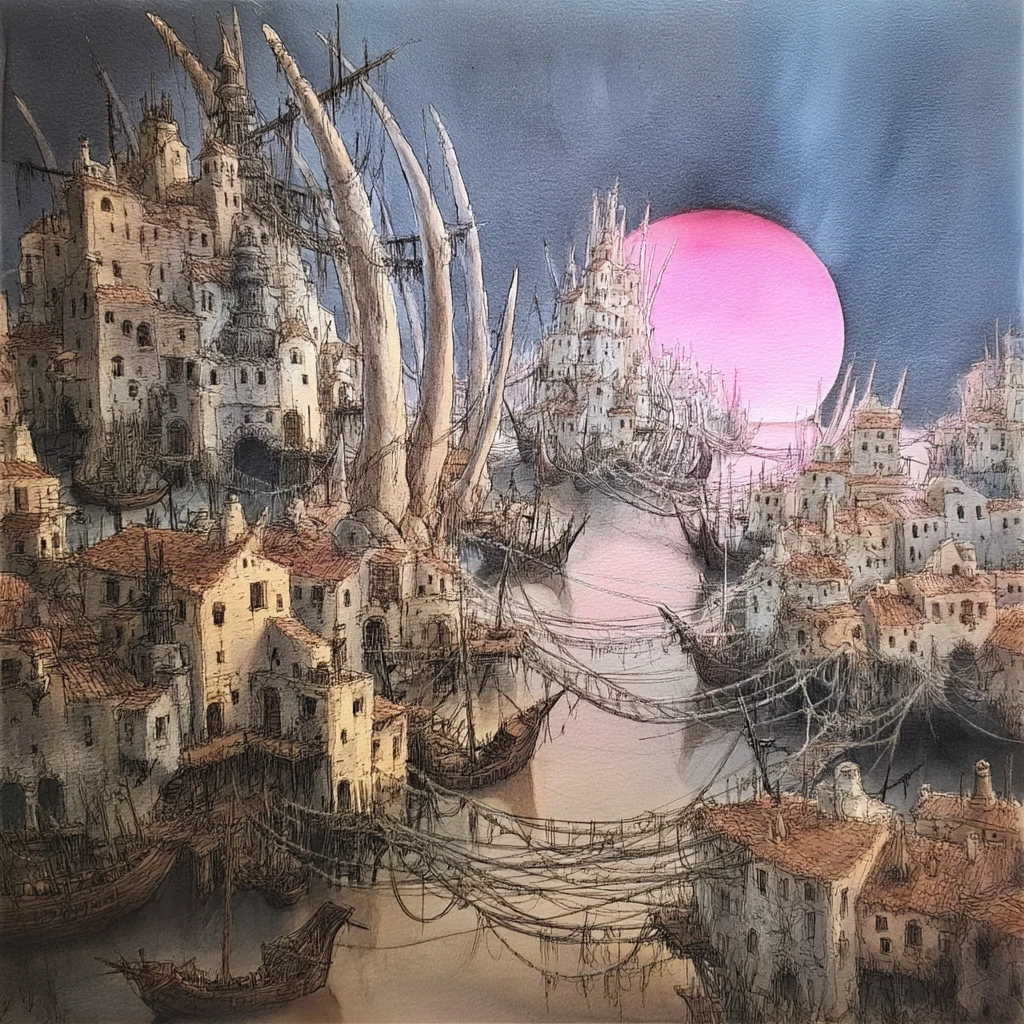
Ciccarone rises out of the sea like a drowned rat left to fester in the shallows. Built across perhaps one hundred small islands, it has acrid canals instead of roads. They are clogged with the skeletal ribs of beached whaleships and the white shells of dead crustaceans. The burg’s many towers of coral and stone lean at angles that gravity would forbid in any sane world. Bridges sag between buildings, their arches half‑eaten through. The widest waterways are spanned by tattered nets of black sinew that creatures must clamber across. The burg’s narrow alleys are a maze of dark, water‑stained ginnels and raised walkways slick with brine and algae. They echo with the clicks and scrapes of the mutated crustaceans that have learned to crawl up the walls like oversized, predatory barnacles.
Vorrethis the Gilded Mouth (planar wastrilith tanar’ri [he/him] /CE) holds court in the largest palazzo, a structure with rust‑streaked balconies where the grand canal once reflected the pink sun but is now black with pollution. Vorrethis is an ancient, gold-etched wastrilith who rules Ciccarone with impeccable courtesy and comprehensive treachery, performing loyalty to Addanc with such flawless precision that the would-be Lord of the Ninth has never once suspected him. Centuries old and deeply patient, Vorrethis is slowly poisoning the crustacean armies of the Mustering Reef, feeds falsified intelligence to the Fraternity of Order, and brokers quiet dealings with Demogorgon’s agents through ixitxachitl who visit the burg occasionally at night, all while holding court in the Palazzo Corroso as the perfect, smiling vassal—his true ambition is not the Drowned Throne itself, but the careful, deniable engineering of Addanc’s ruin.
The Drowned Throne
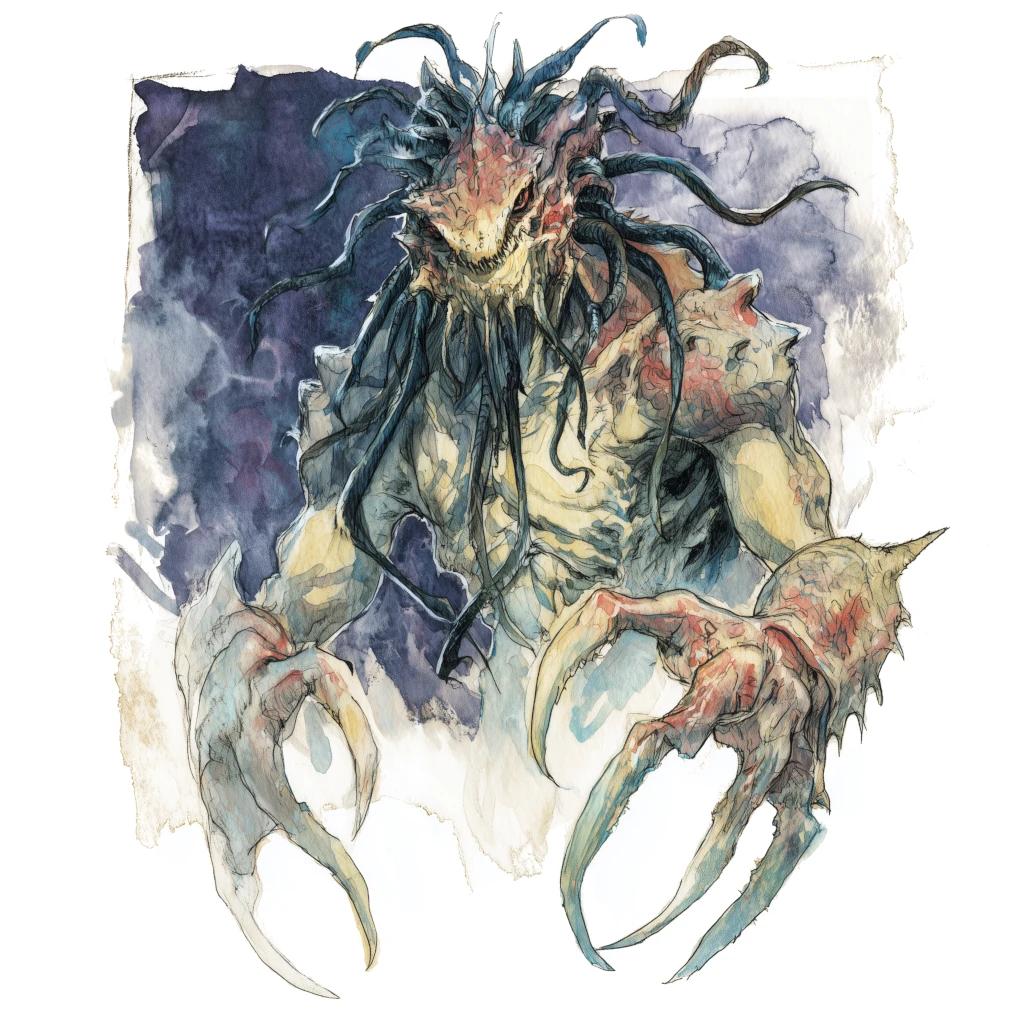
The Drowned Throne, the palace of Addanc, can be found on the deepest ocean floor, in a trench so far below the surface that the pink sun’s light has long since given up trying to reach it. The water here is cold and thick and so saturated with concentrated acid that even the glassy-shelled crustaceans that patrol its approaches bear the etchings of centuries of slow dissolution on their carapaces. The palace itself is carved into the rock of the ocean floor, inlaid with obsidian. At least, it might be that—it’s so dark down there it’s impossible to tell for sure.
The throne room itself is vast and low‑ceilinged, the walls pressing inward like you’re inside the ribcage of some leviathan. The floor is an uneven mosaic of the bones of creatures from a hundred different worlds. The throne sits at the room’s heart on a platform of black pearl, massive and deliberately ugly, its armrests formed from the jawbones of something large and dark. When seated Addanc fills the throne completely, his pike‑tail curling across the platform beneath him, his crayfish claws resting on those great jawbones, and his eyes burning in the dark of the trench like two cold embers. Even from all the way down here, his growling voice carries through the sea to his armies above with the subsonic resonance of someone who does not need to shout, because the sea itself will carry his commands wherever he wishes.
Falseharbour
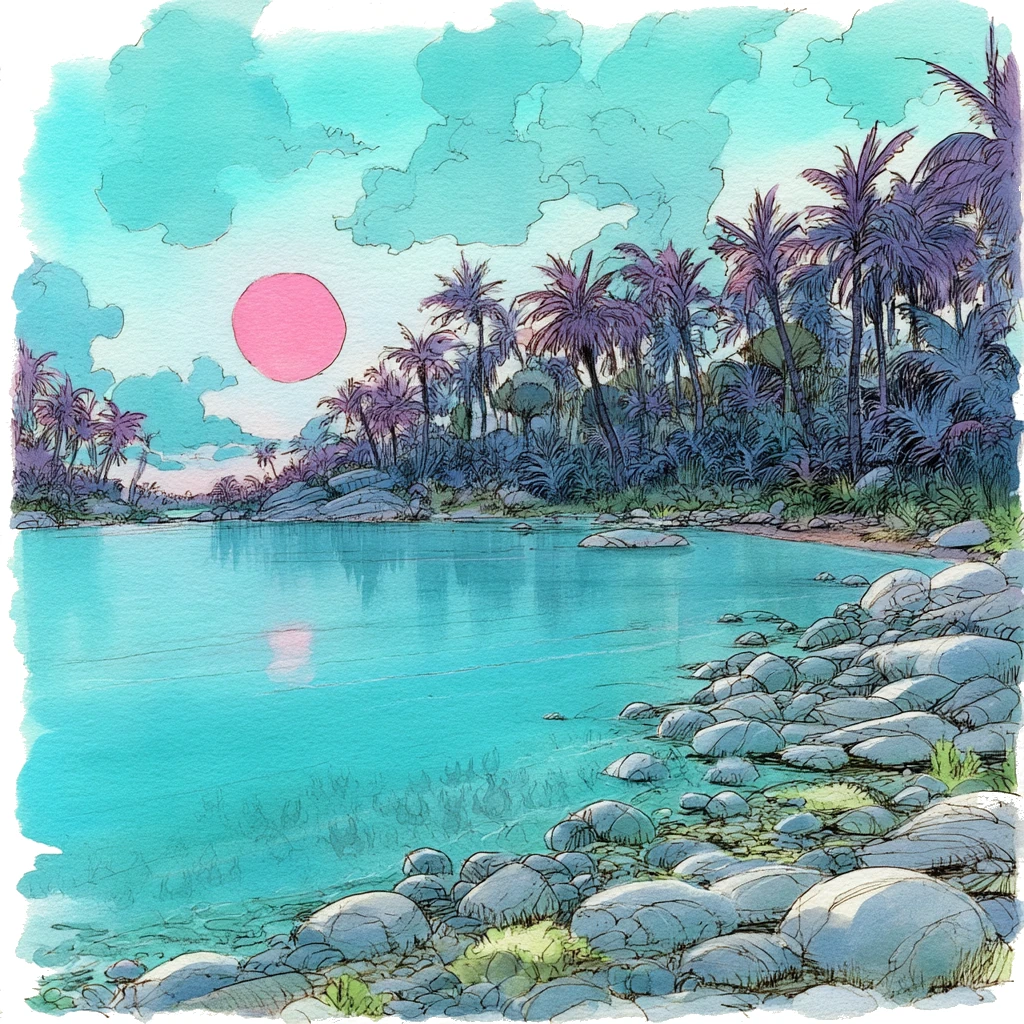
Falseharbour is a deceptively placid cove that festers between several of the larger islands of the Bleached Archipelago. Its gently sloping mouth is fringed with rocks that the sea has polished into smooth curves. From the ocean, it looks like the perfect refuge: a calm, sheltered anchorage where a weary ship might ride out a storm. The sea here seems to lie unusually still, a pale, shimmering blue that almost looks like real water—if a body is addle-coved enough to believe it. The illusion is deliberate. The harbour is not deep at all; the bottom rises in a treacherous shelf of jagged rock and fossilised crustacean carapaces that would tear the keel from any vessel that tries to moor here. The shallow water is thick with the larval and juvenile forms of Addanc’s lobster‑demons, who hide in the murk, waiting for the moment a ship or planar barge moors, or a foolish planewalker steps too near to the shallows.
Ilmurrax’s Grotto
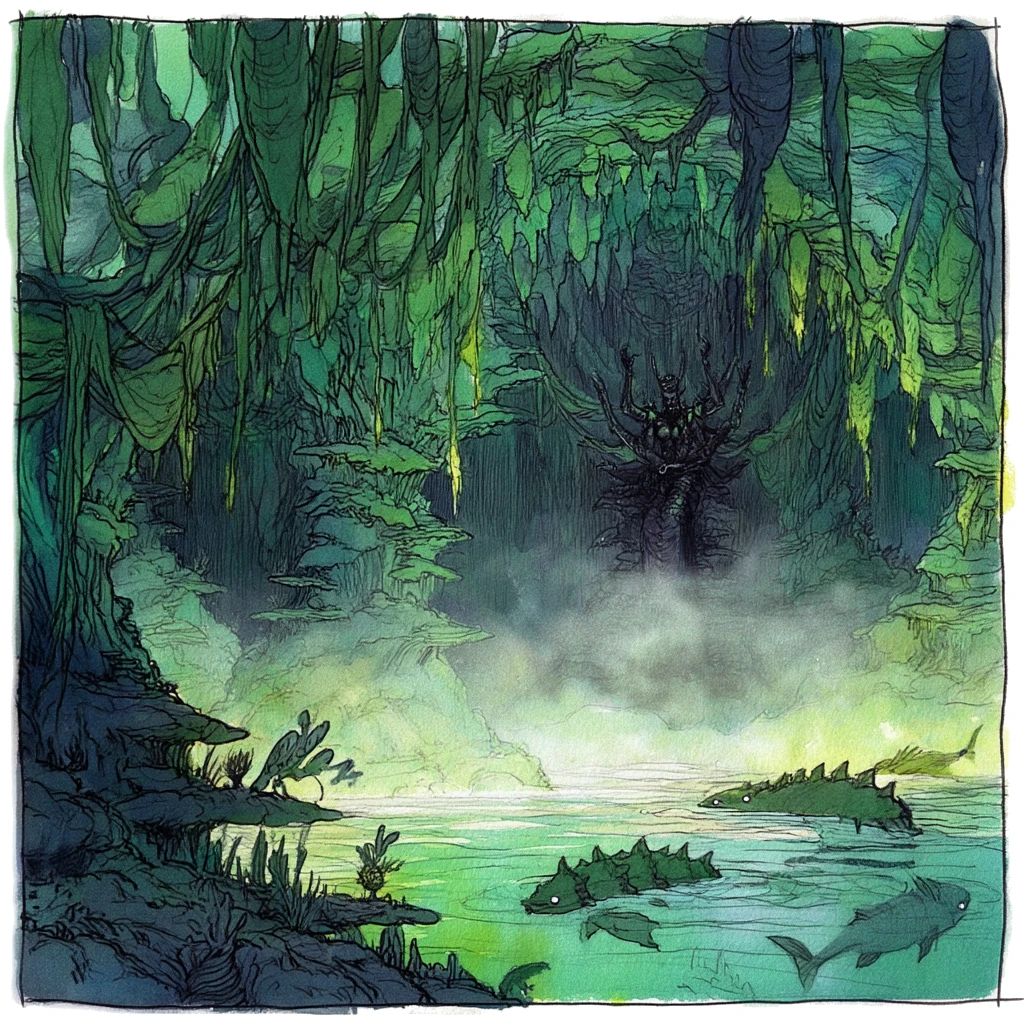
A crumbling sea cave carved into the underside of one of Burningwater’s more precarious islands, the entrance to Ilmurrath’s Grotto is shrouded by a curtain of foam that hisses as it falls back into the sea and glazes the surrounding rocks with an iridescent patina. The walls of the cavern are ribbed with layers of coral and stone that have warped into shapes resembling cages, twisted through with thick veils of slimy kelp‑like growth that pulse with a faint, sickly light. The grotto’s floor slopes down into a central pool of the acid, deeper and colder than the surrounding shallows and where the surface is often broken by the slow, heavy circling of armoured fish-with-claws that serve as Ilmurrath’s private guard, their eyes glowing in the gloom. The grotto’s ceiling is strung with stalactites of salt‑crusted minerals, natron spikes which could make fine weapons. Ilmurrath (planar marilith tanar’ri [she/her] / CE) broods on a half‑sunken throne, her serpentine form shrouded in the perpetual mist of the place. She’s an exile from the Shadowsea, although what she did that angered Dagon, or how she survived his wrath, are both dark. She’s more than half-barmy now from the fumes, but has managed to attract a small cult of equally crazed merfolk petitioners who’ve sworn fealty to her.
The Larval Bore
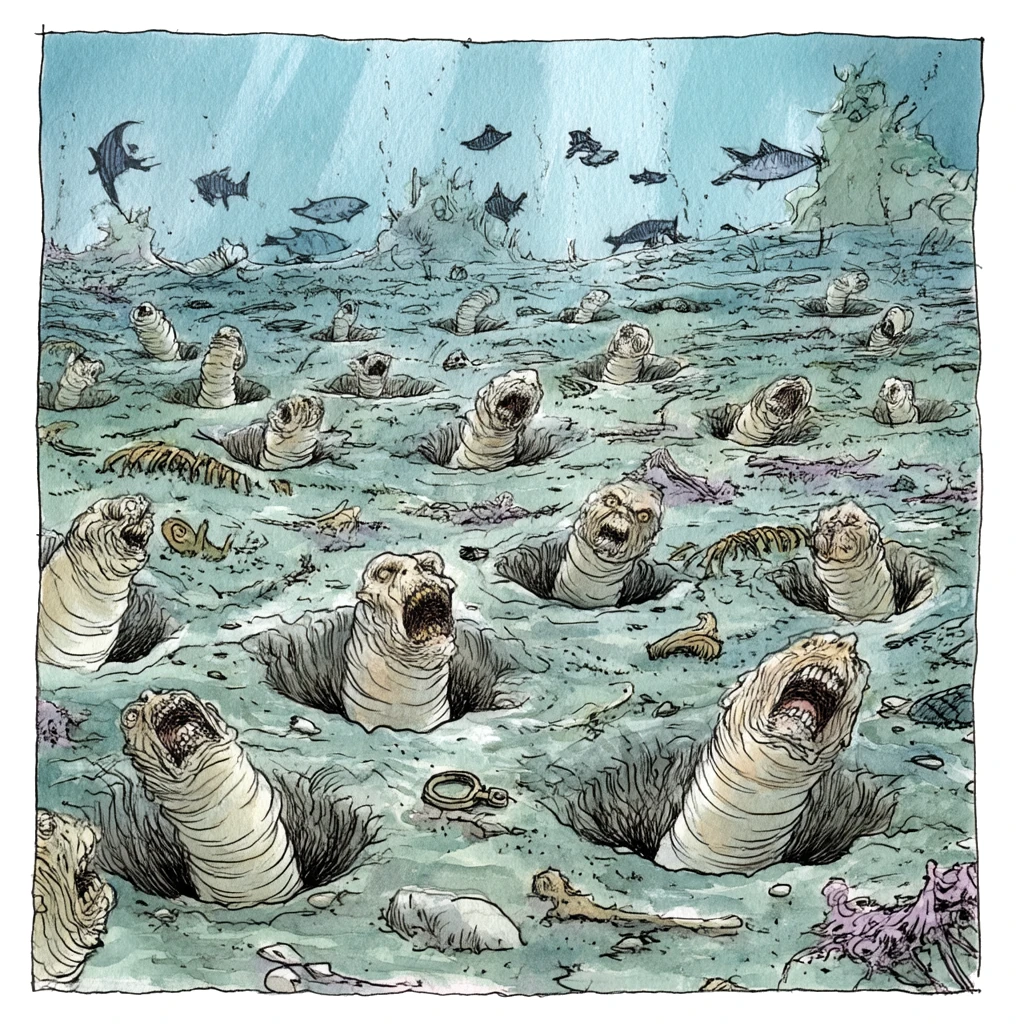
The Larval Bore is a slow, ceaseless current that coils through the deeper trenches of the Sea of Eosvotti like a hungry serpent. Its surface is oily with the detritis of the sea and its depths roil with the bloated shapes of Addanc’s drowned victims and the larvae they are becoming. The tidal bore moves with a terrible, unhurried rhythm that drags the swollen corpses of fishers, sailors, and failed planewalkers down into the dark where the ‘water’ is thickest, and the light of the pink sun cannot reach. The sea-floor here is lined with pock-marked larvae pits, hollows in the rock that are overgrown with pulsing, worm‑polyps that feed on the flotsam of the tide. A carpet of half‑dissolved fragments remains, the bones of the drowned picked clean and then picked clean again, until only milky shells of calcium and the occasional tooth or buckle remain. The larvae themselves float in dense, shifting shoals, their bodies translucent, their tiny mouths twitching with needle-teeth as they strain the sea for the faintest trace of flesh. When the tide surges or the sea shudders from one of Addanc’s distant storms, the larvae rise in a writhing, living wave, mouthes upward, as if even the acid water itself was a thing they can devour. The Larval Bore is an ever-hungry throat, well—a million throats—a slow devouring abyss within the Abyss. To drift into its current is to be swallowed, digested, and then, if the powers are in a cruel mood, returned into another form entirely.
The Mustering Reef
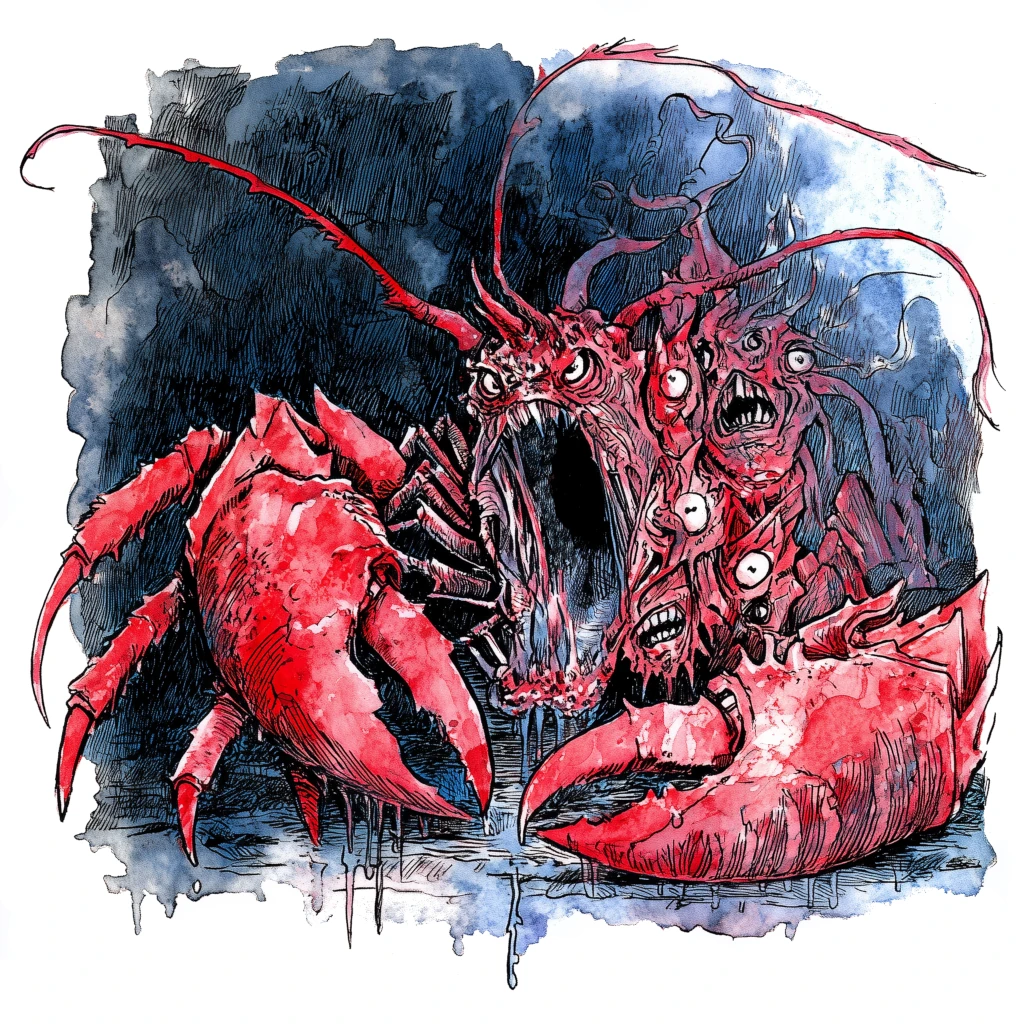
This place is a vast, unnaturally flat shelf of stone running for leagues beneath the sea of Burningwater. Its surface is carved by the currents a grid of shallow trenches and low, fossil‑encrusted ridges that give the place the look of a drowned graveyard. The Mustering Reef glows a dull green with phosphorescence of the crustacean demons that cling to its surface, their shells hard and vitrious, their bodies piled in chaotic, teetering heaps. Here a lobster‑demon with far too many eyes is wedged atop the back of an armoured fish, there a cluster of crab‑ish horrors is stacked in a lopsided pyramid, all of them twitching restlessly, as if the mere act of staying still in this place is a struggle. The acid tide here is thick and strangely sluggish, the only movement is the slow drift of the banners strung on tendons that hang from the few jagged spires rising from the reef’s surface. Each flag is marked with the sigil of a different Abyssal cohort, but most of them are obscured by the shells of the creatures that have crawled up them to get out of the acid. At the reef’s heart, a colossal, half‑dissolved Chaos Ship’s prow thrusts upward, its hull long eaten away, its outline now a skeletal frame of bone and rust. Above it towers a crude altar where the generals of the Mustering Reef occasionally gather to listen to the distant, echoing commands that come drifting on the tide from Addanc’s Drowned Throne and plot—something….
The Oily Isle
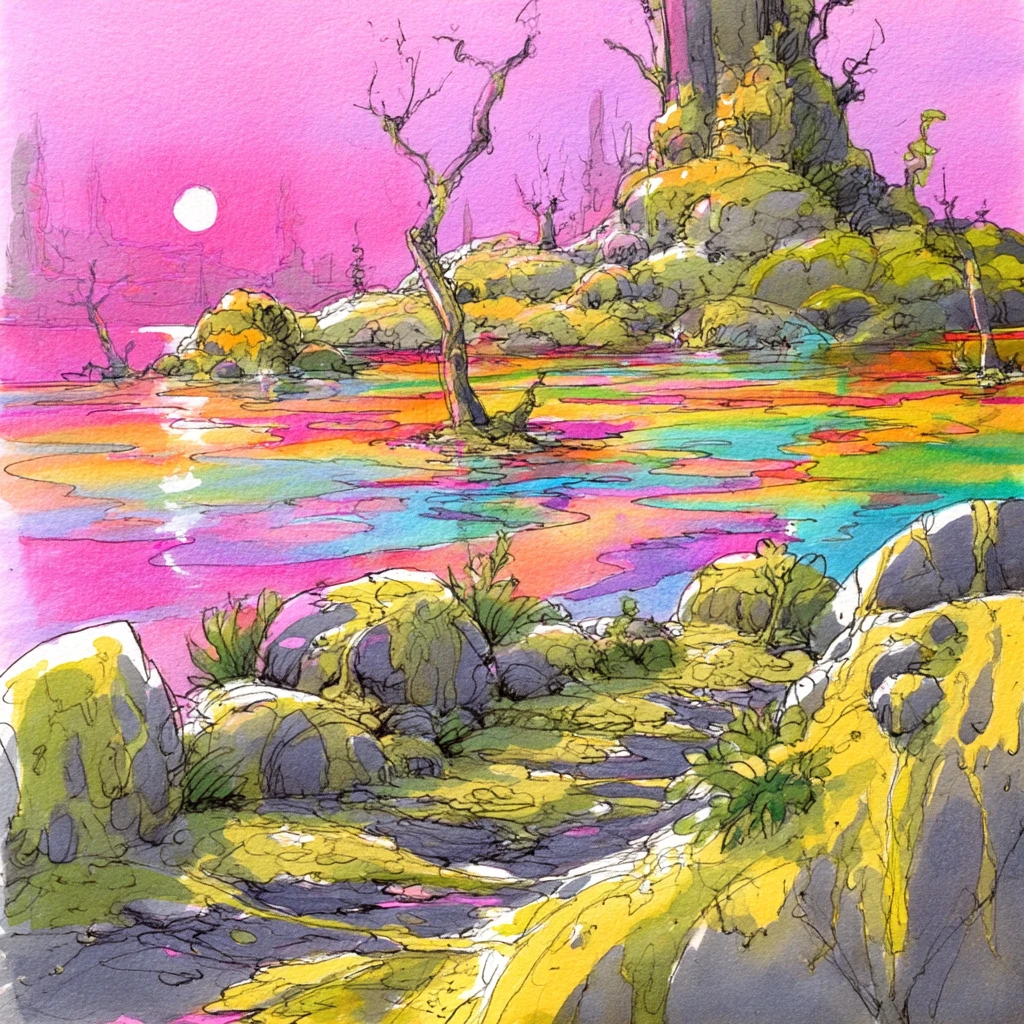
A broad, squat island in the shallows of the Sea of Eosvotti like a half‑drowned whale, the surface of the Oily Isle coated in a thick, glistening layer of yellow‑grey blubber that rises from fissures in the rock. It pools in shallow, rainbow-coloured lakes that reflect the sunlight in dazzling patterns but smell of burning fish. The air above it hangs heavy and foul, obscuring the island so that it’s not visible from a distance. The ground is a treacherous mix of slick rock and sucking mud that clings to boots like tar. The sparse, twisted vegetation that somehow grows here is stunted and half‑dissolved, with leaves crusted with scum. The island is home to a fractious colony of tanar’ri outcasts—weak, malformed, or politically disgraced fiends who have been driven from less undesirable Abyssal realms and now huddle in the oily caves and half‑collapsed shelters they have scraped from the cliffs. Their bodies are slick with the same foul substance that coats the land and their voices rasp as if their lungs have learned to breathe nothing but smoke. Any water here is tainted almost immediately, turning greasy and iridescent, but here even the foul‑tasting stuff is be a luxury. To the Abyss, this place is a useful dump, a place where the weak, the broken, and the unwanted can be left to stew in their own filth until Addanc decides what use they might still have.
Olhado
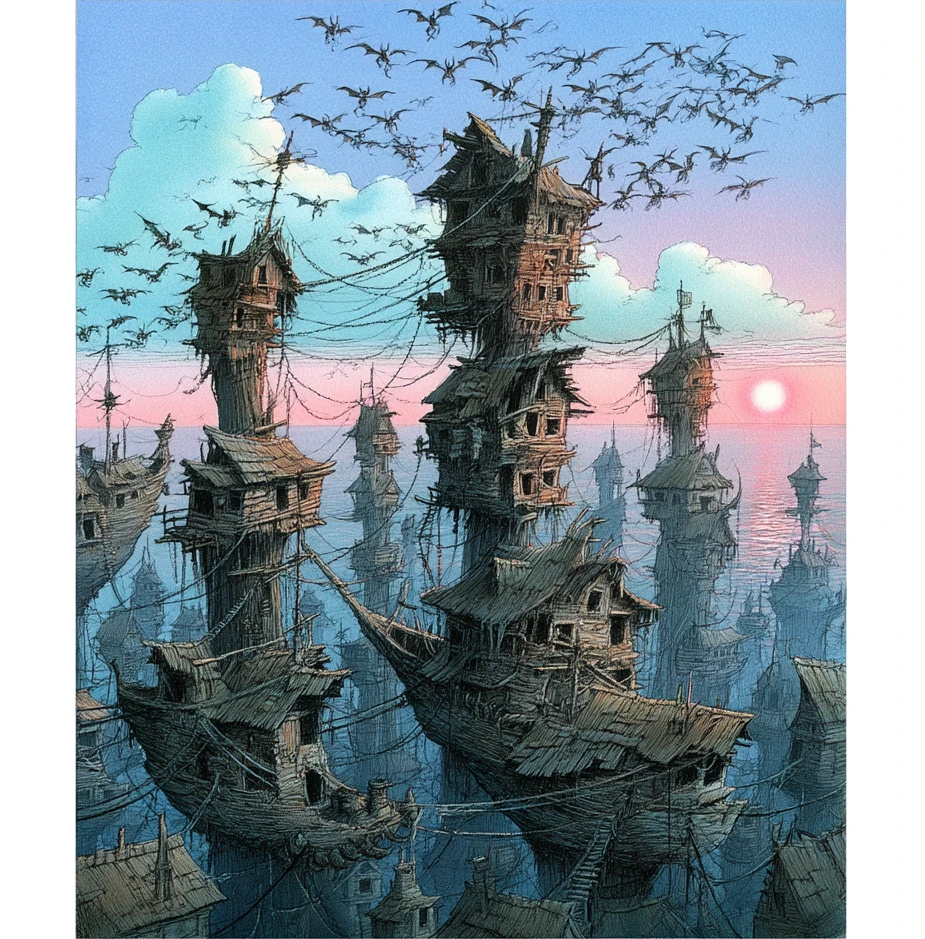
Olhado [oll-HARD-oh] looks like a settlement that should have collapsed under its own weight long ago. It’s a jagged, lopsided island‑burg that juts out from the sea like a bag of bones. And that’s basically what it is— the corroded, skeletal remains of unidentifiable colossal sea monsters that have been dragged up from the depths and strapped together with chains. The rib bones have been warped by centuries of acid immersion, thick leathery hides have have been stretched out into platforms and walkways, and enormous scales have been used as the rooves of crooked, makeshift hovels that lean into each other for support. The island is littered with the bones of berks who met their end in the Burningwater, their skulls and long bones embedded in the walls and streets like grisly tiles, the acid‑whitened remains forming a macabre mosaic that the tanar’ri consider both functional and decorative.
Above the burg, the skies are patrolled by spray‑scarred quasits, their wings stained with salt, and their bodies slick with the corrosive mist that rises from the sea. These little fiends circle ceaselessly, peering down at the waves for any flotsam that has somehow survived the acid long enough to bob to the surface, because in Olhado, anything that does not immediately dissolve is a building material in the making. The imps snatch up the least‑corroded bones, the most intact shells, the occasional half‑melted bit of metal or the rare, acid‑resistant hide, dragging them back to the island’s skeletal cranes and winches where the lesser demons and petitioner castaways labour to bolt, lash, and weld the new arrivals into the growing, sagging structure. That it hasn’t yet sunk under the waves is a testament to Abyssal ingenuity and sheer bloody-mindedness.
The Reef of Ssythorex
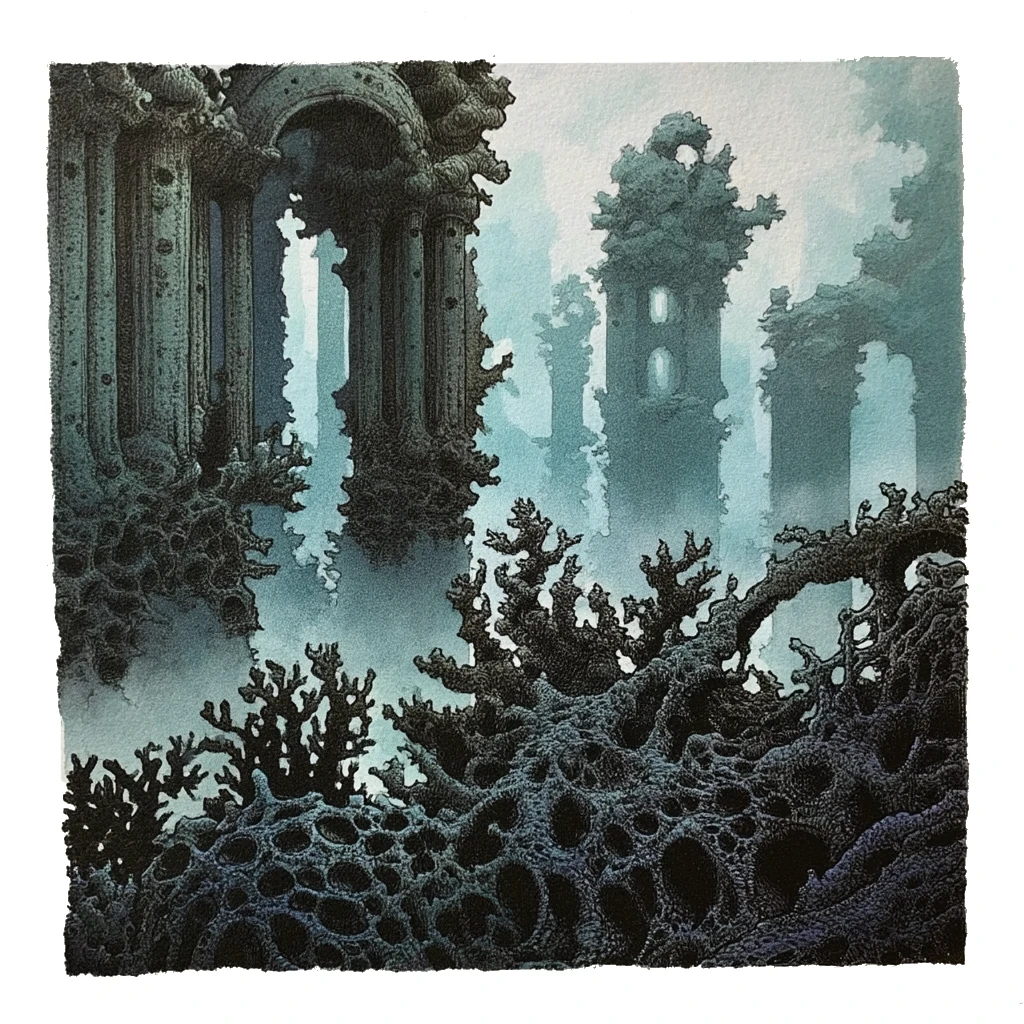
The Reef of Ssythorex [sss-EYE-thor-ex] is a jagged, sprawling barrier of blackened coral that rises from Burningwater like a sunken spine. Its surface is pitted and riddled with tunnels and crevices that oozes veins of phosphorescent black-ultraviolet slime that pulses in colour like a heartbeat. The reef’s surface is a maze of towering columns and broken arches, twisted into grotesque, tooth‑like shapes. The ‘water’ that flows through it is thick and heavy, the acid seeming to hang in the currents like a viscous fog. The tanar’ri that rules this shadowy place is called Ssythorex (planar nabassu tanar’ri [it/its] / CE) and is a mysterious cutter for sure. As any planewalker worth their salt can tell you, nabassu spend most of their time as juveniles wreaking havoc on the Prime Material plane. Only when they mature into their adult form do they settle down to torment Pazunia—so quite why Ssythorex has made its lair on Burningwater is a matter of speculation. It has surrounded itself with a pack of ghasts, and its reef in a shroud of shadows. It seems that Addanc is giving the creature a wide berth, and perhaps this is a clue as to the motivation of the nabassu, for these tanar’ri are also known as death stealers and are said to hunt fellow fiends. A nascent Abyssal Lord would surely be a tempting quarry.
The Sea of Eosvotti
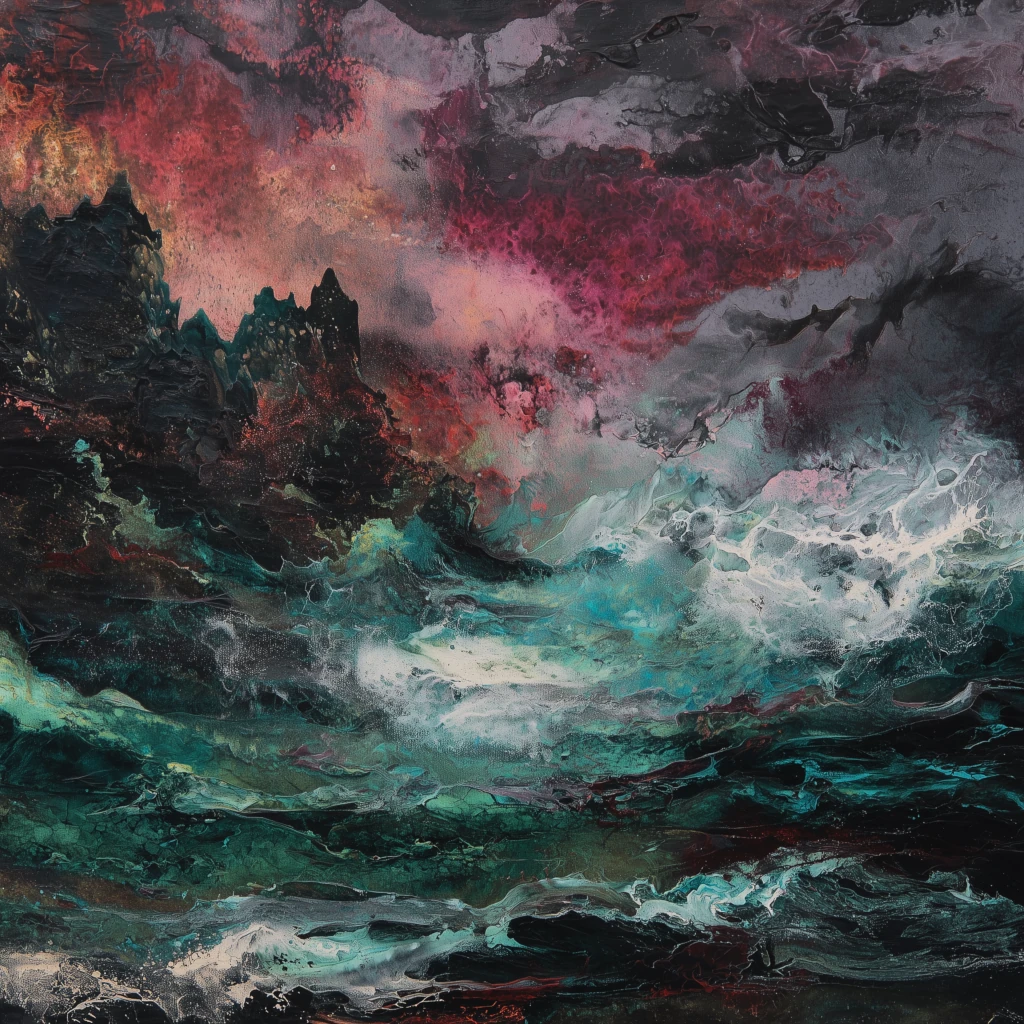
The Sea of Eosvotti [ay-oss-VOTTY] is an endless, undulating expanse of greenish‑acid water that stretches to the ragged, acid‑clouded horizon in every direction. The islands of the Bleached Archipelago and the burgs of Ciccarone and Olhado float upon it like scabs on a puddle. From a distance, the sea appears almost tranquil, its surface reflecting the pink sun in broad, rippling bands of rose and gold, the cyanic clouds overhead drifting lazily. The air is warm and humid, although it carries the faint, cloying sweetness of something long-spoiled. The water is deceptively clear, the blue‑green depths seemingly inviting, the kind of sea that might lure an addle-coved marid from the Elemental Plane of Water into its embrace…
The sea is the heart of Burningwater, the layer’s one consistent feature and (apart from its inhabitants) the source of all its horrors. Its surface is usually calm, but frequently wracked by sudden and unreasonable storms that carry the crushing fury of the Abyss within them. The sea is alive with the creatures that have adapted to its acid, the glass‑shelled lobsters, the armoured fish, and the bloated larvae. The Sea of Eosvotti connects, somehow, to the Ethereal plane, its surface a thin, trembling veil that can be pierced by the right magic, the right ritual, or the right pitch of scream. The sea’s surface sometimes shimmers with the faint, ghostly images of the Prime worlds that float just beyond the reach of the Abyssal mists, memories of some other, better world that deserves to be corrupted.
As for ‘Eosvotti’, your guess is as good as mine, cutter. The tanar’ri here utter the name with a mixture of fear and reverence, and refuse to elaborate.
Shimmergate
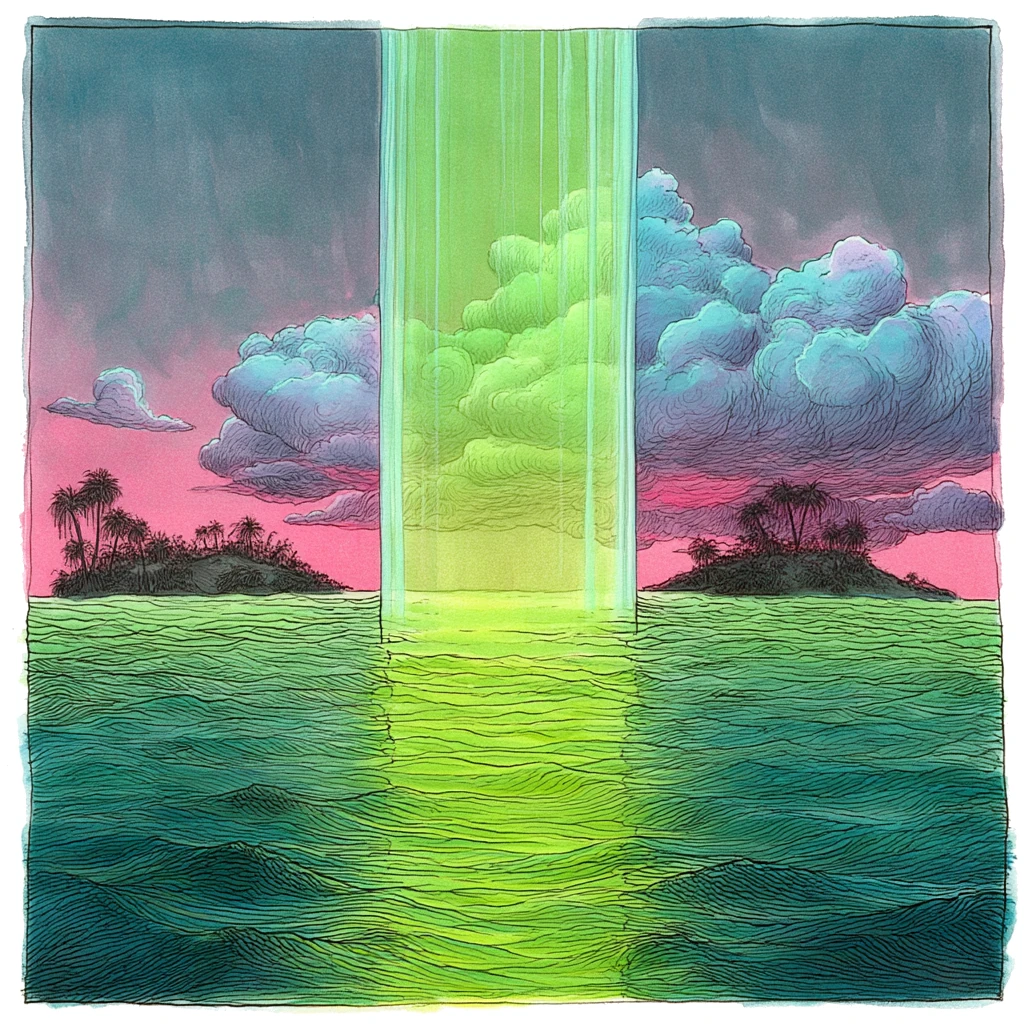
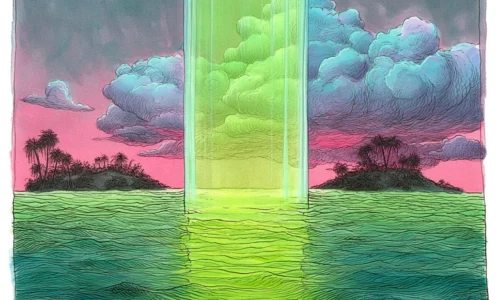
The Shimmergate is a place where the Sea of Eosvotti grows thin and the layers of the multiverse press close together, a vertical rift in the acid‑green waters where the sea seems to dissolve into a rippling, translucent veil that hangs like a curtain in the deep. Around it, the usual cloying, corrosive sea behaves oddly: the currents slow, the light from the pink sun above fractures into shimmering bands of silver and green, and the ocean’s surface glitters with a faint, opalescent haze. Here the Ethereal plane presses against the Ninth so closely that the barrier between them is little more than a trembling membrane—to swim, or be pulled through, the Shimmergate is to pass, for a moment, where water and mist become one.
The gate is a crossing‑point of great value, which is why Addanc’s forces guard it jealously from both sides. On the Ethereal side, the gate appears as a vertical waterfall of liquid light in the silvery fog; on the Abyssal side, it is a column of unnaturally still luminous water, a kind of surreal laminar flow. Anything that passes through must contend with the sea’s acid, true, but there’s no more efficient way to get from the Abyss to the Deep Ethereal, and from there in to whichever Prime Material Plane you’d like to visit, or if you’re Addanc, harvest.
Stinking Pearl
I wept, when I first saw it. I was already in some pain at the time, which did not help — but I would like to believe I would have wept regardless.
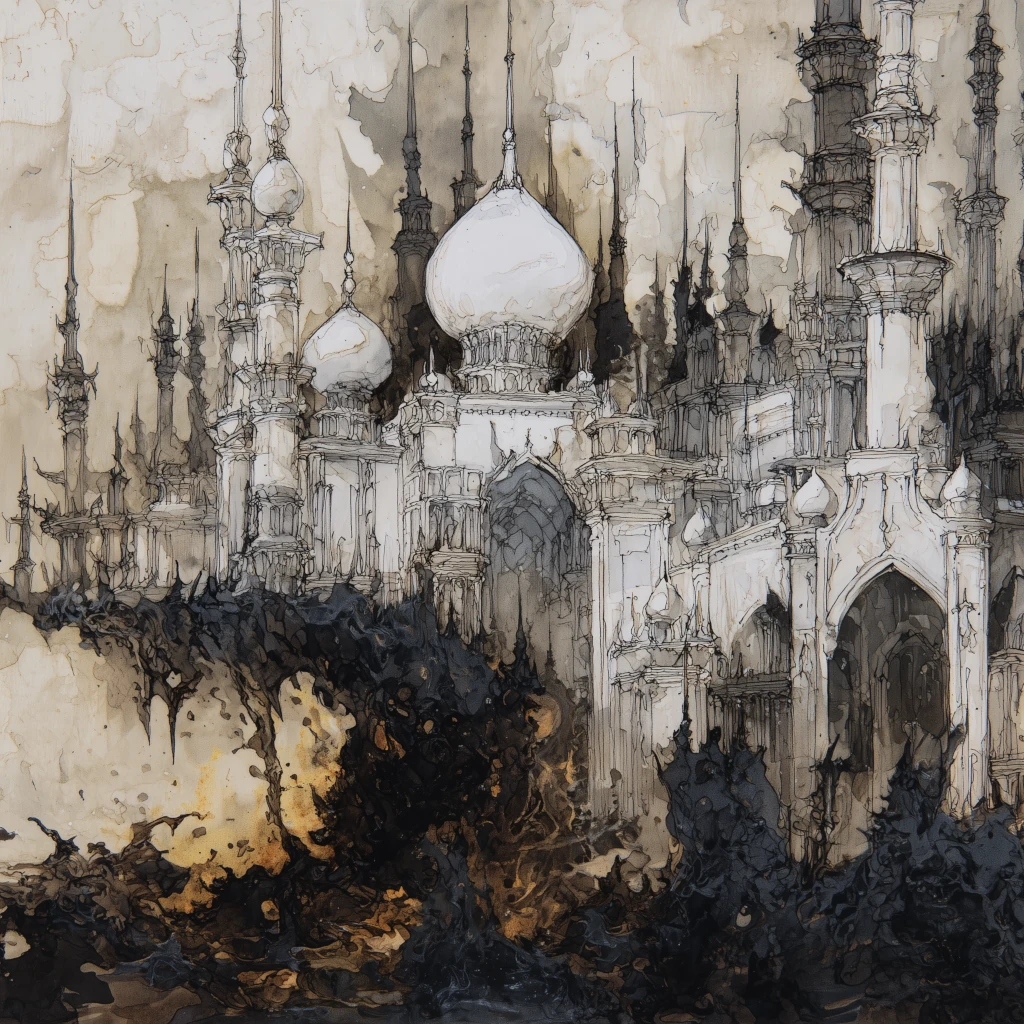
Planewalkers who have come back from the Ninth describe Stinking Pearl with a particular expression: They weep while they talk about it, and the tears are not entirely grief. The burg is surely one of the most beautiful settlements on the planes. Delicate spires of coral rise from its streets. The roads are inlaid with mother-of-pearl. The buildings are carved from conch shells of improbable size, shaped with craft and evident love into something that deserves to be seen. It is, in every aesthetic particular, a wonder.
And it is dying. And it stinks. And it was stolen.
You might not be surprised to learn that Stinking Pearl is not originally of the Abyss. It was once known as Shining Pearl, a burg on the seafloor of Thalasia, the great sea that comprises one of Elysium’s layers—a place of peace and beauty and the gentle, good death of those who deserved their rest. The chant holds that Addanc reached across the planes using the Thalastrom, a sea-storm of terrible and apparently interplanar intensity. The Thalastrom descended upon Shining Pearl and engulfed it for days and nights, and when it moved on, nothing remained on the floor of Thalasia but a gaping wound in the rock and the stench of evil rising through the pure water like oil. At a similar time, more or less, there were cataclysmic seaquakes in Burningwater, and then suddenly Stinking Pearl simply was, where before there had been only acidic sea.
The name “Stinking” is in the acid water, literally. The sea is eating the burg alive. The mother-of-pearl streets have lost some of their shine. The coral spires have hairline fractures that widen by the cycle. The conch-shell houses are pitting and crumbling at the edges, dissolving grain by grain into the caustic sea that surrounds them. The burg is still beautiful—genuinely, achingly beautiful—in the way that beautiful things are at their most beautiful when you can see they are ending. But the sadness is ingrained in the shells now, and the tanar’ri who’ve made the place their own, naturally, love it there.
The Vents of Vitriol
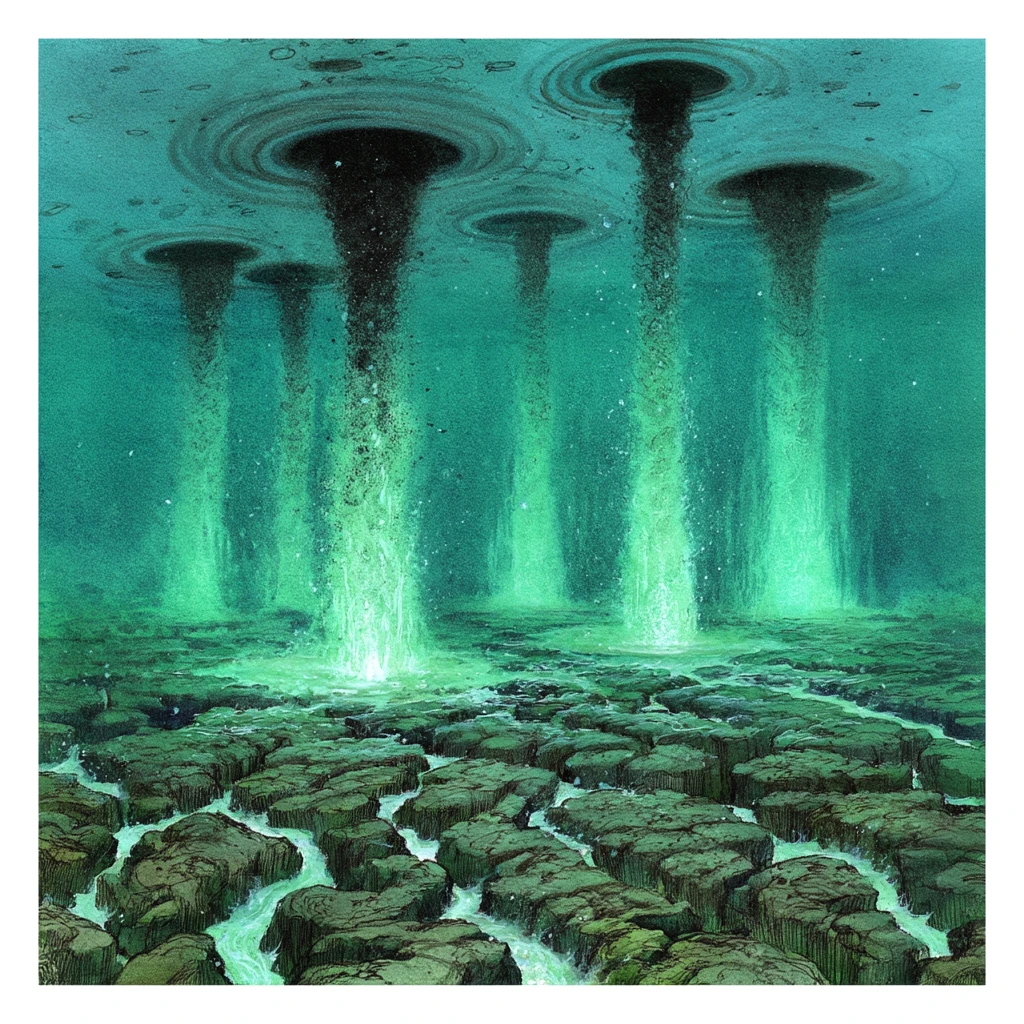
The Vents of Vitriol are a series of fissures which snake across the deep sea floor of the Sea of Eosvotti, where the Abyssal crust has cracked open and the layer is turning itself inside‑out. Boiling plumes of concentrated acid erupt upward in columns, their edges shimmering with heat‑distortion halos and their cores a seething, emerald‑green so intense it looks almost alive. The water around the vents roils in a constant churning updraft, the current tugging anything loose like the Abyss is trying to drink the sea itself. The rock around the fissures is pitted and warped, and streaked with mineral veins that glow in the perpetual gloom. The Vents are not quiet; the sound of them hissing and crackling echoes through the water for many leagues.
These pits seem almost sacred to the glass‑shelled crustaceans of the Ninth Layer. The mutated lobsters, shellfish‑like horrors, and armoured fish gather in dense congregations around the vents, treating the acid plumes like unholy fonts. They cluster just outside the currents, the acid burning streaks into their carapaces, and they raise their pincers in slow, rhythmic motions that resemble dance or even prayer. Some of the largest specimens stand on the very edges of the fissures, riding the updrafts like aquatic birds. Their bodies might etch thinner with each exposure but their eyes gleam with the agony of fanatics. They know, like their lord Addanc, that if the pain doesn’t kill them, then it will only serve to make them stronger.
The Weeping Wound
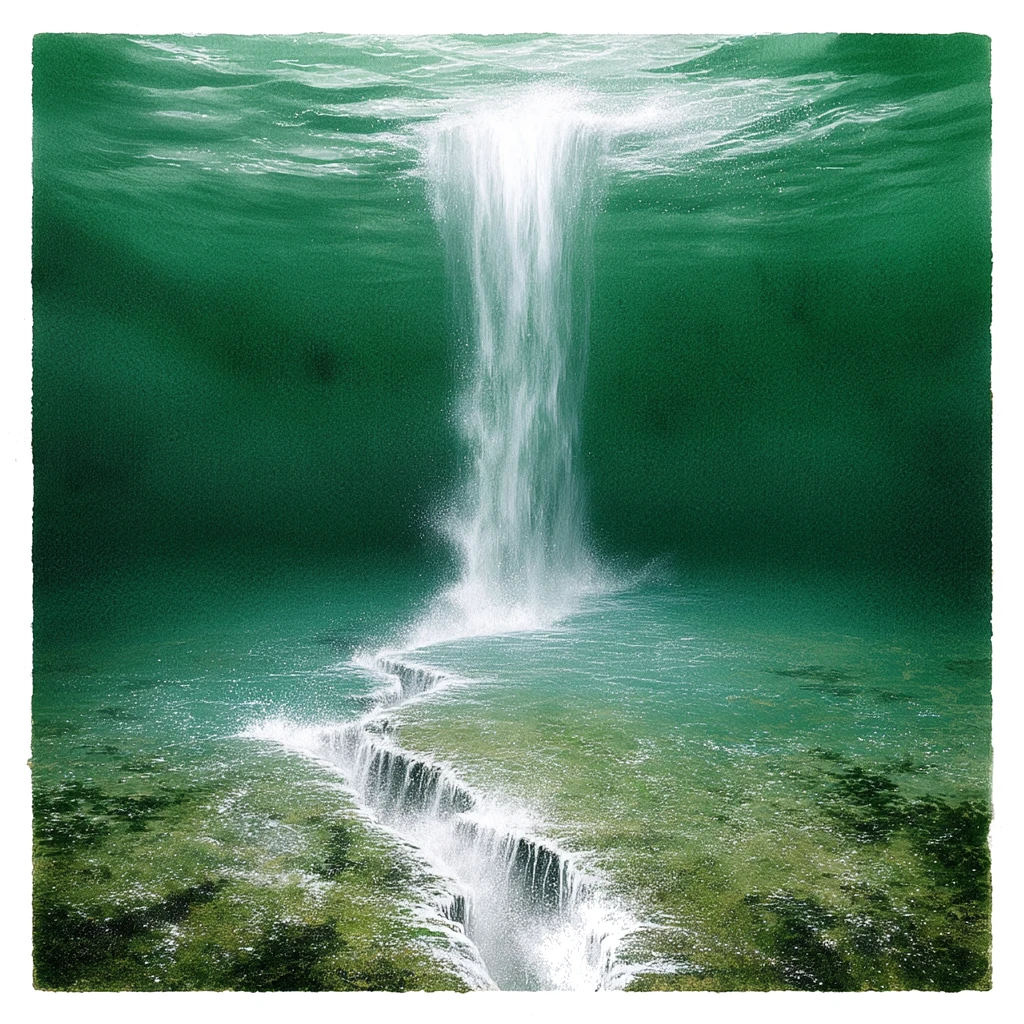
The Weeping Wound is a jagged, ragged tear in the sea floor not far from the dissolving foundations of Stinking Pearl, a place where the Abyssal bedrock has been ripped open by some tremendous, ancient violence and has never managed to heal. The edges of the fissure wound are coated in a strange, slick, whitish mineral that glistens like frost despite the sea’s heat. From its depths, every so often, come slow, pulsing jets of effervescent fluid that rise toward the surface in trembling columns. The sea around the wound is unnaturally quiet—the usual skittering of crustaceans is silenced here, as if the place is holding its breath.
What makes the Weeping Wound truly cursed—in the minds of the tanar’ri anyway—is the scent that drifts from those jets. Sickeningly the water around the wound carries the unmistakably clean fragrance of fresh water. It’s the kind of sweet water smell that would belong in a river of Elysium, not in the acid‑drenched depths of the Abyss. Tanar’ri who’ve come near it have described the sensation in the same way: a brief, jarring pang of recognition, that makes them pause, turn, and then stare in something uncomfortably close to blissful nostalgia. The chant says that the Weeping Wound is a fragment of Thalasia from which Shining Pearl was torn, that came along for the ride when the burg was dragged into the Abyss. The plane has tried for centuries to twist it, to poison it, to make it feed on the very corruption that surrounds it—anything really to exorcise the wound. So far the Abyss has failed. The Wound weeps because it is a thing out of place and out of time. Somehow it has resisting becoming what the Abyss wants it to be, and as well as being a rare respite in the horrid sea of Burningwater, it’s also something of a curiosity for planewalkers. Whatever is the secret preventing the Weeping Wound from either being assimilated into the rest of the layer, or else kicked out of the Abyss in a conjunction, would be of great interest to graybeards and Abyssal Lords alike.
Canonical References
- Planes of Chaos [2e] Chaos Adventures poster
- Non-canonical details (I think) on the layer at Fandom here and here
Source: Jon Winter-Holt. Only the vaguest of information is available in the canon for this layer—the interdicted nature of the layer, the acidic ocean and the danger—all the the entires for this layer are speculation and homebrew… [‡]