[ Outsiders > Fiends > Parochial > Likhoradka ]
[ Cattle’s Death | Gneteya | Korcheya | Kostolomka | Ogneya | Ospa | Oznoba ]
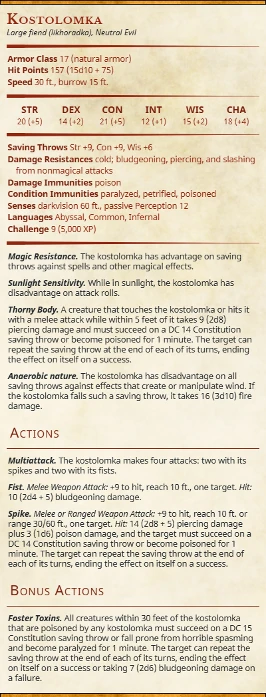
Likhoradka, Kostolomka
The Devil’s Smile; the Bone-Breaker
| TRAITS: | Fiend | Unholy |
| PLANE / LAYER: | Gray Waste |
| ACTIVITY CYCLE: | Any |
| DIET: | Rust |
| INTELLIGENCE: | 12 (+1) |
| ALIGNMENT: | Neutral Evil |
| SIZE: | Large |
| CHALLENGE RATING: | CR 9 |
Their name is blunt in the way that those old Slavic words for suffering tend to be: kostolomka—the bone-breaker. Not because the disease they embody shatters bones directly, but because lockjaw does something arguably worse. It turns a body’s muscles against its skeleton, contracting everything at once, bending the spine backward until the head and heels both touch the ground, clenching the jaw so tightly that teeth crack, twisting the face into the sardonic rictus grin of the damned. The expression of victims killed by a kostolomka is that of someone tortured, and death, when it finally comes, is a mercy.
Lockjaw is an ancient disease. The ancient Egyptians knew of it, associating it with deep wounds that had been contaminated with soil. Roman armies knew it as a silent consequence of surviving a battle: more sods died of their wounds in the days that followed, than had fallen in the fighting itself. The link between wounded earth and lockjaw was always understood intuitively. It seems kostolomka have always lived in the ground.
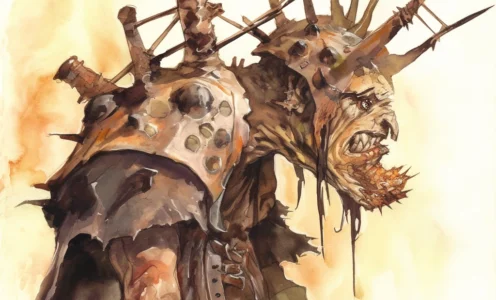
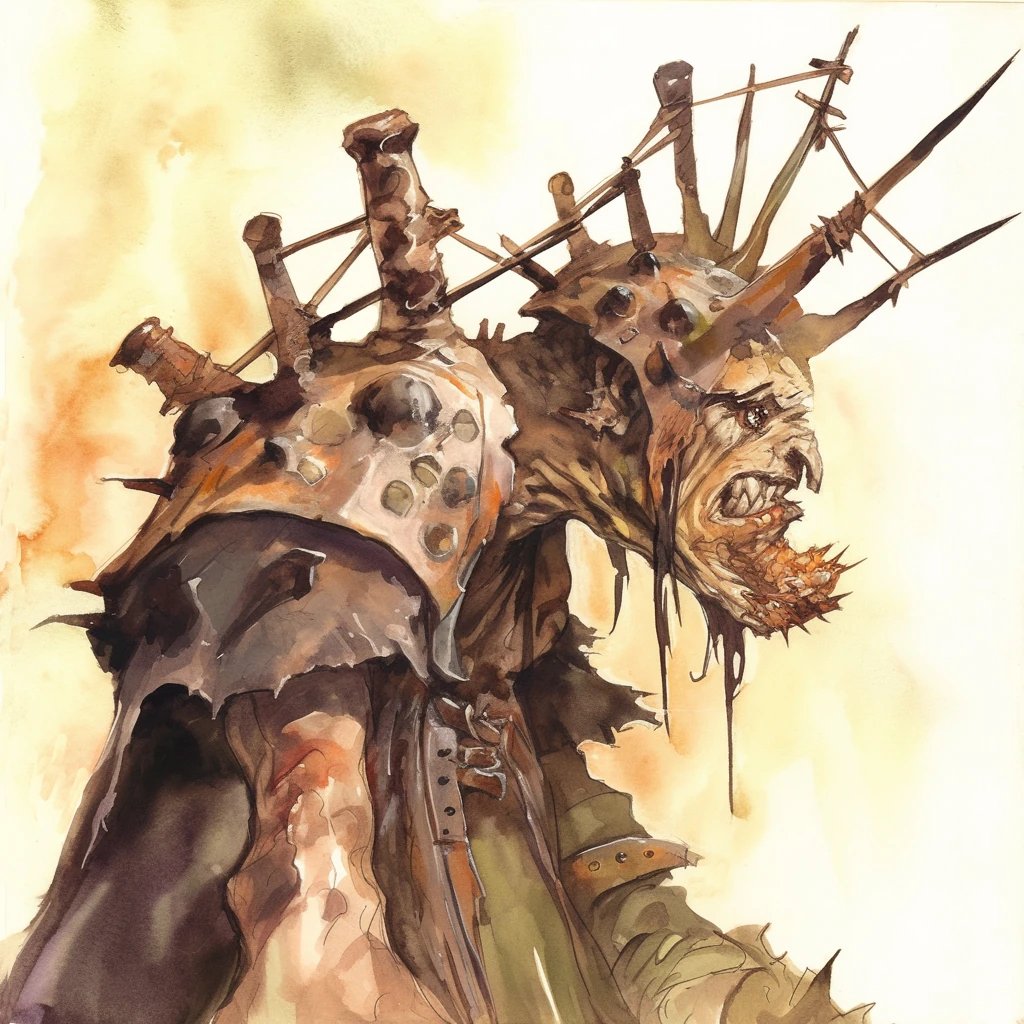
Kostolomkas are unnervingly, wrongly tall, their proportions stretched as though something has pulled them upward like taffy. They are gaunt in the way of something that has been buried for decades and then dug back up. Their skin is the grey-brown of waterlogged earth, and they are caked in it: mud packed into every joint, filling the hollows of their eyes, coating their lank hair in clumps. They smell of deep soil, of rust, and the inside of a wound left too long. But it’s the spikes that cutters remember. Rusty iron thorns and corroded nails erupt from their bodies at every surface: shoulders, forehead, thighs, knuckles. While they might look rusty and crumbling, this is an illusion. A blade that strikes a kostolomka risks returning notched, and slicked with the rust-coloured ichor that weeps from the base of each spike. A fist that strikes a kostolomka does not strike it a second time. And the spikes shift, pivot, and angle themselves toward whatever contacts the fiend, as if they are themselves intelligent.
A kostolomka can pull a spike free, with a wet, grinding sound. The spikes are wielded like daggers, handheld or thrown. Should they wound the flesh of a mortal, it can be a death sentence. Progressive stiffness spreads from the puncture site outwards, the jaw locking first, then the throat, then the back arching, arching more, arching too far. The body becomes its own cage.
Kostolomkas move slowly in the open air. Wind—clean, moving air—is their enemy. It seems to be the one thing that can disperse the miasma of soil and spore they emit. In still, enclosed, underground spaces these fiends are at their most terrible. Kostolomkas are, among their siblings, the most patient. They wait, deep in the ground. Some of them have been waiting in the ground longer than most mortal civilisations exist, for the right victim to come blundering along. They are drawn to battlefields, construction sites, farming communities, to any place where the earth is broken and cutters reach their unprotected flesh down into the darkness. They follow armies—not to take part in the battle, but to pass among the survivors afterwards. Kostolomka walk the field when the fighting is done, among the wounded and the not-quite-dead, and do their work in the silence that follows violence. They do not hurry. There is plenty of time.
Kostolomkas have a particular contemptuous affinity towards those who underestimate wound care. The soldiers who wipe a blade on their breeches and call the cut clean, farmers who bind a gash with whatever rag is nearest. These berks a kostolomka regards almost fondly, the way a predator regards prey that has walked helpfully into the trap. Conversely, they despise prepared cutters who clean wounds carefully, wash their hands, keep bandages dry. But even the careful make mistakes. Especially in the dark, in the hurry, in the aftermath of something terrible.
And a kostolomka always has time to wait.
Sources: Margarita and Jon Winter-Holt. Margarita notes: The likhoradkas are a homebrew fiend race, inspired by the eponymous disease-riddled spirits of Slavic mythology. While based on Slavic folklore and beliefs, the amount of actual information we have on pre-Christian Slavic deities is so minuscule that building any kind of lore out of it is impossible. However, there are a lot of folk beliefs about things these deities are thought to represent, which I have worked into the piece.