
[ Layer the Ninth ] [ Bestiary | Addanc | Locations | Stinking Pearl ]
Addanc
Master of the Corrosive Deeps
Planar tanar’ri would-be lord of inhospitality and extremes [he/him] / CE
Lair: Abyss / Layer 9 — Burningwater / The Drowned Throne
There’s this word that keeps on cropping up in the myths of the Celts throughout the ages, on Prime after Prime. Sometimes it’s theafanc, the addanc, or even the avanc, and it’s refers to a lake-dwelling horror that defies a singular description. Some graybeards record it as a crocodile; others as an enormous, armoured beaver; others still claim it’s a dwarf-like demon of the deeps. It is said to lurk in the cold, dark lakes of the hill-countries, pulling under any berk foolish enough to swim in its waters. Its hide is so thick that no spear, arrow, or mortal-made weapon can pierce it. In some tellings, the addanc caused floods so catastrophic that a whole nation was drowned, with only two survivors left to repopulate the land. In others, the addanc was lured from the water by a sleeping maiden, chained up while it slept, and dragged away to a deeper, colder lake—for even the heroes of the Prime understood that the addanc could not simply be killed, only moved.
Of course, canny planewalkers know the truth behind these myths: the addanc of Celtic stories is not a single monster but a fiendish shadow cast backwards through the Ethereal by the genuine article. The real Addanc is here in the Great Ring, lurking in the caustic waters of the Ninth, and has been here far longer than the Welsh hill-folk have had words for the things they feared in their lakes.
I had heard of Addanc, of course.
Most cutters who study the Lower Planes have.
What the stories do not prepare you for is that the myths of a hundred Prime worlds,
the lake-monster that drags children under,
the water-demon that floods kingdoms,
the beast that no weapon can pierce,
are not fairy stories—but field reports.
— Omar al-Djibou, dictated from the Order’s hospice
Appearance
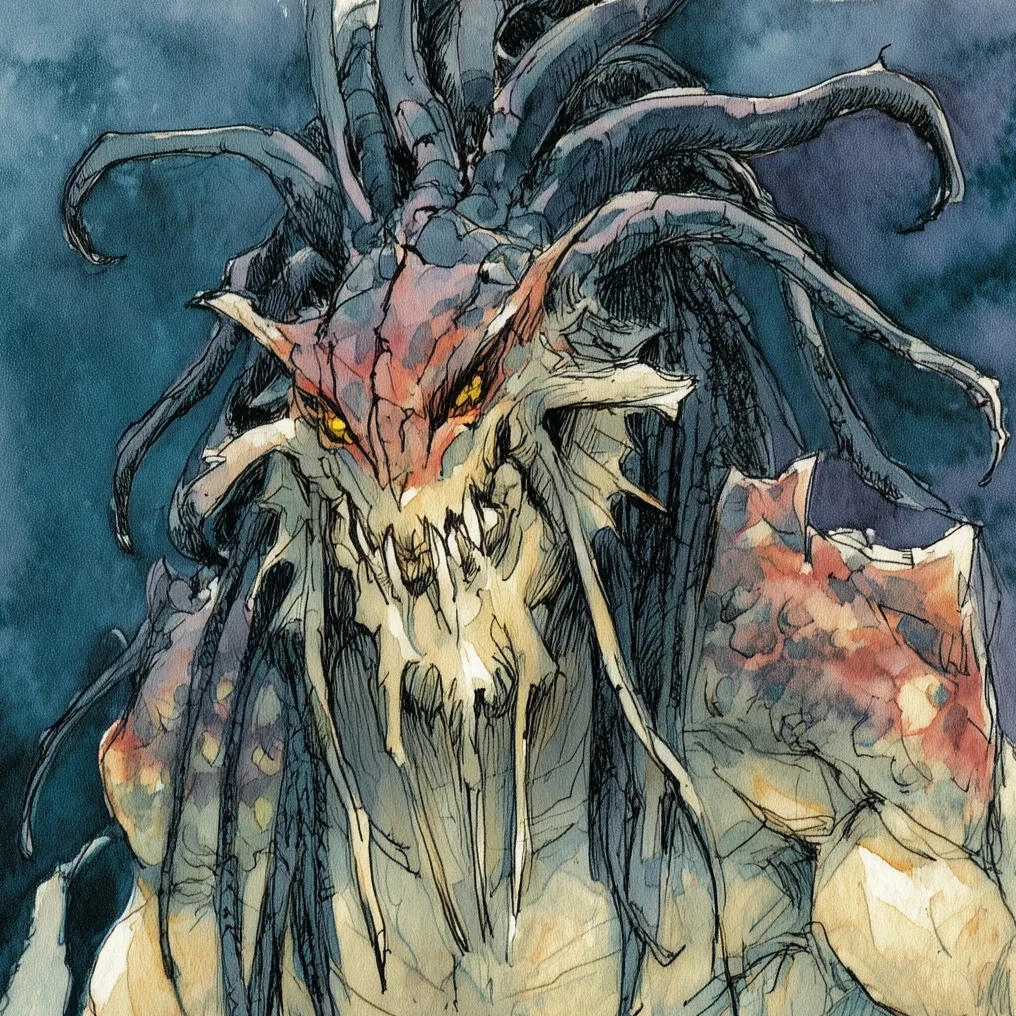
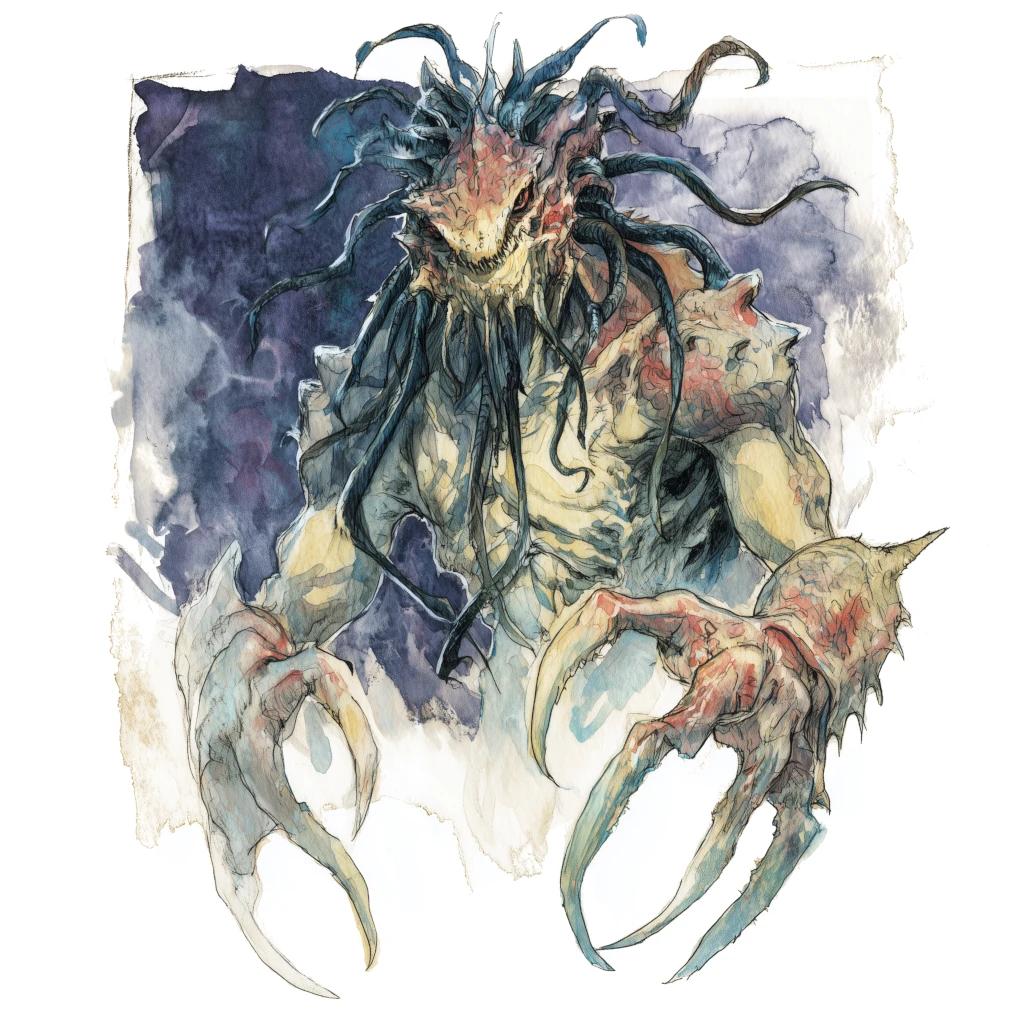
The fiend that calls itself Addanc has a broad humanoid torso and rises at least nine feet tall. His flesh is a patchwork of exposed, raw red and the yellowed ivory of shell-growth beginning to claim it from within. He rises above a mass of crustacean limbs, his lower half a fish-like tail. His broad chest is scarred with the acid of the sea and covered in patches of barnacle-growth that have been there so long they’re now part of his body rather than parasites upon it. His face is predatory, and deeply wrong—his jaw unhinges further than it should, his teeth are set in multiple rows like a shark, and his eyes burn with a cold, patient light that belongs to something that’s waited in the deep dark water for a very long time. From his bony head cascade thick, ropy tendrils—part hair, part tentacle—that drift in the currents of the sea even when he stands on dry land. His claws are enormous and asymmetric: two vast pincers capable of crushing a ship’s hull or severing a man’s torso with ease. He has several smaller, more dexterous grasping limbs that move with precision. In the water, he moves with a grace that seems impossible for his bulk; while on land he drags his body along with those colossal claws, still surprisingly mobile despite having a tail rather than legs.
Philosophy
Addanc is driven by an all-consuming conviction: the weak die, the strong adapt, and only the fittest deserve to survive. It’s the reason the acid sea tests and scours its inhabitants so brutally, the reason the crustacean warriors wear their scar tissue as if it were a war trophy. Addanc did not impose this truth on Burningwater. The layer expressed it, then Addanc arrived and recognised himself in it.
He may be many things, but Addanc is not stupid. This is what makes him genuinely dangerous rather than merely powerful: he plans across timescales that most tanar’ri—fiends of appetite and immediacy—cannot sustain. Addanc’s campaign of Prime-world raiding ain’t random predation as the prime legends might have you believe, but a systematic program of conscription. His army of glass-shelled chuul warriors led by kazrith tanar’ri has been adapting and growing for centuries, each generation tested against the acid of the sea, their shells slightly thicker, harder, more resistant than the last. Likewise, learning to wrest control of the Thalastrom was the culmination of decades of research into interplanar storm-working.
The chant says he intends an assault on the baatezu, or Dagon, or Demogorgon. Or even all three. Most cutters who hear such talk smile at its apparent absurdity. The more perceptive ones stop smiling when they’re told about the depth of the Mustering Reef and the patience of the fiend that has been filling it for three centuries.
The Ninth Wave
Look out to the ocean, far as you can. and you might just spot a series of nine breaking waves. According to the Celts, the Ninth Wave is the great crossing point which marks where the mortal shore turns into a planar pathway to the Otherworld—a veil between life and death, the mortal world and the afterlife. The druids will tell you that its the way that the spirits get to Tír na Óg, and the Ninth Wave is powerful enough to bear away the dead into the River of Souls, or reveal what lies hidden beyond the mortal world. Addanc has corrupted that old tide into something predatory: Where the Ninth Wave once guided worthy travellers toward the Otherworld, the fiend has learned how to use the same cadence to catch the souls of the drowned, hauling them not to peace but down into the acid depths of Burningwater. Once Addanc begins his vile ritual, every ninth breaker ferries the spirit through the thin Ethereal veil and from there into the Ninth. Finally the soul is broken down, scoured, poisoned, and conscripted into Addanc’s army.
It turns out the Ninth Wave wasn’t so hard to subvert. After all, it was already a test of endurance and and transformation—Addanc has simply found a way to twist the test to be cruel enough to serve the Abyss. His minions drive their prey toward the deep water, herding the sods into the right place at the wrong moment, and when the ninth breaker comes it does not deliver them to their afterlife, it send the on a one-way voyage to the Drowned Throne at the bottom of the Burningwater.
By the way, cutter. The legends also preserve one genuinely useful tactical note: the real Addanc, like its mythological shadow, is most dangerous in water. The stories of heroes dragging the afanc from its lake and finding it suddenly powerless are not entirely wrong—Addanc on the sea floor of Burningwater is a different proposition entirely from Addanc forced onto the islands of the Bleached Archipelago. He knows this, and he rarely leaves the sea.
Source: Jon Winter-Holt