Where are all the Dragons?
[An interview between Kallis Tharzar and Lung Tzu of the Fraternity of Order.]
Kallis Tharzar: Sir, I understand that you’ve got a novel explanation of the way the Multiverse works. Would you care to describe this for my readers and Voilà!’s?
Lung Tzu: Of course. It’s why we’re both here, yes?
KT: Very well. [Begins taking notes.]
LT: First, you’ll need to understand how infinitely old planes can have a beginning. There’s a paper on it by Sping Soovin in the Fraternity’s records, which you can check later.
KT: Will do.
LT: In essence, the theory relies on the viewing of the Multiverse from a different direction.
KT: Does this have anything to do with Synjyn the Exile’s Nine-Dimension Theory?
LT: Yes and no. Whilst Synjyn is right about the dimensionality of space, he mistakes the nature of one of the dimensions. He claims that there is an abstraction dimension — not so. The differences in abstraction are a separate consideration, and you’ll see a little of how they’re achieved later on.
KT: So what is the ninth dimension?
LT: Meta-time. The dimension in which ideas are first generated. It is the timeframe of the greatest and widest-ranging legends and the deepest truths about reality. To take an example we’ll return to in a moment, dragon legends describe both how Io the Ninefold One is an eternal being, and also how he came to be out of nothingness. This has no rational interpretation in real time, but by using a meta-temporal axis, it’s easy, comparatively speaking, to talk about the origins of an infinite being.
KT: Hold on. Are you saying that gods get an extra time dimension?
LT: Only the oldest gods. Finder Wyvernspur, for example, is a new god, little more than a mortal —
KT: You remind me of Leir the Explorer.
LT: I’ll come to his theories in a minute. Don’t look surprised. I’ve studied the other research in this field too. Anyhow. Finder is a young god, and always will be. Even Zeus is pretty young in this sense, although he does have an idea of meta-time and is using it to promote his alter-ego of Jupiter, or Jove. But a truly ancient, eternal power like Io or Ptah has the full scope of meta-time revealed, and can understand such wide, transcendent concepts.
KT: OK, I think I’ve got this straight. The deeper the nature of a power’s eternal existence, the more insight into their own true origins in this meta-time they’ve got?
LT: That’s right.
KT: So carry on. How does this affect the actual functioning of planes?
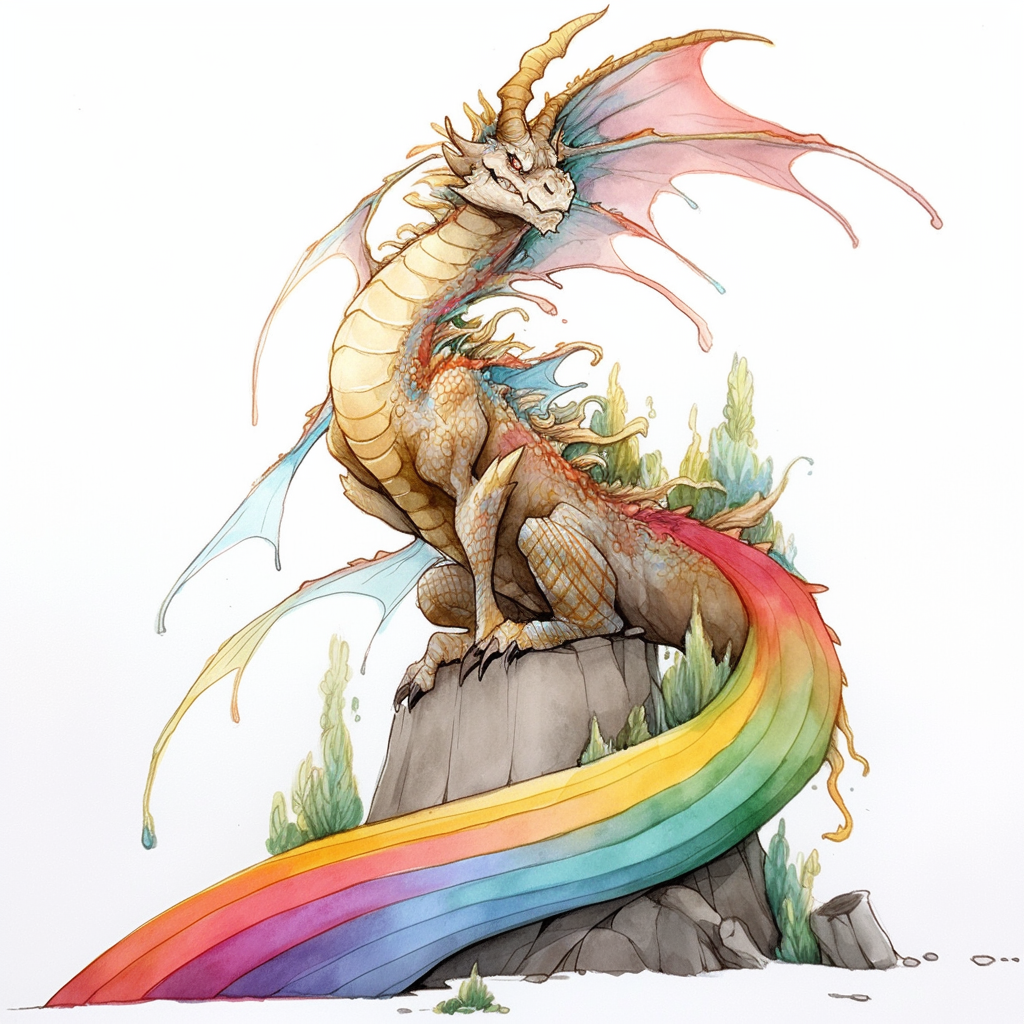
LT: Allow me to tell you a very old legend of the dragons. In the beginning — meta-temporal consideration here, young man — in the beginning, there was nothing. And the nothing divided into three. Three nothings? The meaning is a mystery. But we now see how it is that the number three underlies the whole multiverse. For in the first void there was Io. Where did he come from? No-one knows. But Io looked, and he saw the nothing, now twofold, for he encompassed the first space entirely, although it was still there. It was against his infinite back, and under her immeasurable belly. And the Ninefold One thought, and his thoughts crystallised into the second space, and there were twenty-seven thoughts of substance. And he took these thoughts, these ideas, and built them into something to call her own.
KT: What were these ideas that he — she — that Io had?
LT: They were what we now call the Inner Planes.
KT: Aren’t there only 18 Inner Planes?
LT: I thought you had researched this topic? You forget the nine semi-elemental planes, described by Kristias Fireflight.
KT: I thought it was eight semi-elemental planes?
LT: You’re forgetting Shadow.
KT: Ah. I’m beginning to see where this is going. Three to the third power is twenty-seven, so the Inner Planes form a cube, not a globe?
LT: Right. But allow me to continue. Io took the materials of the Inner Planes, these realms of substance, and created realms of shape, what we call the prime. And there was life. And there was intelligent life, and thought, and belief. There were not yet any powers other than Io, though.
KT: I thought that the powers or the overpowers created the prime worlds?
LT: Meta-time again. Although you are right in describing the origins in normal time of those worlds, it was Io who created the substance of them, and let them be placed where they would. This was in the third void.
KT: So where did the powers come from?
LT: Allow me to continue my story. Io, of whose beliefs those of the mortals were but the palest reflection, was inspired by the diversity he had created, and she gave birth. Whether there were eggs is a matter for dragon theologians. There were twenty-five children.
KT: Why does that number remind me of something?
LT: I said I’d return to Leir the Explorer’s theory. The children of Io were vast, encompassing spaces on the infinity of his body. But she chose not to fill the void she rested in.
KT: I think I see what you’re going to say next. But one thing. Were the other voids also not filled?
LT: The second void, where the Inner Planes lie, was totally filled. Shadow, the admixture of all substance, flowed into the gaps and the void was filled. The third void, containing the prime, was nearly filled by worlds. Some remained, and the phlogiston came into being. Where from, who can say? Very likely Io made it. And where it flowed, there were joins between the voids. These were the Astral and Ethereal planes. But we have not finished yet. The twenty-five children of Io are what we call the Outer Planes. You may have heard tell that Elysium or Baator is sentient. The truth is, they all are. And yes, Leir the Explorer has the right of it when he talks of twenty-five Outer Planes. There are actually twenty-seven —
KT: Another twenty-seven?
LT: – twenty-seven Outer Planes. Io is a twenty-sixth, having nine layers, one for each of his aspects, and the primal void, home of the utterly destroyed, is the last.
KT: But what of those planes with many layers?
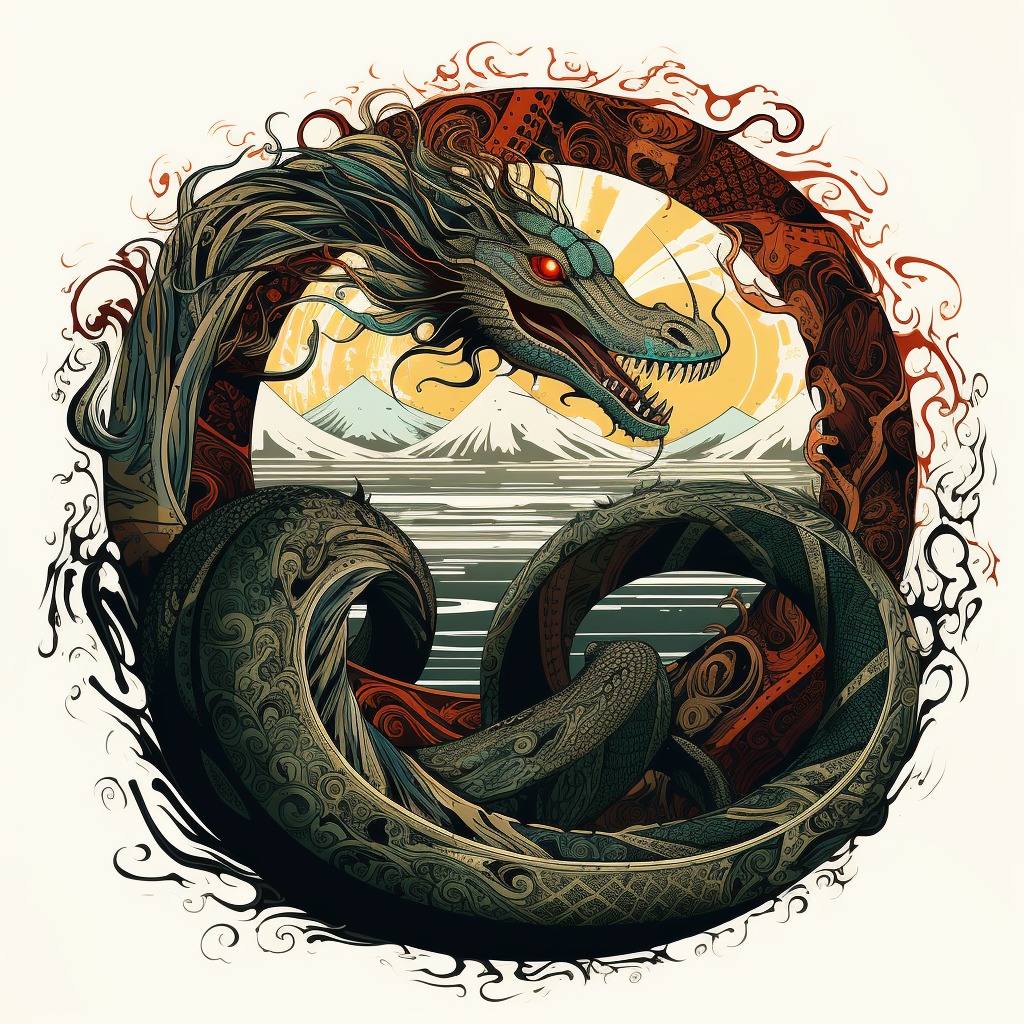
LT: Each layer is a coil of the dragon that the plane is made up of, and every realm a scale. And now I can explain to you why it is that Mount Celestia has so transcendent a top layer. Each plane’s layers represent the mood of the dragon, and hence there are feelings as well as philosophies for every plane. The dragon of the Holy Mountain embodies contemplation, and so her head is wrapped in the purest serenity of meditation, which few indeed can comprehend. The dragon of Limbo writhes uncontrollably, thus making it impossible to measure its coils.
KT: That’s a pretty incredible theory. Can you back it up?
LT: Not directly. But permit me to talk about powers a little. Io’s children themselves gave birth, and their spawn are many. Do you know the scripture that speaks of ‘The Dragon and his angels fighting’?
KT: It’s an Archonite Apocalypse, isn’t it? I’ve studied them a little.
LT: That’s right. Well, the dragon of that quotation is the Dark Lord of Baator, whom some call Melchiresha. He is the eldest child of the dragon Baator.
KT: So there’s a whole dynasty of dragons ruling the Multiverse?
LT: That is broadly correct. Some powers, like Ptah or Annam, are derived directly from the thoughts of mortals, and other powers from their thoughts. But there are many, many dragons hiding. Ultimately, all dragons are their descendants. You know of the worms Jormundgandr and Nidhoggr?
KT: Certainly.
LT: In a meta-temporal sense, whatever is said of Loki, they are the children of the dragon of the Waste. And then there is the Dragon King himself, the Jade Emperor’s chief minister.
KT: I don’t hear much about him, even though he sounds very important.
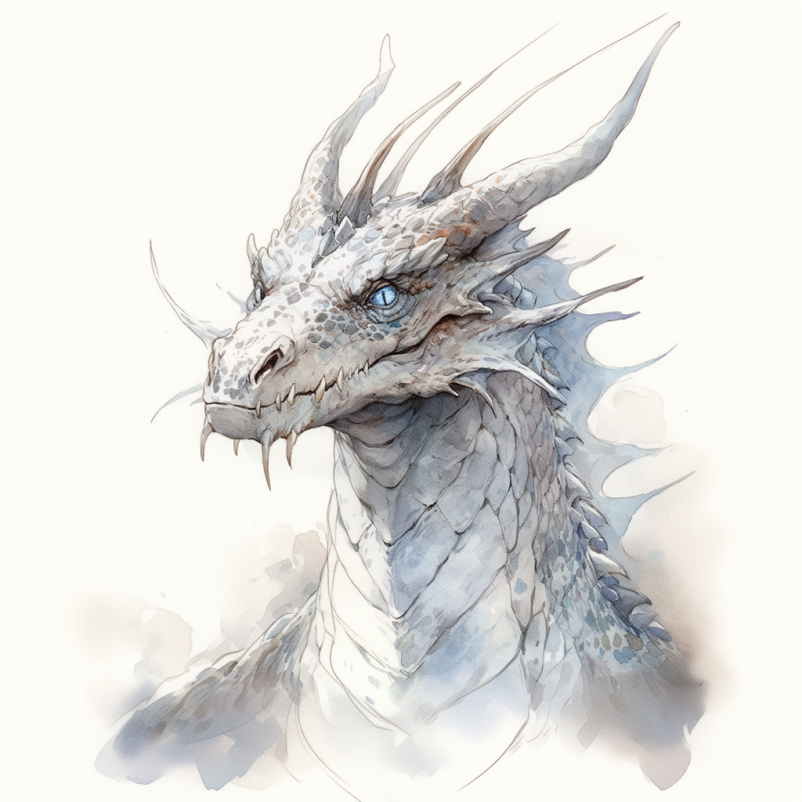
LT: Quite so. But the Oriental dragons know him, for he is their ancestor and master. He is the son of the dragon of Mechanus. And Tiamat, Bahamut, Takhisis and Paladine —
KT: Are they two powers or four?
LT: Four. There’s some inclarity as to whether the two Krynnish powers are the children or the younger siblings of the others, but the elder pair are the children of their home planes. And the list goes on…Apep, Shekinester, Yamm, Jazirian and his realm Ouroboros…
KT: That’s incredible in some ways, but very plausible in others.
LT: Quite so. Two more points, on the mathematics of the planes — a field you have studied, yes?
KT: That’s right.
LT: You have seen how there are three to the third power, twenty-seven, Inner and Outer Planes. Do you suppose there are as many Primes?
KT: There must be more worlds than that, but I’m sure there’s only one, perhaps three, Prime Planes.
LT: Exactly. Even as I speak, research is continuing to discover exactly where the twenty-seven fold nature of the prime lies. And threes are found elsewhere, too. I spoke of the Ethereal and Astral planes, but are you aware of the Ordial?
KT: Magnum Opus says it links the Inner and Outer Planes, right? But we can’t get in.
LT: That’s because it’s Io’s tail. It coils right around the Inner Planes, and counts as a plane separate from her ninefold body. Only powers of considerable insight can use it. And so there are three intermediary planes too.
KT: But I still don’t know how you know all this. The Fraternity hasn’t published any of this data…
LT: I mentioned the Dragon King earlier. He knows about this truth behind the planes, and so do some of his loyal servants…
[Lung Tzu grins wolfishly, and Kallis swears he saw a celestial dragon in the seconds before his interviewee vanished.]
[Lung Tzu has not been seen since, and it cannot presently even be proved that he was or is a member of the Fraternity of Order.]
Source: Alex Roberts
There’s a small error near the end of the article. Right after Lung Tzu asks Kallis if he’s studied mathematics of the planes, and Kallis responds in the positive, it skipped Lung’s statement of the three to the third outer and inner planes, where he asks if there are as many primes. The sentence that should have been there from Lung was posted further down in the article, right after Kallis mentions Magnum Opus.
Thanks for spotting that! Think I’ve fixed it now….?
> You’re forgetting Shadow
> I’m sure there’s only one, perhaps three, Prime Planes.
I love how perfectly it lines up with 5e cosmology, if you replace Shadow with Elemental Chaos. Feywild and Shadowfell are basically layers or parallel planes to Prime
As I read that the theory puts the plane of shadow/Shadowfell with the inner planes, I expected it to then add the Feywild to the outer planes to help bump the number up to 27. I get that the original Planescape structure came before the introduction of the Feywild, but this gives me a neat idea of how to explain the placement of these two (And help prop the total numbers of planes to 27 each (: ).
How I would structure it:
The Feywild is a reflection of places on the material plane, yes, but it is a place where belief and stories are important; it is meant to be the fairy-tale world after all. So the Feywild is the outer-facing reflection of the Prime: a place where the belief of living things DOES hold weight.
Meanwhile, the Shadowfell is the dismal reflection. This is because it is the inner-facing reflection, a place far away from the outer ring. Here, the belief of sentient creatures does NOT matter. This is why it look so depressing to the living: the place literally doesn’t care about them.